
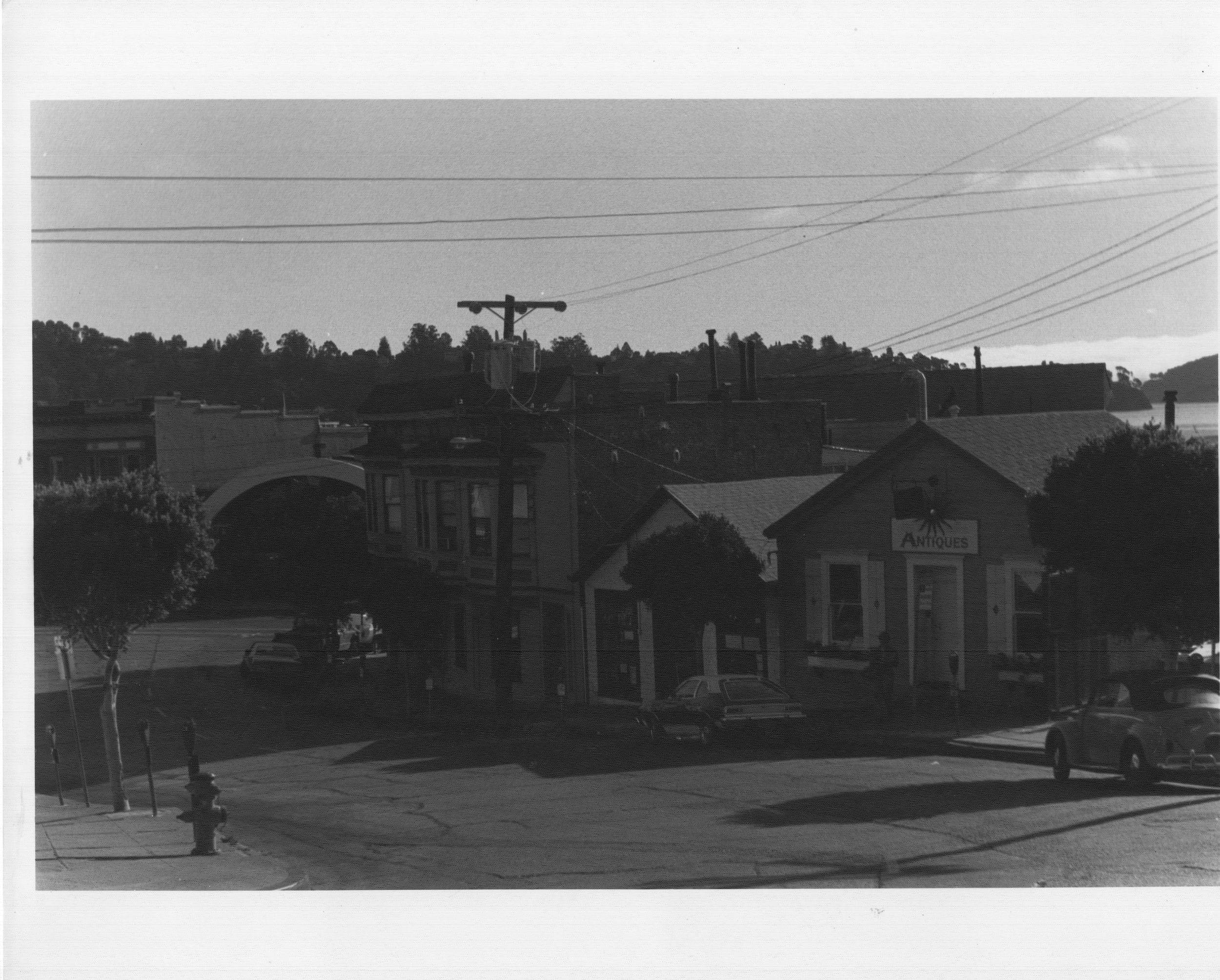
A black-and-white photograph of Porto Bello Antiques, at 21 Princess Street, and Salvage Shop, at 19 Princess. The Ryan House and Purity Market buildings are visible in the background.
By Doris Berdahl
Princess Street was laid out in the late 1860s, part of an ambitious land development scheme to sell “view lots” in the hills above the central waterfront. The steep, winding little street, just one block long, was meant to provide access to what is now some of the most expensive real estate in California, the warm, fog-free zone known locally as the Banana Belt.
The street, ascending straight from the bay, derived its name from Sausalito’s first ferryboat, the Princess, a 130-foot paddle wheeler which brought prospective buyers twice daily from San Francisco, docking at a hastily-built landing where this tiny street intersected with Water Street.
By the end of the 19th century, Princess Street had become the hub of one of Sausalito’s busiest industries, the wood, coal and hay business. On the evidence of early photographs, Princess Court, today an arcade of upscale shops, hosted a dusty swirl of horse-drawn express wagons, daily picking up and delivering their goods.
Last week this space described how rapidly the foot of Princess Street moved with the times: the high technology of the early 20th century, the automobile, transformed it, making it the site of Sausalito’s first auto ferry service. Photos of the period show a swarm of Model Ts, either waiting to make the bay crossing or returning from it. The wood, coal and hay business was long gone, and the San Francisco Yacht Club, immediately to the south on Water Street, had retreated to a less frenetic, more elite environment in Belvedere.
Today, the water end of Princess Street is graced with a small park, suggestive of a waterfront plaza on the Italian Riviera, named after a beloved local merchant, Yee Tock Chee (Willie Yee). From the park the street winds up past a diverse assortment of shops and galleries, among them a small, unassuming storefront on the left which until recently housed the Sausalito Salvage Shop -- the oldest still-standing commercial building in town.
The tiny gable-roofed cottage at 19 Princess Street was built in 1874. On the 1891 Sanborn Map, a primary data source for historians of Sausalito, the use ascribed to that site was “Wood and Coal,” the building itself probably serving as a storage facility. On the Sanborn Map of 1894, the little storage shed had come up in the world. Its use was described as “Express Wagons,” probably suggesting a livery stable, or a kind of late 19th century version of a parking garage.
This 1910 photo of Princess Street shows it to be a no-nonsense, dirt road, still frozen in the horse-and-buggy era, but near the end of its days as a bustling trading center. Number 19, on the far right one door down from its sister cottage next door, has undergone another change of use. It now sports a sign clearly signaling the rising standard of living of 20th century Sausalitans by proclaiming it to be “The Mason Engineering Co.; Dwellings Heated--Steam--Hot Water. PLUMBING.”
By 1924, the earliest year for which we have Sausalito property tax records, the building is still designated as a “Shop (Hardware & Plumbing).” The assessor estimated its construction cost to have been $651, but due to depreciation over 50 years, its value in 1924 was said to be $460.
In 1957, the Sausalito Salvage Shop, after moving among a number of temporary homes, settled into 19 Princess, carrying on a charitable tradition that began with a “Bundles for Britain” bazaar in 1940, the first volunteer effort of that kind in Marin. The event was planned as just a one-day affair. But because “the stuff (donations) just kept pouring in,” as one of the founders recalled in a newspaper interview a few years ago, “we just kept going.” At first the founding group, Sausalito women dedicated to raising money for good causes (initially for wartime Britain and then for a wide variety of philanthropies), called themselves British War Relief, but switched to Allied War Relief after the United States entered World War II. When the war ended, devoted customers continued to come, eager to buy everything from designer evening gowns, to Franklin stoves, to Christmas tree ornaments at bargain prices. And once again, the shop volunteers “just kept going,” choosing for their permanent name the Sausalito Salvage Shop.
The building underwent very few changes over the years. Some time between 1910 and 1924, its original drop-siding exterior was shingled over. Later, the front windows of its Mason Engineering days were enlarged. But now, engineers have concluded that the building is unsafe, and major changes are in the works. The aging structure needs major rehabilitation, and the Salvage Shop organization has had to disband and move out.
That doesn’t detract, however, from the miracle of the Salvage Shop and the fact that this locally-inspired charitable organization was able to remain so many years in one of Sausalito’s prime retail locations -- due in large part to the generosity of landlords who kept the building’s rent affordable in recognition of the good work that went on inside. Maybe the story is true – although there’s no documentation to prove it -- that the building at one point was used for Sunday prayer meetings. Which could mean that it’s destined to lead a charmed life, and its future is still promising.
