
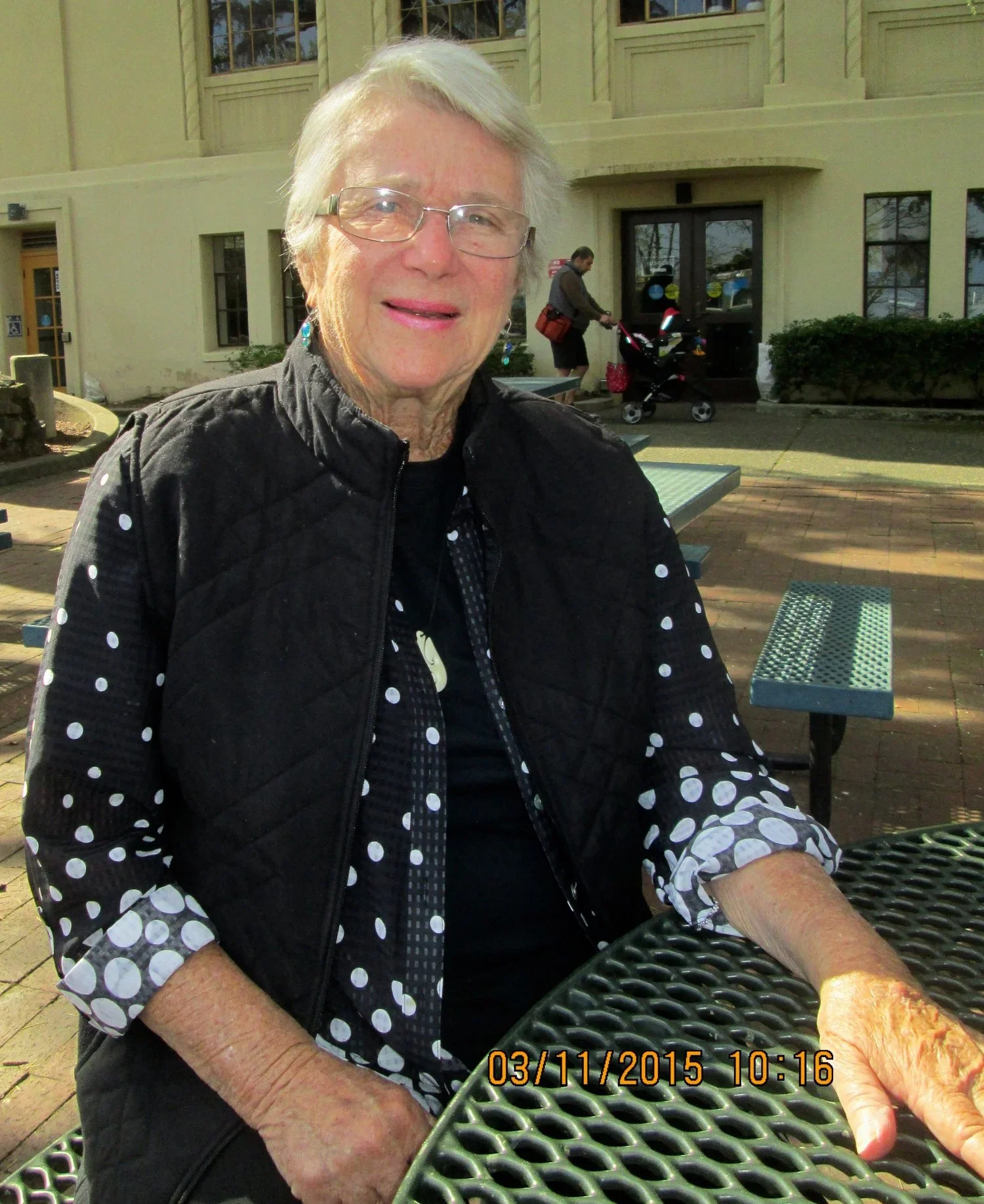
Annie Sutter. Photo by Steefenie Wicks
By Steefenie Wicks
Annie Sutter was born in Wisconsin and traveled to San Francisco, but in 1974 she found her way to Sausalito, working as a travel agent for Sunventure Travel. Then in 1976 she began writing for the MarinScope in what she refers to as “the waterfront gossip column,” called “On the Water.” She published one jewel of a book called The Old Ferry Boats of Sausalito in the 1980s, and in 2019 she published what she calls a booklet that describes the history of the Issaquah Dock.
She begins her research by describing how the place where Issaquah Dock lies today was once a quiet place of tidal flats and saltwater marshes. This stretch of land was inhabited by wildlife and shorebirds.
World War II would change this. In 1942, as the war escalated, life on the waterfront changed abruptly when two hundred acres of Sausalito were selected by the U.S. Government to build ships for the war effort. When the war ended in 1945, Marinship closed down almost as abruptly as it had begun.
By 1950 the area from Gate 3 to Waldo Point Harbor had already established itself as a waterfront community of artists, craftsmen and boat workers, along with families seeking a new life.
The ferryboat Issaquah, affectionately known as “Squash,” was built in Houghton, Washington, then launched with great fanfare on Lake Washington in March of 1914. By May of 1914 she was serving ports on Lake Washington; she had scheduled runs but was also used as a floating dance hall and party cruising vessel. The little ferry was retired from service in 1948. There are different accounts as to how the Issaquah ended up in Sausalito. One famous story has it being bought by artist Jean Varda for one of his girlfriends, but she did not like the vessel and refused the gift.
Annie goes on to say that it was Donlon Arques who ended up with the ferryboat and settled her into a space at the side of Gate 6 Road in the heart of all the new activity. Once settled in, the Issaquah quickly became a home to many, from families to wandering visitors just passing through. Usually one person would rent the entire vessel from Arques for a monthly rate, then rent or sublease to tenants.
Smaller boats gathered around the Issaquah, side-tied and connected by planks or rickety walkways.
But by the early 1980s it had become clear that the end was near. The Marin County Board of Supervisors declared the old ferries that had become mothball living facilities a safety hazard; they were all scheduled to be destroyed.
Annie raises the question: Why?
This is a question with no reasonable answer. She feels that with a little effort these ferries, the last remaining representatives of our maritime history, could have been saved. There had been talk of using the Issaquah for offices or a possible maritime museum, and several businesses came forward wanting to take over the entire vessel, but the destruction of the ferries proceeded.
Protests from the locals were loud, sometimes violent, while the powers that be brought in bulldozers along with debris barges that broke up the ferries and hauled away the last remaining bits. When it came time to destroy the Issaquah, she still had residents on board who clung to their home. This did not work either, but the residents were able to save the pilothouses by promising to have them off within a week, and they did.
The destruction of the ferries in 1983 came well after work had started on Issaquah Dock. In 1977 Arques had had enough of the politics of starting a marina on his land, so he leased a substantial portion of it to the newly formed Waldo Point Harbor.
T.J. Nelson and Ted Eitelbuss, who were both Arques employees, found it a difficult task as they tried to create order out of chaos. The project was not easy for many reasons, some having to do with the entrenched locals protesting, blocking equipment, setting fires, throwing rocks and shooting guns.
But if you walk down Issaquah Dock today you’re in a bright world of color and creativity, along with quiet beauty. There’s a sense of freedom, of community and family. It’s a place where free spirits and risk takers are content to live where they can float on the water.
Annie Sutter is a true Sausalito waterfront historian, having lived in this area long enough to see change and growth. Her stories are full of truth and history that concern this area.
In her closing she states:
“And so ends this ferry tale that began in 1914 in Washington with the birth of a ferryboat, and all the subsequent adventures, mishaps and wonders until her end in 1983. The memories thereafter kept alive by loyal, dedicated members of the Dock along with the Galilee Harbor Community, who became the caretakers of the Issaquah Pilot Houses.”
Thank you, Annie.
