
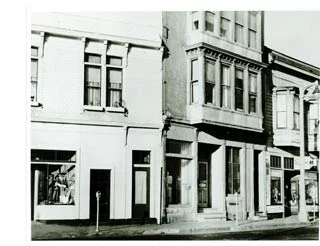
From the Historical Society's files, “The Port Hole Tailor, once located here, is remembered as a dark and cluttered shop where one could buy almost anything
by Annie Sutter
Jan's coffee shop was on El Portal facing the park and today is the site of an art gallery. The Port Hole was at 753 Bridgeway and Duke's was next door. Today it is the site of the Holiday Shoppe.
Jan's Coffee Shop, The Port Hole, Duke's Plumbing
From the Historical Society's files, “The Port Hole Tailor, once located here, is remembered as a dark and cluttered shop where one could buy almost ...
In 1950 there were three restaurants in downtown Sausalito. None sold liquor, and only one served beer and wine. One such restaurant, or lunch counter, was Jan's, located in a drugstore on the corner of Bridgeway and El Portal. The food counter was back of forty feet of glass directly facing the park. Sitting there, drinking coffee, one had a view of the park and more than half of the business district. This didn't mean you had a large, sweeping view, but rather there wasn't much business district to see. But it was a nice place to drink coffee and meet friends, and before you finished a cup you could see who was downtown and where they had been by the packages they carried. If Jan wanted to charge what the coffee was worth she could have made a fortune. But she didn't. All customers were friends. Things evened out at Jan's. Leaving a nickel for coffee and walking away, she'd shout at you, "Hey, wait a minute. Cy paid for your coffee yesterday, and so did you." After a huge lunch of her prize lentil soup and a plate consisting of bright crisp salad, a portion of the casserole of the day, refreshing sherbet and maybe a piece of banana bread, you paid, but never left a tip. The place had a similar feeling to eating at home.
Glancing to the right you had an unobstructed view of the sandspit and the bay. Looking up Bridgeway to the left, you saw the city hall, a clothing store, a butcher shop, a bank, a hardware store, a plumbing shop and the Port Hole. The latter was an institution; a necessity. Its entrance was deceiving, for the door was narrow, and you couldn't see far inside. But once you entered, the walls led you through corridors that branched out into various rooms and closets each stocked heavily with clothing of all descriptions; new, used, abused, mended, fisherman's foul weather gear, work clothes, shoes, boots, galoshes, each with their individual color. It was also a cleaning, pressing and mending establishment. These latter garments after being neatly cleaned and pressed, hung from the ceiling. Ernie, the owner, was a thin, pale man, with a pained smile, always sweatered in navy blue and wearing a green eye shade. He was particular about distinguishing between clothes to be sold and clothes to be cleaned and repaired. In the Port Hole that wasn't easy, but he never lost an article left for cleaning, nor made a mistake. Sometimes a garment hung for years; he didn't mind. His system was simple. Anything hanging from the ceiling was not for sale. And that was considerable. There was an overwhelming number of suits, dresses and overcoats bearing down on you wherever you walked. Beside wearing apparel, the Port Hole had fishing gear. The bamboo fishing rods standing in a wooden barrel poked up through the alphabetical 'H's' of cleaned and pressed garments. How Ernie ever got those poles inside the store through the maze of crowded corridors was a puzzle.
Cora, the calm, diligent, dependable lady who did the cleaning, pressing and mending was indispensable to the town. She was always there, standing behind the hissing pressing machine, sitting at the sewing machine or fitting a garment for alteration. The sound of the escaping steam and the odor of damp cloth was familiar to everyone. Some residents after being away for a long period of time would return to say hello and walk through the shop to satisfy their nostalgia.
Next to the Port Hole was a plumbing shop. Duke, the owner, was an unusual man in the 1950s; in the 1970s he would be unique. Duke was a plumber who enjoyed sharing the mysteries of his craft with laymen. This didn't endear him to colleagues, but it did to citizens. The windows of the shop had the usual display of sinks, faucets and fittings, which to Duke were not put there to entice customers, but because it was the safest place to store new and shiny goods. Once up the few steps and inside the shop you quickly learned that order and neatness was not Duke's greatest feature. Scattered over the floor were piles of four inch cast iron tees and ells and closet bends, sections of pipes, boxes of oakum, mounds of lead, plumber's pots and other tools. Overhead, but not far out of reach, were long sections of water pipes, both copper and galvanized steel. On one wall were bins of small fittings, another wall had a long work table showing scars of many years service, stained black from cutting oil. A huge pipe vise at one end with its hardened, intractable jaws and long, smooth handle showed heavy work and dependability. Leaning against the table were various sized pipe threaders. The smell of oakum, hot lead, cutting oil, pipe compound, butane exhaust, coffee, Duke's pipe and a little sweat all marinated together to make a distinct odor of work and material. The hissing plumber's furnace and the ratchety click of pipe threader were familiar sounds to everyone entering the shop.
