
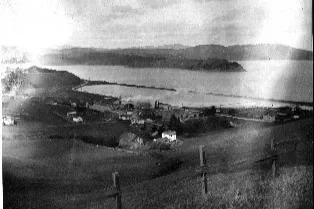
By the early 1920s the Mason By Products Company’s facilities had expanded over most of Whiskey Springs. That gravel road on the right is now known as Bridgeway.
Photo courtesy of Sausalito Historical Society (Mary Bettencourt Smith Collection)
This article is excerpted from the Sausalito Historical Society Newsletter, Summer 1978.
After a long and grueling journey around the Horn, John Mason and his wife landed in San Francisco in 1849 — almost with the first wave of gold-seekers.
A shrewd businessman, Mason quickly realized that there was more money to be made in selling whiskey to the miners than in becoming one himself. So he established San Francisco’s first brewery. It did so well that he was soon a ranking member of the business community and on the city’s Board of Supervisors.
But by the late 1800s San Francisco’s explosive growth was outrunning its supply of fresh water. Since this was an essential element in the fine spirits Mason had built his name on, it was time to look for another location for his brewery.
Whaling ships had been stopping off at Sausalito since the early 1820s to fill their casks with water. It was considered so pure that it actually “stayed” longer before spoiling during long voyages. That was good enough for Mason. By 1892 the Mason By-Products Company was making quality Irish Whiskey and scotch at its new distillery at Whiskey Springs (then called Waldo Springs).
At least until January 1, 1920 when the 18th Amendment to the Constitution put an end to the whiskey business. Prohibition dealt Mason By-Products a mortal blow. Almost immediately, the company was sold to its financial backers — including famous San Francisco entrepreneur Adolph Spreckles.
Under the unlikely banner of the Industrial Solvents Corporation, the new owners struggled to survive by producing industrial alcohol. But after several years of operating in the red, the company was about to fold.
By the early 1920s the Mason By-Products Company’s facilities had expanded over most of Whiskey Springs. That gravel road on the right is now known as Bridgeway.
Photo courtesy of Sausalito Historical Society (Mary Bettencourt Smith Collection)
The American Distilling Company of Pekin, Illinois, was looking for a plant site in Northern California. Whiskey Springs was an ideal location. So on December 5, 1933, the very day that Prohibition ended, the company bought Mason’s old brewery.
American Distilling then spend $12.5 million to make their new plant the most modern west of the Mississippi River. Before long, it was the largest independent producer of whiskey, gin and vodka in the United States. With a work force of 200 people, it was a major source of revenue and jobs for depression-ridden Sausalito.
But it all came to an abrupt end on the night of May 4, 1963. Alcohol fumes caught fire and turned the entire complex into a raging inferno. Sausalito residents were treated to a pyrotechnic display that rivaled any July 4th extravaganza as barrels of the company’s stock exploded 300 feet into the air in bright blue flashes of thunder.
Several hours and $4.5 million later, the western division of the American Distilling was no more. Whiskey Springs was once again an empty piece of land.
But not for long. Presently 47 condominiums are under construction on the site where the Miwok Indians had a village and John Mason built his distillery. Just as soon as the Water District gives them service, another 156 units will follow. And thus begins yet another chapter in the three thousand year story of man’s occupation of those 13 acres at the north end of town.
