
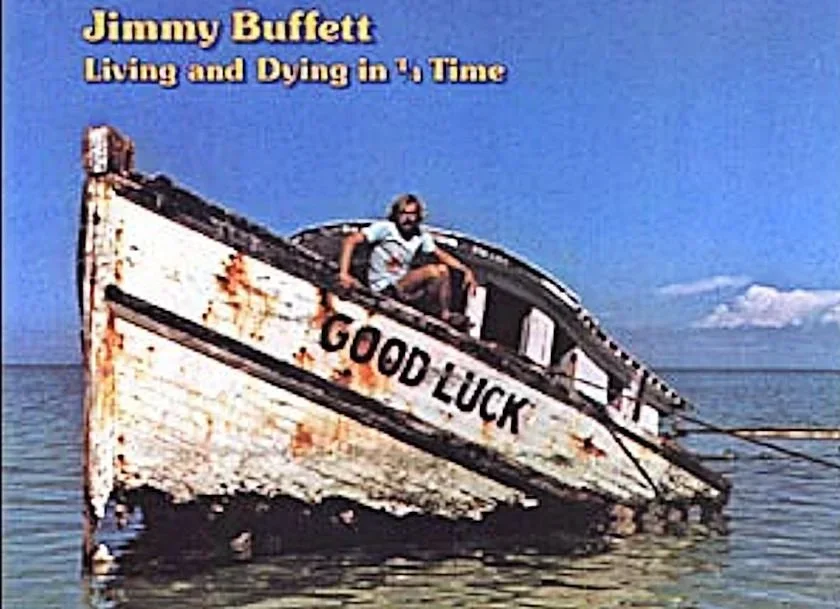
“Come Monday” was on Buffett’s 1974 album Living & Dying in 3/4 Time. Album cover
By Larry Clinton
Jimmy Buffett’s death in 2023 from — what else? — skin cancer reminded me of his many ties to our part of the world.
In 1983, Buffett told David Letterman how he got the inspiration for his hit “Come Monday” at the Howard Johnson’s in Mill Valley. His comments go something like this:
“This is the song that kept me from killing myself in a Howard Johnson’s. I was deathly depressed by the size of the room and the food next door. It was awful and I wrote this song and it hit. I paid the rent and got my dog out of the pound.”
The song was written after Buffett had performed at a Labor Day weekend show in San Anselmo, having previously spent “four lonely days in that brown L.A. haze.”
I know whereof he speaks about that HoJo’s (now a Holiday Inn Express with the adjacent Floodwater restaurant) because I spent a few lonely months tending bar there in the ’80s. It was one of the few joints that hired newbies right out of bartender school, and it worked for me because there was very little bar traffic and I made all my mistakes in private fixing drinks for the servers to take to the dining room.
One of the highlights of my day shift was serving martinis to the mother of David Carradine, who would come in each afternoon to watch Kung Fu reruns and complain about what a heel David’s recently deceased father (esteemed character actor John Carradine) had been.
Another time, a couple who’d been staying at the inn for a few nights without a car complained they were getting tired of all-you-can-eat fried clams, and asked about a nearby restaurant they could walk to. I recommended El Rebozo in the Fireside motel (now a senior community) just across busy Highway 1. They finished their drinks and departed, only to return just a few minutes later.
“What happened,” I asked, “was it closed?”
“No,” they replied, glumly retaking their bar stools, “We couldn’t cross the street.”
In 1985, Jimmy Buffett opened his first successful Margaritaville retail store in Key West, and it soon blossomed into a booming chain of restaurants in the U.S., Canada, Mexico, the Caribbean and Australia.
In 1990, according to the MarinScope, the chain took over the waterfront space that had housed the legendary Zack’s and turned it into a Margaritaville. Their niche was serving novelty drinks like a Fuzzy Navel or Sex on the Beach. By then I had graduated to weekend shifts at the No Name, and whenever some old geezer ordered a Manhattan or Old Fashioned at Margaritaville, the bartenders had to call us for the recipe. That location went through many incarnations before becoming the well-regarded Salito’s in 2011.
Buffett parlayed Margaritaville into various entrepreneurial successes. According to the New York Times, he “turned his personal brand into a lifestyle empire that included everything from restaurants and resorts to lines of merchandise such as at-home ‘frozen concoction makers’ and cornhole game sets.” He died a billionaire.
Another rocker who followed in Buffett’s footsteps was Sammy Hagar, who was part owner of Mill Valley’s El Paseo for a few years and also developed the Cabo Wabo restaurant chain and liquor brands, including a line of canned rum cocktails. He collaborated with our own Sean Saylor to create some of these drinks and to establish the Cabo Wabo room upstairs at Saylor’s Restaurant on Bridgeway.
