
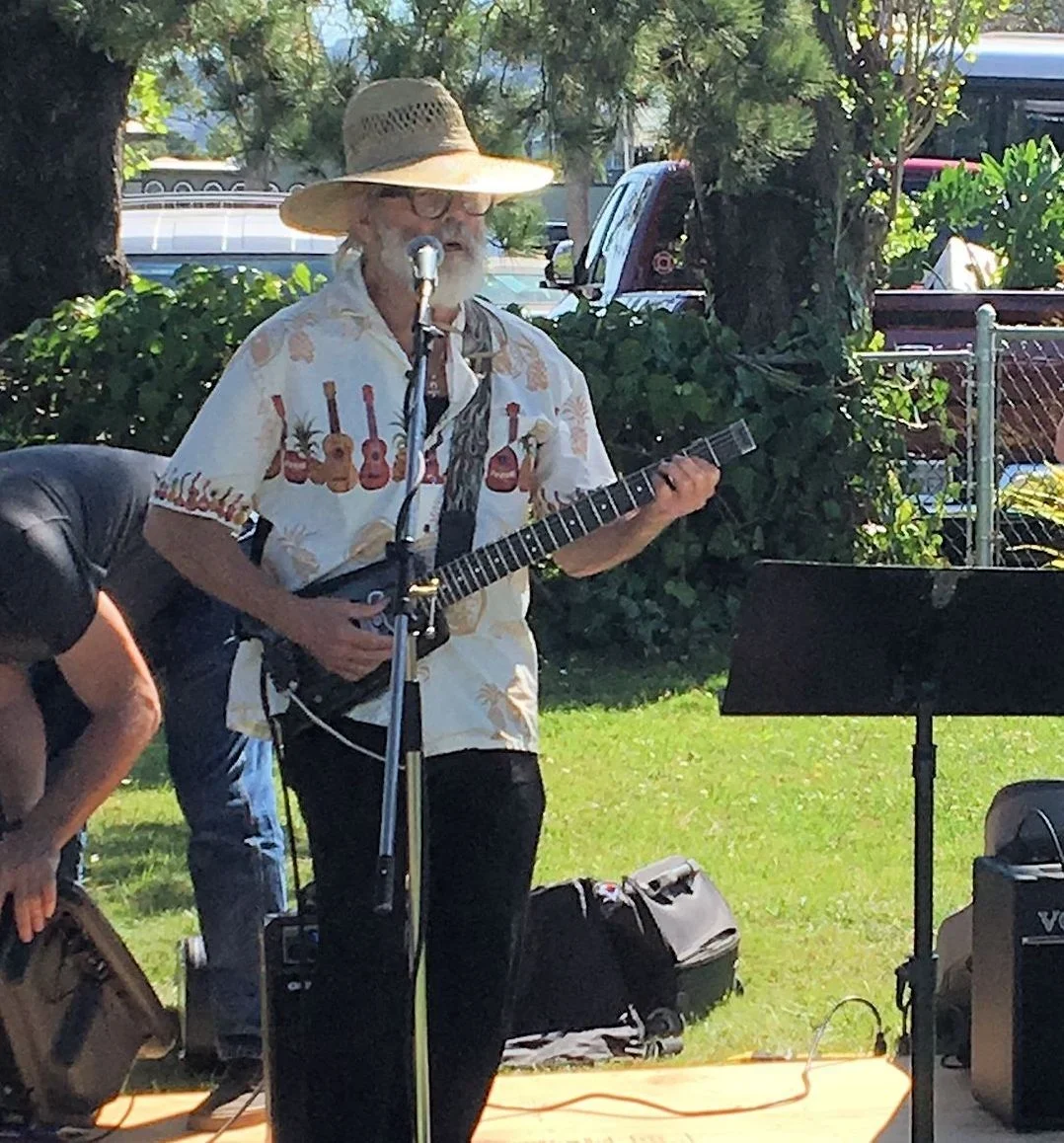
Joe Tate entertains during a floating homes tour. Photo by Larry Clinton
By Christine Leimer, Floating Homes Assn.
Joe Tate and the Blue Monday Band were longtime Monday-night regulars at the Sausalito Cruising Club. You may also have caught his escapades in the videos The Houseboat Wars or Last Free Ride. Joe was one of the founders of the Sausalito floating homes community.
A life of music, mischief-making and community building wasn’t in his plans growing up in Normandy, Missouri, a suburb of St. Louis. As a high school senior, in 1956, Joe built a working cyclotron—an atom smasher—in the school’s basement for the St. Louis Science Fair. His physics teacher suggested it as a joke. Joe figured, why not? But then, after the fair, what to do with a $20,000, 5-ton machine? He took it with him to Wesleyan University, where he was on his way to becoming a nuclear scientist.
Then he hit UC Berkeley. Even though Joe was a few credits short of a bachelor’s degree, he’d been accepted into the grad school where the cyclotron was invented. But it was 1964. When he arrived to register, protests were going on outside Sproul Hall. He couldn’t get in. After trying for a third day, he talked to student protestors who were playing music and smoking pot. That ended grad school. “I turned on, dropped out, formed a band and got into music,” he laughs. “I’ve got no regrets.” After all, “atmospheric bomb blasting’s not very safe.”
A knack for applied physics is useful for keeping junk boats floating and at least semi-livable with little money, which is what he did when he moved to the Sausalito waterfront a few years later. It probably helped to have a father who was a riverboat pilot, too. Joe’s dad plied the muddy waters of the Mississippi River. So, it’s ironic that, when Joe bought his house at the head of South Forty dock in 1999, its name was the Becky Thatcher—one of Mark Twain’s characters. It’s an 1890 ark towed over from the Belvedere Lagoon in the 1960s. It was sunk in the mud when Joe fell in love with it. He set it sturdy on pilings, with dragon gates guarding its entrance.
If you like tales, Joe’s the man to talk to. He’s got plenty and tells them with a twinkle-eyed grin that would make Tom Sawyer proud. There’s the Houseboat Wars-era battle with the Marin Sheriff’s deputies and Coast Guard when they tried to tow away the houseboats. His split-second escape after pouring water on the generator powering the fire hoses police were using to spray protesters who were trying to stop them from removing houseboats to build a permanent pier. Another time, he led a flotilla of rickety boats and band members up the delta thinking they’d play gigs at bars and restaurants along the way. When they finally got a gig, a band member opened the kitchen and started cooking and giving away the owner’s steaks. He ran them off his property, of course. “We were our own worst enemies,” Joe says, recalling their exploits. “We were good at snatching defeat from the jaws of victory.”
Joe once played a concert with Chuck Berry, who accidentally fell on top of him as they scrambled to the stage. And he wrote a book about the narrow escapes, bribes, junkyard deals, at-sea fixes, and shifting configurations of crew members when his Houseboat Wars-era band, The Redlegs, sailed their reconstructed boat (they used a telephone pole for a mast), the Richmond, from Sausalito to Costa Rica, Acapulco, Hawaii and back, barely.
In 2019, Joe was still playing weddings and other events when he could get a gig. “All my acquaintances are dying, not getting married,” he told me with a philosophical shrug. He also recorded a CD of protest songs called Free Bullet Wounds: Fight Back Against School Shootings, and another, Joe Tate with the Blue Monday Band and the Hippie Voices.
