
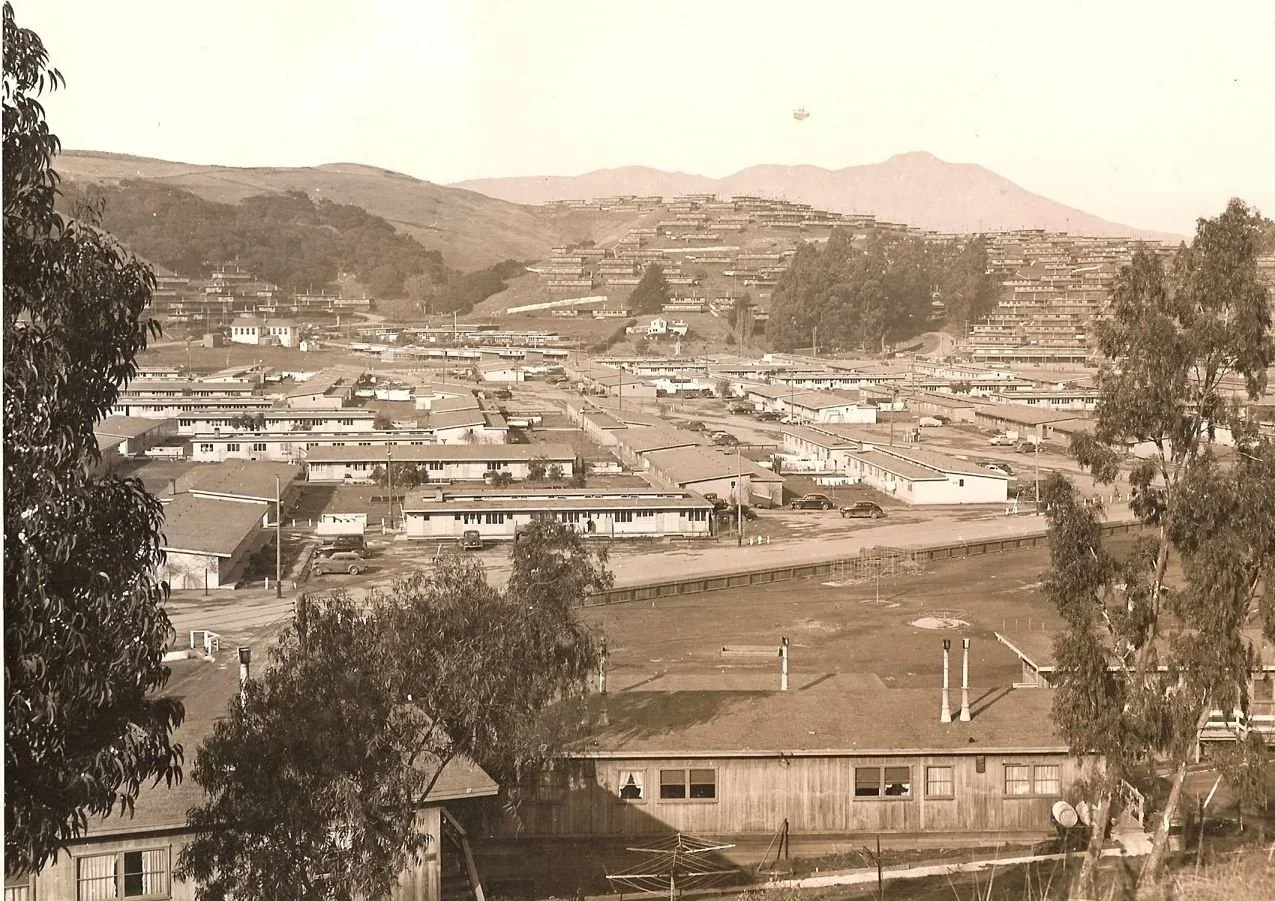
Marin City housed 6,000 Marinship workers and their families during WWII
By Larry Clinton
Prior to WWII, Waldo Valley north of Sausalito and west of Highway 101 was occupied by a dairy farm and a handful of families. In June 1942, soon after work began on Marinship, Sausalito’s waterfront shipyard, a new town was built there which came to be called "Marin City." By the end of 1943, Marin City's population was nearly 6,000 — about 1,000 in dormitories.
Since Marinship was one of the last WWII shipyards, experienced workers were hard to find. The Bechtel Corporation, which built and managed the shipyard, devised a system of pre-fabricated elements which could be welded together quickly and with less expertise than previously. They recruited workers from all over the country, including women and minorities for the first time. Marinship developed a training program to teach the recruits how to build ships assembly-line style. According to filmmaker and historian Eric Torney, “Women were noted as being most efficient welders, their welds being more precise and smoother than a man's weld.” So instead of Rosie the Riveter, Marinship became known for Wendy the Welder. A total of 93 ships were launched there, including 15 Liberty Ships and 78 Tankers.
After the war, many families chose to stay in California. Most white families moved to other nearby communities, but redlining, housing covenants and other restrictions kept most of the Black families in Marin City, which included a market, schools, churches, a candy store and other amenities that made it a largely self-sufficient community.
2022 marked the 80th anniversary of the community, celebrated with a year-long series of events under the banner Marin City 80. The woman behind these activities was Felecia Gaston, well known for her work with the Performing Stars troupe of young entertainers. Felecia teamed up with Jahi Torman of Microphone Mechanics to co-produce the celebration. Said Jahi: “Our partnership is one I have been very proud of, and we look forward to continuing for decades to come with the establishment of the Marin City Historical and Preservation Society.”
The celebration included art installations, an album of songs about Marin City and the shipyard, and a cookbook with recipes by Marin City grandmothers, Grandmothers Feed Us Love.
The Bartolini Gallery at Marin Center hosted an exhibit titled A California Story: 1942-1962, featuring memorabilia from Black shipyard workers, along with contemporary art, artifacts in various media, a virtual reality experience, and never-before-seen photographs.
Another exhibit at the Marin Civic Center told a narrative of housing discrimination, land grabs, predatory developers, and the continual fight for housing rights and equality in Marin City. One major accomplishment was to replace dilapidated WWII housing with an award-winning public housing project which came to be known as Golden Gate Village in the early ’60s. Six decades later, that development was in need of major upgrades, which were being negotiated between residents and the Marin Housing Authority.
A multimedia show at Marin Center’s Showcase Theater, The Spirit of Joseph James, featured actors and singers celebrating the life of Joseph James, a shipyard worker and world-class singer whose stand against a segregated union led to a landmark ruling by the California Supreme Court. Thurgood Marshall, who later became the first Black justice to serve on the United States Supreme Court, was one of the attorneys representing James. “Marinship became known as the most effectively integrated and efficient workforce among all WWII Emergency Shipyards,” according to Eric Torney.
The official celebration of Marin City 80 took place on Monday, September 5, 2022, in the 100 block of Drake Avenue, with a Blues and Soul Party in the Park featuring live music, local artists and vendors, a car show, youth activities, food stations, and visits by local, county, and state officials. The event also marked the launch of the Marin City Historical and Preservation Society and the release of a #MarinCity80 commemorative book.
