
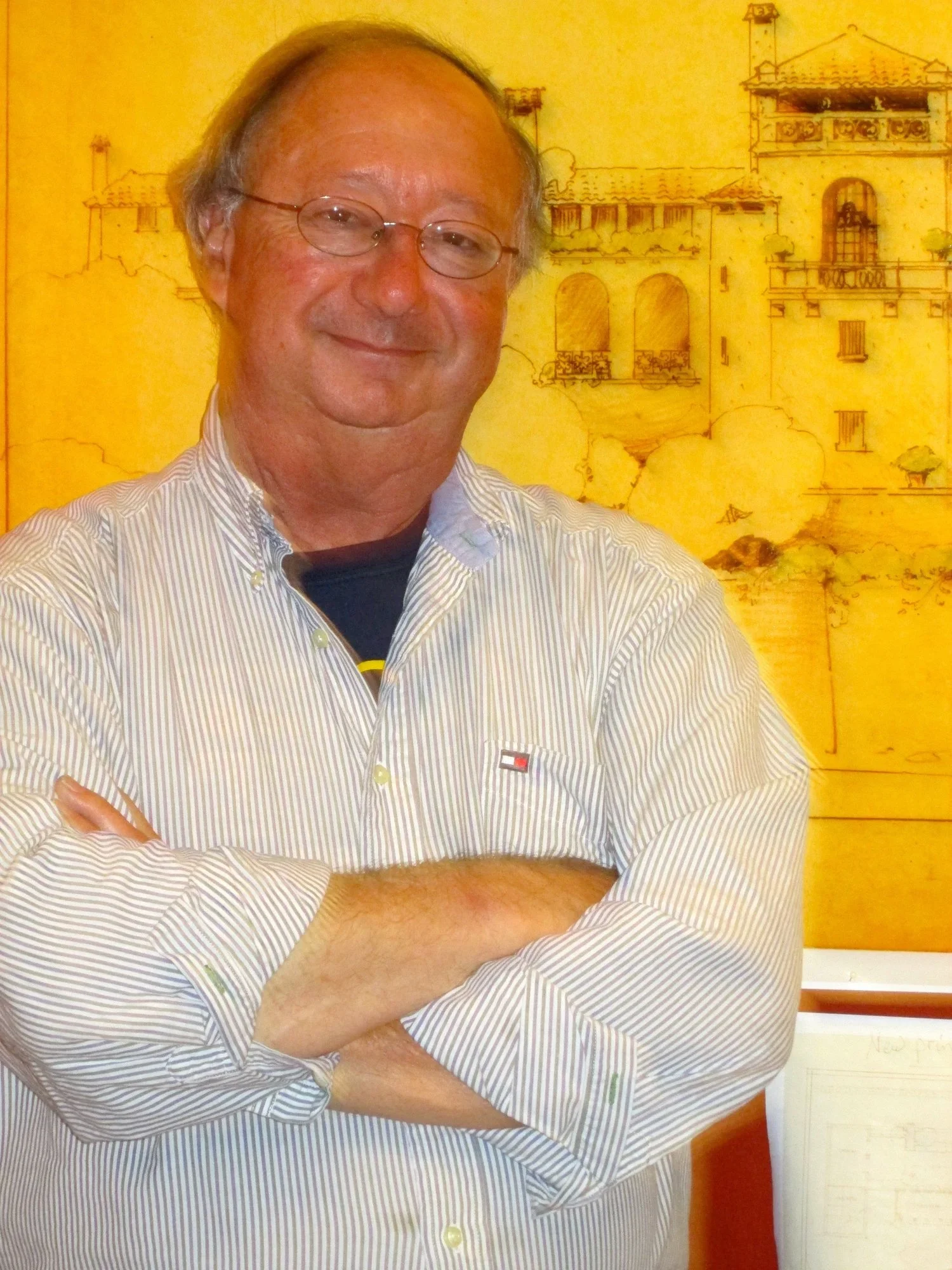
Jerry Taylor at the Historical Society exhibit “The Sausalito That Never Was.” Photo by Steefenie Wicks
By Steefenie Wicks
It’s safe to call Jerry Taylor Mr. Sausalito, not only because he has lived here all of his life, but because he still resides in the family home his family bought in 1949.
That was when his family purchased the home on 3rd Street in Old Town. Taylor has been part of many of Sausalito’s civic organizations and is known for his appearances in costume at the Sausalito Art Festival. When needed, he will dress up in a turkey costume for the Lions Club to help sell roasted turkey legs, or in a toga to help sell Caesar salads for the Sausalito Nursery School. He has worked with the Sausalito Historical Society’s schools program as a turn-of-the-century train conductor. Many a time he has been approached by a young student outside of the school who wants to see the large watch he carries when he plays the conductor. He considers himself an entertainer at heart.
“I’m always being recognized, even when I’m not in costume,” he says, “but the best was one day when I was driving down Lombard in the City with my daughter. This car pulled up next to us, and one of the two teenage boys in the back seat yelled out, ‘Hey, there’s Caesar,’ to which the other replied, ‘No, that’s not him, it’s the Turkey.’ Now that’s recognition.”
Taylor is open to telling about his childhood in Sausalito, where he went to school with the same kids that he played Little League baseball with. “When I go to speak at a City Council meeting,” he says, “I’m reminded of how that room was my 4th grade schoolroom; it’s so familiar that I’m at ease to speak.” He attended Tam High School, then went on to college at U.C. Berkeley, where he played the glockenspiel in the Cal Band. At Sausalito’s 4th of July Parade, you could see him conducting the Cal Band as they marched down the streets of Sausalito. As a child he figured that all towns were like Sausalito, where everyone knew everyone else. When he walks downtown today he doesn’t see the T-shirt shops or the tourist shops; instead he still sees the shops that were there when he was a child, shops where he bought candy or delivered papers as a paperboy.
When Betsy Stroman’s book “The Art and Life of Jean Varda” was published, he was delighted to read it because he knew most of the people in the book. The families, the children, the places were part of his life as he grew up.
In 2018, Taylor was president of the Sausalito Historical Society, a group that he feels quite at home with because of his own history in Sausalito.
One of his projects with the Historical Society was the planned Ice House Plaza.
Taylor recalls, “I became involved in this project shortly after the death of Bea Seidler, who at that time was president of the Sausalito Foundation. The Ice House was the original icehouse in Sausalito. As a child I can remember going with my mother to get ice. You placed a coin in the slot on the side of the building, then out came a block of ice. There was a box in my mom’s kitchen where the ice was then placed for cooling purposes. Eventually, the place became the office of architect Michael Rex, but Rex did not own the property where it sat. This property was sold, so Rex sold the Icehouse building to the City for one dollar, but it had to be moved.”
He continues, “Around this time the 100th birthday of Sausalito took place. The Sausalito Foundation had taken over an abandoned building space downtown, and with the help of cartoonist Phil Frank they put together a display of the history of Sausalito. Soon it became apparent that the display would have to be placed elsewhere because the building had been sold. Phil Frank came up with the idea of moving the Icehouse downtown to its present location, then placing the historical display inside for residents and tourists to view. Since then it has become known as the Historical Society’s Visitor Center.”
Taylor goes on to say, “There had always been a plan to expand the area where the Icehouse sits, to make it a plaza where strollers could enjoy the surrounding area. Plans were drawn up in 2012, but then we had to go through a process of contacting the downtown businesses to see how they perceived this area, and then new plans were drawn up to accommodate their wishes.”
Taylor continues with a little background on this area, which was all railroad activity up to 1940. After WWII, when the tracks were taken out, this area became open space, which is how the Icehouse came to be placed there. He explained that the plaza design called for tiles laid in place to resemble the railroad rails that were once there, and that San Francisco historian Carl Nolte was asked to write about the history of the area for display in the plaza.
Taylor is quick to mention that after the death of Phil Frank, his wife Susan stepped forward to fill the void that he left. Her efforts to raise funds to see this project through are known to all who have participated in getting it built.
In closing, Taylor says that’s what Sausalito has always been about: people coming together for the good of the community. “I’m always proud to tell people, I’m from Sausalito, I’m a Sausalitan.”
