
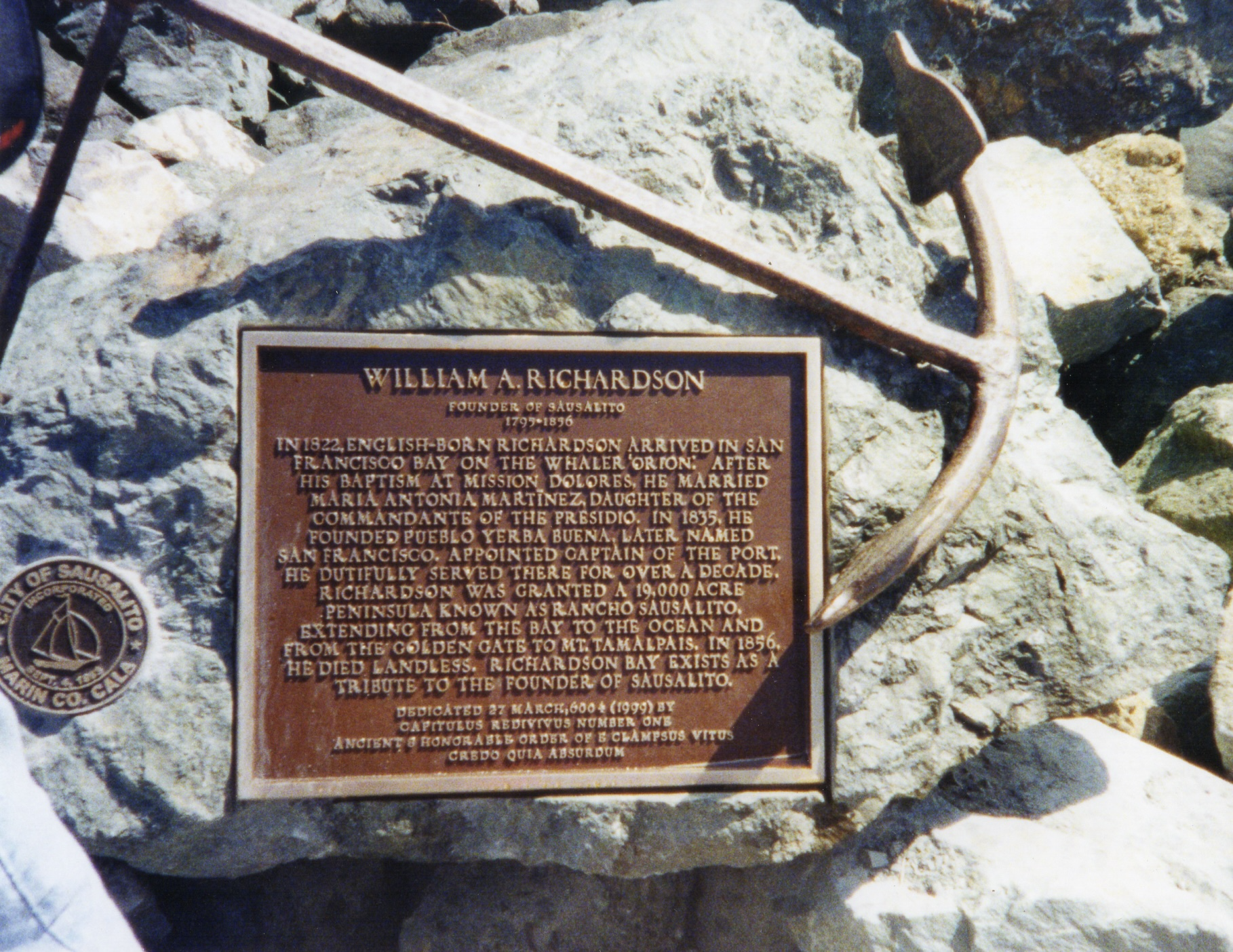
William A. Richardson plaque installation and parade, March 27, 1999
This is the first installment of an article that appeared in the very first issue of the Sausalito News, February, 1885.
While not a very imposing figure among the early settlements of the State, Sausalito has a history that may be classed as ancient – for California. Far back in the forgotten past, its harbor was visited by whalers and ships on voyages of discovery. Its first regular settler was John Reed, who came to the locality in 1826. He was followed two or three years later by Wm. A. Richardson.
These two received extensive land grants from the Mexican Government, and under their patriarchal rule a small colony of the English-speaking race had been collected in the old colonial days. Little, if any record is left of this period. The adobe dwellings have crumbled into dust, and a couple of small mills have suffered a like fate. With the rush of population when gold was first discovered, Sausalito profited but scantily.
Some enterprising individual planned a city there which was considerably larger than London – on paper – but San Francisco monopolized the tide of immigration all the same. There was no room for another competitor. Besides, a dark shadow hung over the neighborhood. There was no assured title to the land. The same litigation of Mexican grants that has cursed so many sections of California kept Sausalito effectually in the back-ground. For fifteen years after the admission of the State, the town was little more than a shipping point for a not very extensive agricultural country, and a watering place for vessels.
In 1806 the title of S. R. Throckmorton to the Rancho Sausalito was finally established, and from that date something like life began to be infused into the community. In 1809 a most important sale of 1,000 acres was effected. The purchasers were several land speculators, who formed themselves into a stock association, under the name of the Sausalito Land and Ferry Company. The original incorporators were Messrs. Harrison, Hitchcock, Thompson, Easterby, Girard, Bosqui, McCrellish, Dore, Woodward, Spencer, Bee, De La Montagine, Currey, Platt, Romer, Tillinghast, Hooker, Cobb, and Cazneau. These organized with Messrs. Dore, Thompson, Girard, Romer, Harrison, De La Montagine and Platt as the first Board of Trustees.
The officers and managers went to work with an energy that should have commanded success. A ferry line between San Francisco and Sausalito was established forthwith. The newly purchased tract was laid out judiciously in blocks and lots by skillful engineers, streets and drives were constructed and thrown open to travel and a beginning of a water system made. But as in many enterprises in which the judgment of the originator has been ultimately fulfilled the gentlemen who first conceived the idea of the Sausalito Land and Ferry Company did not profit by the scheme, Nearly half a million dollars was paid for the land. Large sums were expended for the various improvements and the anticipated real estate boom did not come. Few lots could be disposed of and under the strain the Company became seriously embarrassed. Nearly all the original incorporators fell by the roadside and yielded up their stock. Of the twenty gentlemen by whom the Company was brought into existence only five now have other than a sentimental interest in its affairs. The balance, to be expressive though inelegant, were “frozen out.”
Still there was a constant progress — a slow, but at least healthy development. Each year saw some new improvement added, some now houses built, some pain in point of population. The town received quite a little boom when the North Pacific Coast Railroad was constructed. The shops were naturally located at Sausalito, as the tide-water terminus of the line, and the presence of forty or fifty additional families made a very perceptible change for the better. Doubtless the advance would have been more rapid, had the Land and Ferry Company been less hampered financially, and able to carry into effect all the plans contemplated. The managers did their best, but could not compete successfully with the great corporations that were furnishing traveling facilities to other suburban sections with a lavish hand. The ferry-boat was a relic of antiquity, slow, ill arranged, and uncomfortable, and it was only profitable to run it two or three trips a day. When we compare it to the floating palaces and half-hourly trips that Oakland and Alameda enjoyed, the only wonder is Sausalito was patronized at all.
In the fall of 1882 the town’s first boom began.
To Be Continued
