
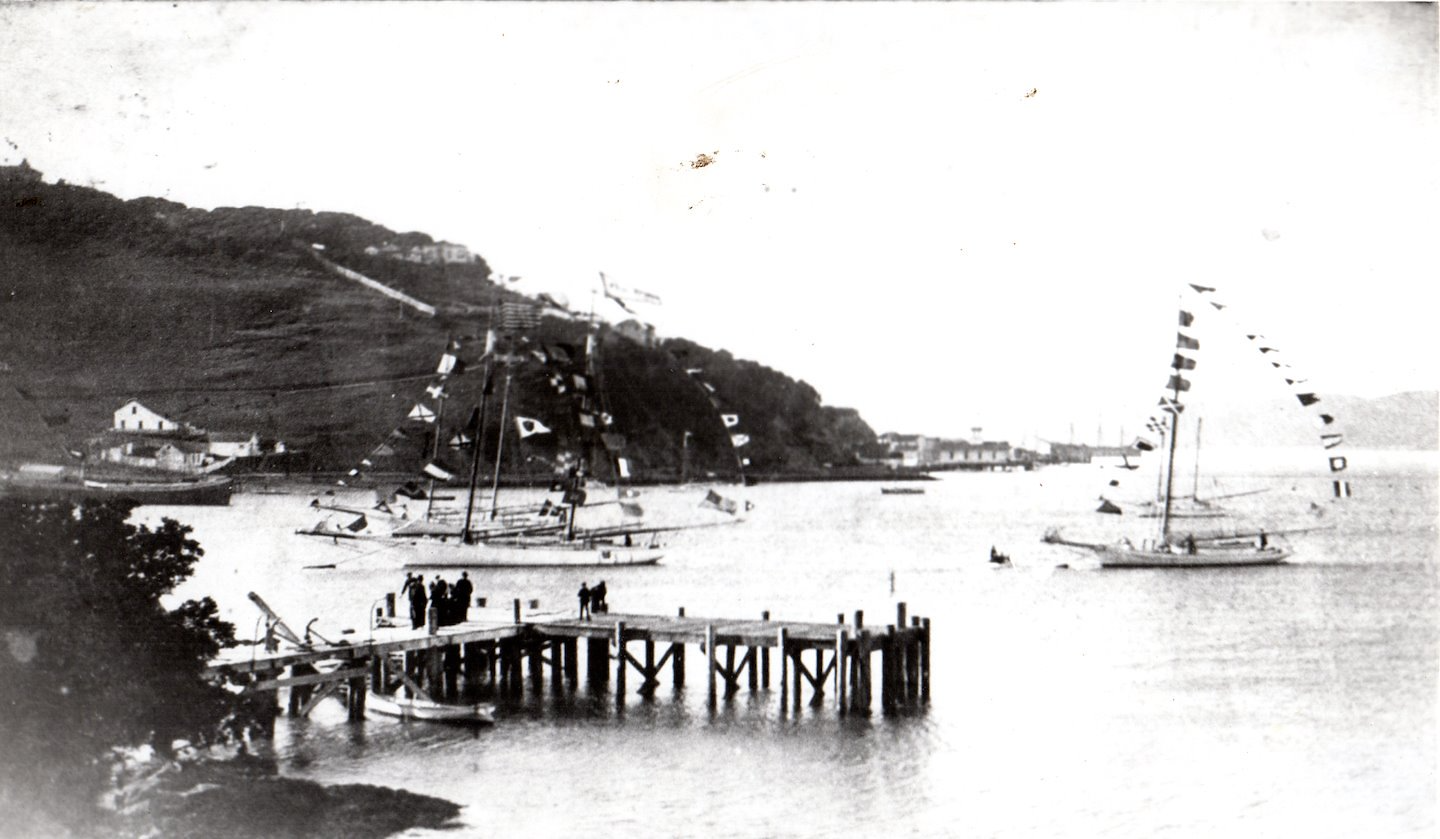
A photograph of Whaler's Cove, circa 1890.
By Annie Sutter
his story appeared in the Fall 1991 issue of the Historical Society Quarterly. It has been modified.
In the rolling hills of what came to be known as Sausalito, fresh water springs and streams were abundant. They poured down to the bay, creating marshes and watering holes visited by deer, elk, mountain lions and even grizzlies. The water was also enjoyed by Indians who built steambaths or "temescals' in their beach huts, some of which were in the little cove at the south end of Sausalito which later came to be known as Whaler's Cove.
The area was first mapped by Juan Manuel de Ayala of the bark SAN CARLOS in 1775 and named Saucelito after the willow trees on shore. Other ships' logs had it noted as South Salieto, San Solito, and finally as Sausalito. The word circulated by visiting ships said that Sausalito's water was the sweetest on the coast and was reputed to stay fresh longer than any other. Ships took on both wood and water at the cove beginning in the 1820s, and according to the log of Captain Beechey of the exploration vessel H.M.S. BLOSSOM, William A. Richardson, an English sailor who arrived in San Francisco in 1822, had a profitable little water business going at Whaler's Cove by 1827. Richardson made it easy for visiting ships to find the anchorage with the sweet water - he put out the word for ships to announce their arrivals outside the headlands by cannon, then his crew of Indians would paddle out and guide them to the anchorage. In the 1830s, a "traveler of the period", William Osborne, observed ships' crews throwing casks overboard, tying them together through the handles and towing them ashore "like so many sea serpents." They were lugged up the hillside, filled and rolled back down to waiting longboats. A tedious task, and doubtless one with high cask casualties.
The watering facilities soon were expanded. During the 1840s a cistern was built along with a series of flumes to carry water down to the beach. In "Historic Spots of California," written in 1937, we find an idea of what remained: "Captain Richardson piped water to a great cistern 30' square and 15' deep which he had dug for the purpose. From this cistern pipes were run on a trestle and thence to a boat, the WATER NIXIE, and transported to San Francisco and distributed by horse and mule-drawn carts for the price of fifty cents a bucket." Another account has the hull of the ship CORDOVA being put to anchor in the cove and used as a cistern to which ships' longboats repaired for water. In the 1850s Richardson had added two more boats to his fleet, to carry water and sell it in San Francisco. He also began selling oysters (125,000 bushels annually were reportedly shipped to the city), produce, horses and cattle. In the 1850s the cistern became known as "The Water Works", a business which changed hands several times until it became a part of a large land purchase by the Sausalito Land and Ferry Co. in 1868, which continued to sell Sausalito's "liquid gold."
