
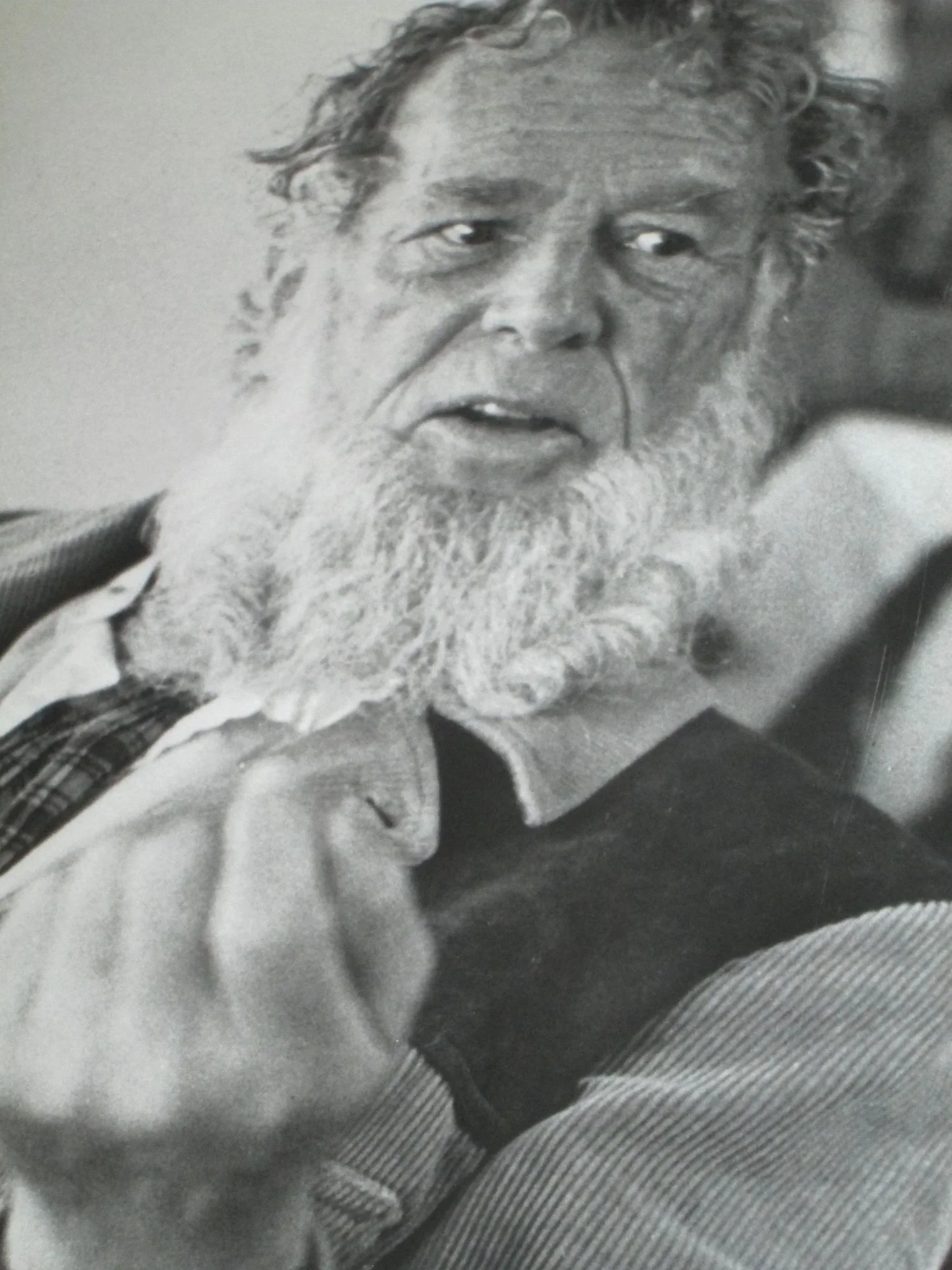
Sterling Hayden
By Steefenie Wicks
“With his back to the wind he plows up the dock and reaching the land turns left. He corners the squat brown bank, crosses the Bridgeway Road, turns right past the Tides bookstore, and steps from the storm to the warmth of the No Name Bar. He buys a drink and turns to a ship lost in the night and drinks to a life that was. He turns to stare at a face in the back-bar mirror: a vague face with bleak and querulous eyes. The eyes lock and he drinks to himself alone. Vale! Wanderer.”
The above is from the last page of Sterling Hayden’s epic book “Wanderer.” Hayden wrote only two books in his lifetime, his autobiography “Wanderer” and a novel titled “Voyage.” Both were written by a man who had a love for going to sea, tackling the adventure that it brings while calming his overpowering nature.
I never met Hayden, but I have read about his Sausalito adventures from people who befriended this 6’5” good-looking blond man who had the brains to live by the luck he was able to pursue.
In my own pursuit to find out about him, I ran across two interviews in the Historical Society archives by Sausalito writer Annie Sutter and editor June A. Osterberg. Sutter became friends with Hayden during her interviews with him in April 1982. He would later rent an apartment in a house she owned; this is where he would spend the last few years of his life.
Sutter writes, “Hayden is living in Sausalito once again, writing his third book, an autobiography sequel to ‘Wanderer,’ [named for the schooner] he left in 1960. What has happened since then? Two books, some films, life on a barge in Paris, ‘a lot of booze, sadness, a lot of tears, a lot of booze; but I had some marvelous times.’”
Sutter asked him how he got into films; she writes that his answer was as intriguing as his broad smile. “I just fell in off a ship,” he said. “I had my picture in the newspaper when I was on the Gertrude Thebaud. It said, ‘Gloucester fisherman like movie idol.’ I was so embarrassed. All of the boys were holding up the paper teasing me, but then the picture somehow found its way to Paramount. A few months later I was working on the docks in Brooklyn as a longshoreman; when I came back to the rooming house where I stayed there was a message from Paramount.” The message was from Ed Griffith, who worked for the studio. They met at his elegant hotel, but when Hayden shook his hand, Griffith remarked on how coarse his hands were. Hayden then took a blue-tip match from his pocket and struck it across his palm to light his cigarette. A week later he was given a screen test, and suddenly he was in the movies.
Hayden was what one could call a man’s man, but also a ladies’ man. The other woman in his life to work with him was editor June A. Osterberg.
Her sister, who was a neighbor of Hayden’s when the family lived on Belvedere, introduced Osterberg to Hayden; it was during this time that Hayden had a small studio in Tiburon. She was asked if she would help him pare his story down and turn it into a really worthy book, all for $2 an hour. She said yes. The book was “Wanderer” and the time was spring 1961.
Hayden and Osterberg had a rare partnership that required her to commute every day in her 1955 Triumph TR2 sports car from San Francisco to the quiet, open Marin countryside.
Hayden insisted on keeping fairly conventional working hours, but Osterberg remembers the lunchtimes when they would go to Tiburon Tommie’s to eat Polynesian food. She goes on to say that he wrote in longhand, and he was coherent in his thinking along with being articulate.
He was excellent company, though he was nobody’s idea of a peaceful person. Reliving his past in order to describe it for the book was a harrowing experience: his stormy childhood; his work with the Office of Strategic Services (the WWII forerunner of the CIA) in Yugoslavia; playing silly roles in films; joining the Communist Party and then renouncing it; testifying before the House Un-American Activities Committee and implicating some of his friends. And, lastly, the bitter fight to keep his children: he defied a court order and sailed the Wanderer to Tahiti with his four kids.
All these experiences seemed to make him who he was.
Hayden parted ways with Osterberg when he took the family back to Nantucket. However, she was with him when the book came out in the fall of 1963. “Wanderer” was launched on board the square-rigger Balclutha at Pier 43 in San Francisco. With rum and chowder being served, all had a good time.
In closing, there is so much one could say about Sterling Hayden, his adventures at sea and his adventures in Hollywood. These are stories that others have written about this man who referred to himself as the “Loquacious Bastard.”
Annie Sutter ended her piece with this statement: “And now he’s back in Sausalito, scribbling in the big journals, beginning the story of the twenty-three years since Wanderer returned from Tahiti. We can look forward to tales of the barge, the writing of Voyage, ‘a lot of tears, a lot of sadness, with some wonderful times to remember.’” As Hayden ended the conversation, he said, “It starts right here in the first chapter, called ‘Down and Out on Sunshine Avenue.’”
