
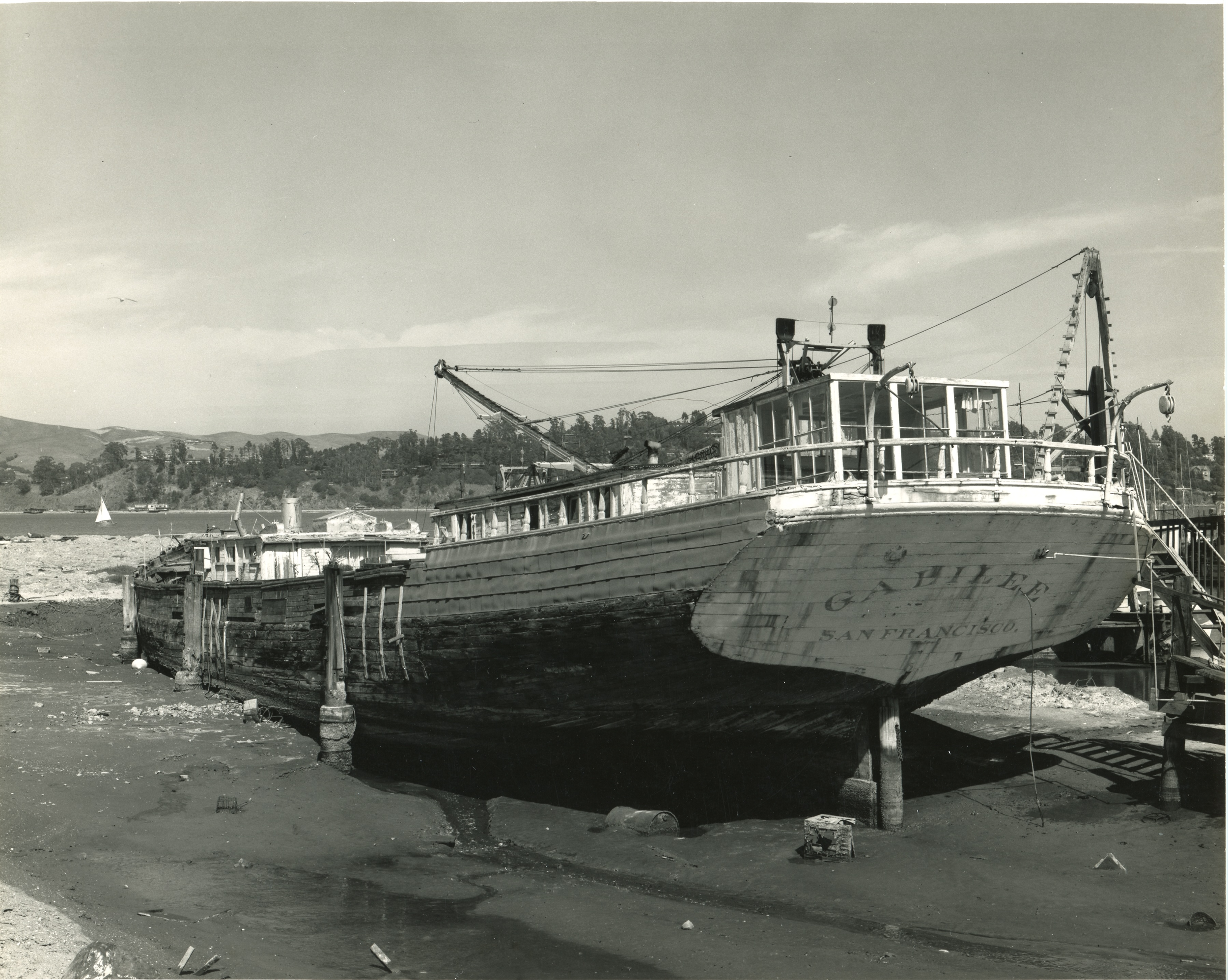
Black-and-white photograph of the "Galilee" sitting on the mudflats at the foot of Napa Street.
By Margaret Badger
Over Galilee’s half century of retirement, several owners lived aboard her. British Captain John Quinn, who purchased Galilee in 1936 and brought her to Sausalito, spent weekends and vacations there with his family. “Old San Francisco gas lamps illuminated her by night and pots of flowers cheered her appearance by day,” the Marin Scope of 7/22/75 quoted an earlier account of that period. Quinn gave up ownership in 1958, and Galilee temporarily lay abandoned until Walter Leaskin and his family bought her and lived aboard until 1962.
Old photographs are the best record of the changes that occurred to Galilee over decades. In 1948, Galilee still had two masts and maintained her regal presence on the water. By the late fifties, the masts were gone, the bowsprit broken and the rudder invisible in the mud. In the 1970s, the enormous hull emptied and filled with the movement of the tides and the deck boards cast shadow patterns on the enormous interior bulwarks. Toredo worms weakened the mighty beams and, in the final photographs, the hull is only held together by supportive pilings.
By January, 1962, the City Council decided that the hulk was a health and sanitary hazard and ordered she be abandoned and destroyed.
With demolition imminent, new interest in preserving something of Galilee was born. In November 1962, Belvedere architect John Lord King stepped forward and purchased her from Leaskin “to save her from being destroyed.” According to the San Francisco Chronicle, King hoped she might “form the nucleus of a maritime museum for Sausalito.” He was supported by the director of the Maritime Museum, Karl Kortum, who had gone over the Galilee with King and “was as enthusiastic about the project as he.”
A few landmark events determined Galilee’s ultimate disposition. Habitation was ended in 1962, but no aggressive action was taken to destroy her. In fact, a campaign was mounted to preserve parts of her. Although John Lord King did not live long enough to create a marine museum in her hull, in 1975, long-time Sausalitan and boat-lover Ron MacAnnan (owner of the Trident-Ondine building) became decisively involved.
MacAnnan, working with Kortum of the Maritime Museum and Harry Dring of the State of California and Aquatic Park convinced the City of Sausalito to let him chain saw off a 20’ section- the whole stern - for restoration. MacAnnan volunteered the machinery and labor, along with Herb Madden who loaned a tractor loader and Barry Hibben who negotiated the use of a crane, to remove the transom, barge it across the bay to San Francisco, and heft it up onto land. Today, the restored stern of the Galilee is on display outside the Maritime Museum thanks to MacAnnan’s efforts.
In the mid-1980s, the Benicia Historical Society and the Benicia Historical Museum Foundation negotiated with Sausalito to remove “by sawing” the bow of Galilee and, in another Herculean engineering effort, successfully moved it to Benicia where it presently rests under a tin roof at the Benicia Historical Museum.
Call of the Sea, a local organization founded in 1985 with a vision to build a New Galilee and to provide “education before the mast,” three years later won from the City of Sausalito a site on which to build the New Galilee.
As for the rest of the hull, the remaining beams can still be seen resting in the mud just north of the foot of Napa Street, in the community known as Galilee Harbor. Harold Sommers, Sausalito’s veteran seaman and maritime historian, reports that the original rudder is still perfectly preserved under the mud.
Is Galilee’s future still unfolding? Some are dreaming of one day uniting the bow and stern. The activists of Call of the Sea are realizing the mission of Galilee as first envisioned in their New Galilee project. Their schooner Seaward docked at the Bay model is a successful educational and sea-adventure program in the tradition of tall ships.
Galilee was an iconic sailing ship beloved for her beauty, her speed and her utility. Her legacy may still be emerging.
