
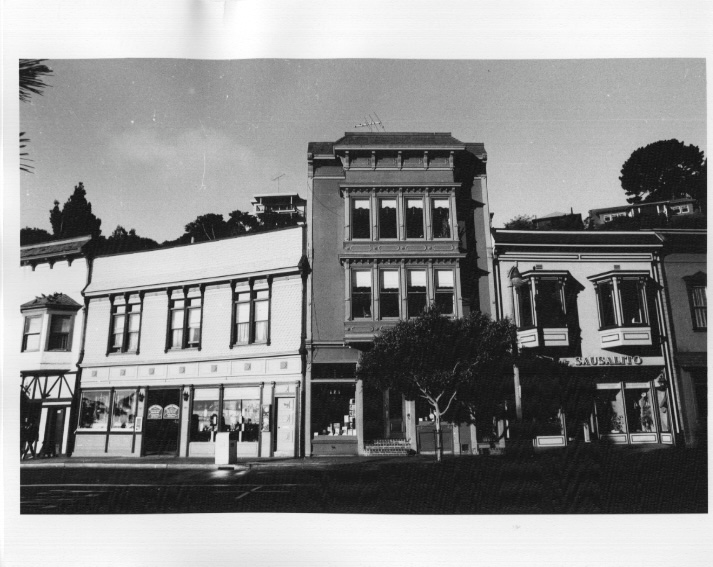
A black-and-white photograph of 751-755 Bridgeway. Image shows signs for The Upstart Crow bookstore, The Tides bookstore, and GG of Sausalito clothing store.
By Doris Berdahl | December 5, 2008
It was built in 1895, a product of 19th century-style urban renewal. Downtown Sausalito had suffered a disastrous 4th of July fire two years earlier. Someone at the old El Monte Hotel, directly up the hill from the vulnerable wood structures marking the west side of Water Street, had dropped a lighted firecracker on the roof of Hunter's Resort, a local saloon. By the time the town’s primitive hose carts and volunteer fire crews had subdued the flames, ten buildings had burned to the ground, wiping out most of the downtown business district. Today, the tall Victorian we see at the turn of the road on central Bridgeway (number 749), its false façade vaguely suggesting something out of a western movie, became the most prominent of the new storefronts that revived the commercial life of the new city. Sausalito had been officially incorporated two years earlier, the year of the fire.
The Sausalito News, in an item in its community gossip column, Brieflets, declared on October 5, 1895, that builder Manuel Barreiros -- presumably a turn-of-the-century equivalent of our modern day "developer" -- had completed his "new building on Water Street to the second story." On November 2, the Brieflets columnist breathlessly reported that the Barreiros building was "now nearing completion, consisting of four stories including the basement. It presents a fine appearance."
Rising a full story above its neighbors, presenting a dramatic profile against the sky, it must have been impressive. And it still is, particularly in its upper portions. The most authentic of the downtown's remaining wooden Victorians, its square bay windows and ornamental moldings remain virtually unchanged.
In the early years of the 20th century, the tall Victorian was best known as the home of the Sausalito News, which occupied it from 1909 to 1925. Longtime publisher George Harlan, writing in the MarinScope in 1979, recalled that the News "bounced around town five times in its 82 years," the Victorian being one of its longer-lived locations.
In 1925, the building at 1065 (its pre-Bridgeway address) underwent a striking change of use, becoming the headquarters of Drechsler's Plumbing.
But prior to either of these occupants, it had served purposes far less respectable than publishing or plumbing. Soon after it was built, Sacramento gambler Frank Deroux opened Sausalito's first poolroom (a venue for betting on horse races across the country) in the Barreiros Building, as 1065 was then known. Around 1900, when Daroux moved out, Barreiros quickly rented to a second gambling operation. But by then Sausalito's poolrooms were encountering stiff resistance from a group of solid citizens calling themselves the Municipal Improvement Club, popularly known as the "anti-poolies." In the end, following a lengthy city hall struggle during which the "poolies" were mostly victorious, Sausalito was relieved of its poolrooms by the California Legislature, which outlawed off-track betting in 1909.
Over the years, perhaps the most celebrated tenant of the building now known as 749 was The Tides bookstore. Customers were encouraged to linger over its collection of serious literature, its fine art and marine books, free to sit on the floor for extended browsing. The Tides pioneered the now-popular concept that music and coffee should accompany the reading experience. Lectures and informal talks featured provocative figures such as Eldridge Cleaver, Alan Watts and Anais Nin. A highly regarded literary magazine, Contact, was briefly published from editorial offices on the upper floors, attracting contributions from some of the most noted authors of the day.
The Tides was followed in the later 1970s by Upstart Crow and Co., which attempted to perpetuate the aura established by its predecessor. But tourism was on the rise and Bridgeway rents were becoming prohibitive for small, independently-owned book stores. In the 1980s and `90s, the tall Victorian at the bend in the road became the home of a series of retail establishments catering to an altogether different clientele. For better or for worse, it remains so today .
