
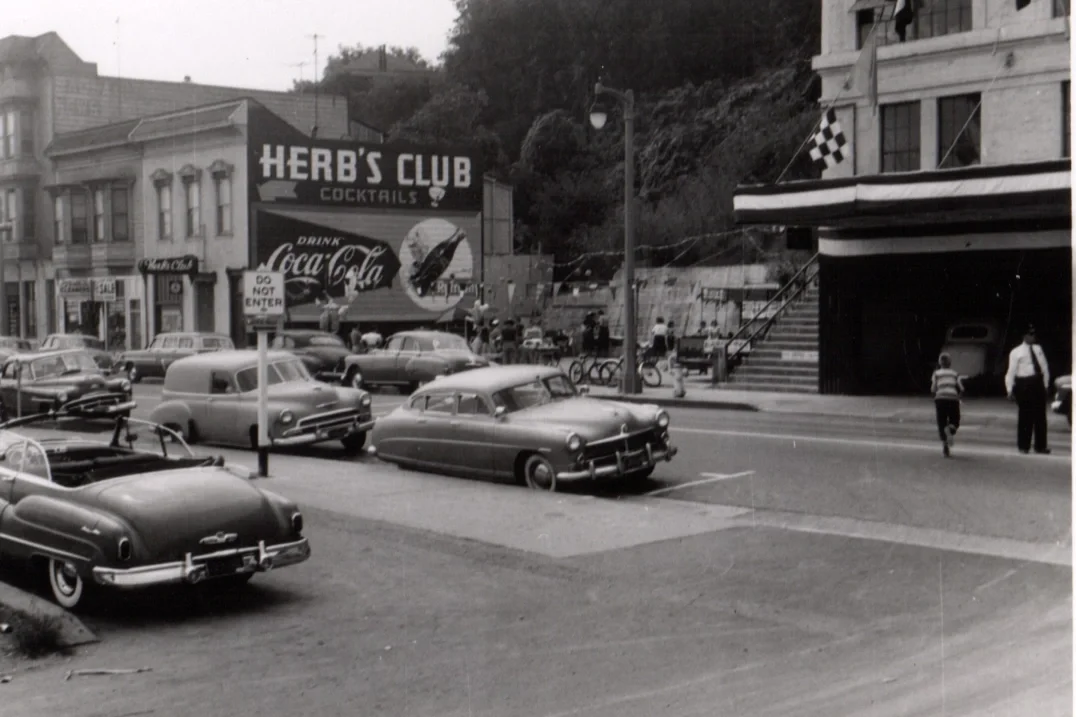
View of Sausalito
Transcript
Annette Rose, interviewed by Betsy Stroman | October 7th, 2008 | Temporal Coverage: 1964 to 1969
Betsy Stroman: I'm at the Antenna offices at Fort Cronkite with Annette Rose, on October 6th. And Annette, as I've explained, I sort of wanted to hear from you about your knowledge, your impressions of the creative world in Sausalito, from the period after you first arrived, in '64, and I'm sort of stopping at the end of '70, or January '71, when Varda died, for a variety of reasons. And I know you went to Europe in '69, is my recollection, so I'm really talking about a five-year period. If you could just tell me what you saw when you arrived, and what was going on in the world of creative people in Sausalito. Just free-associate, I'd love to hear it.
Annette Rose: Oh, I'd be glad to. I was married to Tim Rose at the time, and we drove across country in the winter of 1964, and stayed with various relatives. We had one of those drive-it cars, that someone who was transferring needed delivered. We went to Los Angeles, near Los Angeles, where he had relatives we stayed with. But his uncle, of that family group, who was an engineer, was in San Francisco at a convention, so we thought we would go see Uncle Jim, whom I'd never met. Tim and I had only been married a very short time, we were married in October before this. And I had my very closest friend from college, from the University of Denver and the University of New Mexico, named June Morrison, and she had transferred to the Art Institute in San Francisco. June was a wonderful painter and a great writer, and she was my age at the time, 20, I think I had my 21st birthday around then. So we were going to stay with her after visiting. We were actually on our way to Seattle, and had made arrangements to stay with some people there. We had gotten all the classified ads for jobs, we were applying to the University of Washington, we had everything going, we were going to go to Seattle. Because I had said to Tim, when we got married, we're going to finish school, and we can do it anywhere we want in the whole country, and I love to travel, and I said, let's just go someplace else, I don't care where, you get to choose. And he said, okay, I'll choose, but you make all the arrangements, which is the way we always did things. So he chose Washington, and because we were already familiar with it, that's how we ended up there. But quite frankly, when we got to San Francisco, and Uncle Jim took us out to dinner and up the elevator at the Fairmont or whatever, and then we drove over to my friend's house, who was living in Mill Valley on Miller Avenue, in this wonderful house up about a zillion stairs near downtown, we never said the word Seattle out loud again. Months later, people would say, do you want to stay in our extra room, we'd still have the bed, whatever, and we'd say, oh, yeah, we forgot, we were so totally in love with this area.
Annette Rose: And very soon after, we found an apartment on Bridgeway in Sausalito, across from the Trident and the Ondine's, in a building owned by the family of the Marin Food Company, that Chinese family. And through June, and others, and going to the No Name Bar, and whatever, and seeing writers and other artists who were there all the time, we met a huge variety of people. The first party I ever attended that was on a houseboat was on the Amphitrite. It's now burned down, but it was a huge barge and had a huge ballroom in it, where many musicians would play, or we would play badminton. At the first party we went to, Alan Watts was there, with his silver and turquoise belt buckle, and his blue jeans and his blue jean shirt. I looked out the windows of the Amphitrite and there was a sea lion cavorting around. I just thought I had died and gone to heaven.
Annette Rose: We met, then, Bill Kirsch, who is an architect still in Marin and now has another houseboat. So Bill Kirsch, and Al Garvey and his wife Barbara, who had just come back from remodeling a windmill in Ibiza and had made enough money to buy quite a sizable house in Fairfax, it was very cool. So those folks, and Leah Schwartz, and Jane Bakker, and Art Grant, and Val Bleeker. Val Bleeker would play her zither in a club that was on Caledonia Street, that is now the Food's Market, and, I think it was every Wednesday, do the whole Threepenny Opera. She would sing it all while accompanying herself on a zither on her lap. That was fantastic. People like Evan Connell were playing chess every night at the No Name bar. And lots of other folks, probably folks I didn't know who they were. But the whole thing with Alan Watts was that here I had been studying his work in school, and here was a real-life person. That was quite amazing.
Annette Rose: Tim and I became friends with a group of people who were quite good friends of Jean Varda's, and they were a bit older than we, they were our parents' ages. But they had traditionally, and certainly well before we showed up, done things they called masques, or Venetian parties, beautiful parties. And we were told about them, and they sort of adopted us, because Tim was a sculptor and very handy, and could help them build things and lug things around, and I was willing to do things such as take on a dragon they had used in a previous masque and slipcover it into an Aztec bird, a giant bird. And Tim was willing to actually wear said bird costume at Varda's huge birthday party, which was held out in the middle of the bay, on the dry docks.
Betsy Stroman: This was the 75th?
Annette Rose: Actually, it was the 74th, I think. Mythically, we all think it's the 75th, but I think the 75th was the following year, but whatever.
Betsy Stroman: But it may have been the 75th.
Annette Rose: It should have been, but whatever. It was these dry docks which had been floated into Richardson Bay and gotten stuck there, had been there a long time, and they were enormous, huge in size. We were part of the group organizing the party, and they had trees taken out there in big pots, they had a stage built, a sound system, they had porta-potties brought out, and hundreds of people came. People came in Aztec-y kind of costumes, and there was a masque around that particular scene, with Tim playing the firebird. I remember cutting out felt red, yellow, and orange feathers for that bird, for the wings, which must have been ten feet across, at least, until I had blisters on my fingers, I couldn't use scissors anymore, and gluing each one to the bird. Anyway, it was a fantastic evening. After the night of the dress rehearsal, which was the night before, the weather was fierce, the wind had come up, and it was horrible, and Tim was out there with his bird costume being blown around, and came home just freezing cold, even in spite of wearing the costume. And the next night, the night of the party, the water just laid down like glass, and it was as warm as the nicest evening you're ever going to experience in Sausalito. They had boats taking the visitors back and forth to the event. It was quite something. To meet these kind of people, who thought this way and did these things with great joy and great generosity for each other and their friends, was really something.
Annette Rose: Tim, along with another artist who knew nothing about sailing, as Tim did know nothing, were the people that Varda chose to build his last sailboat, called the Cythera. I used to say, a story you could say, that his first sailboat was named after his mother, and his last was named the Isle of Venus. So we were sort of, Varda had an international circle of friends, very famous people, many of them, and some of them not, who, when they were in town, would come and visit. Every Sunday he would take his sailboat out, but he had a certain group of younger people, and we were in that group, who'd learned how to sail, or could follow his directions, or whatever, and who would come out and keep everything going and keep the food flowing and everything else, while intermingling with the guests. So we used to go out with Landor, and, oh gosh, what was Jacques's last name, the sculptor...
Betsy Stroman: He's Dutch.
Annette Rose: Older?
Betsy Stroman: Older?
Annette Rose: Yeah.
Betsy Stroman: Yeah, that's right.
Annette Rose: And lots of other folks, and that was grand.
Annette Rose: One year, Bill Kirsch, and Tim, and myself, and, well, the Garveys and maybe fifteen other people or so, on Memorial Day weekend, we took Varda's boat, and all of us sailed up to the Delta, and then anchored the boat at a place with no dock or anything else. We all got off the boat, and Varda led us through these fields, and we were in the town of Locke, but we didn't approach it the normal way. I've been to Locke by boat many times since, but it was just completely mysterious to me. And there we were, in a Chinese ghost town, after sailing on the boat.
Annette Rose: This being the '60s, most of the guys had pretty long hair, and so did the women, and the people on the sailing trip were young. The guys would have their bandanas tied around their heads, and the girls were all in flowy things. And the boat, of course, was painted like Mediterranean boats often are, with big eyes on the front and a zillion colors. It was quite beautiful. He had three types of sails: a Chinese junk sail with a big sun on it, which he painted in Tim's sculpture studio, and the others were colored sails, a lateen sail and another type. He said his sails represented the three great sailing nations in the world, I remember him saying that.
Betsy Stroman: What were those?
Annette Rose: Well, it would, it was the French...
Betsy Stroman: Greece?
Annette Rose: French, the Chinese, maybe some type of Spanish ship, possibly Greek, I'm not quite sure. I'll have to think about that. Maybe Tim would remember, since he helped build the boat.
Annette Rose: In any case, I remember, there we were in the Delta, sailing along, and I remember this little boy, on this small, live fiberglass, sort of normal-looking boat, with his parents, and he looks up and says, Mommy, look! And I hadn't thought until that moment what we looked like, from the outside looking in, but it must have been really quite a wonderful sight, so colorful, and the people having so much fun.
Betsy Stroman: Anything else?
Annette Rose: Okay, let me think.
Betsy Stroman: What were some, were there any galleries where art was being sold and shown here in the '60s?
Annette Rose: You're probably aware that I had a gallery in the '70s, but before that, I worked at what is now the Museum of Modern Art, which was called the San Francisco Museum of Art, when it was on McAllister Street, in the Veterans Building. I worked there after I graduated from San Francisco State, for the last three years of the '60s, before I went to work at ICB. Quite frankly, I remember no gallery.
Betsy Stroman: The Tides Bookstore. Tell me about the Tides Bookstore.
Annette Rose: The Tides Bookstore is quite a wonderful institution. It's great. The Tides was very near the... And the Tides Bookstore would do windows, and they would show work on their walls. A person whose work I saw a lot there was Enid Foster. And at one point, my job was running the Sausalito Hotel, and so I went back to college, and I took all my college classes on Tuesdays and Thursdays, and worked the other five days at the hotel. And that also meant, and of course Tim helped, and whatever, but he was mostly working full time elsewhere. We also ran the Del Monte Hotel across the street, across the cement steps, over where the pharmacy used to be.
Betsy Stroman: Isn't that an apartment house?
Annette Rose: I think it's, I don't know how it's rented out now.
Betsy Stroman: It's just to the left of the steps.
Annette Rose: That's right. It was called the Del Monte, I think it still is. You could rent, it wasn't, you could rent by the week. A lot of people, fishermen and other people coming and going, and sometimes people getting out of San Quentin, would rent for a week or whatever. And sometimes we'd send people to the Vallejo, we'd have them come and rent a room at the Sausalito Hotel where we were living and renting it out. Will Hearst, who's now head of his corporation, used to come with his big German shepherd and rent a room at the Sausalito Hotel quite often.
Betsy Stroman: You mean young Will Hearst?
Annette Rose: Mm-hmm.
Betsy Stroman: What was he doing?
Annette Rose: He was dating.
Betsy Stroman: Dating.
Annette Rose: And he always had this big German shepherd. It was perfectly okay, it didn't do anything to anybody. And we had the occasional celebrity type coming in and out of there, too. But the hotel across the street, that's where Enid Foster lived.
Betsy Stroman: Yes.
Annette Rose: And she had apartment number one. I knew her from before I had the job running the hotel, we became friends, and she would invite me over. We were either served incredibly sweet sherry, so sticky sweet you couldn't even believe it existed, or she would serve her version of a martini, which was gin with a slice of onion, so it tasted exactly like onion juice, pure onion juice, with the added kick of the alcohol, of course. Way too much alcohol for me at my age.
Annette Rose: When Tim started designing some papier-mache jewelry in the '60s that was sold at Macy's and other places, Enid once did a whole stack of drawings, suggestions for earrings, and he made those earrings from her designs. They were quite wonderful. One of the designs I remember was called Eyes with Tears, and it looked like an eye, and you would screw it on, so it would be a wonderful eye with an iris. He did both brown and green eyes, as I recall. She called them Eyes with Tears, and then he would make little wire connections and papier-mache balls, small ones, that would come down from the corners of the eyes, and you would wear them here, of course, on your face. Anyway, that's one I remember in particular, she made a whole stack of them. She thought that was really quite fun.
Annette Rose: She would love to go out in the morning and go through all the merchants' garbage or trash, and so she had a lot of recycled art. I have those types they used in the hospital, sort of rubber jugs, kind of vases or bottles. She often painted herself, and so I have a series of profiles of Enid that go around these two vases. I have another picture that is just a portrait of herself. And then she did monotypes, which often were quite detailed.
Annette Rose: And once, when my boss, who owned the Del Monte and the Sausalito Hotel, told me that he was raising the rents, and I had to tell everybody, the people who'd been living there for a long period of time, that their rent was going up, and they could have fewer towels on Monday than usual, Enid became enraged. And so I once had an entire window of the Tides Bookstore dedicated to what a horrible person I was, all drawings and pronouncements by Enid Foster.
Betsy Stroman: I knew she decorated it. She was paid to do that, wasn't she, to decorate the Tides windows?
Annette Rose: I wouldn't be a bit surprised if he didn't pay her.
Betsy Stroman: I think he did.
Annette Rose: Oh, sure. And one week she decorated it with horrible things about me. She did a monotype where I looked really nasty, and I was called a landlady. She was mad, it was on her mind. On the other hand, she really liked us, and I would go over there while she and Val would cheat each other at cards. They were very good friends.
Betsy Stroman: Where did the artists hang out, other than at the No Name?
Annette Rose: Well, the No Name and the Tides. The Tides had tables and chairs where you could have coffee and sit and talk. The bar underneath the Sausalito Hotel, which then became Hilliard's, and now is a combination coffee place and gallery. It was a bar, and it was a gay bar.
Betsy Stroman: Is that on Bridgeway?
Annette Rose: Oh, and they also hung out at the coffee house, down the street, facing the water, which is still a coffee house. It had this wonderful mural on the wall, painted by this guy in Mill Valley who's still around, an artist. His name is escaping me right now, but I just saw him recently, he came to Chris's opening of the show. He did this great street scene of Bridgeway and Princess, and identified all the stores and the various people walking down the street. That was done just prior to when Tim and I would have moved here.
Annette Rose: And the man who owned that coffee house, and always rode a motorcycle, he died recently, in the last couple of years. He got in touch with me because he knew of my interest in art and that I'd owned a gallery for a number of years. So a few years ago he got in touch with me, and he wanted to do something with that mural, because it had been painted on canvas, and he'd taken it off the wall when he sold the business years and years ago. And so the Sausalito Art Festival, I believe Paul Anderson has it, but they asked me to sort of curate and put together an exhibition for the 50th Sausalito Art Festival, and I did so, and it was really fun to get all the artists back together. And then, because I had to go to Europe during the time they were going to have the real opening, they had a second party when I got back, so I got to see a whole bunch of artist friends, and talk with Guy about the mural and everything else.
Betsy Stroman: So that coffee house, that was really a place where people hung out.
Annette Rose: I don't know if it was the Glad Hand, which is now Scoma's. The Glad Hand was great. If you asked what the soup was, they would tell you whether it was white or red, because it was composed of anything that everybody who worked there wanted to throw into the pot. But basically you could tell it was white, red, or green sometimes, or brown. You got a general picture about what the soup was going to be like. They had menus written with chalk on the chalkboard, and it was sort of beatniks sloshing into hippie time. It was wonderful. A lot of the wait staff, if not all of it, who worked there, were artists. Jane Bakker worked there, she was an artist.
Betsy Stroman: Did she have two names? Did she change her name at some point?
Annette Rose: Yes.
Betsy Stroman: Somebody mentioned her, Tim may have mentioned her.
Annette Rose: He may have, yeah. Jane Bakker, the printmaker and silk screen artist.
Betsy Stroman: Yeah, I have a tiger she did, on a purple-striped tiger.
Annette Rose: It looks exactly like a tiger coming right at you, but it's purple on white rice paper.
Betsy Stroman: I'm curious about those masques, which I know, I've interviewed Victor de Sobrero and a number of other people about those masques, and what I would love more than anything would be to see any photographs of those masques. Do you know whether there are any in existence?
Annette Rose: Early Pacific Sun.
Betsy Stroman: Okay.
Annette Rose: Steve doesn't own it anymore, but I know he's got some Varda pictures. Chris, in fact, did a giant Varda figure, he was in last year's county fair about the waterfront, but Chris has a giant Varda mask that was done from a color photograph of Varda that appeared in a magazine.
Betsy Stroman: Have you ever talked to Herb Gold?
Annette Rose: I haven't yet, but I have an introduction from Victor, so I'll probably get in touch with him.
Betsy Stroman: Herb, from time to time, would write stories. It would be like in the Sunday magazine for the Chronicle, there would be like two pages with photographs, and I always thought Herb really captured Varda best. I really do. I remember once reading in one of those, just apropos of nothing, articles that would appear, I remember once when he said that any woman who got to sit next to Varda at these big lunches he had on the Vallejo always felt like the most important and most beautiful person in the world.
Annette Rose: And it was so true, because I was lucky enough to be able to sit there for several lunches, at different times. It was amazing, the type of attention he could give you, without it being at all smarmy or ridiculous. Amazing.
Betsy Stroman: He was quite the central, yeah, he made the art colony, as far as you're concerned, would that be fair to say?
Annette Rose: Yeah.
Betsy Stroman: Okay.
Annette Rose: And he was, I think because he attracted people from around the world, it was, you always have to have the salon going, and somehow it always appeared as if no effort had been put into it whatsoever. But you know that collecting the right number of people who are going to come sailing every Sunday, or the people who are going to eat five times a week for lunch at your house, and there's twenty of them at this long table, and have no one do anything, and have it just happen beautifully, you know that this takes a masterful amount of planning.
Betsy Stroman: Well, he had help on that.
Annette Rose: Yes, but I mean, I was a helper often, but it just always seemed to sort of flow together like magic. One of his favorite things, he would put potatoes in a pot of water and sit it on a heater, and they would cook for twenty-four hours, really slowly, and the potatoes would turn into these creamy things that were not starchy or whatever, because the chemistry was just perfect. They were just delicious. Like nothing you've ever had.
Betsy Stroman: You've probably seen the film, Uncle Yanko.
Annette Rose: Yes.
Betsy Stroman: Actually, what about Bill Kermack and his wife, at Sausalito Artists and Merchants? Were you involved with them at all?
Annette Rose: Yes. Tim and I were members of SAM, Sausalito Artists and Merchants. We were invited because, well, I guess Tim was an artist, and we were definitely merchants, because we were managing the Sausalito Hotel. I remember Bill having us be in charge of a Christmas decorating contest, which SAM ran, Christmas stuff for people's houses and things. Tim and I didn't have a car, so he had us rent a car, which SAM paid for, and we had never done anything so extravagant or wild as rent a car, but we did. And seatbelts were brand new then, and Tim couldn't get a seatbelt on, so we had to slide under, get out on the ground, of the parking lot to get out of the car. Tim is a very clever man with his hands, he's really brilliant, so you've got to know how far out of our depth we felt, for something like that to happen. I'll never forget, it was very funny.
Annette Rose: Yeah, I would go to the meetings, and we would buy some of the pieces of the Sausalito art collection, which are in the hallway at City Hall, with little plaques on them that say SAM purchased them. So that was definitely Bill's idea.
Betsy Stroman: Was he involved in running the art festival for a while?
Annette Rose: No, no. It was run, as I recall, during the early '50s, by the Chamber of Commerce.
Betsy Stroman: Is that right?
Annette Rose: Yes.
Betsy Stroman: And then at some point, I know Bill Kirsch got involved in taking it...
Annette Rose: Yeah, and Tim, and myself.
Betsy Stroman: Okay.
Annette Rose: And when we first arrived, the Chamber, and Barbara Leach Voorhees, was hired by the Chamber to run the festival. When we first arrived, I remember Tim deciding he was going to be in the art festival, and neither of us had a single concept of, like, a plinth, or whatever. He just went down there in the morning of the festival and set his stuff up. And because the festival had sort of fizzled out at that point, it was at a very low ebb of its existence, and I don't know what it was like before, but I'd heard from other artists like Leah Schwartz and others that it had been. It was a much more remarkable show earlier on.
Annette Rose: And Tim had gotten this from a junkyard, an old, old, old, old cash register, and he had painted it red, white, and blue. You know, that's from pop art time, right? And he had taken the bottoms of glass beer bottles and bent coat hangers and made turtles out of them. And he would balance a piece of wire with a little piece of broken glass and give the turtles heads, so the head would sort of move and bob back and forth. And then he made a whole family of them that were different heights. So the turtles were about this high, is what I'd like to say.
Annette Rose: And so we set up there, whenever, and lo and behold, the Chronicle comes by, takes a picture of the cash register, and they said, why did you paint it red, white, and blue, and he said, well, what other colors would you paint it? And that was his big political comment on the state of the United States, and greed, etc., very 1960s. And the Weiners, who owned a fabulous ribbon store, with buttons and ribbons and this and that, handcrafts from Europe, Mrs. Weiner bought the turtles. That was the first piece of art Tim had ever sold. And Michael Weiner says, I do believe he still has them.
Betsy Stroman: Oh.
Annette Rose: Isn't that cool?
Betsy Stroman: That's cool. That's great.
Annette Rose: And other places, artists who had more money hung out, were like at, and who's that guy, Danny? There was a doctor who played jazz piano, played there really often, ended up being well-known during the '60s for taking care of people on bad trips. And another, a woman sang there all the time. In fact, I believe she's still alive, because I read something about her in the last few years. She was sort of a scat jazz singer, I'm trying to remember her name, Jane, I think, something.
Betsy Stroman: She was the scat jazz singer?
Annette Rose: And a lot of people would go and watch her, and some of our older friends sort of introduced us to that whole kind of thing. And Denny Zeitlin, the piano player, I'll think of her name too.
Betsy Stroman: He was the doctor?
Annette Rose: Yeah. And that was right across the street from us, mostly too expensive for us, but we did go there. And then there was a sort of big change when it got remodeled, with all the woodwork that Grover Boas did, all that woodworking that's still there today, those big canopies, when they turned it into sort of a real fancy-looking place. Before it was very, it was in blue and gray, and was a very jazz, martini-drinking kind of thing, and then it became this very hippie, whole-grain bread.
Betsy Stroman: Was that when the Kingston Trio came in?
Annette Rose: Kingston Trio sang in the old version.
Betsy Stroman: In the old version, okay.
Annette Rose: And we knew Nick Reynolds quite well, he was in the Kingston Trio, and his wife Joni, they had a little boy. And there was another man, a photographer named Casey Sonneman, and he was a good friend of Enid's, and all of the gang. He in fact stayed at Tim's and my house sometimes, and he, when the top floor of the Tides Bookstore was an apartment, that's where he lived, and it was really fantastic, in its eclectic look. He's still around somewhere, his son sometimes comes around and tries to get in touch with his father's old friends. And that's great. He introduced us to this great poet, Casey Sanova. We met several people through Casey.
Annette Rose: One of them was Stanley Rice, who was a poet, and taught creative writing at San Francisco State, who was the husband of Anne Rice. At that time, Anne was a ticket taker and cashier for the Cinerama movie theater on Market Street. She sometimes wrote in her spare time, she certainly never had anything published. She was mostly supporting Stanley, who was getting through his master's degree and everything else. He had gotten degrees from Berkeley, and then he was teaching at State, which had a very well-regarded creative writing program, with Kay Boyle and other well-known folks. He was sort of the star of that particular family for all of their youth, practically. And then one of Anne's first books was pornographic.
Betsy Stroman: Mild pornography, and not violent?
Annette Rose: But definitely would not be considered...
Betsy Stroman: Family reading?
Annette Rose: No.
Annette Rose: And then she wrote that, and then they had a child named Michelle. We moved away, well, we moved closer to San Francisco State, and lived out in the avenues. And before Tim and I went to Europe, and we were gone for three years, we went out, and had dinner at their house, and saw their baby, it was new and everything. Like most people's new babies, they didn't get out much, so we didn't see them a lot during that period. We used to see them, we'd have Thanksgiving together for years before, either at their house or ours, usually ours. And then their child developed leukemia while we were gone. Many of their friends really felt that the vampire books really came out of Anne's experiences of having her child have his blood changed so often, and everything else. They ultimately had another child, a boy, named Christopher. So the baby had died by the time we came back, she got this disease at a very early age, it was really quite a tragedy. But Stan and Casey used to sit in Vina del Mar Park and have poetry contests, they would each write a line of poetry, and go back and forth with it, and it was really exciting just to hang out and be part of that.
Betsy Stroman: Poetry was a part of the art festival for a while, they had a poetry section. Was that when you were around?
Annette Rose: I don't remember that so much.
Betsy Stroman: You mean poetry readings and stuff like that?
Annette Rose: Well, I never knew what they did. They had a poetry section, it was Herb Beckman and a guy named Gerd Stern, who probably was before you came, ran it.
Betsy Stroman: Maybe.
Annette Rose: Well, I can say what happened with the Barbara Leach Voorhees thing is that the group of artists, and that would be Al Garvey and Bill primarily, and then myself and Tim and others secondarily, all decided that we would take it on, and we got permission to have it in the Bank of America parking lot downtown. It was wildly successful. Lots and lots of jealousy ensued, and eventually the city took it back, because they decided, what were these ragtag people doing, making money off of it? So they took it back. And then they hired Tyson Underwood to run the festival for a number of years, where then, of course, it lost tons and tons of money. Tyson is many things, and a great, good, personal friend of mine, an early friend of Tim's. But being a manager of something like that, at that time at least, was definitely not in his skill set. So they always just spent far more than they took in, no matter what happened. Then, gradually, the art festival was taken over again by a different group of people through the Chamber of Commerce, and it was a success.
Betsy Stroman: Tell me about going back to when you and Bill Kirsch and whoever else, Barbara Voorhees, I guess, were running it, you said it was very successful.
Annette Rose: No, not when Barbara was there.
Betsy Stroman: Oh, not Barbara. You and Bill Kirsch and whoever else?
Annette Rose: Al Garvey.
Betsy Stroman: Al Garvey, were doing it. It was successful, it made money?
Annette Rose: Yeah.
Betsy Stroman: Weren't you trying to make money for the Art Center?
Annette Rose: Yeah.
Betsy Stroman: And that was the thing that was out on Nevada Street?
Annette Rose: Mm-hmm.
Betsy Stroman: That's the one that's been torn down.
Annette Rose: And so we remodeled, we had a ceramic studio. We had the last festival that the artists ran, I think, the last one, it would be the last one that Tim and I attended that the artists ran, and Tim and Jane Bakker were the co-chairs, and I did all the scut work, and sort of held it together, and it was really fun. It wasn't in downtown Sausalito, it was on the grounds of the art center, but that was the first time Tim showed his giant cube that he made, which is a fabulous sculpture, a sculptural mobile, really, really beautiful piece, and he showed it there, and people really loved it. Lots of artists came, and it was sort of a precursor to all this interesting green everything, we had, I had all of these artists and different people baking bread, and we sold this whole grain bread and herbs, in addition to the art, and it was all mixed together.
Annette Rose: And Varda had had his first stroke, because it was the first time I had seen him since he'd had a major stroke. I remember watching him walk up the driveway to the school, and Tim's booth was sort of close to the front, and I see he was walking up the hill with two young women, we always called them the dancing girls, and he was wearing this long white tunic, kind of top, and I thought I could see right through him, the sun was behind him, and he had all that long white hair, and it was like he was an angel, like he was a ghost, like he wasn't with us anymore. And he wasn't, for too much longer after that. But he looked beautiful. I can even remember what I was wearing that day, it was a wonderful festival. It may have been the last one that we attended.
Betsy Stroman: Why did the city want to take back that building on Nevada Street? They said they needed a parking lot, was there anything beyond that?
Annette Rose: Well, it actually wasn't the city, it belonged to the school district. We had a lease with the school district. The school district had sort of a love-hate relationship with having artists there. They were desperately afraid that, as Bill Kirsch used to say, that we were going to start the Cubist School of Art and put all the pictures in the windows. And being school property, it was sort of a problem. We went to a hundred zillion meetings. There was someone on the school board who actually was ultimately on the board of Chris's theater from the beginning, his name was Doug Martin, he was an attorney, he still lives down the street from the school, from that property. Doug could see all the dangers of allowing artists to go in and deal with the building and the liability and everything else. But he eventually ruled, and we eventually did get permission. It was probably really too bad to put as much, to not know how brief a period of time it was going to be, because it had to be rewired for the ceramics kilns, and there was a lot of other kind of stuff. But there were also nude basketball games, and various other things, and people sort of living there from time to time, ultimately.
Annette Rose: Well, Tim and I went away before a lot of that happened, so I don't know, but I'm sure, I mean, I would not be a bit surprised. It probably got a little out of hand.
Betsy Stroman: Okay. No, I don't want to keep you any longer, this is all very interesting.
Annette Rose: Well, I don't know if there's anything else I can add.
Betsy Stroman: I don't know if there's anything else you can add either, because I really was just going to let you free-associate, which you've done beautifully. Who were some of the artists that, during the years you were here, would you say were the people doing the most interesting work? Is there any way you could just, is that too hard a question?
Annette Rose: I would say the other people I've mentioned.
Betsy Stroman: Okay, yeah.
Betsy Stroman: I'm looking for something over here that has a picture of that Varda outfit.
Annette Rose: Oh, yeah. Oh, the sculpture of the puppet, actually, it's a giant puppet.
Betsy Stroman: Yeah, I thought it was a very good picture, because it's very much sunnier than that.
Annette Rose: Oh, my goodness.
Betsy Stroman: Anyway, this was Tim's?
Annette Rose: No, this was Chris's.
Betsy Stroman: Okay, and he did it from a photograph. Where did he do this? Where was this shot?
Annette Rose: Chris did a play called On Site in Sausalito, about the same time we were talking about, which really was done with a lot of free-association interviews with people, and it was about Varda and...
Betsy Stroman: That's not the one you listened to?
Annette Rose: That was later. I went to that.
Betsy Stroman: On Site in Sausalito?
Annette Rose: Well, I went, he's done tons of plays like that.
Betsy Stroman: Oh, all right.
Annette Rose: But it's all pre-recorded.
Betsy Stroman: I did one. No, the one I went to was in the early '90s.
Annette Rose: Most of these I listened to.
Betsy Stroman: Well, there was a giant mask, a mask of Varda, and there's one that was in that piece.
Annette Rose: Okay.
Betsy Stroman: You know, I think I'm sort of coming up empty for questions, so I think that's great, and that's a lot of good information. Thank you for the book. Thank you very much.
Annette Rose: One thing, one person was Bea Bernardi.
Betsy Stroman: Oh, yeah.
Annette Rose: And she, and her niece, have this frame shop, art supply store, called Any Case. And then her niece became pregnant, Sherry Schuster, and Tim probably told you that they wanted to get out from under it, so Tim went in there one day just looking for work, actually, and asked if they needed any shelves built or anything, and the next thing we knew, Bea essentially just gave us the business, if we would just keep paying off the bank loan, and she wouldn't get stuck with it, because Sherry was about to walk away from the scene, because she was enormously pressured.
Betsy Stroman: It was a building she owned, you mean?
Annette Rose: No, it wasn't the building, I think, it was the business that rented a spot in the building. And the business was probably worth nothing, in a sense, it had bank loans against it that Bea had co-signed for Sherry to start it, and Sherry had zero, zilch interest in going back. And so that's how we, and I had an interest in doing something about a gallery, and there was enough space, so I decided we would call it the Rose Bernardi Gallery, to sort of thank her. We actually went to several artists in the Industrial Center Building, to their studios, and Bea and I selected several, let's say, one piece from several artists, and that was to form the first things for me to sell in the gallery, and also to get the artists interested in perhaps showing their work. So that was the beginning of the Rose Bernardi Gallery, which was later than the time you were interested in.
Annette Rose: Bea had done work, going back into the early '30s, and we once did a retrospective of her work, and I saw some things I didn't know she had done. She did a lot of weaving, and she had a piece that was really fine, done with silk and wool, very, very lightweight, called Women in Sports, and it had, I was like, a tennis player and a golfer, this or that, it was very 1930s, it was just of the type, I just loved it, it was fun to show that piece, as well as her line drawings, and her watercolors, and things that people most identify with her. I remember that piece.
Betsy Stroman: If you ever wanted to know about what Bea was doing during that time, I think Sherry Schuster is still around.
Annette Rose: Not Schuster, Sehulster. S-E-H-U-L-S-E-R. And her husband is Tom Sehulster.
Betsy Stroman: I have read, somebody did an interview of Bea Bernardi, so I've read that interview.
Betsy Stroman: What was it, one other thing, the ICB building, Chris was one of the first people in there, wasn't he?
Annette Rose: No, Tim.
Betsy Stroman: Tim, sorry, Tim was one of the first people in there.
Annette Rose: Yes.
Betsy Stroman: And he shared a space with Walter Coleman, is that right?
Annette Rose: No, not with Walter.
Betsy Stroman: Oh.
Annette Rose: When Tim first rented his space, there may have been other artists, there were other artists up there. There was a guy who had his canvases put together like a teepee, and he was sleeping under them. Tim rented the space that didn't have any walls around it yet, and that guy was camped out in the space. There was a flight attendant who had like a claw-footed bathtub and a bunch of other things just sort of sitting in one space. It was like, supposedly, Tim's studio, but they had these other things either stored, or were renting the space there. As time went by, that he was there, they put up walls, and then later they put up all sorts of stuff, and sprinklers, and all sorts of things. But originally, that whole top floor of that building was one room, and one end of it had been walled off, and it was a book depository, literally, for educational volumes. And Tyson even worked there for a while, when he first came out to California, his job was down the hall. So it sort of grew up around us.
Annette Rose: And I'm trying to think, I know that June Morrison, our friend who was at the Art Institute, was working here when we first, who was here before we moved here, that she shared a studio with him for a while, and Tyson did, but that would have been later on.
Betsy Stroman: She wasn't married to Dave, was she?
Annette Rose: No.
Betsy Stroman: No, okay.
Annette Rose: She married a Spaniard, Francisco de Bobadilla.
Betsy Stroman: Did you know Ruth Costello?
Annette Rose: Yes.
Betsy Stroman: Who is she?
Annette Rose: She was, I didn't know her well, but I can picture her.
Betsy Stroman: Well, there's that guy who painted all the rulers...
Annette Rose: The rulers, now, is that...?
Betsy Stroman: And the clown faces.
Annette Rose: That's Cuccaro?
Betsy Stroman: Cuccaro. Yeah, he lived on Princess Lane. And of course, Walter.
Annette Rose: Walter, being, you know, one of the more recognized, accomplished people of any of this gang. I mean, certainly Cuccaro was sort of a joke, in that sense. Buffano was around. Al Cibrian just died.
Betsy Stroman: Well, if I have any real flashes of genius, I will get in touch with you. But it was certainly a great, fun time.
Annette Rose: It was a great, fun time.
Betsy Stroman: Did you have any interaction with Contact Magazine and the people who were publishing that?
Annette Rose: No.
Betsy Stroman: All right, well, I think...
Annette Rose: I wasn't in that loop.
Betsy Stroman: I'm sort of, I was interviewing...
