
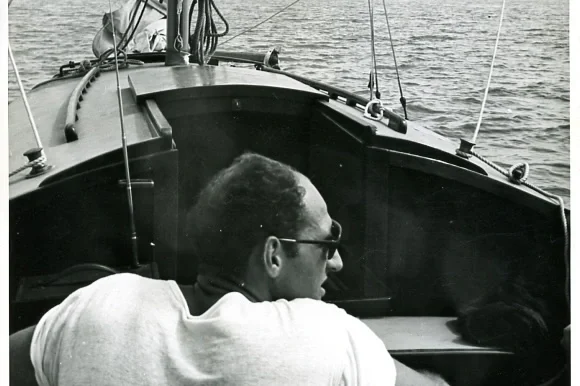
A black-and-white photograph of Bill Hynes on a hurricane-class sloop under sail, circa 1948.
Transcript
Bill Hynes & Dave Lemon, interviewed by Annie Sutter | April 22, 1981 | Temporal Coverage: 1918 to 1981
Annie Sutter: About the Nunes Boat Yard, starting at the beginning.
Bill Hynes: Yes. Well, somewhere around 1918 or 1919, my dad had the yard built, and the original permit is down at the library, I mean down at your museum, I brought it down. It was supposed to be ready when I got out of school so I could be a boat builder, but the thing became such a white elephant that when the Nunes brothers were looking for a boat yard, he was very happy to get rid of it.
Annie Sutter: Why was it a white elephant?
Bill Hynes: Well, boat building is a labor of love, not a thing that anyone makes money out of. And if it's being run by paid management, there's just not enough money in it, it's not economically sound, or it wasn't at that time. So where you had to pay managers and workmen and all the rest of it, it just became a very costly thing to maintain the yard.
Annie Sutter: And it was the Reliance Boat...?
Bill Hynes: It was the Reliance Boat and Ways Company.
Annie Sutter: What had it been before that?
Bill Hynes: It was nothing. They built it. There was nothing but a beach here with a couple of old ways that the fishermen used to use. So the Nunes brothers had been boat builders, they came from the Azores and had a little shop on a barge in the Sacramento River at Sacramento. So they came down here and went over to Alameda, but that didn't suit them and they were looking for another place. So this was our deal, my dad got rid of it, and it was just the thing that they needed. These beautiful old people, and they were old when I last saw them, but these enterprising Portuguese gentlemen who were so skillful in their trade took over, and they went through the Depression and the whole bit, and the yard was very good to them. They raised their family, it was their living for all those years, and it worked very well for them. They were very skillful people and beautiful people to deal with. My own part of the operation was that I stopped in to talk to Manuel about a job, he wasn't enthusiastic, so I went down the street to Madden and Lewis, that's where I got stuck for the duration, so I didn't get to know the old man very well.
Annie Sutter: When did you work for Nunes?
Bill Hynes: It was after the war. Ernie heard I wasn't working at Madden and Lewis anymore, so he called me in. I worked there about maybe four or five years. Manuel used to say, "Bill, you can't afford to rent me that space for that little amount of money," and he used to call me Beetle. He said, "Bill, if it were not for the fact that you boys pay me a little money here and there, we wouldn't even be able to pay the taxes," because there were no boats being built at that time. So my connection was just fleeting, but I spent so much time down in my little corner that the union people came by and started to give Manuel and Tony a bad time, they thought they were hiring me as coolie help, you know, non-union. So finally, I thought this was a bit amusing, these union people, and I told them, get off the backs of these nice old men, I'm working on my own boat, not their boat, I'm not working for them, I just rent a little place in the corner here. So finally I told them, well, look, what do you want? They said, you've got to join the union. I said, all right, I'll join your damn union, get off their back, but stop bothering them. So they said fine. I said, well, hey, you've got to have an examination, I've never served on a private ship. So I told them, if the boats that I'm building are not as good as anything in the yard, I'll eat them, set up your examination, do what you please, just tell me what you want and I'll do it. So they set up this examination over at the union hall on Mission Street, I think it was 13th and Mission.
The Cote d'Azur apartments was the old Spreckels property, and originally it was the Pacific Yacht Club. When the fire came along in 1906 and burned the Spreckels family out, they came over and lived in the yacht club, because he had essentially financed the thing. So they lived in the yacht club, and after that it was known as the Spreckels place, but actually it was the old Pacific Yacht Club. They had that tremendous old building on the corner, there are pictures of that.
Annie Sutter: Isn't that the building they towed to the other...?
Bill Hynes: No, no, that's their boat, that was the boathouse. So the old building was almost up on the corner here, and then that whole thing was all gardened out right to the point, and the old boathouse that was towed out was out on a pier at the end. The Spreckels yacht, the old Lurline, was a gasoline yacht, moored out at the end of the dock. So they had a boat keeper, a captain and an engineer, and I never did see that boat underway. They had it pulled every year, but the engineer would start the engines a couple of times a week, and the boat keeper kept the varnish and kept everything beautifully on it. And this little house up here that has a big sign on it for rent or something, that was the garage, and the captain lived upstairs above that. One of the nice things, they had a 2,000-gallon gas tank underneath the floor at that garage.
Annie Sutter: So if you were kids and needed gasoline?
Bill Hynes: Well, you just took the padlock and pulled over the top, and you had gasoline from the boat.
Annie Sutter: Yes?
Bill Hynes: And when it got empty, why, Mr. Spreckels just had it filled, so they had it for gasoline for the boat, and the little bit that we took didn't mean a thing. This yacht club was beautiful, it was more like the Corinthian Yacht Club now, an old building with big columns, a big deck, and a tremendous big living room. Some cousin or nephew, I think, of the Spreckels were friends of the family, so they lived there for quite a few years, some people named Dwyer, and they had a daughter, and we were kids the same age, so I used to come down and spend a month down here at a time, because it was much easier than going up the hill, we lived up on Atwood, so it was much easier than going up the hill to get a bath, I'd just stay here. The little Chinese man that had the store down there used to stop by and bring my clean clothes down for me, and so I'd stay down here a month at a time. Every afternoon we used to swim on the beach.
Annie Sutter: Swim here?
Bill Hynes: Yes, the whole, all along here. The kids would come up and watch the fishermen work on their boats. The one bit of trouble we did get into, at this late date, the boys and girls would come down and we had an old piano case, and we'd go in there and change into our bathing suits. So some of these dirty-minded old ladies around here figured that if the kids were going in that piano case, something must be going on, and they raised so much hell that they finally had to stop the kids from swimming on the beach. So then we had to come down on this beach, away from the Spreckels' place. I was part of the family, I could go there, but the rest of it...
Annie Sutter: You would call them separate beaches? That one and this one?
Bill Hynes: Oh, yes, they were separate beaches, kind of fenced off. The land has always been precious over here.
Annie Sutter: What about Weikert's place?
Bill Hynes: I don't know which one is Weikert's.
Annie Sutter: The fisherman's shack.
Bill Hynes: Just one or two over. Of course they'd been there forever, that name strikes a note, I don't remember. You see, there were little docks out here, and the fishing boats used to tie up to those little docks. And they had little ways on the beach so they could haul their boats out, because they didn't have money to go to a boatyard. So this whole beach had these little ways on it, they'd bring the boats out at high tide and let them sit on the timbers, then paint them, and at high tide put them back in the water. But it was a real fun thing. And of course the old building there, in those days nobody had any money, but they'd decide to have a party, and they'd have a party at that old house, it was beautiful. Spreckels used to use it as a retirement place for his help, because in those days there was no retirement. Spreckels had his former valet, a colored man, about six foot eight, tremendous man, handsome, retired over here. But when they'd have a party, he would butler. We used to watch him in awe, because he would serve drinks, and as soon as the drink got halfway down, he'd pick it up, put it on the tray, and walk off, got to the kitchen door, down the hatch, this guy could drink, had a hollow leg, never showed it. About 10 o'clock you'd find a bottle and he'd be off to bed someplace, but Harvey was his name, he was just beautiful. His main job was to keep logs for the big fireplace, it was a tremendous fireplace, the only way of heating the place, so he used to make the fire every day, and I would do it every night. All the gardens, they had Japanese gardens out here, and there were two Japanese gentlemen there full-time taking care of those gardens, this was their job, and they were beautiful. The paths went all around, out on the point here there was a gazebo, a little Japanese tea house. They would set up lanterns with lights along the paths, and they'd have these parties. Oh, they were great, there were so many young people there, they'd all get drunk as skunks, go to bed, and wake up and start the party again, the parties lasted for a couple of days.
Annie Sutter: Was this during the years that the Nunes Boatyard was there?
Bill Hynes: Yeah. No, the boatyard was down here, yes, this was going on there. See, that building was there until they tore it down to put the Cote d'Azur in, I don't know just what date that was, but that was about 20 years ago that they put that in. The building was there until that time, it was just a handsome little building, just great fun. It sat on a little plateau out there, and they had two great big brass guns, big wheels. They've got two little guns up there now on the street, but those are not the original ones. And it had a flagpole, hard to believe, it was the biggest pole in the world, it had been in the Exposition in 1915, and when the exposition was over, Spreckels got the pole and put it up over here, it was a tremendous thing. But these, as a kid, are just real nice memories to look back on, they were just real fun.
Annie Sutter: And then, Dave, this was probably about 1958 to '62 or '63, something like that? And what did you do?
Dave Lemon: Mainly we were building these little outboard boats that were quite flimsy, but evidently that's what they wanted.
Annie Sutter: What do you mean, outboard boats?
Dave Lemon: Little fast outboards, Ernie designed them, I think.
Annie Sutter: You're talking about the Nunes jet?
Dave Lemon: I guess.
Annie Sutter: Little race boats?
Dave Lemon: Yeah.
Annie Sutter: Oh, the jets, you built those?
Dave Lemon: Yeah.
Annie Sutter: Oh, tell me about those.
Dave Lemon: Well, we'd build about a hull and a half a day of those, a couple of us. They had the jigs, and mainly I was on the shaper, making parts for these things, which was a very dangerous job because they had these very fancy jigs to turn out the stems and knees and all the different parts for the boats. Then I worked on a nice yacht he did for a fellow named Johnson, he lives right along in here somewhere.
Annie Sutter: Remember the name of the boat?
Dave Lemon: The Moonglow.
Annie Sutter: Oh, yeah. And also, did you do a little work on the one that's still over in Tiburon today?
Dave Lemon: Yeah, I forget that fellow's name, I don't know.
Annie Sutter: Well, do you have any funny stories about working in the yard? Who worked alongside you?
Dave Lemon: An old character, gee, I forget his name, his name was Joe, had a bad back but he kept going, nice old guy. And Joe Ramos was there, I think he was one of the Nunes.
Annie Sutter: What did you think of Ernie and Manuel?
Dave Lemon: Everybody thought the world of Manuel, evidently. I never heard anything but good of him from anybody around the place, although I only met him once, and I was very well impressed with him, seemed like a very nice man.
Annie Sutter: Wasn't he the boss when you were working there?
Dave Lemon: No, he was gone by the time I arrived.
Annie Sutter: Who was the boss?
Dave Lemon: Ernie, his son. He seemed like a reasonably nice fellow too, but evidently he had an alcohol problem, particularly with regard to his wives, three of his wives, I think, died of alcoholism.
Annie Sutter: Is that right?
Dave Lemon: I worked on one of the Bear boats, one of the last ones, I did a little planking on it. One day I was starting to put a deck on it, and the transom extended up like it might be part of the gunwale, but I didn't know whether it was supposed to be flush with the deck or not. So when Ernie came by, on his way to lunch, he lived right next door at the time, I asked him, "Ernie, does this transom cut off flush here, does the deck go over the transom?" He says, "Yeah." He went on. But about an hour later he came back and said, "No, no, I didn't know what you meant. This deck's supposed to butt up against the transom, but I had it cut off," which actually is the right way to do it, keeps the water out better, to have the deck go over the transom and then add a gunwale above that, which he agreed was really the right way to do it. Well, he was kind of absent-minded that way, he didn't really concentrate on what I'd said, he was thinking about something else.
I missed out on some interesting incidents that happened over the weekend with the Nunes boys, they were going to attempt to turn this 35-foot by 12-foot boat over that they'd built upside down, and the stories I heard on Monday morning were that they'd had a real circus turning this boat over, quite a problem. Another time they were casting the lead ballast keel for the Moonglow, must have been about 20 or 25,000 pounds of lead. I had the job of building the forward end of the mold for the lead out of plaster, it was a little complicated the way it fit into the hull, but the rest of the mold was wood. Over the weekend they got the thing all rigged up melting the lead and so forth, and evidently the mold wasn't strong enough where the wood part was, they got it two-thirds full of lead and it let go, the lead started to run out over the floor. But from what I heard, everybody cooperated and got the leak stopped, and finally ended up successfully casting the keel. What I heard that Monday morning, it was quite another circus.
Ernie was rather casual, and his dad and uncle were very hard-working people.
Annie Sutter: So Ernie designed the little Mercury I mentioned, and got the property up? I didn't know there was a separate firm.
Dave Lemon: Yes, that was Ernie's enterprise, it was not part of the Nunes brothers, it was the Mercury Boat Company. Quite a bit later, Ernie came down and ran the yard for his dad and uncle, because they were getting pretty old.
Annie Sutter: And they did?
Dave Lemon: Yes, so it was a family thing, and Ernie had his separate little enterprise up there, quite a few people worked for Ernie, who was one of the Nunes family but not one of the Nunes brothers, so there were two separate things. Ernie's little Mercury was quite advanced, it was one of the first little boats put together with plywood, because he was able to get some shape into it, so the thing wasn't square like a rowboat, he managed to make a very pretty little boat out of it with his skill in handling material. The little Mercury was a very successful little boat, and if he'd paid a little more attention to it, he probably could have sold a jillion of them, but he'd get a few going and then take off for a couple of months. I think I built quite a number of them, though, up until, I guess, today.
Annie Sutter: And you were up there?
Dave Lemon: Up there, right, yeah.
Annie Sutter: What was that like?
Dave Lemon: It was a run-down business. Ernie wasn't really paying attention to it, I think I told you that before, he was just barely squeaking by between the Better Business Bureau and other institutions. I think Ernie was just barely doing it to squeak by, and he wasn't paying attention to it. When I worked there, he wasn't paying attention to it. Ernie was rather successful in other fields, he would buy a piece of property, patch it up a little bit, and then sell the darn thing and come out very well.
Annie Sutter: Really? I didn't know he did that either.
Dave Lemon: Well, the little house next to Sally's parking lot, the blue one, he bought that and converted it into a duplex, and finally dumped that, and then he bought the little house on the other side, right next door here, and he'd get them when they were dreadful, patch them up with a little baling wire, make sure they were the right price, and when he'd get rid of them, he'd get rid of them at the right price. And then he went up into Petaluma when things got expensive around here.
Annie Sutter: Something up there too?
Dave Lemon: Yes, then he went to Petaluma, did his drinking up there, he could do rather well with these little enterprises that didn't require him to do any work.
Annie Sutter: You mean he'd get someone else to do it?
Dave Lemon: Yes.
Annie Sutter: Yeah.
Dave Lemon: He was skillful with that. But all through this, these were just kindly people, they were nice people, they'd treat you well, they did what they said, and they did it well.
Annie Sutter: What did you do there, Dave? What did you do in the yard?
Dave Lemon: Boat builder.
Bill Hynes: Well, anytime they had something with an extra twist, or an extra thing to fit in some difficult fashion, well, Dave got it, because they did have a few clowns in there who didn't know one end of a screwdriver from the other. So Dave exercised his wood-carving skill, these funny little moldings and things that go in seven directions, that's what this clown did, all of the fancy work. That's our boy, and he can do it. I guess he could still do it if he wasn't so lazy, sitting in the boat all day.
Dave Lemon: Yeah, I had a little advantage over the average boat builder, having had training in sculpture and the arts in general, which makes a big difference, you know how to handle the material. Some of them, if they couldn't knock it into place with a hammer, they'd forget it. But they did build some very nice boats in that yard.
Annie Sutter: What kind? Where are they?
Dave Lemon: Well, of course, they built the Zaca. They built that one out on the street here, it was too large to build in the shop, so they set up the ways out there and built it right on the street.
Annie Sutter: How many ways were there?
Dave Lemon: Recently, just one. They finally wound up with two, they put up a second little one on the side for small boats, but for most of the time it was just one set of ways, and then they added the tiny one later. During the war they built some of those Coast Guard boats, beautiful boats, wooden Coast Guard boats.
Annie Sutter: Did you work on those?
Dave Lemon: They built some boats that were kind of a PT hull, that had twin Chryslers, very fast.
Annie Sutter: Did you work on those? A yacht?
Dave Lemon: Two, they built two of them at one time.
Annie Sutter: For Coke?
Bill Hynes: No, that was a different boat. I know you worked on that, it was a very lovely little boat, Ernie designed that.
Dave Lemon: Yeah, I don't know the boat you're talking about.
Bill Hynes: Well, they built two of them, they were about 45 feet, but kind of a...
Annie Sutter: Fast?
Bill Hynes: Well, fast, I think they had twin Chryslers in them, big Chryslers, they'd do about 40.
Annie Sutter: Oh, very, very nice boats.
Dave Lemon: They came because of him. Well, Ernie gave me the most difficult job I was ever given on that Coke boat. He went over to the city and got a Packard automobile windshield, cut it in half, gave me half of it, and said, "This is the window in the corner of the pilot house. You build the pilot house to fit it, and I'll take care of the rest."
Annie Sutter: Was that a problem? He never rushed you on anything, though?
Dave Lemon: No, he never rushed you, as long as you worked at it. He'd just say, go away, you do it, just don't bug me.
Annie Sutter: What boat was the Coke boat?
Dave Lemon: I don't know what it was.
Bill Hynes: Coke Luggage.
Annie Sutter: Coke Luggage, yeah, I know that.
Dave Lemon: Coke, that was horrible. Luggage.
Annie Sutter: Luggage, remember?
Dave Lemon: Yes, sure, I came down here with all this fiberglass and resin, I remember the boat, I still don't know what you mean by Coke boat.
Bill Hynes: Coke was the guy's name, the Coke Luggage Company, they had the plant up near Corte Madera.
Annie Sutter: Okay, remember the name of the boat itself?
Dave Lemon: Oh, I forget, it could have been a very important boat, the fiberglass, the bottom of it, I forget if it was plywood or not, but I don't think it was.
Bill Hynes: No, it was veneers and mahogany, I remember.
Annie Sutter: Cold molded?
Bill Hynes: Kind of, yeah.
Dave Lemon: Yeah, and then they resined it, and the whole thing turned white after a year. About the third time he ran it, he hit some piece of drift that hit the bottom about a third of the way back, and that opened up the fiberglass a little bit, and then it just peeled off, the whole bottom of the boat peeled off. Brought it into the shop here, there were ribbons of fiberglass trailing it. So they left the fiberglass off after that, if I remember right, just painted it.
Annie Sutter: Yeah.
Dave Lemon: But he built his luggage out of fiberglass, so he was all for it.
Bill Hynes: Well, he put clothes on a luggage ship, probably. He was a forerunner of the modern Tupperware boat.
Annie Sutter: He was building luggage before Samsonite was?
Dave Lemon: Yeah, oh yeah, now they build luggage with keels on them.
Bill Hynes: Nearly burned and shot down one time.
Annie Sutter: You did?
Bill Hynes: No, in Costa Mesa, that's true. He was very inventive. He figured out this water-pressure fire-hose clamp for gluing the sheets of plywood together at the scarf joint, and they also had some kind of electrical heater hooked up with it to make the glue set up quick. He'd turn on the water in the hose, and that would put pressure on a whole pile of these scarfs, quarter-inch plywood, and then he'd turn the heater on to make it set up fast. You were supposed to leave it overnight without the heater on, but I left it on, and fortunately the heat lit the wood all right, but it also lit the hose with the water in it, so as soon as the hose burned a little, the water put the fire out.
Annie Sutter: That was clever of you, self-destructing.
Bill Hynes: Ernie was very inventive. He had a big trough made with a piece of rubber hose running down there, you'd put the pieces in and turn the water on, and get a hundred pounds to the square inch, or close to it, that you couldn't possibly get with all the clamps in the world, and the glue would just squeeze out, it was beautiful.
Annie Sutter: Yeah, equal pressure all the way.
Bill Hynes: Yeah, the little masts were only about that thick, you'd put the hose in there, and when you put the pressure on, you just couldn't do it with clamps. He started building some of these little plywood runabouts for a while, I built a number of those, they built a lot of those little things, putting them together with staples and glue, dreadful little boats, but they'd get one of those little hulls out in a day, and at that time that was pretty fancy, because they weren't very good, but it was ingenious.
I used to live in that tin building when I was building my boat, and one night I set... I called up Ernie and said, "The building's on fire." He said, "Why didn't you call the fire department?" And Ernie said, "Don't call the fire department, I don't care what you do, but don't put me out of business." So I didn't call the fire department.
Annie Sutter: You just hosed it?
Bill Hynes: I hosed the whole building down all night, because my boat was in there and I didn't want that to burn down.
Annie Sutter: Better have good luck and good judgment. I don't know what else to add to that. Any more memories? Come on up here, you don't have to stay back.
Walt: Well, I'm just listening back here.
Annie Sutter: Any more memories?
Bill Hynes: Never saw the yard except in a movie once.
Annie Sutter: Yeah, I saw that movie too. That same movie?
Bill Hynes: Yeah. These banks back in the '30s, right, well, the Nunes brothers were in there, the picture in the yard, it was shot up here in Sausalito, it was Orson Welles, he was a young kid.
Annie Sutter: Yeah, he was a mate on the schooner that came in here, right?
Bill Hynes: Yeah, and it was Sally's, and then the boatyard.
Annie Sutter: Yeah, it's a great film, a funny film. What was the title?
Bill Hynes: The Lady from Shanghai.
Annie Sutter: Is that right? That's right.
Bill Hynes: She was the wife of the lawyer that owned the yacht Welles was the mate on, or whatever it was. It was a good film, it's on television every once in a while.
Annie Sutter: Turn it on. But...
Bill Hynes: These fellows were, those old gentlemen were so nice. I built that first Hurricane.
Annie Sutter: That was a Nunes design?
Bill Hynes: Yes. Nunes designed the boat they called the Big Bear, and I had one of those, it was all right, but it was tender. So after the war was over, I saw the old man and said, "Hey, how about another boat, but can't we change it, get up on the drawing board, and instead of iron, put lead on it," well, that raised the ballast up about a thousand pounds. And the stern of that thing is pretty homely, so I said, "How about dragging it out a foot or two on each end," pull the ends out, it doesn't cost that much more, it eases the lines and would be prettier. And the Bears and the Big Bears came in right at the keel, I said, "How about getting a little reverse," that's why the bilges always leak on those boats. So we changed that. They tried putting another strake higher so you'd have a little more room in the cabin, but they had to be long and racier, they didn't like that, so we compromised, used the Big Bear form, just altered it to accommodate the slightly eased lines, and that became the Hurricane. So they built the hull for me, and then I took it over and finished it up. I prevailed on my sweetheart to go along with this, let's get out of the Bear class, and it'll just be a little cruising boat. So we went to a party and the gang was interested, "What are you doing?" The result of that party was, you know, it got eight orders for eight boats, so we were right in the middle of the whole thing all over again. But finally, I think they built nineteen or twenty of those Hurricanes, and they were pretty good little boats.
Annie Sutter: There were a few of them left though, right?
Bill Hynes: Yeah. When I finished mine and was ready for launching, it was on the little ways over here, and there was a big overhang, and old Tony was looking at it, a little bit worried, he said, "You know, that damn thing bothers me," he didn't know whether he'd sleep, wondering whether that thing would really go down the ways or not. So he said, "Let's put it on the water," we put it over the other way. He put a big four-by-four under the transom so it wouldn't, he was afraid it might give a jiggle and tip backwards. So he put the four-by-four under it, threw it in the water, pulled it around, pulled it up in the ways, and the next day we had the launching on the big ways. He said, "Don't tell anybody it launched early." I think I have some pictures of that launching, if I can find them.
Annie Sutter: Anything we can get. Yeah, that was number one Hurricane. What was that story about the first Hurricane that nearly capsized?
Bill Hynes: Well, he was afraid it was going to flop on the ways, so he launched it early, a day early, but it never capsized, as far as I know.
Annie Sutter: I heard that when they first sailed the Hurricane, it sailed on its side.
Bill Hynes: Oh, they were very stiff. I had the boat a year before I ever got the chainplates in the water. Little 30-foot boats, and you had 4,000 pounds of ballast in the keel.
Annie Sutter: They added how much?
Bill Hynes: They had 4,000 pounds in the keel.
Annie Sutter: On the first one?
Bill Hynes: Yeah.
Annie Sutter: And then they added more to that?
Bill Hynes: Yeah, what happened was, they were so stiff, I'd set the rig and the sail area, and the little boats had self-tending jibs, they were just like a board, they didn't heel over at all. So the rest of the gang decided, "Hey, they're so stiff, let's put overlappers on them." And what had happened was, I'd made the boom a little long and the mast a little long, so that in the harbor off the river you could get the mast up so you wouldn't have to duck it, get the boom up to the top of the track, keep it off the deck, so we had a couple of feet extra mast and boom, so the mainsheet wouldn't take your head off every time it came about. So they got new sails made, and they'd go to the top and block the end of the boom, it's not supposed to be there, it's supposed to be over the center, and then they put overlappers on them. Then suddenly they said, "Oh, they're too tender now," so they dug out the keel and put another 800 pounds of ballast in it.
Annie Sutter: My God, so there's almost 5,000 pounds in there?
Bill Hynes: Yeah, nobody knows exactly, but close to it. At first they were so stiff they just wanted to put more sail on and make them go better, and they went very well. I never did alter the one I had, and yet three seasons I think we got second for the season, we could keep up with the others with just that short mainsail and a little club jib, we'd be standing up while they'd be laid way over, and what the hell, you don't win with it, but you're pretty consistent and it's much more comfortable to sail. The chap I sold it to promptly had the additional ballast put in.
Annie Sutter: You had a Hurricane?
Bill Hynes: Yeah, I built the first one.
Annie Sutter: Oh, you did? That was number one. The old man designed that?
Bill Hynes: Yes.
Annie Sutter: Manuel?
Bill Hynes: Yes.
Annie Sutter: How many boats has Ernie designed?
Bill Hynes: Well, Ernie studied under George Wayland, a naval architect in San Francisco, Ernie went over and worked under him for a while. Ernie was a pretty good draftsman, but as far as designing boats, that Coke boat, he designed with help from the old man, and a couple of fishing boats he designed.
Annie Sutter: He designed the Moonglow, didn't he? I thought that was Ernie.
Bill Hynes: Well, the old man pretty much, that was the old man's boat, Ernie was advisory. They worked well together, but the old man was the one who made the calculations and actually drew them, he was a pretty sharp old boy.
Annie Sutter: Ernie designed the Moonglow, didn't he?
Bill Hynes: Sort of, I think the old man designed that.
Annie Sutter: Is the old man Manuel or Antonio?
Bill Hynes: Manuel. Tony ran the shop.
Annie Sutter: The old man had been dead for years before the Moonglow was built?
Dave Lemon: I don't think so. Sure, I remember that, I remember when they cast the keel for it, it fell right through the bottom of the whole boathouse.
Annie Sutter: Ernie went out the back door and they couldn't find him for two days?
Dave Lemon: Yeah, we had everybody running around with these little ladles.
Annie Sutter: Were you around when that happened?
Dave Lemon: Sure, I heard it go. He had a chain of ladles, it was like building the ancient pyramids, pouring a little bit of lead in, and suddenly this thing let loose, and there was thousands of pounds of lead lying in the sand under the yard with the scorched keel apron underneath it.
Annie Sutter: This was a little lead-casting place, right?
Dave Lemon: They cast it up against the boat itself, charred the daylights out of the bottom.
Annie Sutter: Yeah, that's Mungo, well, the guy that invented the neon light?
Bill Hynes: He invented the neon light? Didn't he? What was his name?
Annie Sutter: I'd never heard that.
Bill Hynes: I had heard that, but probably from you. Johnson?
Annie Sutter: Johnson, I think his name was, didn't he have a hand in the neon light?
Bill Hynes: Well, he was in the electrical supply business in San Francisco, a very ingenious chap, got into designing machinery later. They didn't let that thing get down in the waves, they smashed that pinion thing on the back of it into a piece of matchwood. He was a nice fella.
Annie Sutter: Who, the guy that owned the Moonglow?
Bill Hynes: Yeah, he kicked everybody off the boat down in, where was it, Santa Barbara?
Annie Sutter: Somebody offered him some money for it?
Bill Hynes: He did, on the maiden voyage, and he said, "It's over," sold the boat right there on the spot.
Annie Sutter: Well, that's Moonglow One you're talking about, isn't it?
Bill Hynes: Well, I don't know, she was about 45 or 50 feet, all full of teak.
Annie Sutter: Yeah, that was the Moonglow the One, and then he sold it, and he missed it so much...
Dave Lemon: Unless he had Ernie build him another one, it was really the Moonglow II.
Annie Sutter: That was the one that was downtown for a number of years?
Dave Lemon: She's down in Los Angeles now.
Annie Sutter: It is, huh? But he sold the first one so fast he had to get another one right out, I'd say.
Dave Lemon: He built two of them, he sold the first one so fast he was without a boat.
Annie Sutter: Where did the Typhoon come from? There was only one Typhoon, wasn't there, Bill?
Bill Hynes: There was just only one Typhoon. You see, I'd been building little boats around there, finishing them up, they used to build the hull for me, that's the easy way, you finish it up, let them do the hard work. Manuel wanted to build that Typhoon, so he wanted me to do it, build the hull for me, and I started to do a little arithmetic on it, and it was just too expensive for the kind of job I had. So he said, "Well, you're going to build it anyway," and maybe when he got through with it I'd like it. Well, I sure would have liked it, because it was a beautiful boat, and it sailed beautifully.
Annie Sutter: How big was that?
Bill Hynes: About 38, something like that, I don't know.
Annie Sutter: I've seen her once from a distance.
Bill Hynes: Yeah, 38, 40 feet, something like that. The genesis of it was, when they built the Farallon Clippers, they put them out for bid, various yards to build the first of the Farallon Clippers, and Manuel had worked out the preliminaries of the Typhoon to see if he could build them for that group. But they went up to Stevens and built the original Farallon Clippers up there at a much more reasonable price than Nunes could do it for, but it's not the same boat, I don't think. So we got through with it, I sweat blood over that, because Manuel wanted to sell me the hull, the keel cast, planked, planed, ready to put the deck beams in, for thirty-five hundred dollars, which was just a gift, but the old man wanted to see that boat going, and he knew if I started I'd finish it, I mean reasonably sure, but I just imposed on myself.
Annie Sutter: What year was that?
Bill Hynes: I don't remember, time goes by so fast, I've got a memory like a...
Annie Sutter: When did the old man die?
Bill Hynes: I don't know, I just forget these things. That was about 1940, because I built the Hurricane around then.
Annie Sutter: We're taping, about the Nunes boatyard.
Bill Hynes: Nunes?
Annie Sutter: Nunes.
Bill Hynes: I call it Nunes.
Annie Sutter: The family says Nunes, but...
Bill Hynes: Well, whatever they say. Nunes invented one of the best sailboats on the bay, it's been downhill ever since.
[New Arrival]: Good afternoon. What time does the soiree start?
Annie Sutter: Quarter past two this afternoon, so we're probably all done.
[New Arrival]: No kidding. This is the definitive report? You want some kind of government grant here?
Annie Sutter: No, I just came up on happenstance.
Bill Hynes: Well, I wish I were. I have no idea. If anybody knows about Ernie Nunes, he might be sitting right there. There was a fine boat that they built for Percy Yeane.
Annie Sutter: Oh, yeah?
Bill Hynes: Well, Percy was an Australian, I believe, and he had sailed down the Tasman Sea, was just a sailor, had been to sea as a radio operator. He had Nunes build this boat, about thirty-six feet long, but it was a big Bear boat, pretty much the same transom, pointed on one end but out on the other. Percy would sit around here for a few days, and he'd just take off, do the hobble of the race like nothing, no problem, then the next time it was down to Australia.
Annie Sutter: What was he like?
Bill Hynes: He was quite adequate, I recall one day he was going to Alaska, so I said, "Percy, when are you leaving?" He said, "We're going to leave this afternoon, we'll be back in about a day." I said, "What do you mean?" He said, "Well, we've got these kids, they all want to go out to sea, they all want to go to Alaska, so we'll go out here and go up the coast a little bit, they'll all get seasick and want to die, and I'll come back, and then they'll decide whether they want to go or not, and if they want to go, three or four days later, that will be the actual start, but in the meantime we'll just go out and shake the loose ones out."
Annie Sutter: I knew Percy quite well, I cruised with him. Wasn't he an individualist?
Bill Hynes: He was an individualist, rigid, but I'd say just an adequate person, a magnificent mechanic, he could do things.
Annie Sutter: Yeah, he was an individualist. Is it true, the story about him shooting at somebody who came aboard when he was moored out in the bay? Remember that story?
Bill Hynes: Nobody remembers, huh? I wouldn't put it past him. I hardly knew him, though.
Dave Lemon: I remember the story. Somebody came on board, and it was a documented vessel, and he wouldn't let anyone board, it had to be a government official, remember that?
Annie Sutter: I don't know what happened then. All these little stories, most of them not true, but they're a lot of fun. Where did you fit into the Nunes boatyard?
Walt: In the front door and out the front door. I'd come in, look around, and say, "How you doing, Ernie?" And he'd say, "I'm doing okay." He had a Bear boat, one of the family boats, and I'd push the sawdust around with my foot, help him load the heavy pieces into the planer sometimes, he'd trust me. I had a Merc, I'd come down and ask him things about the boat. I don't know, what business did I really have with Ernie Nunes?
Annie Sutter: You didn't work in there?
Walt: No, good heavens, no. I'm trying to think what I used to do in there. I was there a lot, though.
Bill Hynes: You used to come down and visit me.
Walt: I visited you a lot, and I visited you when you were building the Merc.
Bill Hynes: Yeah.
Walt: And I visited you at O'Cunningham's, watched him work on that boat for a thousand years.
Bill Hynes: Yeah, I was a fearless observer in those days.
Walt: I still am.
Bill Hynes: Yes, quite fearless, the executive type, you see, he runs the board instead of doing the work.
Walt: Right, that's right.
Annie Sutter: We're going to turn it off now. Well, if you have any exciting things, say it. Walt, say it, what's exciting?
[From this point the recording continues informally as a group conversation among several former boatyard hands, with voices overlapping and often difficult to attribute with certainty.]
Unidentified Speaker: Anybody have any good memories?
Unidentified Speaker: Well, let's do it. The way it was, let's tell them.
Unidentified Speaker: We used to argue about the price of Jimmy's Cancer and the Monterey fishbowl. Johnny Ruggs, I don't know, everything was always too much, he was always stepping out the back door.
[Recording becomes repetitive and garbled at this point — a long looping stretch of the phrase "and the bottom" repeated many times, most likely a transcription artifact from background music or noise.]
Unidentified Speaker: Come on, now, you need a beer.
Unidentified Speaker: How about the money? How about my check?
Unidentified Speaker: All right, what about Wednesday?
Unidentified Speaker: What? Hey, that's me, I want a check.
Unidentified Speaker: Why, Jimmy, you stink. Go up to your brother's and get a shower. I'm not going to pay you to get a shower. You stink, you know.
Bill Hynes: So he makes sure Jimmy's off to his brother's to get a shower before he gets paid. Otherwise he couldn't get to him until he'd made it home.
Bill Hynes: George would drink the water in the gutter. No, George would drink it in the bar with Sam, he came out of the bar with Sam, and there was a Cadillac parked out in front, I just clapped for it, made a little ticket. George went up, he'd be strong, he'd go away, George just went to his house.
[Laughter]
Unidentified Speaker: We were all on the end of that thing, pulling in the cat side, all of us got up and went in, everybody's guys were there, I had a pipe in my mouth, and the next thing I knew I was in the salt water.
Unidentified Speaker: Oh, Jimmy was telling that joke, did you hear the one about...?
Unidentified Speaker: Yeah, they didn't know which way the wind was, and we were all in the water, and the first thing I knew, I was coming out of the water sucking salt water.
Walt: Do you remember the story about when I was out on the dock, way out at the end of it, going around breaking the can because of the motor mount on the engine I had, and I kept hearing this guy calling me, "Walt. Hey, Walt. Hey, Walt." And Johnny Ruggs was way down in the yard where he was supposed to be working, and I'd come up out of the hatch and say, "Wait a minute, what do you want?" And he'd look at me from way down there. So I'd go back down below, and he'd start calling again, "Walt, hey, Walt," and this happened about five times. I'd yell down there. Funny, I came up and heard it again, and he said, "What did he call me? Walter." That's how long it took him to come down to the cabin, he had to keep going and coming back and talking to me before he could get back to work.
Unidentified Speaker: Boy, you were there for a long time, I thought you were going to get back.
Unidentified Speaker: That Sunday, I watched a flagpole up on the podium, from Don Evans. I found a flagpole that was just as cold as a teapot. I thought the whole thing was going to be dark, I thought it was going to be a good day. What do you think of the American flag? I thought it was going to be a cherry bomb.
[Another long garbled stretch follows — repeated "I don't know" and similar fragments, apparently noise rather than dialogue.]
Unidentified Speaker: This is like a storage thing down at Gate 5, is this your spot?
Unidentified Speaker: Oh, yeah.
Unidentified Speaker: Oh, no, there's a room right here.
Unidentified Speaker: It's still around, yeah, it's still going.
[More repeated fragments and background noise follow, largely unintelligible.]
Unidentified Speaker: When we went to run it during the concessions at Chi-Ori, the thing needed to be described one way or another, and a lot of people were calling us about it over the weekend. It was built, the runner announced it, and Chris came in, took one look at it, and said, "What's that?" "That's a rudder." "Who told you that's a rudder? Put it on the bandsaw and cut it up for firewood."
Unidentified Speaker: That was another guy, that was Percy, he's got a boatyard down in Nevada now.
Unidentified Speaker: They used to hang around when they were building the docks, and the old man would set his sights on something, and they'd be throwing suits and things over the side of the street. Percy and Arthur were there, and I think he was getting all this linen and wine, and the special Manuel costume.
Unidentified Speaker: What did you guys think about that? This guy is walking around in a purple suede full-length overcoat, driving a purple car, wearing a purple beret.
Unidentified Speaker: I got into it, and I started making these kits we were going to use, but I wasn't sure how to work out the technical material that goes into the price and load figures for it, so I found a chart to use. I was talking to him a few years back, I couldn't get any Honduras mahogany at all, so I said, "You can get it, buy it for me." So anyway, I bought $6,000 worth of mahogany before it was gone, and he kept telling me, "Well, I'll pay you for it, I'll sell it," and we'd just take it off, so at the end of the month I really had to take it off, but it certainly wasn't going to catch up, so I was just getting ready to finish the boat up. I went out and said, "I need a piece of that." He said, "What the hell are you doing, that's my wood, you haven't even paid for it yet." I said, "Well, you can go to the bank and borrow the money."
