
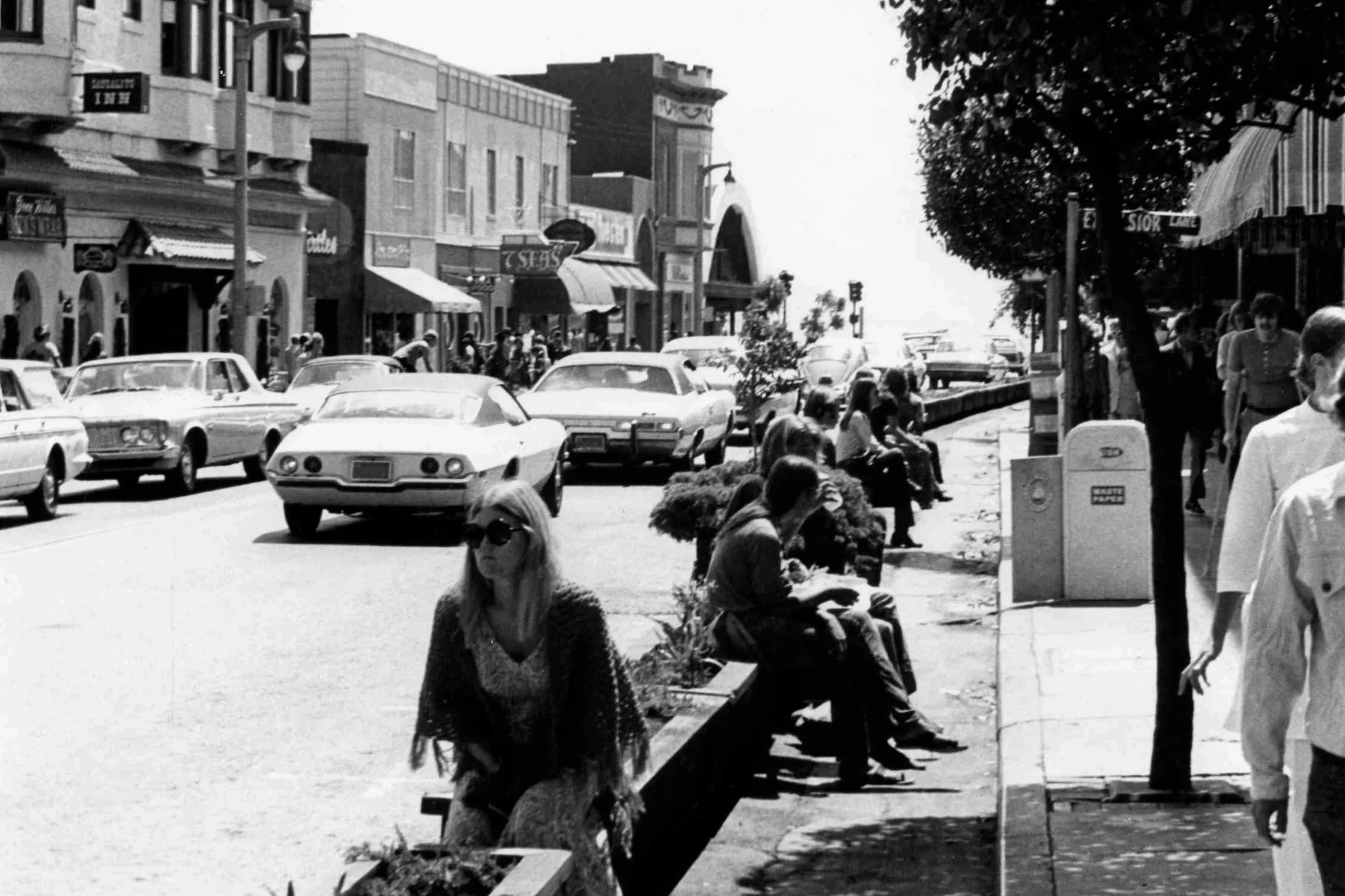
View of Sausalito
Transcript
Bill King and Nancy Stephens, interviewed by Annie Sutter | July 1984 | Temporal Coverage: 1958 to 1984
Unidentified Speaker: So it was participating in the RIMPAC exercises.
Annie Sutter: What's RIMPAC?
Unidentified Speaker: RIMPAC is the joint venture between the allied, I guess, NATO group, all our allies, and they're having practice maneuvers out here.
Annie Sutter: I see.
Unidentified Speaker: As the guests of whatever, the United States Navy based in Pearl Harbor. We had, I think, Australia, Japan was there, New Zealand, ships that operate in the Pacific have joint exercises. So the exercises were just about over, and the Australian supply ship anchored there off Lahaina, and obviously gave their guys R and R for four or five days in Lahaina, and they came ashore like any other sailors and went to the bars and partied and had their problems, and probably knocked over a few bar stools and broke a couple of windows, but if you're a bar owner you've got to accept that, I think that's part of the game. But then the part that hit us that wasn't part of the game, as far as we're concerned, this would have been a Monday, whatever last Monday's date was, Monday the 25th, well, actually it would have been into Tuesday then, because it was 3:30 in the morning, I'm not sure if it was Monday or Tuesday, it was 3:30 in the morning either on Monday morning or Tuesday morning, and I was asleep on our boat, which is a 38 Bird from Sportfisher in the charter boat business, named Sea Wolf, and I woke up hearing the sound of diesel engines being revved up, which at first I thought was one of the Australian Navy's shore boats, because their boat handlers often do a lot of revving of engines. The only thing I can remember at that time was that I wish those stupid guys would go to bed and quit revving engines at 3:30 in the morning, quiet little harbor, half asleep. I sort of heard the sound of a high-powered diesel boat coming under power, and the next thing I heard was a lot more revving of engines, and then I heard a pretty good solid crashing sound, and I could only assume at that point that's when he hit one of the boats. Then I started to get up at that point, and the next thing I heard was another crashing sound, followed almost instantly by a terrible crashing sound into my own boat, and the impact rolled our Bertram, which is about 16 tons, up on its side at almost a 60-degree angle, as it put blue bottom paint on the cap rail of the sailboat next to me that has four feet of freeboard, and the blue bottom paint was all the way up on his cap rail. So it rolled our boat at a 60-degree angle, and I guess at that point I got knocked out of my bunk and started crawling out.
So rather than go on from here, because everything's a mystery now, I'll go back to what caused all this, and what I found out later. What this Australian had done is he got on a boat called the Ariel, and he broke into it, and he was evidently familiar enough with power boats to find out where the master switch was, to turn on the electricity. He got the boat started, and it was in a slip Tahiti-style, stern in, with its bow out in Lahaina Harbor. He pushed the throttles up to full bore with twin three-hundred-horsepower Detroit diesels, full RPM, slammed it into gear, and it took off like a shot across the harbor. Well, what he didn't know was the boat was being worked on, and the hydraulic steering was disconnected, so he couldn't steer the boat. So it went straight across the harbor, missing Finest Kind, which is Dave Hudson's Merritt, by about six inches, and ran right up on the breakwall, at which point Dave, who was on board his boat, came out, put his hands on the side of the Ariel, which was still full bore forward against the breakwall, looked up at the Aussie sailor on the flybridge, and said, you can edit this whichever way you want, "Get off of there, you're going to hurt somebody, shut that thing off." And the Aussie looked down at him and said, "F-- you, mate," slammed it in reverse, went straight across the harbor backwards into the bow of the Judy Ann, which is on the other side of the harbor. Judy Ann's a 44-foot trawler at about 30 tons, hit her right on the stem, split the transom open on the Ariel, which is a Pacemaker 44, and probably at about eight knots, it'll go backwards at seven, eight knots, and lifted the Judy Ann about four feet out of the water, cracked the stem and everything on it, engine still full bore. Then threw the boat again into forward, slammed the throttles right down, took off across the harbor again at a slightly different angle, hit the 60-foot trimaran Trilogy.
Annie Sutter: And another charter boat?
Unidentified Speaker: All these are charter boats now that are involved in this. Sheared off the transom of the Trilogy trimaran, the main hull transom sticks out further than the side hulls, sheared that off without blinking an eye, cut its stern mooring lines. It again was tied Tahiti-style, but bow in.
Annie Sutter: That's on the breakwater side?
Unidentified Speaker: Breakwater side, right.
Annie Sutter: So he's got a hook out?
Unidentified Speaker: Yeah, it comes across and hits them at more of a down-harbor angle, more of a right angle to the boat the way it's tied, and shears off his transom, and goes right into the side of our stern quarter.
Annie Sutter: That was a straight-on blow, that's the one you felt when you were there?
Unidentified Speaker: Yeah, that was about four or five feet forward of the transom, right straight into the side. I'd probably guess his speed at that point, considering the horsepower, I have a boat very similar, probably up around 12 knots, and that boat, Ariel, is right in the neighborhood of 18 tons with 650 horsepower. Slammed into me, of course that's when it rolled the boat at first, because it hit the corner of my side and pushed it under like this, because his bow goes over the top, pushed me up like this, of course that's when I hit the boat next to me, our boat rolled down again, and he was still kind of sitting against us. But of course what the boat did then is it pushed my boat this way against all the other boats in a domino effect, and peeled off and took off down the harbor.
Annie Sutter: Now he's going toward out, or toward the end?
Unidentified Speaker: No, now he's going toward the dead end of the harbor. But also the impact on our boat knocked him off the flybridge onto the foredeck of Ariel, and at that point in time he jumped off of Ariel into the harbor.
Annie Sutter: He did?
Unidentified Speaker: Now the Ariel, at full bore, is off down the harbor all on its own, nobody on it. It shears off about 10 or 12 anchor lines off the sterns of the boats on the breakwater, and down the harbor impales itself on, the name of the boat is the Waterworks now, which is a Grand Banks 52.
Annie Sutter: That's still on the breakwater side of the harbor?
Unidentified Speaker: No, no, that's on the other side now.
Annie Sutter: So it went across the harbor?
Unidentified Speaker: Yeah, it went across the harbor then from the breakwater side toward the dead end, toward the dinghy dock, past the dinghy dock, and ran into the Waterworks, the Grand Banks, which was in its slip almost toward the end of the harbor, and just rammed it. It stuffed the bow of the Grand Banks into the side of the Pacemaker, probably about 10 feet, put a hole in the side of the Pacemaker 12, 13 feet long by about seven feet high, destroyed the boat. The Pacemaker's a wooden boat, it's all ribs, and it just sheared all those ribs out of there, totaled the boat from the cabin forward. And of course it already split the transom open on the Pacemaker, so that totaled the back end too, and completely burned up one of the engines, and the other engine is probably pretty dead, those engines are about $15,000 apiece with the big diesels. And in the meantime, going down the harbor there, he sheared off all those stern lines, because at that high RPM a propeller is not going to wrap a rope in it, it's just going to cut it. Now a boat like that, when it digs out, digs a big hole in the water and throws a stern wave darn near six feet high. What that did was it pushed 13 boats up on the rock breakwater, just like a tidal wave had done it. But they're all sailboats, of course the keels were all sitting, laying over, and their masts went over into the masts next to them, which snapped rigging and broke spreaders, that's why there's so much damage, you get boats all banging together like that. Seventeen boats total got nailed, and ten of them charter boats that are in business.
Annie Sutter: But before we get to that point, is it over yet?
Unidentified Speaker: Right, okay. The Ariel's dead now, impaled on the bow of the Grand Banks. But in the meantime, our sailor boy swims to the breakwater side of the harbor, I guess right next to my boat, swam right past my boat but I didn't see him, it was dark, somebody saw him run over the top of the breakwater, and he started swimming out into the roadstead, because we're way out offshore, three-quarters of a mile maybe, is where the Australian supply ship is anchored, and he's swimming out, not necessarily to hit it, just escaping what he'd just left behind. And the Broadbill, which is a 36-footer, he got all scraped up on the reef right there, he must have, because that breakwall's been there since 1935 or something, and it's covered with old rusty cables, broken anchors, broken hunks of metal, old pieces of chain, broken bottles, beer cans, it's like running on broken glass over there, it's just terrible. And he went across that, obviously in a big hurry, with no shoes on, we found his shoes on the Pacemaker, he'd taken them off. Now he's swimming out into the roadstead, and the Broadbill is about 350 yards anchored offshore. He made it to the Broadbill, the 36-foot sport fishing boat, twin diesel, climbed on board, got it started, threw its mooring line off, because it was on a permanent mooring, and now he's taking off on that boat. In the meantime, Ariel III, at this time, makes it out of the harbor with a Maui police officer on board and the captain of the boat, and they're going in pursuit of our sailor friend, who is now roaring off, he doesn't know what direction, he's just escaping, running. They come out and start to catch up with him a little bit, and he stops his boat, and at the time the police officer and the captain of the Ariel III think he's probably giving up at this point. So they start heading over to him, and the police officer plans to take him into custody. So all of a sudden he slams the throttle wide open toward the Ariel III, he's going to ram him. So then they spent about an hour out there, playing with him, no running lights on, whisking off into the darkness and then coming out of nowhere again trying to ram the Ariel III. This went on for an hour, hour and a half.
And now you've got, things are starting to come under control radio-wise, you've got three Coast Guard cutters in the area because of the RIMPAC exercises, see, they have those exercises out by Kahoolawe, because as you know, Kahoolawe is the bombing island, the one they use, the state of Hawaii would love to get back for other purposes, but anyway, a little political pun there. So he's wandering out there, we're talking to the Coast Guard, the Cape Corwin, the Cape Small, and the Cape Hatteras, which are three 85-foot Coast Guard cutters, all now in hot pursuit. And I'm on a boat called the Islander II now, another Uniflite 38-foot boat, which is in hot pursuit with three more Maui policemen, the captain of that boat, myself, and Chris Rose, who owns the Ariel, owns all of Ariel Charters.
Annie Sutter: That's a good name for you if you do write some, Ariel?
Unidentified Speaker: Yeah, it's A-R-I-E-L, and there's the Ariel, the Ariel II, the Ariel III.
Annie Sutter: A-E, not A-R?
Unidentified Speaker: A-R-I-E-L. And Chris Rose is the owner of the whole operation. Anyway, we're out there now in pursuit too. So as it starts to get light, which right now is about quarter to five, five o'clock, it starts to get gray. The Ariel III finally spotted the boat headed over toward Lanai. So the two closest boats to him at the time were ourselves on the Islander II and the Cape Corwin, the Coast Guard cutter. So we went in hot pursuit of the guy, and he headed for Lanai, and we missed him by about 10 minutes, if 10 minutes sooner we would have stopped him. But he made it to the reef outside, a fringing reef, comes out from Lanai about, I'd say at least somewhere in the neighborhood of 400, 500 yards maybe, and just drove the Broadbill full bore right over the top of the reef and into the shallow lagoon on the other side, which is maybe three feet deep or so, which of course grounded the Broadbill on top of the reef, and left the Broadbill just sitting there with the engines going full bore again, wide open, and he bailed off and ran up into the kiawe trees on Lanai. Now, the guy crossed two reefs, bottles and chains and cables and rocks and everything, and he runs into the kiawe trees, which are just covered with thorns an inch, inch and a half long, it's like running into a rose bush. The guy's body must have really been in pretty bad shape through all this stuff, and of course we lost him then, because we couldn't cross the reef with the other two boats, and in the meantime you can't see him because it's pretty jungle-like over there.
Now the rest of the story is that about 7 o'clock in the morning, the Lanai police had him in custody, and now he's returned to Lahaina, he's in Lahaina jail. Police Department, and the captain of the Australian ship and the Australian Consul, who's based here in Honolulu, met with some of us that were closely involved in this, Chris Rose, myself, marine surveyor Dennis Smith, and discussed, now what are we going to do about this, we're going to clean this mess up, sure, but now what are we going to do. This fellow is a sailor from the Australian Navy. The Australian Navy so chose not to put any shore patrol ashore for all these sailors that came ashore, accepted no responsibility for their action, in this small little tiny port of Lahaina, whose businesses totally depend on tourism, totally left it up to the county of Maui, the Maui Police Department, who in a sense protect us from this onslaught of rip-roaring, fun-timing sailors. And one of these sailors, and I said to you guys before, I'm not blaming the Australians, or the Australian Navy, or any individual Australian anywhere, they're great people, but I'm a little irritated at the attitude of their Navy and their Consul and their government, because really nothing much more to say than they just basically told us, without much detail, "I'm sorry, it's your problem." The Navy ship hoisted anchor, recalled their men, hoisted anchor, sailed away. Of course the Maui Police Department, they had every cop out there doing overtime to pick up four or five AWOL sailors they couldn't find that were out on the mountain. It cost a lot of money to run 15 or 20 policemen around in cars looking for five Australian sailors. And finally gathered them all up, the ship hoisted anchor, left for wherever, and the Australian Consul got on the airplane, flew back to Honolulu, and said bye, sorry.
And the other thing on this, however you want to use it, is you've got a situation now where insurance companies, generally speaking, are going to pay for the damages, but if this goes in a boat magazine, people know boats, you know what happens to a boat that's hit hard like that, sometimes they're never the same. Ariel's a total, Broadbill's a total. Some of the sailboats in there are going to have tweaked masts and bent chainplates, you don't know how much strain was put on when you start slamming boats around, so you never know where the boat's going to be right again. You've probably got, I would say safely, at least three-quarters of a million dollars in insurance claims, maybe as high as a million. You've got probably about 25 people directly out of work who work for the charter boats. You've got 10 charter boats temporarily out of business, possibly a couple of them might not even recover from this and go back into business. Then you've got all your support people, the guy who sells the lunches, the girl who sells the tickets at the hotel booking desks, the travel agents, the guy who sells the 1,500 gallons of fuel in Lahaina harbor every day, over 30 days you get 30, 40 thousand gallons of diesel fuel, those big fishing boats burn a lot of fuel, and you've got all the people who work for them. So you're talking maybe this is going to affect maybe three hundred people easily, and I could easily see, somewhere in all of this telescoping type of thing, a million and a half, two million dollars of lost revenue, of which the state gets four percent, the Department of Transportation would get two percent of some of that, the state would get four percent of all of it, gross dollars I'm talking about, gross revenues, not net. A lot of money moving around in there that's just not going to move around for about 30 days.
Annie Sutter: What do you estimate are your losses?
Unidentified Speaker: Well, we got, somewhere in the neighborhood, they tell us between twelve and fifteen thousand dollars worth of damage, which will be covered by insurance, which will change our premium structure certainly, even our own, because our insurance company is the same one as the other boat's, so whether we go against him or ours, it really doesn't make any difference. Then you've got, I'd say, actually Bill and I figured it out, probably $16,000 gross revenue in one month before you can get back, oh it's less than a month, three weeks. We look at about $20,000 a month gross revenue, that's gross, yeah, that's one boat out of ten. So you're at about $200,000 in gross revenues just on the boats.
Annie Sutter: I'll have to ask you about that after a year.
Unidentified Speaker: But that's pretty much the story as far as I can think of.
Annie Sutter: Did you read, have there been articles in the Honolulu papers about it? Or in the papers, period. Did anybody get a statement from the fellow, what he thought he was doing?
Unidentified Speaker: The only statement I heard from him at all, well, the police officers asked him, in front of witnesses, local people, "Did you intend to steal a boat?" Which is a simple question because he did. "But did you intend to steal a boat, and do you know how to run powerboats?" And he said yes. And then they asked him, "Did you intend to ram and possibly sink the Broadbill, the pursuing boat?" And he said yes. He said, "They were chasing me, I wanted to get rid of them." He said, "If I had a gun, I would have shot at them."
Annie Sutter: He said that?
Unidentified Speaker: Yeah, that's the only statements I've heard. But those statements were never in the paper.
Annie Sutter: But see, they can't put them in the paper because until he's actually arraigned and charged, there's a formality to the law now.
Unidentified Speaker: I mean, the law now, the law used to protect the innocent, now the law protects the criminal.
Annie Sutter: It does.
Unidentified Speaker: Oh, yeah. You don't touch him until he's arraigned, then when he's arraigned he has to have a trial, and even the Australian government said, "We are leaving him here in your custody only if you guarantee his rights." I mean, what rights has he got, he just wrecked 17 boats and put God knows how many people out of business. And the other thing is, let's face it, it left a feeling in Lahaina of hatred toward Australia. Hatred. And obviously, as you take the various sophistications of the people involved, smarter people are going to not blame the Australian people or the Australian Navy personnel for what one idiot did. But you've got to remember there's a lot of people who don't think that far, they blame straightaway the Australian Navy and Australian government. And right now it would not be a very nice place for an Australian cruising boat, it wouldn't be quite paradise, I think it'd be dangerous, actually dangerous, for an Australian boat to go anywhere near Lahaina right now.
I mean, you don't know what these guys might do when they sit around the pier and get a little drunk, and they're out-of-work deckhands, and all they think of is hatred toward the Australians. And somebody anchors their boat out there and goes ashore to take a shower or something, and comes back, and all he sees is his mast sticking out of the water, or cuts it loose, or if they catch an Australian, who's easy to spot with his accent, in the pub or something, they just beat the hell out of him.
Annie Sutter: Is the feeling, or do you think that this man had intent, a figured-out intent to steal a boat and go somewhere with it, or was he just performing a drunken or drugged-up act of meaningless...?
Unidentified Speaker: You've got to go over there and interview him, really.
Annie Sutter: Yeah.
Unidentified Speaker: And the only thing I could say on a case like that is your guess is as good as mine. I mean, I can answer your question with a question, do you think he, who knows what he was thinking, was he drunk? The only thing the police said was he appeared to have been drinking, that was in the paper.
Annie Sutter: Sure he was drunk.
Unidentified Speaker: You don't know, he could have been drunk, he could have been on cocaine, he could have been on pot, and he could have been on all three.
Annie Sutter: Well, a lot of these details have been in the Maui papers by now.
Unidentified Speaker: Yeah.
Annie Sutter: Can you get the Maui papers over here?
Unidentified Speaker: Yeah, I'd have to call the Maui News, I'm sure they'd send you copies.
Annie Sutter: Just ask the Maui News what the latest statements have been?
Unidentified Speaker: Yeah, Maui News, they're in Wailuku.
Annie Sutter: Bill King, how did it overtax your schedule and ruin your sailing life?
Bill King: What I had for fifteen years really was sort of an ideal combination. I had the basketball and the football, which basically ran from the start of August until, with some flexibility, about the start of April. Playoff time in basketball could make it run well into May in certain years. But essentially I had three to four, even four and a half months from the end of basketball to the start of football, and that was at the right time of year for sailing.
Annie Sutter: And you planned it that way, didn't you?
Bill King: Yeah, but the baseball opportunity came along, and it was so impossible to refuse. I hadn't sought it, economically it was a very fortuitous circumstance, but I wasn't ready emotionally to quit either football or basketball at that point, and I wasn't sure just how it would go, whether I would like being back in baseball after all those years. So all my contracts were set up on the basis that at the end of every given sports season I had the option to renew for the next year or to terminate, and that way I knew that if that point came I wasn't going to be saddled with having to do it around the calendar for an extra year or two. But essentially what I was doing was working twelve months a year, and the overlap of baseball and football at one end, and basketball and baseball at the other, made it really quite hectic. It was fascinating and challenging and sort of satisfying to meet the rather rigorous nature of the schedule, dovetailing and flying all night from city A to city B, getting in at 6 in the morning, doing a basketball game that afternoon, getting out of there after the game, and getting back in time to do the next day's baseball game. I liked that, it stimulated me. But it also shut off this part of my life quite a bit, and I knew it when I went in that for a while that was going to be the case. And then, through a series of circumstances, the basketball thing ended last year.
I would have liked to have perhaps done another year, only for a couple of personal reasons, not economically, it was difficult to break the habit, it's a way of life, a rhythm of a cycle, and it seemed very odd not to be where it was happening, like removing oneself from the trenches a little bit, and I probably would have done one more season if the circumstances had worked out right last year, but they didn't, because there were some limitations on it, and I couldn't do the playoffs if the Warriors made the playoffs, and that was the only way I would consider doing the season, and I left it up to them, and they felt that would be denigrating their product if, theoretically, they went through the season, were good enough to make the playoffs, and then their main man moved on to baseball, it would make their product seem second-rate. So all things being equal, it worked out right, it was a good time.
Annie Sutter: Sure, sure.
Bill King: It was a hard thing to face, the very termination, it was a little bit of a cutting of an umbilical cord, twenty-one years with the NBA and pro basketball. And also, I suppose, the fact that people generally were in accord that that was my best sport, whether that's true or not. I think probably that was a breakthrough sport for me at the major league level, although the Raiders then later became more prominent, and probably I was better known for that.
Annie Sutter: Which do you enjoy reporting the most of the three?
Bill King: The answer will sound like a cop-out. Baseball was my primary sport as a kid, I lived and slept and ate and died year-round, I could be flopping on my sled in December and being mad because I couldn't play baseball. And as a broadcaster, when I started through the bushes and through the minor leagues, it was still the most important of the three to me, the most satisfying, the one I felt closest to, and the one professionally that I always pointed to as the one which would mean more in financial return and in recognition. I think major league baseball broadcasters generally are quoted more than the other two sports. Through odd circumstances over the years, it seemed I was always being thrown into situations, with both college teams and then at the pro level in basketball, even though I was also doing football all the time, where the basketball assignment always seemed to be the one that had the highlight to it, Bradley University back in the '50s when they were very good, and then the NBA. So there came a time when I got away from baseball in the '60s that I think the answer was very easy, I felt pro basketball would be my favorite, even though I enjoyed the football. When I got back to doing all three, I had trouble answering that question, and one day we were talking about it, and she pointed out to me, from her point of observation, that probably I like the one I'm doing at the present time the best, whichever one it is. There's a different challenge to each one of them, and different problems that are created, and they require different approaches.
Annie Sutter: Back to getting out of the Warriors, you did not orchestrate that in order to get back into your sailing world?
Bill King: Well, the whole idea of cutbacks, if I was going to cut back one sport, obviously to attain the most time for sailing and make a combination of occupation and sailing, not doing baseball would give me the best combination, calendar-wise, season-wise. But two things worked against that: number one, it's really the foundation, economically, of my income by far, it's extremely rewarding; and number two, I enjoy the ownership and the people I work for and with so much, and back in my original sport again I really feel very, very comfortable and very satisfied with it. So then the next question is, if you were to take your choice on the basis of seasons, what would it be? To give up football would avail nothing, because basketball would begin two weeks after baseball ended, and basketball was still butting up against baseball in the spring. So to give up basketball gets me some time, whenever football ends until spring training, it's not the right time of year by comparison, and it's not enough time, but it's a start, it's a foot in the door, so to speak.
Annie Sutter: You're unique in that you can broadcast all three.
Bill King: No, no, I'm not unique at that, a lot of guys do that, but at a little different level. Let me explain it. A lot of guys in smaller markets, I did this when I was a kid broadcaster, in my twenties, it happens a lot in smaller markets, where people do the three sports, but not necessarily the three pro sports, because the pro sports seasons are all longer. For years I did football, basketball, and baseball, as did lots and lots of other broadcasters, but it would be a college football season that lasted from roughly September 15th through Thanksgiving, college basketball season would begin December 1st and end March 15th, and the pro baseball season would begin April 15th and be through by Labor Day, so they obviously fit, with a little time in between each one. Whereas in the pro scene, the seasons are lengthened, so when I first started doing pro sports it was not quite as extreme, and they've just stretched out until they overlap each other seriously at every end. And I gather that at the time I was doing it, the last three years before last year, I was the only one doing three pro sports full-time around the calendar, overlapping and all. And actually the only way I could do that is with the cooperation of the owners of the franchises I work with, and Nancy.
Nancy Stephens: You were getting squirrely.
Bill King: No, I wasn't.
Nancy Stephens: He doesn't think so, but he was, he puts so much effort into everything he does, his total concentration, in basketball he's totally wrapped up in all the statistics and what's going on all over the country and all the individual problems, and he's equally wrapped up in all three. There's no time at all.
Annie Sutter: Do you have to consciously shift gears to go from one type of broadcasting to the other, or does it just come?
Bill King: Not shift gears, I don't find any problem with that, the sports are so different in themselves. When I would leave a basketball game on Saturday night and catch a midnight flight to, say, Houston, and land at 9 the next morning and do the football game at 1 o'clock, the moment I got to the airport my whole thought was on the football game, on the preparations, all the nuances and the personnel and things I had to do to be ready at one o'clock. All the preparation had been done in various increments during the week.
Annie Sutter: Do you talk the fastest for basketball?
Bill King: Oh, I don't know, it's the fastest game, it demands more speed. I have a very rapid-fire delivery naturally, and that game was very natural for me in that respect. I wouldn't say that I'm necessarily the fastest, I think there are probably several who are very quick, and that isn't the only criterion for doing the utmost job in basketball, it's also what you're seeing and revealing with your narration.
Annie Sutter: One of the stories said you talk 300 words a minute, is that true?
Bill King: No idea, somebody probably pulled that one out of the air, I really don't know.
Annie Sutter: Well, you are known for how fast you speak, aren't you?
Bill King: Well, in basketball, yeah.
Nancy Stephens: He's slowing down since he got into baseball.
Bill King: The game dictates your pace by and large, although, again, I probably speak more rapidly in everyday conversation than a lot of people, and I think probably I might speak a little more rapidly than the average football broadcaster. But still, you bring it back down, the test there is if you can speak rapidly but with clarity, you'll hear a lot of people try to speak rapidly to keep up with the acceleration of a play, but they're not clear, and that's counterproductive, they might as well find a way to do it with less rapidity and be more selective with their words. Hank Greenwald does a good job, and he's much slower than I am, but he selects what he's saying rather than try to articulate everything at a rapid pace. So that's just one of the many ingredients that go into it. Baseball is a more relaxed game, offers more time between pitches, between hitters, between innings, to analyze, to compare, to deal in anecdotal material, that's the laid-back nature of the game. It has its moments of tension as they build and then explode with one play that is the climax of that inning, or perhaps of the ball game. The biggest thing with all sports, whatever their speed, whatever their tempo, as a broadcaster, is the constant, and that's what is so energizing, as compared to a writer, for example, who watches the game, absorbs it, makes his notes, talks to the participants afterward, and then he has to sit and compose his piece, he has time to reflect on a given play. We broadcasters have to have it instantly or it's gone, the opportunity does not present itself again for reflection, for correction, you either have it or you don't. It's almost like the athlete himself in this situation, it's a 3-2 pitch with the bases loaded, two out in the ninth inning, and now you're going to get a decision, and it's now, you don't have three shots at it, it's this pitch. So that's what's the exciting part of broadcasting sport, and that applies no matter whether it's a marble tournament or whatever.
Annie Sutter: You said that you were glad that he was getting out of one of the three.
Nancy Stephens: Oh, I thought he was getting a little, he doesn't think so, but he puts so much effort into everything he does, his total concentration, he's totally wrapped up in it, in all three.
Bill King: He speaks it now, so there's no time at all.
Bill King: Well, it depends on one's definition of squirrely. I wasn't aware of anything that was going on, because a lot of times it would be said and it would slip by me, because we might have only a few opportunities, and she had told me something, and then a month later she tells me the outcome of it, and I said, I don't know about that. On the other hand, I think there were times, also, because we didn't have that much time, and it was fleeting and flitting, that there were times she thought she may have mentioned it and didn't.
Nancy Stephens: Yes. And I don't know if you want to put it in your article, but living in Sausalito is getting more and more expensive, and that baseball money is nice, that's one of the reasons, again.
Bill King: I don't know if I'm getting you.
Nancy Stephens: I'm getting you for sure, but Nancy isn't making a thing about it.
Annie Sutter: I think this will say something, Nancy, are you glad he got out of basketball?
Nancy Stephens: He's still not making it bounce.
Annie Sutter: Let's talk about Nancy and life in Sausalito. Let's talk about sailing.
Bill King: Well, that isn't what she said. Who's running the interview?
Annie Sutter: We'll get you sooner or later, Nancy.
Nancy Stephens: Well, that was the other thing too, he got so involved with Sausalito, with the waterfront problems and so forth, and there was a brief period, I think one of the articles mentioned it, a brief period of time where he could apply some time, finding out what was going on, and then he gets wrapped up again and he can't continue it.
Annie Sutter: Well, in that article you lambasted several new developments.
Bill King: Well, one happened to come to mind because it was, at that time, just opening. I don't think it's any worse than a whole lot of others that have gone on here, I guess perhaps anywhere one is in the country, I would have come to the same conclusion, but it seems to be more of a focal point in Sausalito. If there is one word in the English language today that has more negative connotations in my mind, it is the word "developer." I think it is a monstrosity, what it connotes, and that's a terrible blanket indictment, and there are probably some well-intentioned and conscientious developers who would be painted with the same brush, but the unscrupulous and the unthinking and the uncaring far outnumber them, and here in Sausalito we've been a prime target, bullseye, right dead center, for every avaricious, money-grabbing, unthinking developer to try to zero in.
Annie Sutter: And you can say all of that you want?
Bill King: I will.
Annie Sutter: Who particularly do you level this at?
Bill King: I don't really want to get into specifics, because I have only been sporadically in touch, because of my schedule, but the thing that appalls me is that it seems one can never turn his back for a moment, the old cliche, "the price of liberty is eternal vigilance," it's almost a cornball phrase, but it couldn't be more truly applied here, because most everyday people, every day their primary concern is with their job, their family, the everyday problems of life, and when things around you begin to affect your whole environment, you try to apply as much of your energy and attention to that as possible, and try to keep a balance. The problem is you finally gear yourself up, you give up a lot of your time, and the Lord knows I haven't given up that much because I didn't have that much time to give up, but I know so many people who have, and you fight a long, difficult battle against overwhelming odds, and at least win a partial victory, in which at least some of the negative aspects of what developers want to do are moderated, and you heave a great sigh of relief, it's like finishing a very, very difficult campaign, it's over now, you want to go back and plow the land instead of manufacturing weaponry. But your opponents don't do that, their entire absorption 24 hours a day is with achieving their end, so whether you delay them two or three or four years from their appointed ends, they are constantly there, and it's very discouraging. On the other hand, even with all that's happened to this town in the 25 years I've been here, I don't know personally of a single place in the mainland USA that I would rather live, there's no way we would ever leave.
Annie Sutter: How was it different, or what was it like when you came in '58?
Bill King: Well, everywhere, I think, on either coast, or any US coast, would have a certain comparison, this is more acute here because developers and financial people have become very well aware of the attractiveness of the water, wherever it is. We had a certain amount of commercialism here, there was a certain amount of tourism, it's humorous to think now what volume of tourism irritated us a little bit in those days, it would be considered almost a ghost town by those standards today. So you know that there is inevitable progress, or whatever they call it, it's not going to remain the same, and I understand that, but the accelerated pace of what's happened is what's astounding. When we came here I think there were six people on the police department, that's a guess, I can't remember more than six, you got drunk and came out of a bar, and a cop spotted you, he'd ask if you were driving, and he'd take you home rather than let you drive. There was not a stoplight in town. The harbors were not as well organized, Herb's done a great job here, making everything neat and clean, I'm sure it's much more efficient, but there was a nice, you used to know everybody, natural feeling about it. It was before fiberglass, too.
Nancy Stephens: And before "frozen snot."
Bill King: That's what Spike called it, "frozen snot."
Nancy Stephens: There were a lot of different types of people who owned boats then, because to have a wooden boat then you had to be one of several things, you had to either have the time and the ability to maintain it, or you had to have the money to have it maintained. There was a definite reason and a purpose, and very rarely did people have wood boats and just have them and ignore them, they were around them, they liked or loved them in varying degrees of seriousness. And I think what happened with fiberglass, it had pros and cons, it made it possible for a whole lot of people who couldn't previously afford to be on the water to really enjoy it, and it's been a great part of their life, but it also put a lot of people on the water who treat a boat like their golf clubs, they drag it out every three weeks out of the closet and play 18 holes, or in this case go out and take a little tour around the bay, have a few drinks, and wrap it up, because they don't have to worry about maintaining it. That's not to in any way denigrate people who have fiberglass boats, but it was a different type of people we had in the harbor in those days.
Bill King: They have to maintain their boats too.
Nancy Stephens: They maintain them, but not at the same level, you couldn't let wooden boats sit the way fiberglass boats sit.
Bill King: And that was, in other words, I'm not making a report, but the harbor was small, and everybody knew everybody, rents were cheap.
Nancy Stephens: Well, everything was cheap, that's not fair, no individual is responsible for that, but I think, how best to articulate it, there was really a true bohemian slash artistic community here, it existed under natural circumstances, I think there was more live-and-let-live, there was a great chasm between the hill and the waterfront, either the boating people or the artistic or houseboating people, but I don't think there was any effort, or if there was, it was very minimal, for one to impinge upon the other's lifestyle, I think it was very compatible, they just didn't get in each other's way. Essentially, when I came here, it was sort of the backside of the beatnik era and predated the hippie era, it was very natural here, I don't think we had nearly so many residents who really did not have any direct connection with the community, you didn't have the developments, we didn't have condominiums, and as a result, when that development began, generally speaking, I think you bring people in here who love this lifestyle, it's great, and I can't knock them for that, that's why I came here, but who really have no idea of the day-to-day workings of this place as a town, and don't care, probably, that may do a disservice to a few of them, but I don't really think it does. I find it kind of humorous, if you wind up at some sort of a social gathering where there's a definitive cross-section, conversation starts up, inevitably somebody says, "Oh, I love it here, I've been here so many years." The question will come up, "How long have you been here?" "Four years." "Oh really, how long have you been here?" Well, they look at me as if I'm the ancient man when I say twenty or twenty-five years or whatever it is. I've noticed this over the last several years, so I don't think there are that many people with long-standing residency here, there's a lot of young singles.
Bill King: One of the great aspects of town was Bridgeway, right on Bridgeway, those two primary blocks, we had two hardware stores, two butcher shops, a shoe repair shop, and two drugstores, and that endless delight, the Porthole, which, I guess one probably could describe it as the essence of pure funk, but it was real, it was the only place you could get real watch caps, there was nothing cutesy about it, and you walk in there and it was just a delight, because there were all these garments and foul-weather gear and pea coats hanging from the ceilings, and you had to sort of peel your way through, and you never knew where you were going to come out, and there were little bins and boxes of watch caps and sailing shirts and very inexpensive surplus-type khakis, they had the old tailor in there who used to do alterations, and God, it was really so much fun to go in there, but the whole street was a town street. If tourists came over then, fine, they still had the Village Fair, it was there even then, and they had the old ferry building, what did they call that?
Annie Sutter: The Berkeley?
Bill King: Yeah, the Trade Ferry.
Annie Sutter: Trade Ferry, right.
Bill King: Yeah, so the tourists pretty much went to those places. I think the pivotal time seemed to come when the walk-away food stores began, the fish and chips, the ice cream cones and so on, I don't know, something changed. We lived on the little yard we had, with my two kids.
Annie Sutter: And how old were they then?
Bill King: Ten or eleven.
Annie Sutter: Ten or eleven?
Bill King: And everybody in the harbor used to party, used to get together and play guitars and drink wine and so forth. I could send my kids over to play in the park or go to the library.
Annie Sutter: In the evening?
Bill King: In the evening, as long as they were home by nine o'clock, this type of thing, but they were perfectly safe. I would no more do that now than the man in the moon.
Annie Sutter: How did you two meet? Out here in Sausalito?
Nancy Stephens: Mm-hmm.
Bill King: I was on a big schooner.
Nancy Stephens: And we had that funny little yawl.
Annie Sutter: What was the name of that funny little yawl?
Bill King: Hurricane. It's a 32-foot Winslow design.
Annie Sutter: Backyard built?
Bill King: Yeah, she was built by an old retired Mare Island shipyard worker, worked for the Navy twenty-five, thirty years.
Annie Sutter: What was his name?
Bill King: Oh, I can't remember. It took him eight, nine years to build it, and he'd had it two or three years in the water, and I bought it, I think, spring of, no wait a minute, spring of '60, I bought it.
Nancy Stephens: I had the old Kahuna by the end of the year.
Bill King: You're right, I got it in the spring of 1960.
Nancy Stephens: We did a trip with the kids down the coast in 1962.
Bill King: I never liked that boat, I was always convinced this one was going to fail.
Nancy Stephens: Well, it's funny, he did some things, he digressed a little bit from the original sail plan design, actually the sail plan was all right, but he made the mast taller than it should have been, so she was a little bit tender, even though her sail area was right, and she was a good-looking boat, a nice hull, and he did a good job on her.
Bill King: And the four of us lived aboard for about two years.
Nancy Stephens: And we did a trip to Southern California, just the four of us, Catalina, San Diego, the whole business, and it was good, we had fun with it.
Bill King: It was a nice-looking boat.
Annie Sutter: Are there a lot of changes down at the harbor since then?
Bill King: I don't know, because I'm gone so much, when I'm home and I go down to the boat, I sort of go straight down and I work, so I don't have the harbor social exchange that I used to, so I'm not aware of day-to-day developments with people personally and with boats, and I come and I look and I say, "Holy Christ, what happened to so-and-so, where'd they go?" "Oh, they've been going to Hawaii for three months." Or I'll say, "Where'd that boat come from?" "Well, it came in last winter." And the one thing I don't do anymore, because of that, I don't get down to the other docks other than my own, and I regret that. So I don't know whether there's as much of the type of harbor society we had then or not. There are an awful lot of cruising people, or would-be cruising people, and people like the Ross Norgroves, when they would come through here, and they'd be here a year, year and a half, or two years, real, honest-to-God cruising people from Australia and New Zealand and so on, it seemed like there was so much of that, just constantly. At that time too, Bob Van Blerkum and Jane lived up on the hill.
Nancy Stephens: Oops, God darn it, I'm sorry, these glasses are so good, but they're such big mouths, and I...
Annie Sutter: Oh, I meant to tell you, that's not any kind of awful stuff, that glass spent six months on the bottom, and a diver brought it up.
Nancy Stephens: Really? I thought it was designed, I really did, good God.
Bill King: But Van Blerkum's place was one of the gathering places for everybody in the harbor, cruising boats would come in, Jane would go down and meet them and invite them up for a shower, great parties up there, it was in that big brown house up there.
Annie Sutter: I know them, I've heard this.
Nancy Stephens: And we were living over across from the post office, at a later time, after we got off the boat, but it used to be every day, almost every day, you'd stop at Van Blerkum's, and all the cruising people in the harbor, there was this focal point. And after they adopted their first child and moved over to Tiburon, we moved ashore up here at 319, across from the Chevron station, that became sort of the center for all the liveaboards in the harbor to come for showers, and cruising people when they'd come in, and word of mouth spread, or she was there much more than I, because I was doing sports even in those days, and gone a lot.
Annie Sutter: You were doing the Giants then, weren't you?
Bill King: Well, no, by that time I'd left the Giants and I was doing the Warriors and the Raiders.
Nancy Stephens: But she held forth at the kitchen table there for hours and days on end, and in fact there was a letter came one time addressed just to "Nancy in the Yellow House," and it was delivered, and it became far and wide rather well known, and anybody who came into the harbor, that's the first place they headed, they heard about it word of mouth. And those were still good times, those were in the '60s, and there was an evolution going on here, but it wasn't as dramatic and traumatic, there was more of a graduality about it, the developers really hadn't discovered it yet, what was happening was that tourists were discovering it on their own, it was becoming busier. When we moved into that place, we were living aboard Hurricane, we used it just to stow clothes and extra stuff and take showers and have a party once in a while, and that was in the summer of '62, and again we had no stoplights or anything. By the time we left there ten years later, actually eleven years later, it had become almost untenable, of course it was very small, but so much of our life was in the harbor, even when we were calling that our main residence it was okay, but it had gotten so hectic, we were into the hippie era, which made Sausalito kind of a state of turmoil down the Bridgeway level, and the tourists had really discovered it, and it got to the point you couldn't play your stereo because the buses would come, it would just track right across, and the dust was becoming intolerable, and that was one of the most visible changes, because you could live down there on Main Street, and although there was noise with midday traffic, generally we never noticed it, and then it became so intense that it was almost beyond abiding.
It's not of any particular interest to what you're writing, but I can't help but laugh, it was so funny, Kid Africa and Johnny and a bunch of their cronies, I don't know how old they were, they were little, I think 12, 13, someplace in there. One Sunday there was all this honking outside, and I'd go to the window to look, and there must have been eight of them, eight or nine of them. One would start across the street, and the traffic would have to stop, but before that one would get clear across, the next one would start, they were having a field day, stopping the traffic, and they'd just saunter across and look at the cars, people are honking, the kids just look at them, and then they let the traffic go through, and they started again, they wanted to stop the traffic.
Annie Sutter: Even the kids hated it?
Nancy Stephens: And they were well taught.
Bill King: Another thing, don't forget, Spike Africa was a permanent resident here.
Annie Sutter: Uh-huh.
Bill King: My god, that in itself kept the town from being dull, and the house from being dull.
Annie Sutter: Tell me a few Spike Africa tales.
Bill King: That's actually for another story I'm going to write up. Before she and I were together, I lived in that little cottage right up at the triangle at Turney and Casa Nova, there's a little grove of trees, a little tiny cottage, I lived there for a couple of years, and I had a party one night there. Spike lived up the hill on Casa Nova, looking down. Me and Carter and a whole lot of the people at that time, and the house was wide open, it was a warm summer night, and I had it all funky with fishnet and tatami mats and stuff, all the economy decor. It's the only time in his life he was ever single, he had at it. So anyway, we were having a great time, we had a little hibachi set up there, about that big, and we called Spike, and he said, "Oh God, yeah, I'll be down." So pretty soon he came down, he was wearing a Brooks Brothers coat and a peacoat and his cap, and he had a real heat on, and he walked in, and everybody has a big greeting for Spike, and he'd get him a drink, and he's standing there toasting with all of his sayings that he had, and he looked around, and he started "the ships of the sea," and he started to sit down, and two of us dived and tackled him, he just about sat on the hibachi, it was glowing, a fried butt, but there isn't any specific anecdote, he was always so much fun, and you never knew when he'd show up, and when he did it might go on for two days.
Some of the stories I can think of you can't print. We were all down on the Wanderbird, Bob Dorey owned it then, I don't know what we were doing, we were all down there, and Spike and I were sitting in the fo'c'sle, Spike chewing his snuff as usual, and he and I were all cuddled up in the corner in the fo'c'sle, in this little bench up there, and all of a sudden Spike starts looking around, and I looked at him and he looked at me, he reached over, and there's this portion that lifts up, he lifts it up and he looks in there and goes, "Pachoo," spits into it. I said, "Spike, you can't do that." So he sat there for a while, and pretty soon he starts looking around again, so he got the mop, he spit in the mop, at the place up on Casa Nova they had stainless steel, some of the places, I think, where he used to spit, oh yeah, we finally got a big container for him, a big round stainless steel bowl, and he'd come up, and we'd have a party, or he'd get to drinking and he'd stay the night, and he had the bowl right by the daybed there where we'd put him up. But at the house on Casa Nova, they had twin sinks, stainless steel sinks in the kitchen, one was his, and Spike would hold forth in the kitchen for hours on end, he'd drink and he'd make his corned beef sandwiches, and Christ, it would be getting on to dawn. But one of those sinks was for snuff, and the other was for the kitchen business.
Annie Sutter: Was it snuff that he put, it wasn't tobacco he was chewing?
Bill King: No, no, that was snuff, he always chewed snuff. For years, until we redecorated the kitchen, I had to put a can of snuff up on this one bulkhead in the kitchen, and it just stayed there.
Nancy Stephens: That's right, yeah, it was snuff, that's right.
Bill King: Yeah, he'd just spit on the floor at the No Name all the time, poor Neil.
Annie Sutter: What was it that he did at the No Name that one time, when he came out with the toilet, was it the cover, the paper?
Bill King: He'd been in the head, and he came out, and he either had taken the lid off the toilet, the seat off, or something, I don't remember, he came out wearing it. Neil got mad at us that day, or Patty got mad at us, Neil would never get mad at Spike.
Bill King: And, of course, up the other end of town it was all marine-oriented, I recognize it's not sanitary and all of those other things, but I loved that maze back there in those days, and I loved a natural waterfront, not one that's all gussied up. It's nice to have some services, I think that's good, but I really loved it when it was natural, just like the city along the Embarcadero, I love the old American Salvage, you go in there and dig through things and find bargains when you didn't have much money, shackles and all kinds of stuff, I loved that place, the real waterfront wasn't a recreation area, a pleasant little picnic area for tourists. As long as you let them live here, they'll pay the exorbitant rents, but when the government comes in and starts giving you a lot of grief, like this BCDC thing, it's just as if we were too good to be true, they're going to strap us out one way or another. One of the problems, and I suppose that's the penalty you pay for freedom of expression in our society, it's a very subjective thing, is not only a development that to me seems to be not commensurate with an area or a particular aspect of location in Sausalito, but then you get such architectural aberrations, and I don't know how you police that so that it's, quote, in keeping with the spirit and the feel of this town.
Nancy Stephens: You don't want to police anything.
Bill King: Well, by the same token, look at some of the monstrosities we have that have slipped through, how about that abomination down there where the Four Winds used to be, the ferry company?
Annie Sutter: Yeah.
Bill King: You can name that as a specific.
Annie Sutter: Oh, you mean the Herz place?
Bill King: Mm-hmm.
Annie Sutter: Oh.
Bill King: It has absolutely no connection with anything about this community, the water, the hills, the nature of the town, nothing.
Nancy Stephens: Was it Lee Messer's gas station? Remember, that's where we used to get our kerosene from, Lee Messer at the Shell station.
Bill King: What about it?
Nancy Stephens: I don't know, she's talking about hers, that just was such a monstrosity.
Annie Sutter: Well, we can't say all that. Tell me what you're feeling about the future.
Bill King: I don't know, really, first of all, unfortunately, one word I can't stand is "retire."
Nancy Stephens: Oh, he'll never retire.
Annie Sutter: No?
Nancy Stephens: He'll talk until he drops dead on the water.
Bill King: No, the connotation of the word that we put on it is offensive to me, and it's repugnant to me. Even if I did what the word "retire" literally means, I would find a euphemism for it, I don't know why I don't like the word, never have. There was a time in the '60s when all of my energies and plans were to bail out of this business and go cruising on an open-end basis, but several things impeded that. I wanted to do it on a basis where I would be reasonably self-sufficient, so I had to, in some way, try to plan to make enough to be able to get it invested, so I had some sort of constant return, and I wasn't making very much money then, even though I was pretty well known, it was only in the relatively recent past that the financial remunerations have been commensurate with my profile, so it was kind of scratching it out and trying to get a plan together, which probably wasn't the adventurous way to do it, but I looked at other people who went cruising, they were either craftsmen who could work almost anywhere, or if the cruising venture failed, or they bailed out, or didn't like it, or lost their boat, they could come back and go to work at what they'd been doing and resume a reasonably normal life, or a professional person, a doctor or a lawyer, who decided to take three years from his practice and go cruising and come back, he would resume at about the same level. This business is different, if I were to give up where I was at that time, coming back, even though I had accomplished a certain amount and gained a certain reputation, would have been difficult, because this business is like Mother Nature filling a vacuum, when I leave this job I don't know how many hundreds of people will be applying for it. So I didn't like that prospect, and I was trying to do it that way, and it turned out to be a disaster, because I'm not schooled and I am utterly bored by all aspects of financial manipulation and investment, and unfortunately, like a whole large group of athletes, we all got involved with the same guy, whose early performance seemed to our amateurish minds very, very impressive, and who in the long haul turned out to be basically a crook. So it cost me a tremendous amount of rather hard-stashed money and a setback that, at this time, in the early 1970s, I really then put away the idea that I was ever going to do it on an ongoing, total basis, and I went back, really, just starting from scratch in a lot of ways. There were no definitive plans, we did Hawaii, we did Canada, those two years, and I really thought we might keep doing that, some sort of a significant cruise every summer, and I really never dreamed that we wouldn't have been back to Hawaii at least a couple of times in the last twelve years, but it just didn't roll that way. So that was one very definitive change from what I had conceived. And now the only problem is, as she talks about Mexico in the winter, which is fine, I'm not crazy about sailing in the winter anyway, Mexico, obviously, it's warm, but to get there you've got to go down this cold coast, and I'm not crazy about this coast. The problem to do that is I really need to quit football, and I'm not ready to quit football emotionally, I just get too much pure satisfaction out of doing it. I get incredible satisfaction out of what I do for a living, and it's kind of a dichotomy, I wish I had 48-hour days and 60-day months in 24-month years.
Annie Sutter: Do you too, Nancy?
Nancy Stephens: No, I just would like to see him get out of football. But if he doesn't want to get out of football, then we'll just find some other way, we're going to get that boat to Mexico.
Annie Sutter: You are going to? How are you going to do that?
Nancy Stephens: I'll find a way.
Annie Sutter: How'd you get him to Hawaii in '72?
Nancy Stephens: I just nailed him.
Annie Sutter: Come on, tell the details.
Nancy Stephens: No, I just decided that we had to do something with the boat, which I wanted to do, but he wouldn't have gone if he hadn't wanted to do it, I had to kind of push the issue. You had to do a lot of things because I wasn't around that much, and I just proceeded to start getting her ready to go, and I did do just that, I told everybody we were going to Hawaii, and people would tell him, "Hey, you're going to Hawaii," and Bill would look at them, and if he hadn't wanted to, he would have said no.
Annie Sutter: Well, as he put it, you were the support team, you made it happen.
Nancy Stephens: No, I was the push team. In some way I'll find a way that we can manage to get him to Mexico.
Annie Sutter: Was it last year?
Nancy Stephens: I've lost sense of time now.
Bill King: January of 1982.
Annie Sutter: What's this, four? No, '83.
Bill King: Last year, a year ago, January.
Nancy Stephens: This friend of mine had access to a boat that she could take to Mexico and charter, Dale, and so I said, get the boat down there, and I'll charter it, and she said okay, the guy was more than willing, and he knew what we wanted, we wanted to get Bill down there, and he likes Bill, he's a fan of Bill's, and so she got the boat to Mexico, and then I went down and joined her, and we didn't know whether he was going to be able to make it or not, we had planned this four months in advance, before the Raiders got into the playoffs. So I went down and joined Lou, we sailed, the boat was in Manzanillo, Lou and I sailed the boat up to Puerto Vallarta, and it wasn't until I got to Puerto Vallarta that I knew whether he would show up.
Bill King: What it amounted to, football and basketball were in their overlap period, which goes on for quite a while, and the playoffs now move into January, but I had, in that contract in basketball, some windows built in where I could take a number of games off at my choice, so I'd taken a six-game block that covered about two weeks, and that's when we made the plans and the dates, all clear back in the fall. Now the Raiders move on to the playoffs, and they're in the semifinals in the West on a given Sunday, and the following Tuesday I'm supposed to leave and join them. Now, if they win, then I'm not coming, because we've got a game the following Sunday.
Nancy Stephens: So I was down there and didn't know whether he was going to be coming or not, it was an odd thing, all through that game, and it was a brilliant game between the Jets and the Raiders. We laid out a perfect trip for him because we wanted him to see the coast.
Bill King: All through that game the Raiders were winning at one stage, and I'm thinking, "Oh boy, I'm blowing Mexico." But there is such a high in broadcasting games as the level develops, as you go on more and more toward the championship, that sort of offset it. And then the Raiders fell behind, and I thought, "Well, God, I hate to lose, because I really want to watch and broadcast next week's game if there is one. But, hey, I can't lose, if the Raiders lose and I go to Mexico; if the Raiders win, then I get turned on by my football game anyway."
Annie Sutter: So what happened? They lost?
Bill King: They lost, in the last thirty seconds.
Nancy Stephens: They lost, and I heard that some fisherman, an American fisherman, happened to be in Puerto Vallarta, who had been in Mexico City, who had seen the game, and told me that they'd lost, and so I realized that he would show up. So I go out to the airport when he was due to come in, and another friend joined us too, and she was coming in before he was, and so I'm looking all over for her, and all of a sudden this bearded man says, "Hey," and I looked at him, and I've never seen anything so funny in my life as Bill King in Mexico.
Bill King: No, what you did, you looked right at me and kept going.
Nancy Stephens: I just, this is my territory, I spent a lot of time in Mexico, I love Mexico, it was really funny, and to see him on my territory, I just, it was weird, I looked at him and said, "Who's he?"
Bill King: So we get him aboard the boat, and what does it do?
Nancy Stephens: It rains.
Bill King: It was raining when he arrived.
Nancy Stephens: It rained, and it rained, and of course Puerto Vallarta is just dandy.
Annie Sutter: When was the last time you were there?
Nancy Stephens: Five, six years. Well, they've got their nice little yacht harbor, it's just nothing but mud, and these bad cement piers, it's pretty bad, but we had had to go in, we'd had some problems, and Lou and I had to take the boat in, and so we're tied up in there, it's just grim, and here's his first sight of Mexico.
Bill King: Why? This mudhole? I didn't expect anything more, I loved it, all I did was eat and sleep, I just loved it, I thought it was great.
Nancy Stephens: We very carefully planned it so that he could see a good cross-section of the Mexican coast, and how nice it is to sail on the Mexican coast in the wintertime, it was great.
Bill King: No, it wasn't, it was perfect.
Annie Sutter: Where did you go?
Nancy Stephens: We had a rental car, we took him down to Tomatlan and all over Puerto Vallarta, then we sailed down to Yelapa, and from Yelapa we went to Careyes, and Navidad.
Bill King: Don't print this.
Annie Sutter: No, I won't.
Bill King: When we were in Navidad, you can go up that river, when you go down there, do it, take your shore boat, and go up that river. I'm running out of tape, so I'm going to stop.
Annie Sutter: Your cars.
Bill King: They're really nothing to tell, actually.
Annie Sutter: Do you love them?
Bill King: No.
Annie Sutter: Do you get attached to them?
Nancy Stephens: Oh yes, he does.
Bill King: Would you like to do an interview?
Nancy Stephens: Tell her about the Pontiac.
Bill King: Would you like to do the interview, honey? Tell her about the Pontiac.
Nancy Stephens: Honey, she asked me a question, tell me about your cars.
Bill King: No, I don't, cars are probably the lowest priority of anything in my life to me, they're merely a means of getting from point A to point B, I don't like the act of driving, I don't care whether it's a Porsche or a Model T, it's a drag, it's a bore, therefore I'm not interested in driving to Tahoe, or L.A., or Seattle, or the Grand Tetons, or Canada, or anywhere else, I'm only interested in getting from here to San Rafael, or the boatyard, or the Coliseum, or the airport, quite honestly. And I have certain areas, I suppose, of frugality or common sense, I cannot find any logical reason for spending exorbitant amounts of money on an automobile to do those things, I don't care what they look like, they're not a thing of beauty to me, and so all I'm interested in is their functional capacity.
Annie Sutter: What does that mean?
Nancy Stephens: But when I went to buy a car, you sure went out and looked for me.
Bill King: Because you were the one who was making such a fuss about it.
Nancy Stephens: And he picked my car, and he said you have to have wire wheels, you have to have this and that on your car.
Annie Sutter: Would you like to qualify that now?
Bill King: I wasn't paying for the car, neither were you.
Nancy Stephens: That's true, he wasn't paying for the car.
Bill King: Nor were you, he is buying the car, so that shouldn't be in there.
Nancy Stephens: No, anyway, I was knowing what you wanted, and I wanted you to stay within the bounds so you didn't irritate them too, you were talking about some pretty exotic things.
Annie Sutter: A Ferrari?
Bill King: Yeah, anyway, to get back to what I was saying, in all seriousness, I bought a new car in the Midwest in 1955, it was nothing, a brand new car, red with a white top, I still wasn't captivated by cars, but the other car was getting to the point that I needed replacing, I had an automobile sponsor, and about a year into that I thought, this is no better than any other car, why am I spending this money, I couldn't stand the idea I had to make a payment on an automobile every month, I sold it after about eighteen months, and a friend of mine who was a car dealer went to the car auctions in Kansas City, and he got me about a two-year-old Buick with 12,000 miles on it at a very good price, and I drove that from 1957 until...
Annie Sutter: It burned up?
Bill King: No, it did not burn up, please don't interrupt, you make it really difficult to make any sense, I'm serious now.
Annie Sutter: Okay.
Bill King: Anyway, I drove it until about 1963, I had 138,000 miles on it, and I gave up the ghost, and so at the time I wasn't making that much money, and the guy who ran the Shell station at the time, a fellow named Bill Bowes, he had an insight into used cars and stuff, and he got me a car for, I think, $100, $150, and so from that time on until 1978, when I bought the car I have now, I never paid over $200 for a car, and I would get, usually, the car had maybe anywhere from 60 to 80,000 miles on it when I got it, usually it was either a friend, like Jerry Thompson, or my gas station man, like Tom over at the Chevron station, or the guy before at the Shell station, and I might get anywhere from a year and a half to maybe three years out of it, and as long as it ran that's all I was interested in. I had a Pontiac station wagon, I had it for about four and a half years, before I finally, the transmission went out, I was well up into the hundred fifteen, hundred twenty thousand mile range, but the floor on the right passenger side of the car had just sort of rusted out, and I took a guy for a ride one time, driving him, and he said, "What the hell is that down there?" Well, it's just the highway.
Annie Sutter: You're glad you do it that way, though?
Bill King: Absolutely.
Bill King: This car I have now, I'm just about to turn 155,000 miles, I bought it from Tom at the Chevron station, it was his father-in-law's car, he knew the car, it had about 76,000 miles, and this was six years ago this spring, and I paid $1,100 for that car, which to me seems just incredible.
Nancy Stephens: It's the first car he's ever had that I've seen him wash.
Bill King: Yeah, and had it washed, because it had a pretty decent finish on it, and I take care of the car, I put gas and oil in it and changed the oil.
Nancy Stephens: We were going down the freeway one night, and all of a sudden there's this plop, plop, plop, plop, plop, and I said, what the hell was that?
Bill King: It was a top, a vinyl top.
Nancy Stephens: Or a metal...
Bill King: The vinyl was peeling off, and it still is.
Annie Sutter: But you don't regret you're doing this?
Bill King: Oh no.
Annie Sutter: The inconvenience of stalling on the freeway?
Bill King: I don't do that, if that happens once and then I give up the car, that's fine, that's one time, that's no problem.
Annie Sutter: Tell me what happened to the Buick. You were up at the Fairmont when you were still working for KSFO in the old days.
Bill King: No, no, no, it was parked.
Annie Sutter: It was parked?
Bill King: It was parked, and I had a problem with the choke, the carburetor and the choke, I don't remember what it was, and it backfired, and the engine caught fire.
Nancy Stephens: Oh yeah, that was one of them.
Bill King: There was a guy right there on the street, and I opened the hood, and he came over to try to smother it or something, and the fire started spreading, and hell, I just took off running like a striped ape down the street, I wasn't going to get blown up by that sucker, and finally it burned itself out, and I had it towed back to Sausalito, the engine was still fine, it was just the whole electrical harness had burned out. And Jerry Thompson, old underwater search, Jerry was a close friend of ours, he's now dead, and he was a pretty good auto mechanic, he said, go buy a harness for whatever year Buick it was, and he said I'll install it for you, I paid him whatever, and I drove the Buick another couple of years.
Nancy Stephens: And I bought a car from Jerry for $100 and drove it for about three years. I remember Lee Messer at the Shell station giving Bill hell, because one day I had to drive the car, and I went in to get gas, and Lee just gave Bill hell, he said, "How can you let her drive that car?"
Bill King: Same way as I drive it.
Annie Sutter: You might get killed or something?
Nancy Stephens: I might get hurt.
Bill King: Now, that's not true, and that's a misconception.
Nancy Stephens: You asked Lee.
Bill King: I don't care what Lee said, that's not true, though. Now, basically, in all seriousness, I told Tom, keep your eyes out for whatever today passes for an inexpensive used car, six, seven, eight years old, and if you find one that's in good condition, let me know, because I'll buy it, because this one will give up the ghost one of these days.
Nancy Stephens: It gave it up, you just don't want it.
Bill King: Oh no, I'm sorry, it's not, I can still go out and crack off eighty miles an hour if I need to. So, it's just that cars have no meaning to me, or importance to me, whatever, except the most utilitarian.
Annie Sutter: And, of course, then it began to be a subject of interest for people, for some reason?
Nancy Stephens: Yeah, it's mentioned in all the articles.
Bill King: Well, the last subject I have...
Annie Sutter: Oh, the funniest one...
Bill King: I'm sorry, the funniest one, this is kind of an interesting anecdote. Around ballparks and stadiums there's a prevailing practice, I guess you'd say, it's almost...
