
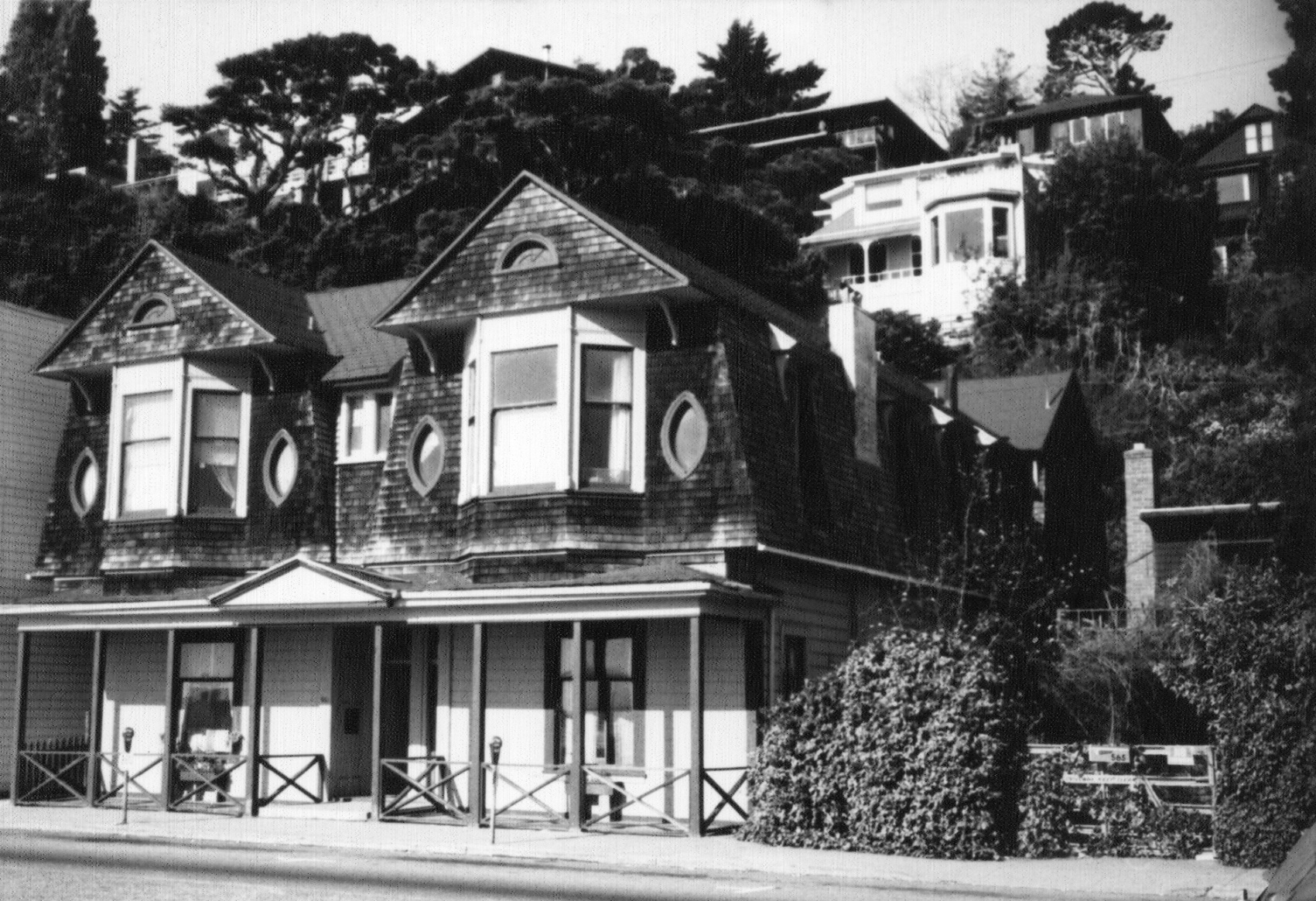
View of Sausalito
Transcript
Sally Stapp, interviewed by Annie Sutter | January 5th, 1985 | Temporal Coverage: 1945 to 1985
Annie Sutter: Now it's working. This is Sally Stapp, and it is January 5th, 1985. I don't know how to run this any better than I know. Sally, first thing I want to ask is when you came to Sausalito?
Sally Stapp: Right after World War II.
Annie Sutter: Where had you been before?
Sally Stapp: Naval Air Station, San Diego, for the duration.
Annie Sutter: And where are you from?
Sally Stapp: I was born in Cleveland, Ohio, April 3rd, 1905. But then when I was two years old we moved to Shaker Lakes, because my two-and-a-half-year-old brother got run over by an ice wagon, and Mother said, "This ends it, we're going to the country." So Daddy said, "Oh, Mary, I don't want to..." She said, "This is the way it's going to be. We have Milo and Sarah, and we're going to the country." So we moved to Shaker Lakes. There was only one house there. Now it's Shaker Heights, and I guess there are a million people there. So what else do you want to know?
Annie Sutter: Okay, well, then we find you in San Diego during the war. Were you married to a serviceman?
Sally Stapp: Philip Stapp, who was my second husband. He'd been a World War One captain in the field, field artillery. And I said, "But you're scared to death of horses, Philip Stapp, and you were in the field?" "Yes," he said, "I'm scared to death of horses." Of course, I raised those horses, we always had our own horses. I said, "Well, why are you scared of horses?" He said, "I'm so scared they'll bite me." I said, "A dog might, a horse would never bite you." Well, yeah, that's beside the point. What else do you want?
Annie Sutter: Okay, you moved to Sausalito after the war?
Sally Stapp: Yeah.
Annie Sutter: And is that when you went up to Cloudview?
Sally Stapp: No, no, no, no, no. The war was over, and, uh, '45, well, I guess '44 and a half or something like that, and, well, anyhow, I moved here shortly thereafter, on a Friday afternoon, to 16 Second Street, right down here, and I moved in.
[Editor's note: Sally asked that a personal comment about her husband here be left off the record, and Annie agreed.]
Annie Sutter: So you lived at 16 Second...
Sally Stapp: Well, then you were, there was a lot of historical people and fishermen's boats down here at Shelter Cove.
Annie Sutter: Yes. Describe that.
Sally Stapp: May I get a glass of water?
Annie Sutter: Yeah. You were going to tell me about what it was like at Shelter Cove, and the beach, and all that down there.
Sally Stapp: Well, when I moved in, 16 Second Street, which is right around the corner, the middle of a three-apartment building, we were in the middle. Philip had rented it unbeknownst to me and moved me from San Francisco here. And my few things that I'd salvaged, he said, just bring out, sell everything, and bring out just enough for a two-bedroom apartment, which I did. I arrived, and I'll show you, it's right here.
Annie Sutter: Mm-hmm.
Sally Stapp: And anyhow, it was a quiet little spot with a beautiful view of the bay, and it was peaceful. Mrs. Bolabal and Colonel Bolabal owned the property, and they lived next door, and it was being remodeled, it smelled like mildew and stuff. But next day I walked down to the village to get some Clorox and Bon Ami, and went by what is now, well, it was a thrift shop, and so I peered in, that's where the old, oh yeah, Purity Grocery. So I put my nose in and went in and said I was just looking. It was Bundles for Britain, and I looked in and said, well, I'd been president of the thrift shop in Ann Arbor, and I was wondering how this one was doing, and I belong to Bundles for Britain. So Claire Crosby and a couple other gals, Doris Whitaker, were working, and they said, well, ours was a thrift shop too, and this was Bundles for Britain, and they said, would you come and work? And I said, well, sure, I just moved in yesterday afternoon, I don't know anybody here, I'm all alone. So they signed me up to come to work there, and I went to Purity and got my Bon Ami, and next day was Sunday, and so I worked all that day cleaning up and making it smell a little less awful, and went to Christ Church, had to walk up, because my ex-husband, well, he wasn't yet, but he was off with his mistress. Anyhow, I walked up to Christ Church, because my family had been Episcopalians forever and ever, and it was coming on Christmas time, must have been November. And I got on my knees, and walked out, and I looked over and spied a pretty little girl, a beautiful young girl, there with her mother. I was all alone, she was all alone with her mother, and I walked up after the service and said, "I'm Sally Stapp, I've just moved to town yesterday, and my two sons are coming home from University of Michigan for Christmas vacation, and I don't know a living soul, and I'd like to have a party for them, because when I'd come home from college or boarding school I'd have a stack of invitations this high, and now they don't know anybody and I don't know anybody. Could you help me plan a party?" So this dear little girl, Patti Smith, and her mother, Delphine Smith, leapt at the idea, the University of Michigan boys were coming home, they played on the Michigan football team, and sure, they'd help me plan a party. So they got Bill Whitaker to come and help, and, anyhow, yes, he said he'd help.
So Patti Smith got her cousin, and got Miriam Smith's child, Wendy Smith, and Mickey Smith, we had five Smith girls, and Bud got a couple of his Michigan playmates, and I had, I don't know, we pulled up the rugs, and I cooked some sort of a turkey, and we had fun over here, it was fun. And then they went back by train, sat up all the way, because we didn't have any money. The war was over, and Philip Stapp was supporting 14 people on his payroll, and that's a lot of people to support on Navy pay. He sold everything, his chain of restaurants and his brokerage business, and left me to pay all the bills. And it weren't easy. Anyhow, it was cozy there. Then, let me see, oh, he got mad at me one time, and he picked me up and threw me completely across the room, onto the bed, the double bed, and I fell in a hell of a mess. And I had my two little Bedlington terriers, sweet little powder-puff dogs, you know, they look like little lambs, lamb of God. And I just said to those little dogs, "Get him!" And those little dogs, they jumped up on his back and grabbed him by the shoulder, and ripped his $360 suit right off him. And I ran out the front door and just stood in the middle of the street, screaming, "Help! Help!" And Miriam Smith and Sally Hetridge just happened to be coming by, and they picked me up, and the two little dogs ran after me, and we got in. I said, I shouldn't tell you this about my ex-husband, because I love that man.
Annie Sutter: Yeah. Let's talk more about Sausalito, all right?
Sally Stapp: All right. So who were your neighbors here in Shelter Cove?
Annie Sutter: Well, who were your neighbors?
Sally Stapp: Well, Marge Palmer and her baby girl lived right next door to me, and Papa and Mama had a little grocery store right this side of my place, it's still there. They were Dutch people, didn't speak much English, and they had a little grocery store, but precious, lovely people, and we used to deal with them. And it was a quiet little beach here, none of this, the Cote d'Azur wasn't there. Well, anyhow, then from there, I don't know, I've moved six places in Sausalito, I kind of lose track. And anyhow, from there we got kicked out, because Philip Stapp was screaming and beating me up, and so the landlords kicked us out. And so I found a place, 5 Third Street, which had goats, and an elevator. Old Sneavy, do you remember him? Well, he had a lamb, so we moved up there for a while. And then they wanted it back, it was a wonderful spot, and there was an elevator that went up and down to our house, but it didn't work.
And then we moved to, no, I went back East, because my brother's wife had died, and I went back to take care of his kids in Columbus, Ohio. And then we moved up to 16, uh, no, 30 Booker, on the corner of Booker and Spencer, and Cloudview up there. It was a darling little house. The weather, you must remember, is entirely different, the view is entirely different, the people are entirely different in every spot in town, and having lived in seven different spots here, the view, the people, everything is different. And up there it was the cutest little house in town, we were just renting it, and it had only a floor heater, and got damn cold, it was on the cold side of Sausalito. The north side is always cold, and you never got any sun. It had a beautiful garden and a darling house, I loved it, but cold as hell, be damned. And, only one bedroom.
So when the boys came home for summer vacation, there was no place for them. Philip Stapp couldn't care less, because I'd also raised two girls who were now married, and they were back East, in Los Angeles. So Bud and I, well, in the meantime we'd moved to 12 Alexander, which was over here, and there was a great, listen, this is very important, there was this great big pier going out from 12 Alexander, our house has since been torn down, and we had a 48-, 50-foot cabin cruiser, and we didn't dare moor her there, because the storms were so horrible at that point. So we got Herb Madden, Madden and Lewis, to berth us at Pier One, and we moored our big cabin cruiser there. And we got Al Lawson, who still is our skipper, he's from Norway, and he built his own little boat, a gorgeous little sailboat called the Seal. And ours was the Sea Gale, and then we had the Lazy Gale. And so we hired a berth for him next to our boat, and he was our skipper. Although my husband had been a commander in the Navy, he didn't know how to swim, and sure didn't know how to run a two-screw cabin cruiser. But thank God we had Al Lawson, and he's still living up there, and he would crew our boat, and polish the brass, and keep it up, and secure it. And I was never allowed to invite any of my playmates aboard, because it was Philip's boat. That's brass, I say now, it's a little more ladylike.
Sally Stapp: Are we into the '50s yet?
Annie Sutter: The 50th what?
Sally Stapp: No, the 1950s?
Annie Sutter: I guess so.
Sally Stapp: Then, so, what else do you want to know?
Annie Sutter: Well, what was the harbor like then?
Sally Stapp: Petite, dainty, little, and we all knew each other. There was Madden and Lewis down here, our pier out in front of our house, 12 Alexander, which at that point was connected with government property, and we had our own steps going down from our darling little house, which had been Ernie and Miriam Smith's house, and next door was the Barringer's house, Barringer, the wine people. And if you remember, Miriam and Ernie Smith were the greatest couple that God ever made. He was All-American, Ernie Smith, and helped start the East-West football game. And they had two children. Well, their house burned down one time, just before we moved in, and I got the fire marshal to come and inspect the house, and he said, well, Ernie and Miriam Smith's house, they were very famous people out here, because he owned the paperback business, Smith and, something paperbacks, and Miriam Smith was one of the loveliest ladies God ever made. And anyhow, they'd moved out, that had been their honeymoon house, then they moved out, and we moved in, just rented it. But a big storm hit, a southeaster, and by cracky, if you know anything about those storms, they washed this thing away, two years ago it washed our pier completely away. Fortunately, we were bright enough not to keep our boat there, because we knew it was treacherous.
Annie Sutter: Were there boats on it?
Sally Stapp: No, no, no, no. But we've got ours down there. But this is a very dangerous, weather-wise, spot. My ancestors arrived in Dorchester, which is now Boston Harbor, we know about storms. I've spent plenty of years in Nantucket and Cape Cod, and these storms come up, and they're tricky here, especially in this cove. We do not need any boats here in this cove, because the winds come up, well, you can see what it did to this pier. One night, I was here, I just had my strokes, and I was here all alone, I'd fired the three nurses, and the wood from that came up against these windows, second story, and I love it here, but I was never scared, no, that night I was. And I took all my crystal and my goodies and put them back, because I knew these windows were coming through, the wood was coming against these windows. And I drew all the blinds and prayed, I was on my knees praying when I wasn't taking my crystal and Grandmother's things back to the back bedroom, the back hall closet. But we lived through it, and I've got pieces of wood that came crashing in here. This is no place to have a pier or a boat, it is too dangerous. A boat cracks up here, it's coming right through all these windows.
Annie Sutter: Was the Nunes yard here?
Sally Stapp: This was Nunes Brothers, right here.
Annie Sutter: Did they have boats in the harbor?
Sally Stapp: They did, and this is the old pier, and these pilings are where they tied up their boats. But by God, they were here day and night protecting them, and they were great sailors. You get wealthy people, I hate to say this, but I'm very fond of everybody, you know, I just love people too much. And Karen Clary came to me at the Woman's Club Thursday and said, "I want to come and talk to you about, we want to put in a pier there for our boat." And I said, "Don't you dare." And she said, "I want to come and talk to you about it." And I said, "Karen Clary, I lived at 12 Alexander, you live at, I don't know, 10, or something, and it is no safe place for a boat." And I said, "You've got the cutest little boy I've ever seen, a little adopted boy." She said, "But we're going to make it childproof." I said, "There is no such thing as childproof. I raised my two boys and my grandson, you cannot make anything childproof, they're smarter than we are." She said, "May I come and talk to you?" I said, "No, I've gone on record, and you dare not put in a pier down there with your big fancy boat." You know, her family, or his family, bought Candlestick property, and they stuck San Francisco for the Candlestick property, they're loaded with money, and money talks, we know that. But they're courting the harbor commissioners and everybody else to get their piers in. I've got everybody in here to say we don't need any piers here. They get their toehold in down there with one pier, we will have a complete marina here, and a big storm, which they don't know about, I have lived here for, what is it, 40 years, and I know what these storms are, and you don't get them often, but when you do, watch out. We've got plenty of boating down there, and we've got too many boats on the bay, like too many automobiles, people, they've got loads of money, they buy a goddamn boat and they don't know how to handle it, they don't know the rules of the sea, they don't have a driver's license, especially the ones with these cabin cruisers. We sailors, who sail, by gosh, we go out sober, and we respect the sea, and we know the rules of the sea, we who are sailors. But these cabin cruisers, they just go out with a blonde on one arm and a bourbon on the other, and they are a menace, they don't know the rules of the sea, and the richer they are, the worse they are.
Annie Sutter: Let's get into the Women's Club. You were president of it several times, weren't you?
Sally Stapp: I was asked several times, but I always refused, until finally, they sent a cable to me in Europe, and in Florida, and no way, thank you.
Annie Sutter: But you were never president?
Sally Stapp: Yes! Yeah, finally, I'd just gotten back from, I don't know, I used to travel a lot, Philip Stapp would give me fancy trips to get me out of town so he could sleep with his mistress all the time and I wouldn't be bothering him. But this time I just came back from three or four months in Europe, and had just arrived. Oh, there's my kingfisher! Look at him out there, on top of the, oh yeah, he comes, he sits there like the American eagle. We used to have an American flag there, but they won't buy one anymore. Did he, darling? He looks like the American eagle on top of the American flag.
Well, anyhow, so I'd just come home, picked up my little dog, Miss Cricket, her sister had gone the way of all flesh, she was dead, but Miss Cricket traveled with me all over. Anyhow, I was just unpacking, around, I don't know, I guess it was one or two o'clock in the afternoon, and I heard these footsteps coming up my front steps, clunk, clunk, clunk.
Sally Stapp: You never saw my house up on Cloudview?
Annie Sutter: No, that's another thing I want to ask you about.
Sally Stapp: Oh, it's a beautiful house.
Annie Sutter: What number?
Sally Stapp: 49. Like the 49ers, the 49th state. And my dream house. Philip Stapp had me move 17 times in 16 years.
Annie Sutter: What became of him?
Sally Stapp: Both my husbands are dead. First one was alcoholic, he disappeared 10, 12 days, whatever, at a time. But anyhow, so the dog and I, I was just unpacking, and I heard this clump, clump, clump coming up the front steps, and all the doors were open, airing out the house, I'd been gone for three months. And I came down, and here were all my Episcopalian playmates, Nita Koenig, and Rixford, all Episcopalians. And I said, "Well, hello, come on in." And they came on in, and I said, "Can I get you a cup of tea?" "Sure," they said. So I go and boil up some water and find some stale cookies, and we go into the living room and chitchat, I'm so happy to see them, I hadn't seen them for three, four months. And finally little redhead Rixford says, "Sally, you don't know why we're here." And I said, "Well, I guess you just got through with the Christ Church guild meeting", you know, our church, I'm very religious, which people don't realize, but Daddy wanted to be a bishop, and almost was, and all my family were senior wardens in the Episcopal Church, left England on their religious ideals and principles. But anyhow, I said, "Well, I guess you just finished up the church meeting and came to welcome me home." And Rixford said, "No!" That little peewee, you know, Mimi Rixford, a little redhead, feisty, and she said, "No, the nominating committee from the Sausalito Woman's Club."
And I said, "Well, get the hell out and give me back my cookies." She said, "No, we want you to be president of the Woman's Club." And I said, "Look, I've told you no twice before, and it's definitely no way." And she stood up in her little feisty pigeon way and said, "Well, Sally, you've always told me that your church and your Woman's Club are very vital to your life." And I said, "They are." But she said, I said, "But I also have a life to live." And she said, "But if you can't give up one year of your life for the good of the Sausalito Woman's Club..." I said, "Mimi Rixford, all right, you've hit me right here in my heart. Okay, my club and my community do mean everything in the world to me, and I'm new out here, and I'll do everything I can for my church, my God, my Episcopal church, my Women's Club, my family. It'll mean everything to me, all right, I'll not go away for a year." And so I took the damn thing. And it's not as they advertise, the nominating committee, it's just nine months the club's closed. You're on duty for six months before you go in, six months after, helping the new president, and you have to get 70 chairmen for all these 70 committees. And if you haven't been a hard worker and done everything you can for other people, you can't get people to do it for you. So I did it, and it should never be done by a married person, because I was alone, my phone never stopped ringing, and I was up half the night working on stuff, and I loved it, no, I didn't. Well, I guess I did, but it's hard work.
And then I just finished that, and the Yacht Club comes after me, and I thought, well, I'm in the groove now, it would be a hell of a letdown to stop all this activity, and my marriage was falling apart more and more, and so I took that on too. I love that Yacht Club. I remember when I first moved here, my friends, and I was all alone, and I missed my boys so much, and Martha Ansenberger, who had a son, Jim, well, all right, you want to go way back. But in recent years I think Sissy Muldoon is one of the greatest ladies I've known, but she's come into my life more recently, a big, wonderful family. But if you want to go way back, there was Nita Koenig, and there was Edith Wood, and they were great, great people. Probably Edith Wood, who's going to be 100 years old August 17th, what a beautiful character, and beautiful woman, and a great tragedy had come into her life, and she's still alive, up at Tamalpais, I talked to her the other day, and probably she is the most wonderful woman I've ever had the privilege of knowing, Edith Wood. But everybody in this town, I think, are great people, I just love them all, you can't, except she's the oldest, and I probably know her the best, except since I've had my strokes.
So many of my darling friends have rallied around, God love them all. Some of my new friends have come so close to me. And I've been declared dead four times in my life, and I had brain damage from a terrible automobile accident 50 years ago, and strokes. But it makes you a different person, and I don't know, life is wonderful, and I love life, and I want to live longer, and I think I shall. Everybody in my family were born or died at four o'clock, mostly in the morning, which is the hour of least resistance, and they watch my clock, I wake up, and if I see it, I go, "Wait, one minute after four, I know I'm good for another day," and I can get up and see the sunrise. And truly, you have to be dead to realize how wonderful life is.
I've lived a very dangerous life. Somebody said the other day, "I can't imagine you being a tomboy." Well, I was, all my life, because there weren't many of us living up in Shaker Lakes, and my older brother would drag me in to help out with the boys' ice hockey or football team, and I was little and eager, and I thought the boys were much more fun than the girls, because the girls would always cry and play with their doll babies. I didn't like doll babies, I liked my teddy bears and my live animals, my pony, my lamb, dogs and cats. And I love sailing, look at these boats out here, aren't they beautiful? Honey, turn around, I'm sitting on top of the world here, and I hope I can afford it, probably not, but if I can't, I'll be challenged with something else, move to a little apartment, or, this gets turned down, to hell with it, I'll go somewhere else. And I've got two wonderful boys, and they adore me, and we call ourselves the Three Musketeers, and if I croak, we'll carry on some way. Annie, dear, you do whatever you want.
Annie Sutter: Tell me about your car.
Sally Stapp: My car, big white convertible. Listen, that's 25 years old.
Annie Sutter: Have you had it all those 25 years?
Sally Stapp: I bought it 25 years ago, in 1960.
Annie Sutter: And what kind is it?
Sally Stapp: It's an Oldsmobile 98 convertible, white, same original. I was having trouble with my Buick, which was the same size, and the top had broken down, quickly, with the push of a button, and I had it up and down so many times it kind of wore it out. All my girlfriends had bouffant hairdos, I just cut mine shorter and let it blow in the wind. Well, anyhow, I was coming back from the city, and I saw this one on the turntable, on Van Ness, in California, or somewhere. And Mr. Stapp called and said, had I gotten home safely from the city? And I said yes. And I said, I saw the car I want. I said, I'm having so much trouble with this Buick. He said, go and buy it. So I did, and it was the first, it came on the turnstile, you know how they have them, on Van Ness, white, with Bonnie blue upholstery, top down. And I've had convertibles ever since I was 17 years old, when I graduated from Pine Manor, and Mother said, "Sarah, you have done so well, now you buy any car you want." So I went right down and picked out the first, what was it, a Chrysler Playboy? I don't know what to call it, but anyhow, it was the first flashy little thing, only big as a minute, and Mommy bought it for me.
When I picked it up, the day after graduation, I said to them, "Take the top off." And they said, "Oh, but Miss Sarah, what do we do with it?" I said, "We'll just store it, because when I sell it, somebody else might want it." But I drove that thing around for two years in Cleveland, Ohio, with no top on it, snow up to here. And the day I picked it up, I went down to my great-aunt, Auntie Baby, and said, "Auntie Baby, may I have your wolf-skin sleigh rug?", which was four wolf skins with red felt underneath. And she said, "What?" You see, I was the only little girl in the family, and they spoiled me rotten, I guess, except Mother said I would never be spoiled, she's a strict disciplinarian, and she'd say, "Sarah," and I'd go like this, "What have I done now?" But anyway, so I got this one, and I love her, and I used to have the top up and down, because my playmates didn't want to ride in the rain or have their hair blown. I just cut mine shorter, and the shorter it got, the curlier it got, and the rain would make it curl, and if you drive fast enough, by the time you get underneath, the windshield, the rain's behind you. And don't tell the cops this, I've only been arrested twice, from going too slowly, not from going too fast, because I used to teach safe driving. I'm going to be buried in that damn thing.
Annie Sutter: Is that a car, are you going to be buried in it?
Sally Stapp: No, I'm not. I heard about somebody that did that, but no.
Annie Sutter: But you're going to keep that car?
Sally Stapp: As long as I live, it's going to live and die with me. And I shall live and die by my ideals and my principles, you can put that down, I live and die by my ideals and my principles. Well, anyhow, there's nothing else to live and die by. Best job in the world, working in the parking lot. Well, when we first started the parking lot, it was at parking lot number one, which is the main lot, and at that point only people who had done something good for Sausalito were allowed the cushy job of working at the parking lot. And Cotton Mackintosh, who'd had a stroke, and he'd done so much for the Little Theater, and probably the greatest comedian and thespian, well, I think he was even better, was put in charge, because he'd become sick. Well, he was our first operator at parking lot number one, which is the only one we had then. And then we had a couple of other people who had been with Bob Gunn, because he'd been mayor of Sausalito. I was invited in because I'd been president of the Women's Club, and president of the Women's Auxiliary at the Yacht Club. And it was a cushy little job, we sat there and had a telephone, and our friends knew where we were. I think they paid us 65 cents an hour, maybe it was $1.65, no, I think it was only 65 cents. But we all belonged to the Yacht Club, because it was right next to it.
Well, it got busier and busier, and, as you know, 14 of us have died on the job down there, but they only took older people, local citizens, although we did have this darling older woman, I can't remember her name, Mabel Somebody-or-other. And anyhow, I worked there eight years, it must have been 12, 15 years ago that I was working there, and they said, "Sally, the man hasn't shown up to work at lot three, run down there." So I raced down to lot three, and they found the man dead in his apartment. So, I liked it down there, because I was alone, and I could knit and read, and I didn't have to listen to so much men's yapping and dirty stories all day. And anyhow, I worked there for eight years and just loved it, it's the cushiest, nicest job, where you have a phone, you're not supposed to use it for personal reasons, but your friends knew where you were, and you could write your mail, and I knit two sweaters and a couple of scarves, and read dozens of books, holding down that job. That's enough about it, it was a great job, until the equipment all went to pot, and it was no place to have electrical equipment. And I remember very well, I was working at lot three, which is the little one, down by Flynn's Landing, and the men came in to set up this equipment, and I said, "Look, is all this electrical equipment safe down here, with all this salt air and spray coming up?" Because, I said, with our twin-screw big cabin cruiser, we had a tremendous amount of trouble with the salt air and salt spray, with all the mechanisms. He said, "It won't work here." And I said, "Well, I know it won't." He said, "I'm just being paid to put this stuff in, City Hall has ordered this." And I said, "But it won't work." He said, "I know it won't, but don't quote me, because I'm just being paid to put it in, it never has worked where you have all this salt air and salt spray, and drunks and everybody coming through breaking down the equipment." It's not safe, and it's not safe for anybody. I love my job, and it was, you're inhaling, it's not anybody's fault but my own, I love people so much, and my friends would come through, and they'd stop their car and light a cigarette while I was talking to them, and then diesel motors, which were smoking, and they'd stop their car, and I inhaled all these fumes, which I wish they wouldn't, you can do as you please about it, but I'm not going to sue the city, I don't believe in lawsuits. But I was going to have a stroke anyhow, because I was worrying about my children and my grandson, and I was worrying about this job, and worry gave me bleeding ulcers and a stroke. But I don't believe in lawsuits, it's not the city's fault, it's nobody's fault but my own. And so, the parking lot job is the world's greatest job, I love it.
Annie Sutter: What do you think about the way Sausalito has changed?
Sally Stapp: Oh my God, it's completely changed, but we're still struggling to try to keep it the little village, which is impossible, it's a losing battle, but we're doing the best we can. We've got too many committees and too many organizations, working an uphill storm, and every beautiful spot in the world, I know, in my travels, beautiful spots are invaded by tourists and traffic. We have, in my estimation, the most beautiful spot in the world, and how we can protect it, we must not be selfish, but it's being ruined, absolutely ruined, by so much development coming in, too much population. We're doing the best we can, at our Woman's Club, yesterday, or Thursday, where a treasurer used to be able to manage it very nicely, it's now taking computers and computerizing, and it's so much more expensive. And I remember City Hall, we had two people running it, first we only had Chief Doyle, and he ran the whole city by himself. Then we had Miss Paracini and her friend, and the two of them ran all of Sausalito, and ran it beautifully. Now look at it, it's multiplying like rabbits, and the whole world is doing this, we're going onto computers, of course we've gone into outer space, but it was so much nicer in the olden times.
And I think that my life has probably been the most interesting of any, because, see, I've lived, it'll be 80 years in April, and I've gone through, I remember as a child we had to have the Bell telephone and the Kyoga telephone, because some people had one and some had another. And I remember the first Ford automobile was for sale for $365, look at the price of them now. And we were snowbound up in Shaker Lakes for ten days, and there were the five servants, and the five family, and two houseguests, that's twelve of us, housebound for ten days. Fortunately, the family had been used to having a big pantry, and all twelve of us ate, and until, oof, the tenth day, a leg of mutton appeared on the table. And we'd never had mutton, we'd had leg of lamb, and I heard the servants and people kind of whispering, and oh my glory, it was the leg of my lamb, my pet lamb. And I guess I threw a tantrum, and I was banished and never allowed to come back, because Mother was a strict disciplinarian, she said my brother and I would never be spoiled, and they ate the leg, but nobody could eat it. But that's kind of sad, but, I don't know, the animals, I had my pony, and all my rabbits and guinea pigs and a pet raccoon, and it was a wonderful life. And things have changed, Christ Almighty. But come see my vegetable garden, I just harvested my first broccoli, and you must see my cauliflower, it's only this big, but I like little things. Annie, whatever you want to do, good luck to you. And thank you.
