
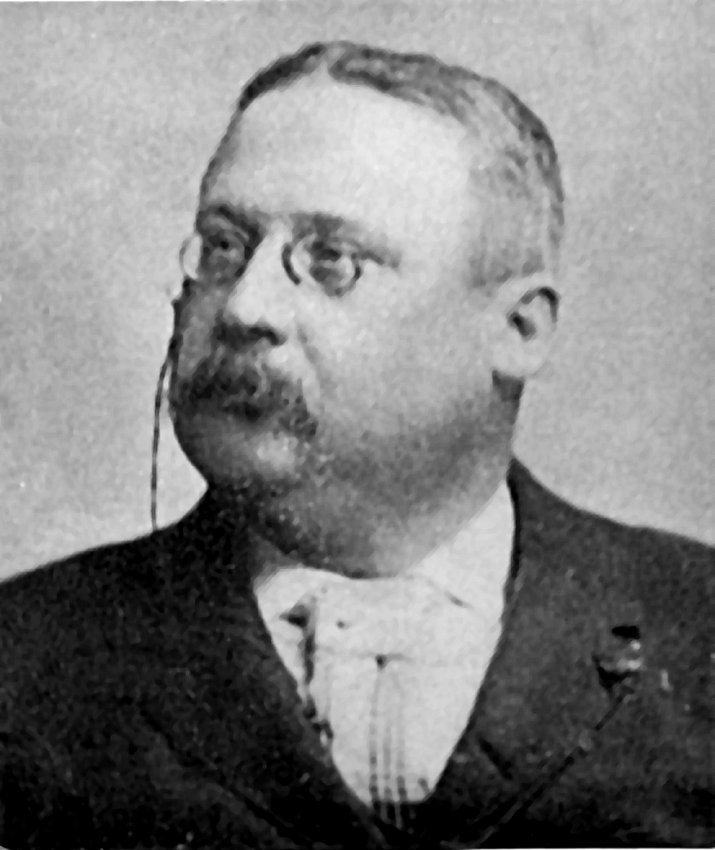
A small photograph of Daniel O'Connell, 1899.
By Jack Tracy
Starting this week, the Sausalito Historical Society will be offering slightly abridged and edited versions of articles on historical topics by SHS founder and Sausalito’s long-time town historian, Jack Tracy. Most were published during the 1970s in the Marin Scope. Lightly edited pieces by other writers who explored, reported on (or sometimes recalled) highlights from Sausalito’s history in the pages of the fledgling newspaper during its first decade will also be included in the series.
Daniel O’Connell, whose life neatly spanned the second half of the 19th century (1849-1899), was one of a kind. The poet memorialized by the stone bench that occupies the northwest corner of the intersection where Sausalito’s Bulkley and Harrison streets meet was a true Celtic spirit who left his mark where ever he went.
Born in County Clare, Ireland, he was the son of a distinguished lawyer and grand-nephew of the great Irish patriot Daniel O’Connell. Following a classic Jesuit education, he emigrated to New York, and then, heeding the popular advice to young people of that era to “go west young man,” he pushed on to California, where he initially taught at Santa Clara College. But he was soon drawn to San Francisco, where he began writing for the daily newspapers and becoming involved with the city’s literary establishment of the time – with writers like Bret Harte, Samuel Clemens (Mark Twain), Joaquin Miller and Ina Coolbrith. According to a descendant of his, he seconded the motion of Colonel John C. Cremony naming the Bohemian Club in 1872.
In 1874, he married Mabel Ashley, the daughter of the late Senator Delos R. Ashley. That union produced seven children, and for awhile he and his growing family lived in the “Octagon House” on Gough Street. His first book of poetry, Lyrics, was published in 1883 and received some attention. During these years, he collaborated on a novel, A Special Deposit, and wrote a play, The Red Fox.
We find Daniel O’Connell walking the hills of Sausalito in the mid-1880s and living with his family at Laurel Lodge, a home still standing at 41 Cazneau. Legend has it that James W. Coleman, President of the North Pacific Coast Railroad Company, which brought the first rail line into Sausalito in 1875, built this cottage in 1886 and loaned it to O’Connell. The glen in which it was built was later often referred to as “O’Connell’s Glen.”
Although never a wealthy man, a dinner hosted by O’Connell at Laurel Lodge is said to have seemed to his family and friends like a “Roman feast” due to his presence. As his friend Hero Rensch has written, “His desire to spend far exceeded his capacity to acquire.”
O’Connell died at Laurel Lodge on February 23, 1899, marking 27 years to the day of the founding of the Bohemian Club. As was fitting, he was buried from the club’s Green Room. A final tribute to him occurred in 1901. Friends, including architect Willis Polk, General John Dickinson and members of the Bohemian Club, contributed $1500 to build a memorial in his honor. The intersection of Bulkley and Harrison was chosen for an oval stone seat because it was a site that O’Connell had often frequented. The seat was inscribed with his final poem, “Chamber of Sleep,” which he finished some ten days prior to his death.
In 1900, Ina Coolbrith, later to become California’s Poet Laureate in 1915, edited O’Connell’s last book of poetry, “Songs of Bohemia.” Its closing poem is “Chamber of Sleep.”
