
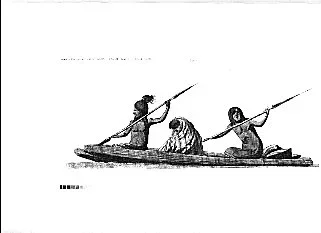
Early Miwoks called this area Lewan Helowah or West Water. Illustration courtesy of the Sausalito Historical Society.
This article is excerpted from the Sausalito Historical Society Newsletter, Summer 1978.
Nobody knows for certain just when the Coast Miwoks (pronounced Mee-wok, meaning “person” or “people”) first set foot on Whiskey Springs. But there is evidence that they were in Marin County three thousand years ago. It’s estimated that, at the height of their civilization, there were at least four thousand of them living in villages spread throughout the county.
There is almost no specific data on the village at Whiskey Springs, but from the size of its garbage dump (called a “midden”), and the artifacts found in it, archaeologists suspect that it might have been a small community. One of three subsidiary, or seasonal, villages in Sausalito located near a much larger “central” settlement (on what is now Pine Street, beside the Marin Theater).
In 1579, when Sir Francis Drake spent five weeks repairing the “Golden Hinde” in a bay somewhere between San Francisco and Point Reyes, he had an opportunity to study the Miwoks closely. His diary gives us a good description of what they wore:
“The Men generally go naked, but the Women combing out Bulrushes, make with them a loose Garment, which ty’d round their middle, hangs down about their Hipps: And hides what Nature would have concealed. They wear likewise about their shoulders a Deer skin with the Hair thereon... The Common People... whose long hair tied up in a bunch behind, was stuck with Plumes of Feathers, but in the forepart only one Feather...”
Drake also describes a Miwok house, which no doubt fits those at Whiskey Springs too: “Their Houses, which are dug round into the Earth, and have from the Surface of the ground, Poles of Wood set up and joined together at the top like a spired Steeple, which being covered with Earth, no Water can enter, and are very warm...Their beds are on the hard Ground strewed with Rushes, with a Fire in the midst round which they lye, and the roof being low round and close, gives a very great Reflection of Heat to their Bodies.”
The Coast Miwok Indians were a peaceful people whose environment provided everything they needed to grow and prosper. Yet the only ones left in Sausalito today are buried beneath a vacant lot that is about to be paved over for parking.
Behind those first explorers who ventured into the Miwok’s territory came others who stayed permanently. They brought with them two things the Indians had no resistance to: A religious fervor that destroyed their tribal unit and diseases like smallpox and cholera.
By the time William Richardson settled on Rancho Saucelito in 1841, there were only a handful of Miwoks left — barely enough to take notice of. In a letter to a friend, he briefly mentioned the “few Indians” still living on his property. Soon there were none, and Whiskey Springs became grazing land for his cattle. And so the land remained until John Mason built his brewery on it in 1890-92.
