
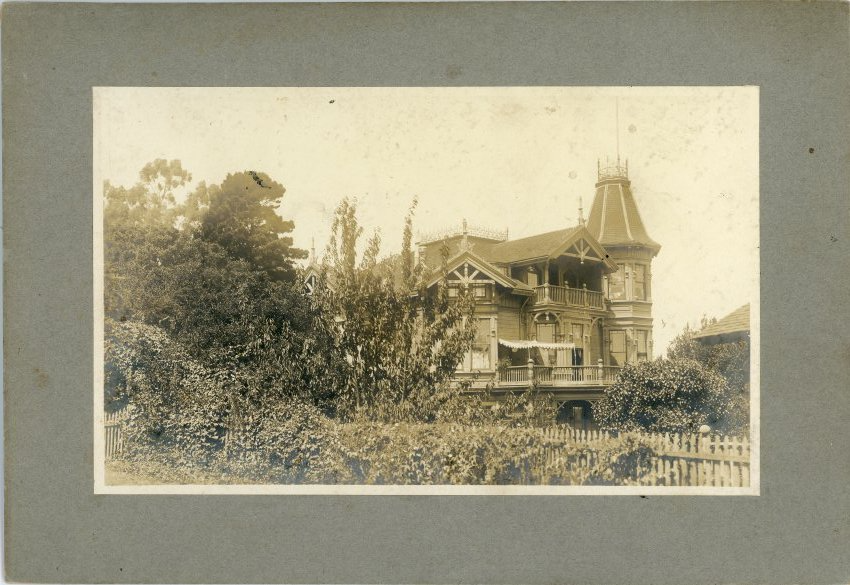
Photo of Victorian home - Holly Oaks residence of George Meade, Harrison Avenue, 1887. Torn down 1939.
By Jack Tracy | October 28, 1975
This article, published in the MarinScope on October 28, 1975, was written by Jack Tracy in his capacity as Chairman of what was then known as the Sausalito Landmarks Committee (it was later made an official agency of city government and relabeled the Sausalito Historical Landmarks Board). The following piece appeared just five days after the city’s Community Appearances Advisory Board (CAAB) voted on the question of what color would be most appropriate for the small Victorian at 108 Caledonia Street, a one-time home which was about to be restored for use as a commercial building. At that hearing, Tracy was asked to render his expert opinion about the color scheme most likely to conform to choices made by home builders of the Victorian era. What follows reflects the information he conveyed to the CAAB that night.
The period of the 1880s and ’90s has been preserved in many of the older homes of Sausalito’s hillsides, and one of the most interesting characteristics of the ones that remain authentic is their color schemes. Contrary to present opinion, Victorians were not all painted white with green trim. Nor were they all gray, which is typical of most San Francisco Victorians that survived the 1906 earthquake and fire. Nor did they sport the garish color schemes that prevail today among older buildings on San Francisco’s tourist-oriented streets.
Information about color schemes true to that period has until recently been almost nonexistent. However, a book entitled Modern House Painting, published in 1883 and belonging to Dr. Joseph Baird of the Davis campus of the University of California, has just been located, and it has been described by historians as “quite an eye opener.” Another book, also recently uncovered, Color Applied to Architecture (1887), published by the Sherwin Williams Paint Company, describes proper paint usage for structures of the late 19th century.
When all this data is put together, the following picture emerges: Multi-color schemes were indeed fashionable in the 1880s and early ’90s, but only earth tones, such as browns, yellows, greens, deep reds, and raw sienna were employed. The rationale was apparently to try to simulate the color of rock, stone and brick. Shingles were normally stained and oiled. The body of the building was painted in a deeper tone than the second story. Color highlights were used for moldings, window treatments and doors.
A statement regarding one building in the Sherwin Williams book is illustrative: “This grand entrance, surrounded by a finely carved framework, was distinguished by a tan color and doors of deep red.” Another passage states, “Subtle orange was used to highlight chimney and gable areas of this fine home, with tones of brown and gold setting off ornate trims and wide porches.”
A paragraph in Modern House Painting that reflects the feeling of this era declares, “These rich, and sometimes somber, colors give a house a certain character and dignity which the washed-out looking light tones and lavenders generally fail to produce. Modern taste of the best kind does not seek for exciting effects, for decided hues, for glare, and for obtrusiveness; but for results which will be restful; for softness of color and for that subdued and quiet expression which should characterize the exterior of every house in which refinement is supposed to lodge.”
This recently discovered information, which the Sausalito Landmarks Committee was instrumental in uncovering, has been requested by the National Trust for Historical Preservation, which regards it as a distinct breakthrough in our knowledge of the Victorian age.
Five days before this piece was published, the CAAB, acting contrary to Tracy’s testimony and the evidence he presented from his 19th century sources, voted unanimously to grant the architect and the owner of the tiny turreted Victorian at 108 Caledonia their preferred choice of color: lavender.
