
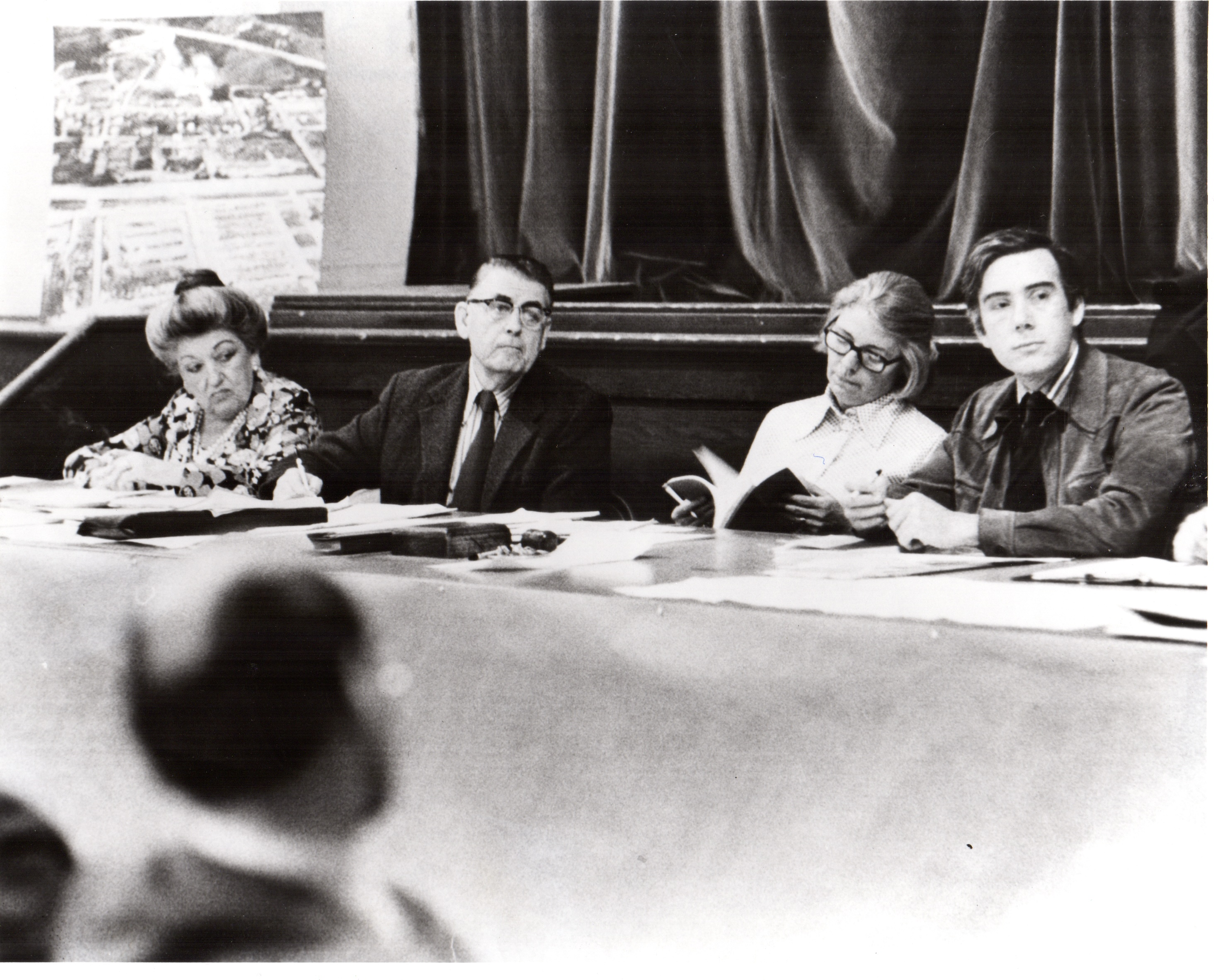
A black-and-white photograph of a Sausalito City Council meeting, showing Sally Stanford, Earl Dunphy, Robin Sweeny, and Steve Fraser seated behind a table.
By Doris Berdahl | March 16, 1976
Among the series of Jack Tracy historical articles planned for this space, we’ve promised an occasional piece by other writers who appeared in the MarinScope during its early years. The following is an objective, but affectionate, assessment of Sausalito’s local VIP, Sally Stanford, in her role as a member of the City Council since1972. It appeared on March 16, 1976, following her swearing in as Mayor of Sausalito
She’s a continual delight to her fans in the audience. Never at a loss for blunt put-downs of people and ideas that displease her, or for no-nonsense reminders that money makes the world go round. Quick with a triumphant half-smile when the vote’s gone her way, or an expansive wave of her cigarette and a bold sweep of her eye when something amuses her, or a rakish wink and throaty aside behind cupped hand when slipping an in-group joke to her friends in the front row.
Combining the stylish pantsuits of the successful business woman with a few well calculated reminders of her past – a profusion of diamond jewelry, bright red fingernail polish, and deep décolletage (where she appears to keep everything from handkerchiefs to $100 bills) – she occupies her seat on the Council with all the aplomb of a generally recognized celebrity.
But now Sally Stanford, San Francisco’s best known ex-madam and Sausalito’s most durable restaurateur and tourist attraction, has achieved what clearly has been her ultimate goal -- the acceptance, and indeed the admiration and goodwill, of a majority of the community.
Contrary to what skeptics predicted when she took office four years ago, she’s never missed a Council meeting. Although she occasionally dozes through the duller moments and doesn’t do her homework on the technicalities or the subjects that don’t interest her, she has represented her special constituency in a vigorous, if sometimes repetitive and single-minded, manner that leaves no doubt of her position on any subject.
She says the unsayable (“This country’s going straight down the road to socialism”) in a town where well-bred liberalism forbids such talk. She states her motives as she sees them with stunning candor (“I’ll know if it’s time to conserve water when I look at my water meter”). Although her judgments seem harsh and cynical to many, she never hesitates to say so if she thinks the emperor has no clothes. “All you get when you go for these nit-wit planners’ schemes are a lot of dreams and a few bicycle paths. I’m tired of dreams.”
Deprecating allusions to her lack of formal credentials for public life, to her age or her health, she answers with a quick and witty retort: “I’m a lot more aware than these people think. There’s nothing I’m not aware of. Somebody said the other day they didn’t think I could hear and see well anymore. Well, I can see across the bay, and I can also see the cash register across the room and how much it says on there.”
Only occasionally has she alluded to her 20 years in the oldest profession, but when she does it’s with subtle good humor. “The rest of you may be tired, but I can go on all night.”
Who her constituents are and how they feel about her has never been quite clear. She’s always attracted youngish social critics who have imagined that by voting for her they can thumb their noses at the full range of Establishment types -- from third generation hill families to policemen on the beat to Rotary Club regulars to big development interests. But they have generally been disappointed. Although she continues to maintain a mildly irreverent attitude toward established institutions and still often befriends individuals regarded as victims of “the system” (eg., her famous defense of death row prisoner Caryl Chessman), she is as strong for law and order and private property rights as any prosperous hill dweller in town.
She’s worked for higher salaries for the police department and regularly stops by there in a GMC pickup with fresh fruits and vegetables from her Sonoma County farm. She has been staunchly loyal to the downtown business community and sympathetic to its need to keep their cash registers ringing. She has given almost automatic approval to development applicants, believing in their right to make maximum profits on their properties as long as they conform to the zoning laws on the books when they bought their land.
In short, with all her tough talk, Sally is a soft touch for the people she likes or has chosen to defend. She’s a winner, seldom a loser, for reasons that she demonstrates daily in her business and political life. She has intense powers of concentration, a psychological defense system that works extremely well for her if sometimes abrasively for other people, a compulsion for perfection, an earthy feel for basic human needs and the surprisingly simple ways they can be met. Her long fought and ultimately successful campaign to get a public restroom for downtown Sausalito is a case in point.
More then anything else, she’s been able to convince even her enemies of her inner core of integrity in dealing with other people. “I believe in spending other people’s money as carefully as I would spend my own,” she says when asked about reform programs financed by the taxpayer. “Anybody who tries to reform the world is crazy. I just try to help the young and the old and the ones who have lost their way. That, and sticking to the Golden Rule, is about all you can do.”
These are the qualities she’s brought to city government. Some of them – the strong, positive ones – have not been put to work for Sausalito as much as they might have mainly because of her love-hate relationship with the rest of city officialdom, her tendency to shoot from the hip, and her suspicion that she’s been excluded from the private strategies of the key decision-makers.
Now, as Mayor of Sausalito, she will herself be a member of the inner circle. What she does in that role can’t help but be interesting.
