
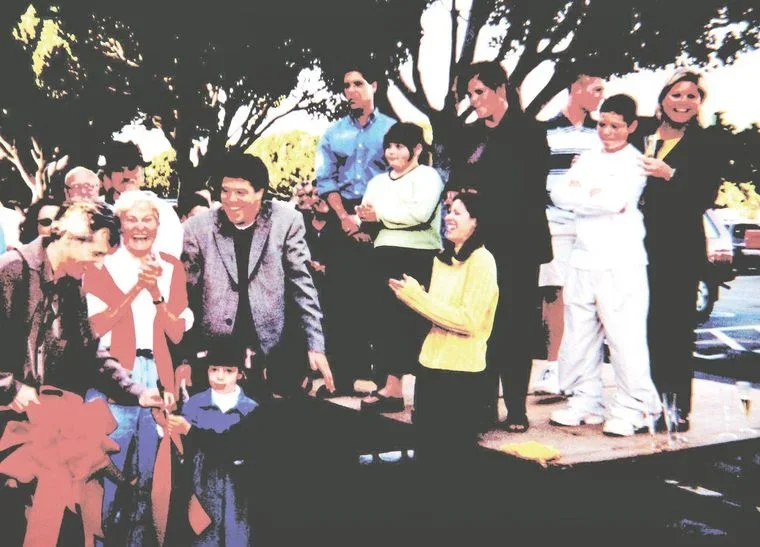
Former Mayor Paul Albritton cuts a ribbon at the dedication ceremony for Tracy Way as members of the Tracy family look on from the raised platform. The street is in honor of Jack and his wife, Janet.
By Steefenie Wicks
The phone rang in the middle of the night. Fire Chief Steve Bogal was putting in a call to his friend Jack Tracy.
“Jack,” he said, “You better get down here. I think that we just found a body.”
Jack got out of bed and was on site in less than 30 minutes. He paced over to the area behind the movie theater on Pine Street, which now had a fire truck and two police cars on guard. He nodded to the chief as others walked over, knelt down and took a look at the body that was now exposed from the wash-off. Jack walked back over to the chief, who asked him, “What do you think?”
“Miwok,” Jack replied. “I always said that there was a burial ground around here.”
As he walked off, one of the police officers turned to the chief and asked, “That the coroner?”
The chief looked over at Jack as he climbed back into his car. “No,” he said. “That’s Jack Tracy. He’s the town historian. He started the Sausalito Historical Society.”
The above is taken from an interview I did with Jack Tracy back in 1990. Tracy started the Sausalito Historical Society in 1975. So how he was able to accomplish this?
“I went to my personal friends [and] asked for a donation of $5,” Tracy explained. “They, in turn, went back, asked their friends and so on. Before I knew it, we had raised enough funds to successfully began the dream.”
The first event the organization put together was for the opening of the new City Hall building on Litho Street, where we sit today. Tracy was asked if it was possible to do a display that would spotlight the history of the town. The display was an unbelievable success that opened at 7 a.m. and did not close ’til 7 p.m. that night.
Days later, the mayor approached Tracy and asked what he would need to start the Sausalito Historical Society. Tracy replied, “Permanent space!”
The next day, Tracy toured the new City Hall with the mayor. The two decided the second floor would be the best place for the new organization. This floor would eventually house a Victorian room, a library of historic books, maps, paintings, glass bottles from the waters of Sausalito, chairs and tables from the first school, old firemen helmets and WWII goggles, along with the many objects collected from Sausalito families that made personal donations from their heritage.
Tracy wanted the society to be a private organization with no money from the City, free from conflict with the political structure of the town. He wanted this to be an organization for the residents – the people he believed were making the Sausalito history of tomorrow.
Tracy found locals wanted to participate in helping to establish their history. The fee to join the society was set at $5; Tracy did this because he felt it made it easier for folks to donate at the end of the year. These private donations of both money and artifacts helped get the organization established. Tracy felt that by preserving Sausalito’s past, one could tell where its life came from.
Over the years, the SHS became a known entity of the city. Tracy’s reputation as a fundraiser is well-noted, as is his ability to be gifted with some of the real treasures that exist in the society today. His lasting efforts to establish the Marinship display at the Bay Model and his book, “Sausalito: Moments in Time,” are just two of the marks that he left.
But Tracy would never forgive me if I did not finished the story about the Miwok Indians of Sausalito:
Shortly after the bodies of the Miwok Indians were discovered, Tracy contacted some of the spokespeople from the local Miwok tribe and asked them to come to Sausalito to bless the found area and the remains, which were re-entombed where they were located.
Tracy told the story of how a young man and woman of the tribe came to visit along with an older woman who was their spirit leader. When he asked permission to tape the interview, the young woman agreed, but smiled and said, “Some things are meant to be recorded and some things are not.”
After the members of the tribe had left, Tracy sat down to listen to the tape. To his surprise, there was nothing on it but his own voice, saying, “Testing, 1, 2, 3.”
Sausalito has always had a reputation for strong-minded residents, people who take on projects for the town’s good and get them done. Stories like this tell the background of the town, how one person, with the help of his friends, could change the town’s historical path forever.
Because of his deeds, the town felt it was proper to honor both Jack and his wife, longtime City Clerk Janet Tracy, with the naming of a Sausalito street after them: Tracy Way.
