
By Steefenie Wicks
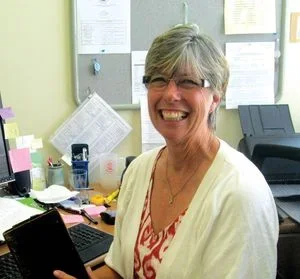
There is one person who can tell you more about the history of Sausalito than any other Marin historian – Sausalito City Clerk Debbie Pagliaro.
Pagliaro, who has spent more than 50 percent of her life working in just about every city government department, is one of those rare individuals actually born in Marin and raised in Sausalito. Her playpen was a cardboard box in the front window of her father’s hardware store on Bridgeway, so she could watch the world go by. She can tell you about the picnics that families used to have in Vina del Mar Plaza, where Santa would come every year for Christmas.
Pagliaro attended Central School (now City Hall) from kindergarten to fourth grade. Along the way she, with a group of involved young folks in 1965, took on City Hall with their demands for a Youth Center. Today, that youth center has grown into the Sausalito Parks and Recreation Department. Once again proving her connection with the City where her grandfather started the family business, her father was born in a house on 4th Street; the family moved to Rose Court where she grew up.
Pagliaro got involved with working for the City of Sausalito right after she graduated from high school when her neighbor asked her to come and work a part-time job down at the old City Hall on Bridgeway.
It so happened that the city had started a new parking program, and she was to begin her civic career selling parking permits. Later, she took the position of business license clerk and from there she moved on to the planning department, building department and the police department.
“It was not until I worked for the police department that I felt that I had finally become well-rounded,” Pagliaro said. “I ended up becoming secretary to the Chief of Police. That was one eye-opening experience because you really got to see both sides of what can become a problem. I was there for seven years when it was decided that the city really did need a full-time City Clerk and here I am.”
Pagliaro said she learned a lot working under long-time City Clerk Janet Tracy.
“If anyone had told me then that one day I’d be sitting here in her position, I would have been the first to say they were wrong,” she said. “But here I am, 30 years later, the City Clerk.
“You know, Janet Tracy was a cutting edge City Clerk. She was part of what I call the sub-group of City Clerks that put together the process of departmental training for what would become the Certified Municipal City Clerk position. She also turned over to me the City Bible: that being a 5-by-7, black, three-ringed notebook with some of the most valuable information on Sausalito, some of it dating back to 1897, including the names of all of the City Clerks since the beginning of Sausalito.”
So what does Pagliaro think of Sausalito today?
“Funny” she said, “but that line about ‘never going home again,’ I think that’s true.”
She said she feels that the city has changed, but all for the good, noting that Sausalito has always been engaged.
Sausalito has always been a city that is circular, so cyclical that if something happened in the 1940s, then it’s bound to surface again some 30 or 40 years later. That’s where the historian enters.
“There was a law on the books once that said Sausalito residents could not have chickens or ducks on their city property,” Pagliaro said. “This came about because my mother got a duck, and the duck had ducklings, which were pretty noisy. A neighbor complained, and the next thing we knew there was a law against it. Now, look around Sausalito today, people love having the ability to have chickens and ducks as pets. “
She continued, “Everyone seems to talk about Sausalito’s small town character. Well, I don’t see that. I don’t see that at all. The way I explain it is, I have grown up in Sausalito and I have spent a lot of time in Mill Valley. But it was not until I started working for the City of Sausalito that I realized Mill Valley is twice as big, but Sausalito seems bigger. Sausalito is community-orientated, but not small town characteristic.”
“I can remember being a child, when you would hear the fire alarm, you’d go get your card to see where the fire was,” Pagliaro said, smiling. “You see, each neighborhood had its own fire call. So on the card, you could tell where the fire was. Also, you had to call the fire department to let them know if you were planning a barbeque so that they didn’t show up to put your fire out. Okay, that then would have been called small town…but not today.”
