
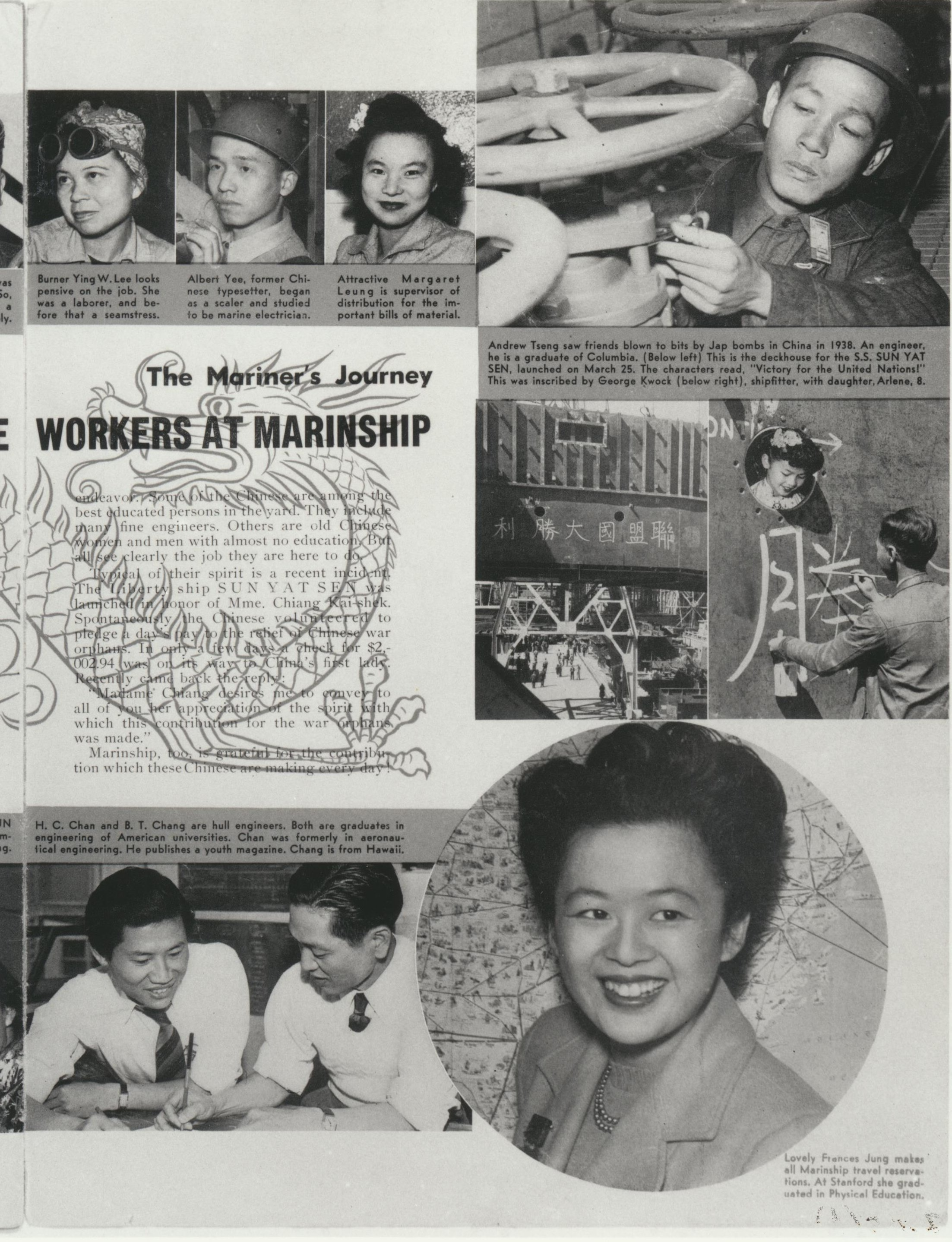
2 Photographs (from Mariner Journey) of Chinese Workers c. 1943
November 14, 2008
The distinctive Asian flavor of some of Sausalito’s most successful businesses today seems to suggest that we have long been home to a prosperous, well-received Chinese community. Not so.
Or at least not so during long stretches of the late 19th and early 20th centuries. True, the late Willie Yee is memorialized at Yee Tock Chee Park and remembered as one of our most revered businessmen/citizens. And yes, the first rail line into town was largely built by Chinese laborers, some of whom went on to farming, fishing, small business enterprises and domestic service. But the passage of the Chinese Exclusion Act by the U.S. Congress in 1882 meant severe marginalization for those Chinese already here. Not until 1943, when the Exclusion Act was repealed, was the Bay Area’s Asian community able to begin its long, slow move out of the shadows.
All of which made the persistence of a small, but enterprising Chinese presence in Sausalito, intricately woven into the fabric of local society, a truly impressive survival story.
First a little history. Chinese have lived in Marin County for over a century-and-a-half, having been among the first non-Hispanic immigrants to settle here after the start of the Gold Rush. Their first years were a relative success story. They fished or gathered seafood from local waters from as far back as 1850, operating both in the bay, mainly off Pt. San Pedro from their villages at China Camp, and in the ocean off the Golden Gate Headlands. With shrimp as their primary bay harvest, they launched the only important commercial fishery ever to thrive in Marin. They were also abalone hunters. Those operating off the rocky ocean coast west of Sausalito were the first people in California to put abalone on a commercial basis.
The story of the Chinese in Sausalito comes into greater focus with the start, in 1869, of construction of the North Pacific Coast Railroad, designed to run from Sausalito to the Russian River. During the peak construction years, until the rail line opened for business in 1875, 1300 laborers worked on it. After 1870, virtually all of them were Chinese, largely replacing the part-Caucasian crew initially hired. In an uncharacteristic move, these usually uncomplaining workers struck midway through construction, demanding and getting a reduction in their workday from 12 to 10 hours. For that, they earned $35 a month.
About one hundred worked on the Sausalito segment of the railroad, twenty-five of whom died the first winter. Along with some 15 to 20 Chinese fishermen, called “clammers,” they were confined to a lodging house at the north end of town near Spring Street which the townspeople labeled “Shanghai Valley.” After the completion of the railroad, a few of them, still harshly segregated, stayed on raising vegetables for sale, only to give up within a few years and disperse. .
By 1900, Marin County’s recorded Chinese population had shrunk from the 1,827 it had been in 1880, when the Chinese were the largest minority group in most of California, to just 489. In fact, with a few exceptions in the small business communities of San Rafael, Fairfax and Sausalito, they became almost invisible.
In Sausalito, most became household servants, quietly working within the walls of affluent homes in the Sausalito hills. In July of 1892, an employment agency specializing in Chinese and Japanese workers, sent along a “first class laundryman” to Mrs. George Harlan (grandmother of longtime Sausalito News publisher John Harlan.). According to a handwritten receipt unearthed from the archives of the Sausalito Historical Society, he was to be paid $25 per month. The Society, with its large collection of Harlan memorabilia, has an extensive memoir of Harlan’s father, George Harlan, Sr., a prominent Marin County attorney, who recalls that his grandmother, residing in the historic Gardner house at 47 Girard in the latter years of the 19th century, employed “a Chinese cook which she had for years. He was a little short man named Ah Loon and he was almost automatic in his preparation of the family meals. We didn’t have many conveniences either. The fire was stoked with wood and coal, most of the wood being cut on the place.”
This, apparently, was the signal characteristic of the Chinese servant class in the Sausalito of that era. They normally became part of these families, much valued (in some cases loved) and heavily relied on by family members to keep these labor-intensive domestic establishments going.
But not all Sausalito’s Chinese were confined to servant status. The best known of the exceptions was Yee Tock Chee, whose Americanized name was Willie Yee, proprietor of the downtown waterfront’s venerable Marin Fruit Company.
