
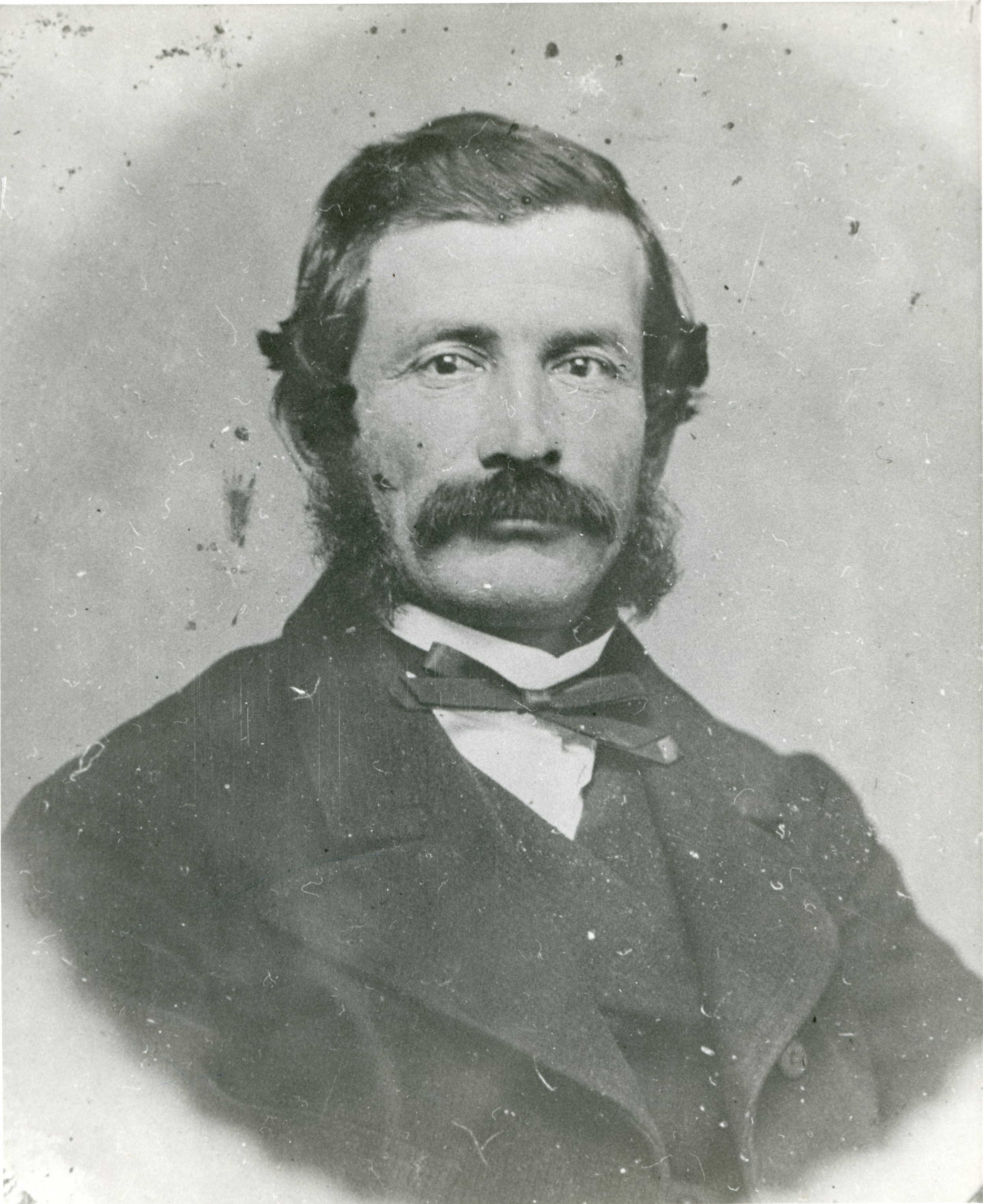
A photograph of Stephen Richardson, son of William Richardson, 1861. Handwritten notes on the back say "Stephen Richardson, age 30, from daguerreotype made in 1861 or 1862; collection of Roy D. Graves, 1201 Moraga Street, San Francisco, Calif., from the Society of California Pioneers."
November 7, 2008
The Sausalito of today doesn’t suggest enough how strongly Latin culture influenced its early development. True, “Sausalito” is a Spanish name, inspired by the little willow trees which Spanish explorers found along its shoreline in 1775. Butour few Spanish street names – San Carlos, Santa Rosa, El Portal -- are far outnumbered by streets named after our Anglo city fathers - Harrison, Currey, Easterby.
But appearances are deceiving. A little over 150 years ago, roughly between 1835 and 1846, Sausalito was the setting for a near-idyllic way of life (at least for the privileged) based on the ethnic heritage, traditions, and interconnecting family relationships of the Californios -- people of mostly Spanish descent who’d been born in or immigrated to Alta California and thought of themselves, not as European, but as Mexican. Although distinct from the native Indians of the region, they were of all classes. Some were patrician by origin and lifestyle. Others were less elite. Many were the legendary vaqueros of Mexican cowboy fame.
The string of Mexican land grants that circled the bay during the mid-19th century, and dominated the social and economic life of what was to become Marin and Sonoma, were held by prominent Californios. It was from this group that Alta California’s social elites and ruling class were largely drawn. The lifestyle that these dons or rancheros, the landed gentry, created for themselves was leisurely, pleasure-loving, hospitable, keenly appreciative of good food, fine wine, beautiful surroundings and festive gatherings. Most were well-connected native-born Mexicans who are memorialized in place names still in use today (e.g., Pacheco, Vallejo), but some were European-born of non-Spanish backgrounds. These men tended to marry into leading Mexican families – for instance, Irishmen John Thomas Reed, whose rancho encompassed the present Mill Valley, Tiburon, Belvedere and Corte Madera, and Timothy Murphy (“Don Timoteo”) who held sway in a large swath of the San Rafael area.
Among these adventurous immigrants was an Englishman, William Richardson, acknowledged today as the founder of Sausalito and the surveyor who laid out much of Yerba Buena (later San Francisco). In 1838, Richardson received a land grant of some 19,571 acres, extending from the Marin Headlands to what is now Stinson Beach and including most of the land now comprising Sausalito. He called his estate El Rancho del Sausalito and built his family hacienda on a site near today’s Caledonia and Pine Street. Notwithstanding his Anglo background, Richardson, who’d arrived in California in 1822, easily adapted to the relaxed, expansive life of the Mexican ranchero, as evidenced by his propitious marriage to Maria Antonio Martinez, the eldest daughter of the Commandante of the Presidio at Yerba Buena, his ready embrace of Catholicism and his adoption of the name Don Guillermo Antonio Richardson.
Here’s how American Charles A Lauff described Richardson at a lavish party given by Don Timoteo in 1847 at which he was a guest: “Capt. William A. Richardson (was) dressed in a black suit, wearing a wide sombrero, with long boots, and riding a beautiful black horse. His saddle and bridle were mounted in silver and gold.” (excerpted from Captain Richardson, Mariner, Ranchero, and Founder of San Francisco by Robert Ryal Miller).
The fact that so many of these land-holding families had intermarried, forming vast familial networks, meant that a great deal of time and effort was spent preparing entertainment and food (mostly with the labor of Indian servants, functioning in near serf-like conditions) in celebration of weddings, christenings and religious holidays. In a series of articles in the San Francisco Call Bulletin in 1918, Richardson’s son Stephen, then 87, recalled. that in those early days “mi casa es su casa” (‘my house is your house”) was an accepted way of life. “It was necessary for the hostess to invite practically the entire population . . . you were sure to have at least 100 guests draw bridle at your door at the appointed day. And . . . no feasts ever lasted for less than a week.“
In the eyes of some strait-laced Protestant Americans, who’d begun entering this relaxed, easy-going scene by ship as early as the 1820s, the manners and mores of the Californios sometimes seemed shockingly libertine and self-indulgent. Captain Wilkes of the American man-of-war Vincennes, having been entertained at some of the great ranchos, felt obliged to reciprocate – but at his peril. Sausalito writer Annie Sutter, in her series on William Richardson in the MarinScope (1987), quoted Wilkes on his 1841 encounter with Californios on board the Vincennes anchored off Sausalito. “A Californian needs no pressing to stay as long as he is pleased with the place; and he is content with coarse fare provided he can get enough of strong drink to minister to his thirst.”
The Arcadian way of life enjoyed by the rancheros came to an end with the Gold Rush and the American takeover of California. Richardson cooperated in the admittance of Alta California into the Union in 1850, and his wealth rose with the wave of Gold Rush prosperity that followed. But after that, a string of bad investments, the loss at sea of three ships purchased for speculative purposes, and the successive sale or mortgaging of pieces of his rancho, caused his fortunes to rapidly decline. In the end, he fell into the hands of an unscrupulous lawyer, Samuel R. Throckmorton, and died deep in debt and landless in 1856.
