
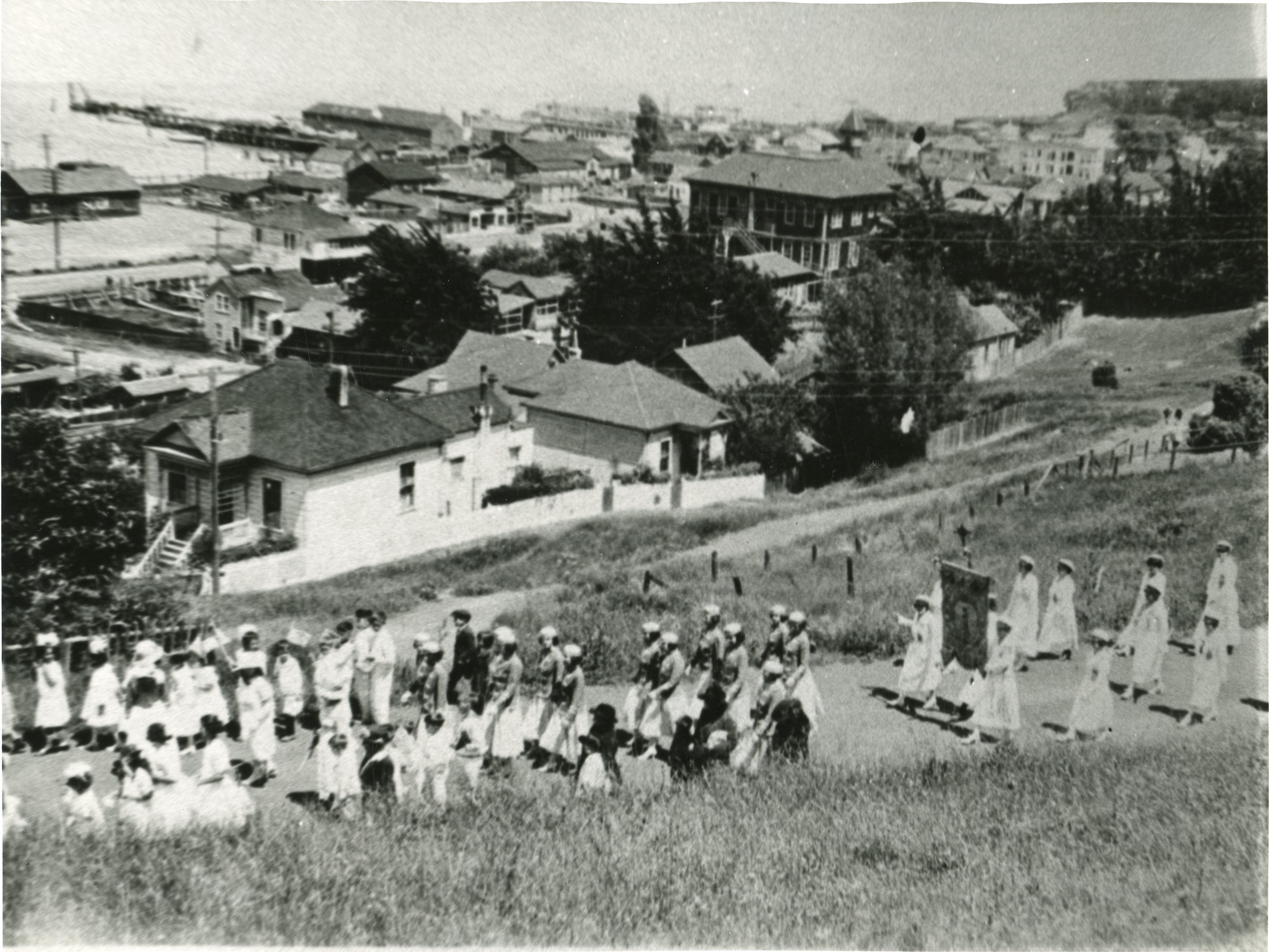
A photograph of the Chamarita festival parade on the hillside, showing the women's section of the band, 1912
By Jack Tracy | May 13, 1975
On May 31, new residents in town who happen to be downtown around noon and visitors just coming off the ferries will be in for a surprise. Winding its way down Princess Street to Bridgeway and proceeding to Caledonia Street will be a most remarkable parade, led by a bevy of young girls dressed in resplendent white gowns, the older ones wearing crowns and trailing long royal trains held aloft by the younger ones, who appear to be their attendants. Accompanying them will likely be a brass band, perhaps a small drill team, and a contingent of middle-aged men, looking very official in suits and ties, one of them carrying a giant banner inscribed with the letters I.D.E.S.S.T. Here’s the story behind this unusual tableau, as told by Jack Tracy in an article that appeared in the May 13, 1975 MarinScope. (Original text slightly edited and abridged.)
Many young Portuguese from the islands of the Azores found freedom in California around the turn of the last century, some eventually in Sausalito where they took up fishing, dairying, boatbuilding and various kinds of merchandising. Precisely why these men from the islands of Flores, St. Jorge, Pico, Faial, Terceira and others came here is lost in the generational gap between that time and this. But no doubt mandatory army service for twenty years and feudalistic land monopolies had a great deal to do with it.
A known fact is that in the 1870s, many American whaling ships from New England, always in need of crews for their three-to-four-year treks to the Pacific whaling grounds, called at the Azores for the able-bodied seamen they could recruit there. Many young Portuguese earned their passage to California that way, jumping ship when they arrived on this coast.
Most of these new immigrants had no knowledge of English. Many had no skills. But Sausalito was a natural setting for a Portuguese settlement – close to the sea, the mountains and agricultural and grazing lands. An 1887 town directory lists the names of Amarel, Azevedo, Barreros, Beirao, Bettencourt, Borba, Cardoza, Dias, Feira, Machado, Mancebo, Pedroza, Preira, Rossa, Santos, Sease, Semas, Silva, Silverira, Souza, Susavilla, Tasheira, Texiera, Vierra, Zaro and others.
The second generation of Portuguese in Sausalito brought the settlement into full flower. The language barrier had, for the most part, been overcome, and the Portuguese were actively engaged in the affairs of the city. But the traditions of their country were still a vivid memory. Like the English, Irish, Germans, Italians, Jews and others before them, they formed societies based on these traditions, one of them the I.D.E.S.S.T., which means in English translation the “Brotherhood of the Holy Ghost and Blessed Trinity.” In the Portuguese translation, the acronym stands for: Irmanda, Dur divino, Espirte, Santo, Santisma, Trindade.
The I.D.E.S.S.T., represented in Sausalito today by the I.D.E.S.S.T. or Portuguese Hall on Caledonia Street, was formed shortly after the first Festival of the Holy Ghost was observed in California in the late 1880s. It was held here in Sausalito and honored an event in Portuguese history when Portugal under King Diniz and Queen Isabel was struck by a severe famine. The Queen prayed for relief, and as with all legends based on a combination of fact and myth, it is believed that ships laden with food did indeed arrive and end the famine. The Queen offered a High Mass and proclaimed a festival, according an opportunity for the populace to rejoice.
Originally, Sausalito’s Festival of the Holy Ghost was marked by cattle being driven into town from as far away as Bolinas and Point Reyes. Along the roads, children decorated the cows’ horns with flowers. At one time a building at the end of Nevada Street (now the site of Rotary Club senior housing) was a slaughterhouse, where the cattle were taken in preparation for the feast that was to follow. The meat was blessed by a priest and given away to the needy, with a portion reserved for the festival goers. A repast of sopa (stew) and carne e vino (meat and wine) was enjoyed, followed by the dancing of the Chama Rita, a ritual traditionally associated with the festivities and since adopted by many as the popular name of the festival.
Queen Isabel’s role in ending Portugal’s 13th century famine explains the procession of young girls in full royal regalia that fills the streets of Sausalito every spring. Many of the Portuguese communities in the Bay Area take part, each sending its own Queen with a retinue of two attendants. The procession through town includes a stop for Mass at the Star of the Sea Church on Harrison Street, where the Queens are crowned. The partaking of the traditional feast takes place at the I.D.E.S.S.T. Hall.
Although, historically, the significance of the festival has been chiefly religious, it has also served as an opportunity to meet friends, renew acquaintances from other parts of the Bay Area and hold family reunions. Today, it is replicated every spring all over California and beyond.
