
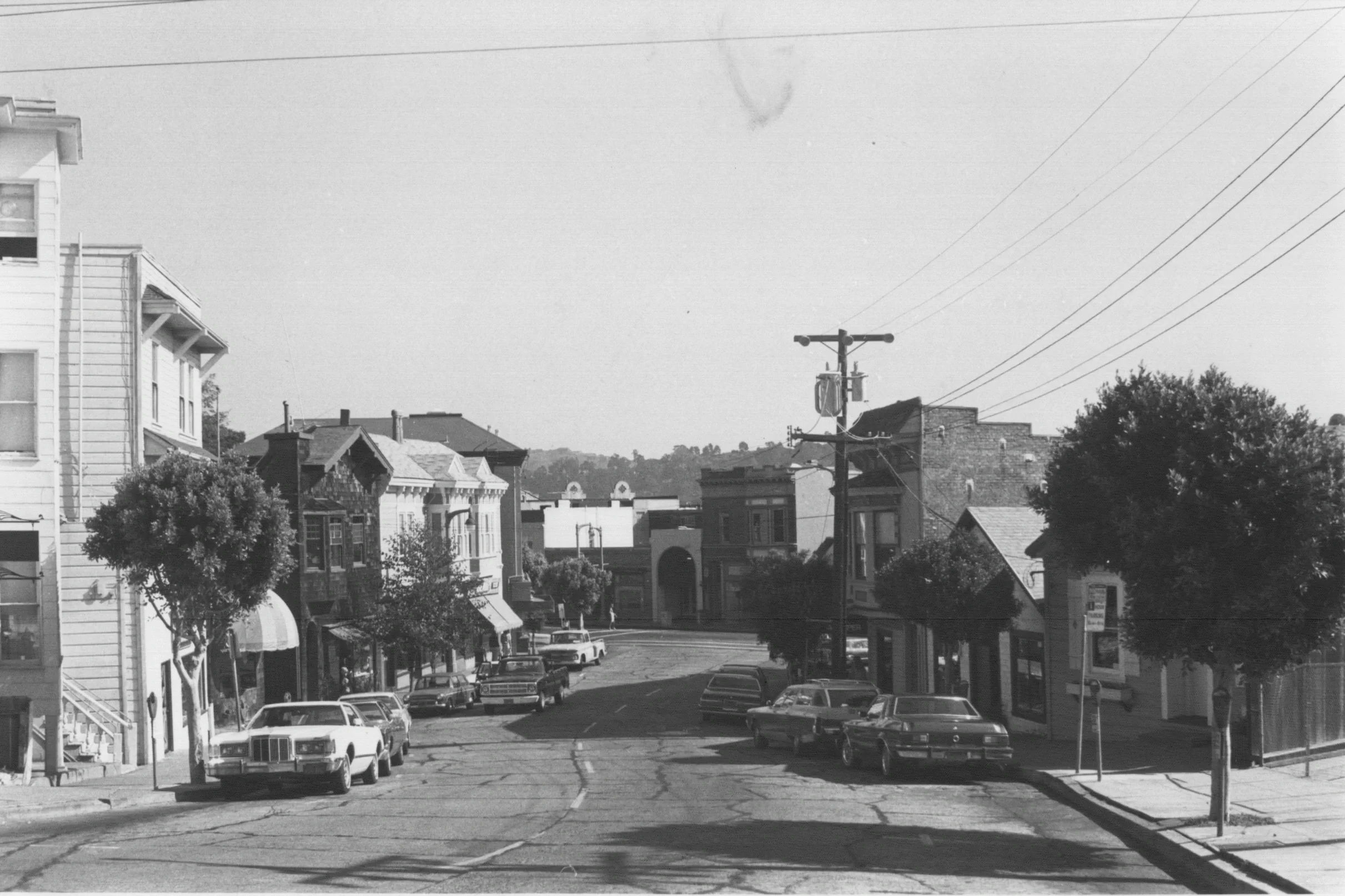
View of Sausalito
Transcript
Bill and Marina Paterson, interviewed by Annie Sutter | December 12, 1985 | Temporal Coverage: 1960 to 1985
Annie Sutter: Marina, where boats are kept. That isn't taping yet, I hope. This is December... 11th? 12th?
Bill Patterson: 12th.
Annie Sutter: 12th, 1985. This is Bill and Marina Patterson. Okay, we're at the Cat and Fiddle, the latest acquisition in a series of places that the Pattersons own. How long have you been up here?
Bill Patterson: Eighteen months.
Annie Sutter: And you also have Patterson's Bar downtown. How long have you had that?
Bill Patterson: Sixteen and a half years.
Annie Sutter: What was that like when you took it over? Did you go directly from Old Silbo?
Bill Patterson: Yeah. It was a plaza bar with pool tables. The neon seagulls outside with the bottled glass, sort of art deco in the rounded front. I've got pictures of before and after that I've kept.
Annie Sutter: Oh, it's funny.
Bill Patterson: And there was shuffleboard, real funny dark paneling, flagstone back bar, a lowered vault ceiling, where the ceiling goes up now. It was sort of like lattice work. And where the fireplace is now was the ladies' room, and where the kitchen is now is where the men's room was. So a lot of changes. It was a very popular place, I know, but it was frequented by a few Hells Angels and stuff, which we had to filter out once it became Patterson's. We still wanted to keep the locals with or without the shuffleboard. Walt had run the place himself for many, many years, and a lot of the locals really did enjoy the shuffleboard. And prior to that, they used to have the little theater in the back there, which was all modified when they put these other stores in.
Annie Sutter: All the little stores in there... it built, right?
Bill Patterson: That's right, yeah, you kind of go through that back door there.
Annie Sutter: Yeah, it was 16 and a half years in operation, and it seems like we're 26 now.
Annie Sutter: What was your experience in the food and bar business? Where did you start?
Bill Patterson: Mine started in the bar business, at a pub in Scotland that my grandfather, my father, and I owned. It's a little village pub that Marina and I have been to a number of times.
Annie Sutter: Where is that?
Bill Patterson: It's a town called Auchtertool. It's next to Fife.
Annie Sutter: Thank you.
Bill Patterson: It's in Fife, Scotland, across the Forth Bridge from Edinburgh.
Annie Sutter: And is that also where you're from?
Bill Patterson: That's basically that area, yeah. I was born in Kirkcaldy, which is only five miles away. The little village had a village store and a village pub, and the house, all adjoining. So that was the first experience of the bar business.
Annie Sutter: Did you work as a boy in it?
Bill Patterson: Yeah.
Annie Sutter: What did you do?
Bill Patterson: Washed glasses, graduated to pouring pints, and then actually whiskies. And in the store, which I absolutely detested, it was like two ounces of butter, two ounces of cheese, and half a pound of margarine, and, "please write it down, mark it down." The credit system was prevalent at that time, and in fact, when I sold the pub and moved to Canada, there were still a lot of outstanding obligations that were never quite picked up.
Annie Sutter: How old were you when you left?
Bill Patterson: Well, in '59, so that's 26 years ago.
Annie Sutter: Early 20s or mid-20s?
Bill Patterson: Yeah.
Annie Sutter: And all that time you'd worked in that pub?
Bill Patterson: Well, I began working in the pub and the store, and then I got into sales over there, I was a sales rep for a pharmaceutical company, but I also still lived at home and still helped in the pub, Friday, Saturday nights, that type of thing, or when my father and mother took infrequent vacations I would run the place. Marina and I have been back to the pub a number of times, we were back there last year, and it's really an emotional experience, not only for myself but for Marina. Well, it's been almost 20 years I've been going there, so I feel it's pretty well woven into me now. And there's this one old guy, Bob Weiss, the old guy survived his life, and he's still going strong, in fact he looked better than five years ago when I saw him.
Marina Patterson: He looks like Santa Claus without a beard. He has red, red cheeks and a red, red nose. He's just a darling, and he adores Bill, he just adores him. So he came up to the pub, he got a ride from his home, and they gave him a lift up.
Annie Sutter: Did he have a pint?
Marina Patterson: No, he was drinking rum, he's not supposed to drink. Of course, everybody gets together, and it's just wonderful. I mean, I feel probably pretty much like Bill did, except I wasn't there in the very beginning.
Bill Patterson: But the family, well, I have pictures of my grandfather in front of the pub, I have pictures of myself in front of the pub, and also my father in front of the pub, and it goes way back. Well, it goes back even before my grandfather, because his brother, or his uncle, had owned it prior to that. So it was the whole succession.
Annie Sutter: When was it started?
Bill Patterson: I don't know, well, I don't think I've even tracked it beyond the uncle. I think it's probably, I don't know, 1915 or something like that, since it was made by my grandfather.
Annie Sutter: Did I ask you the name of it?
Bill Patterson: It was called the Cross Keys, and it has since been changed. After I sold it, in fact I sold it to my barman, and he just couldn't run it, so then he subsequently sold it to someone who called it the Kiwi Inn, and he in turn didn't do too well with the place, and then he sold it to the present owner, whose name is Tom Nickel. And Tom has just been exactly what the village needed, he's an absolute character, and it feels very much the way it used to feel when we owned it.
Annie Sutter: Does it look the same?
Bill Patterson: Very little changes, yeah. The one thing which I think is a great improvement is that they got rid of the store, which I detested, and incorporated that into the pub, so you have more sitting rooms.
Annie Sutter: And a lounge?
Bill Patterson: Yeah, to the lounge from there. They built onto the house, so they've got a nice little situation there.
Annie Sutter: And Auchtertool is spelled A-U-C-H-T-E-R-T-O-O-L?
Bill Patterson: Thank you, you'd never spell it for me. Right next to Kinghorn.
Annie Sutter: We'll have you going to Canada then, right? In your mid-twenties?
Bill Patterson: Auchtertool was really the prototype of the kind of village you'd read about, or see in a "local hero" kind of story. I saw the Scottish film, Local Hero.
Marina Patterson: That was the feeling that we got, too, when we saw Local Hero. God, it's so much like that village, and the humor that went on in that film is really Scottish, it's so subtle and it's so side-splitting when you pick up on it. And that's daily life.
Annie Sutter: Did you see Local Hero?
Marina Patterson: Oh, you missed a joy, if it comes around or if it's on Showtime or something, see it. It's an absolute side-splitter because it's so subtle but very, very funny. And touching.
Annie Sutter: So Canada was a departure from Scotland that was not that well planned or programmed?
Bill Patterson: It was previously well planned, because I was working as a sales rep, and I was also working bar, and had my own car and also a rep car, so it was a pretty good situation locally, managed to take my trips to Europe every year through driving with the contents. One of my friends, we played for a soccer team, and he was really a superb athlete, and we had decided that we were going to leave and move on. The choice at that point had been either Rhodesia or Canada. It was very difficult to get into the United States at that time, because you had to really qualify, it took a long time to get a visa.
Marina Patterson: So Bill went into a very heavy training program to compete at an athletic event in Edinburgh, the team he was on was internationally acclaimed. It was a gambling event, there were a lot of dark horses running, heavy betting. Bill trained rigidly that whole winter, and I'd be pacemaking him and timing him, we were both in good shape anyway because we both played for the soccer team.
Annie Sutter: And it was a semi-pro thing?
Marina Patterson: Yeah. So, training, and Bill's timing, and he was in touch all the time with Emil Zatopek, and his timer was just superb, so he was going for the half mile. My father, who had a few extra pennies, myself, and Bill, who did not have as much money because he was an office worker and they didn't generate as much as when you're working two jobs. The race came, and it was New Year's Eve, New Year's Day, and we were due to depart in the middle of January. Bill blew the race, he froze when the gun went, and he was scared. And then eventually, when he started to go, he went right past everybody until the guy who was up front was leading, so Bill turned on the pressure, and he lost by probably about three inches, and Bill finished without even being out of breath. The guy who won was taken to the hospital. And in the meantime we lost quite a bit of money, so we went to Canada.
Bill Patterson: And I had a hundred dollars when I went to Canada, and that really put pressure on me, especially in the winter in Canada, because it's tough to get a job at all at that time. It's really interesting what you do when you're younger and don't really give a lot of thought to it, because when I first came up to the Bay Area, I think I had like $20 and a roommate who was already established, and I just kept going, she lent me money when I needed it, got a job, paid her back, I never thought about it. I wouldn't have wanted to be doing that now, you just get more into security and the whole thing.
Marina Patterson: Bill would never dream of doing something like it now.
Bill Patterson: I think it only comes when you're young, when you're crazy enough. I don't know, I still think some of the things we've done were still crazy.
Marina Patterson: Well, true, but I don't see them that way, you do them in a different manner, but they weren't reckless. You know, like what Annie does, or Pete's doing with her sailing, that's all adventure.
Annie Sutter: Adventure?
Marina Patterson: I think it's pretty reckless.
Bill Patterson: Right, well, it is, unless, I mean, I guess both of us have enough confidence in ourselves to say, hey, we can do this, and we're willing to take the gamble. Because I even had somebody who was a pretty close friend ask me what we were going to get into with the Cat and Fiddle, "gee, a lot of restaurants fail." I said, I realize that. She said, "Well, what makes you think yours isn't going to fail?" I said, we'll leave that to ourselves, why would it fail, we have a good track record. I think what we try to do is find out what people want and give it to them, that's the secret of success.
Marina Patterson: Find an ego and fill it.
Bill Patterson: No ego problems.
Marina Patterson: Yeah, no ego problems about us, no power plays.
Bill Patterson: So a lot of people wouldn't like, one of the people, a manager we had in Scotland, that's what happened to her, she was very good, very efficient, very cooperative initially, and then eventually she just got, she was struck by power. She must have suffered somewhere, there was something about her family, they lost money, they used to have a lot of money and lost it, and she really resented the class system over there, which is very much in evidence, people look down their noses, and she was very sensitive to that. So when she got the position of manageress of the hotel, she sort of got her comeuppance on a lot of people, whether they had done anything to her or not, but she just really liked using that power, and she wanted to be bad. And she was the most charming lady when she wanted to be good.
Marina Patterson: Well, she was great, I mean, we really kind of regret that that ever happened, because it was a nice association.
Annie Sutter: Well, when did you two get together?
Marina Patterson: We've been together about 20 years.
Bill Patterson: I was working at Rico's, which of course is Sarkis's now.
Annie Sutter: Did you come here from Canada?
Bill Patterson: I worked about a year, probably close to two years, in Canada, and then quit the job in Canada, I was in sales again, and I drove with an Australian, an Englishman, an Irishman, and the four of us drove from Toronto, Canada, down to San Jose, Costa Rica. My car was a Ford, a 1950 Ford. Then we sold the car, had a very sizable profit, and got the first plane out of Costa Rica, and went to Panama, and then we all split up, one went to Italy, the other one went back to Australia, my Irish friend went further south, and I finally met up with him down in Barranquilla, Colombia. And then we split up again and I wandered back through the area, and wound up in Jamaica, working there for nine months, sales again, just going along with what I am in life. Then when I made the split I went back up to Canada again, went back with another company in sales, doing very well in that, and then my father died. So I went back to Scotland and ran the pub for nine months before eventually I sold it. And then after leaving Scotland, I stopped in Toronto for a little while, and then decided to drive from Toronto to San Francisco, and at that point I was really pretty well heading for Australia. I spent about a week in the city, discovered Sausalito, moved over, found a little place up on San Carlos Avenue for $85 a month, and then started to work at the No Name Bar. So I got into sales, decided I'd wait for the Australian trip, and I got into sales, selling a few imported beers which are still being represented around the area, and in the process started to work for Neil Davis, who had the No Name.
Annie Sutter: As bartender?
Bill Patterson: As a bartender. And then finally it became more predominantly bartending, rather than the selling, and that was it, basically.
Annie Sutter: Did you do some of the bartending elsewhere too?
Bill Patterson: Oh yeah, in that same period I owned a partnership in the Coffee Gallery, which was a little place at Gate 5 Road, and we used to have all kinds of different coffees and drinks, hot spice drinks, and also we had some real good jazz. We had guys like Wes Montgomery.
Annie Sutter: Where on Gate 5 Road was that?
Bill Patterson: It was located just behind where the Mohawk station used to be. In fact, George Duke, who was really a very heavy musician, used to play there every week. Now we're in the early 60s, that was between '61 and '64, and I was still working at the No Name and also having a half partnership in the coffee outlet.
Annie Sutter: And then?
Bill Patterson: Then, you and I were at Rico's when Marina came in. Okay, well, at the No Name I worked there for three years, and in that period an opportunity arose to purchase, or be involved in the purchase of, the Blue Rock Inn up in Marshall. So I quit the No Name, kind of rashly, and I didn't really approach it in a real business-like sense. And the Blue Rock thing never did go through the ABC, which all sales should go through, the reason being it was a stock transaction. That only took a short space of time, the business was running great, the business was increasing, but they realized that the place was really heavily indebted, much more indebted than what it had been representing. Instead of an estimated $14,000 in debt, it was something like $48,000. So then there was a lot of credit squeeze, it became a point where there were just no prospects. So then that was back to square one again.
Then I worked in Tiburon, at Tiburon Tommy's, making Polynesian drinks. In fact, you might like this story, I don't know if you can print it.
Marina Patterson: No, that's not the one I was going to tell.
Bill Patterson: A real good friend of mine was Jerry Thompson.
Annie Sutter: Did you know Jerry?
Bill Patterson: Yeah, he used to do all the underwater search diving, he had a Boston Whaler, he's since passed away, he died on an operating table. Jerry heard there was a job available at Tiburon Tommy's, so we got in the whaler, went on over there, and Tommy Cox, who owned the place at the time, had a habit, maybe I shouldn't say this, but he used to drink and go on binges, and at that point he was on a binge, and obviously he was going to be incapable of working much longer that day, so he says, "Well, yeah, you can go to work." So I went back in the whaler, back to Mill Valley, changed clothes, then went back up, picked up the car, and went over to work that night. The funny thing, you don't have to print this, but the funny thing was I couldn't find Tommy anywhere to close up the place, because he had to come back and close it. So I went through the whole business, and then to close up I couldn't find Tommy, so I looked all through the building, and finally I found him on a table, and I thought he was dead, he was wearing a white tuxedo. Then the only thing I noticed was there was a sort of imperceptible movement of the chest, so at least he was alive. I tried to wake him and couldn't. So I left a note on his chest that I had the money and was available at my phone number, and that I would see him the following day. There were no phone calls the next day. So the next evening I went into work with the money bag and the whole thing, and he was totally unaware of it. Ran a hell of a business.
In any case, I worked at Tiburon Tommy's, and worked a lot of shifts there, and then finally there was a vacancy at Rico's, which was the local drinking establishment and good food establishment at that time.
Annie Sutter: I remember it.
Bill Patterson: Okay, so I started working there a couple of shifts a week, and something like ten shifts a week at Tiburon Tommy's, and then it switched over to a full-time thing, because I used to work six nights a week.
Marina Patterson: You were working all that to get yourself out of the hole, to get yourself out of the Blue Rock hole.
Bill Patterson: And then you came into my life.
Marina Patterson: Yes, and the guy didn't stand a chance.
Annie Sutter: How did you meet him?
Marina Patterson: Bob Sarkis took my roommate and I to dinner, and Bill was working, and we had a drink before we went in for dinner, and came out and had an after-dinner drink. And Bob Sarkis to this day has never let me forget the fact that I said, "Now that's the kind of guy I can marry."
Bill Patterson: Sarkis, that I knew, was all over, "Pat Patterson, you'll never make it to Australia."
Annie Sutter: And is that what kept you here, Marina?
Marina Patterson: Yeah, Australia just didn't seem that attractive to me anymore.
Annie Sutter: There were good times in those days at Rico's. Anyway, let's move on, then what happened?
Bill Patterson: Okay, probably a couple of years working at Rico's, and then moved on to Pier 15 on the waterfront.
Annie Sutter: You bought that, didn't you?
Bill Patterson: Well, initially I was just working there, and then within a month or so one of the partners had intended to get out that year, and because at that point I was anxious to get into business on my own, he felt he could get out then and there. So we transacted that deal in about a week.
Annie Sutter: You were married by then?
Bill Patterson: No, let me think, no, did we get married?
Marina Patterson: Oh no, we got married about six months after he was at the pier. We cohabitated, I'll say that. Well, listen, there was a funny thing that went on with that too, because when Bill wanted to get his liquor license, he had to go down and apply, and then they found out that we were living together, and they wouldn't give him the license.
Bill Patterson: Oh, he had to be a citizen, and he couldn't become a citizen as long as he was cohabitating, that's what it was. And then Reagan, God bless Reagan, who was governor then, put through that you didn't have to be a citizen to have a license, so we got past that. And the mistake I'd made at the Blue Rock, I did the exact same thing at Pier 15, it was a handshake, but that worked out well. So we were involved there for 14 years.
Annie Sutter: You still have it, don't you? No, who'd you sell that to, five, six years ago? Now are you strictly Patterson's and here?
Bill Patterson: Right, but from the pier by a year, to almost two years after, Patterson's was created with Dick York and Peter Wells. They put the deal together, Dick as the contractor to do the remodel, and Peter to do the real estate deal. So then Patterson's was created. And then down the road a little bit, we'd been looking for ages, every time we'd go to Scotland, to find a business. It started out to be a pub, and then it grew to something more ambitious, and we started talking to different agencies over there, and they'd send us all this paperwork on hotels, then the hotel price got bigger, and we just got crazier and crazier, and every time we'd go we'd look, which made the trip a lot of fun too, and you got to see more of Scotland, and you'd play with ideas, and look at the sheet, what the place was making, and so on.
Annie Sutter: Are you speaking of before Patterson's?
Bill Patterson: No, this is after we had Patterson's and the pier, they were both going at this point.
Marina Patterson: But there was a ranch and a Casillo in between.
Bill Patterson: In between that, yeah. Oh God, how can I leave that out. Well, that's probably because it was only a year, a year and a half.
Marina Patterson: And the ranch and the Casillo didn't, oh, there were three going at one time.
Bill Patterson: Yeah, there were three going at one time. Well, that's when we were really stressed out, because on the weekends we'd go out there Friday night.
Marina Patterson: We bought a trailer to stay in, because to be out there, and hello everybody, have some drinks, you couldn't drive back, so I would drive back in and open up Patterson's. Henry would stay at the pier, he didn't go out to the Casillo, actually Henry got the better end of the deal on this, because all he had to handle really was the pier, so he'd get us in on the Casillo down here, Patterson's, so Henry would open that, Bill would open the ranch and the Casillo, and I don't know, with Patterson's, so we did this for a long time, freezing the trade.
Bill Patterson: Winters and fog.
Marina Patterson: Yeah. And then finally we sold Rancho de Casillo, and that's what loosened up some funds and attitude to really seriously look for a place in Scotland. And Henry said, "I want to be in on it," so he trusted us to go find it, put the deal together, which we did. We spent a month and a half, almost two months, when we first took it over, in January, in Scotland.
Annie Sutter: Now we're up to present day, so this is six, seven years, six years ago?
Marina Patterson: We owned it for six years.
Bill Patterson: Eight years ago.
Marina Patterson: Eight years ago, because it's been sold two years.
Annie Sutter: Late '70s?
Marina Patterson: Yeah, it's been sold two years this month, and we owned it for six, it was eight years ago. So Bill got into the books and the business end, and I got into the kitchen and the decor. Each one tried to do what they do best, and we were happy at that, and we had evolved it for a long time.
Annie Sutter: And where in Scotland was the hotel?
Bill Patterson: It was located in a town in Scotland, which is 23 miles south of Edinburgh, in the border country, very, very beautiful. The type of hotel was a castle-type hotel, some of the construction dated back to the 14th, 15th century, and it had been modified as it went along. The place had 45 bedrooms, some magnificent antiques, also some beautiful rooms, great setting, green hills. It had seven acres of its own land, a 30-acre drive.
Annie Sutter: It was operating as a hotel?
Bill Patterson: Yes, it had been under the ownership of the people we bought it from for about 30 years, so it was a country house hotel.
Annie Sutter: So it gave you a lifestyle.
Marina Patterson: Then we got tired of living in the hotel through the six years, so we bought a house that used to belong to the estate. It was an old mill that, through the years, people had put together, four separate buildings made into a house, and then also added a kitchen. It was very, very old, very charming, different levels. So we lived in that.
Annie Sutter: That sounded like you lived there, not just went there to visit.
Marina Patterson: No, we went there four times a year approximately, sometimes five, we'd spend a month. So we were spending half our time over there, to make sure the visitors were going the right way, having the input, because when the cat's away, and believe me they did, they played a lot. Then the house that we'd moved back into, we had owned at that time, and it's a big house across the back, so we were going to the big hotel so much, we just didn't live in the big house. So we traded for a house that was behind us, this young bachelor took the big house, he wanted a lifestyle. So as we go full circle, we get rid of the hotel, then we end up buying back the house again. So it's a good trade-off.
Annie Sutter: Why did you get rid of the hotel?
Bill Patterson: It just became too much. After six years it started to lose its pleasure, it became too much work, and that's a long distance to travel each time, and when you go in you've got to rest a few days before you can really think straight, and everybody covers over everything, and the manageress was really getting goofy, that power-crazy thing. And it was the first time the employees, who were always tight-lipped and never spoke about anybody, said to us, "Look, I have to tell you, Mrs. Patterson, this lady is really out of line."
Marina Patterson: And it just, he just got tired, and we had six years of it, and he kept putting money in and wondering, well, why do we have to put so much money in, why isn't this thing sort of leveling out at some point.
Bill Patterson: Now, the way we feel about it is that we had six years of a fantastic lifestyle and an experience we never would have had any other way. We shipped home all the beautiful antiques before we ever put the place on the market, and we had bought a lot of paintings for the place, we had a custom-made four-poster bed, we shipped that home, just everything.
Marina Patterson: The only thing that we felt was, hey, we can leave the place, we can ask a really handsome price for it, we got a tax write-off, but most of all we're living with all this beautiful stuff. So six years, it was good enough, sometimes it's time to say adios.
Bill Patterson: After five years we had reached the point where, one of the fun things about owning a hotel was that when you were going over there so many times, you could actually program other trips from there, in an inexpensive manner rather than doing it from here, because there are special deals coming and going from Edinburgh, special deals from Glasgow, and such like it. So after five years we went to Egypt and Morocco, and we agonized for three days about, okay, what are we to do with the hotel. I was at that point ready to sell, I felt this is the time, when you put it on the market you should put it on right now.
Marina Patterson: I said, yeah, I agree.
Bill Patterson: And we went back to the hotel again, and at that time you go back in August and the weather is so great, and you have the grouse shooting, and you're in such up-tempo contact with the people, and there were also a number of people from Sausalito and Marin County who paid us visits, so it was just such a fun thing that made me say, I don't think I'm ready to sell right now. So we went for another year before we finally did do it, though it didn't make much difference one way or another, it all worked out, it was a good experience, I wouldn't trade it for anything.
Marina Patterson: I just feel it's just an immense amount of things for both of us, as individuals, as a couple, and like I said, to have all these lovely things to live with, there's no other way we could have afforded them, and they fit in this house just perfectly. And the humorous part is that now we go full circle and get back to the big house again, and the hotel's gone. But while we had the hotel, we had Patterson's and the pier going too, so it was a lot to stretch yourself out, a lot to be going back and forth like that, trying to take care of problems there, then you come back and they catch up here. And then finally we got out of the business partnership.
Annie Sutter: What was the partnership, 13, 14 years?
Bill Patterson: Yeah, 14 years, this is the Pier 15.
Marina Patterson: Pier 15, and also the partnership in Patterson's and the castle.
Annie Sutter: Oh, they were in Patterson's too?
Marina Patterson: Yeah.
Annie Sutter: And now you own it completely?
Bill Patterson: So now we own the Cat and Fiddle and Patterson's.
Annie Sutter: You don't own the hamburger shop next door too, do you?
Bill Patterson: No, that belongs to the Silvers, whichever one you like, so the one's a property there, and obviously he rents it.
Annie Sutter: What's Michael's last name, the guy that's running it?
Bill Patterson: Oh, the building one, yes.
Annie Sutter: Did you buy the building here?
Bill Patterson: No, we're still tenants.
Annie Sutter: What are your plans for this place?
Bill Patterson: Well, the plans for this place have been pretty much the way we've been taking it, which was initially to really clean it up.
Marina Patterson: The red light's not on anymore. She said that before.
Annie Sutter: Okay, what are you going to do with the Cat and Fiddle?
Bill Patterson: Well, what we've done since we bought it was get rid of all the rodents and roaches, the place was very, very filthy, it was very run down. Clean it up. We put in a new upstairs kitchen, more or less, to the one that was there, a new stove, hooked up an answering system, brought things up to code, refrigeration, a lot of things were just run down. So it was to spiff it up, number one. Number two, to present a really good place for locals to eat, plus of course the business coming from tourists, and I think that's what we started out to do. You always run into difficulties because of employees you get, some work out, some don't.
Marina Patterson: So the last one that didn't work out as well, when they finally left, that's when I got involved more closely in the kitchen, to direct the cooking, not on the line but in the upstairs kitchen, doing the menus, the ordering, the menu planning. I think from owners having that close contact, because you know what you want, and if you're the one who's leading it physically, because you're doing a lot of the work, then you get a higher batting average of what you want. Right now I've got myself a young head chef who does dynamite food. People who came here before, when we had a German chef, thought Freddy was terrific, now they think the food's even far superior to what Freddy was doing, I think primarily because...
Bill Patterson: I don't think we should get into that.
Marina Patterson: She's not going to quote Freddy, I don't want to get into that.
Bill Patterson: I'm getting into this on an issue I've tried to point out since we built the kitchen. The changes that have been made are that we went from a style of cooking that, to me, and this is obviously off the record, was a little bit tired, to fresh sautes, all fresh meats, fresh seafood grilled, compound butters, fresh soups made daily, these kinds of things which weren't happening initially. So it took a little while to get it in that direction. It's there now, it's just a matter of maintaining it, which takes a lot of work, but it's very satisfying, it's rewarding because people are happy, they come up and say, hey, that was great. It's not that you never hear anything negative, you can still get that too, but the batting average is pretty high, and that's all you can go for is an average, you can never be 100 percent, you can't have everybody happy, everybody's not going to like what you're doing. But we do have a local trade, and for the most part, from what I hear, they're happy, and we try hard to make them happy, we try to please.
Marina Patterson: And I think also, having known Patterson's for so many years, and realizing that just because you own a place doesn't mean it has to be status quo, you keep doing things, even though a lot of people don't notice, you still keep trying to improve it here and there. And the same thing would go for the Cat and Fiddle. The combination is kind of nice, because you get a lot of people who are out drinking at Patterson's who want food, and the locals especially, they give us good service at both places, and there's a lot of tourists that come into town too that we can propel down to the Cat and Fiddle who normally probably wouldn't find the place. Of course in the summer, when the windows are open, it looks like a little sidewalk cafe, that gives you that feeling, so when you have so many bodies in town, there's no problem.
Bill Patterson: For the most part, we're doing okay.
Annie Sutter: Okay. Before I forget, I want to ask, I know that you have feeds up at your house with game, tell me about that.
Bill Patterson: Well, yeah, and we still have feeds at the house, not necessarily in such large quantities with the game, because for a number of years we had ranch property, and that was a recreation, to go up to the ranch and fish and periodically hunt, and just basically get away, a lot of our close friends were invited up there, so we had some real great times up at the ranch.
Marina Patterson: Memorable.
Bill Patterson: Yeah, really memorable, things you'll never forget. Now, in the process of moving on and doing things, and finding that you kind of outdistance the property, the place that used to be so great started to get very populated, so that affected a whole bunch of the enjoyment, so we decided to sell, which we subsequently did. We have a place in Colorado, and from Colorado we manage to have elk every year, and that provides us and some of our close friends with some great meals, and the quality of elk meat is just so wonderful, in contrast to normal beef, because of the type of living standards the elk maintains rather than the steer.
Annie Sutter: What other kind of game do you have on your table?
Bill Patterson: That's basically all we have at this point. Well, we used to have wild boar.
Annie Sutter: Where would you get that?
Bill Patterson: Up in Sonoma, west of Sonoma, from the ranch, and coastal deer, and, oh, of course, wild duck. Venison is back in Colorado too, but once you have elk, you don't need anything else for the rest of the year, there's so many ways you can cook it, like the roast, you cook it on the rare side and serve a really nice sauce with it, wild rice, vegetables, baked biscuits. And with the ground meat, our favorite thing is to make tacos, just the best tacos in the world. And the steaks, just a nice fast saute with some sauteed onions is just wonderful, so you've got different ways to use the meat, and you can also stew it. It's just like having high-quality meat, in fact it's so much higher quality than beef and even lamb because it's so lean, it's so pure, because it grazes, no injections, nothing, it's just all natural. And out of the elk last October we came back with pretty close to 300 pounds of dressed meat, no bones and no fat, that goes a long way. But we'd still do a big party, and there's a party planned for Christmas, when we have a considerable amount of dinner.
Marina Patterson: Well, there'd be a mixed variety of interesting things, and of course a lot of ethnic Greek dishes because of my background.
Marina Patterson: Bill, in his days when he did hunt, went on different trips, like we drove up to Kamloops in Canada one time, packed in for a couple of weeks in this camp, sat right on the lake, it was 50 miles from everywhere, and he didn't have success, so then he flew back up and flew in on a private lake plane that landed on the lake, and just before all the swirling clouds and snow came in, Bill got his moose and flew home with it. So we had that for almost two years, it stays good in the freezer that long. So on one Christmas we had some venison, maybe venison jerky or sausage, and then we had the moose roast, we had wild pig, these kinds of things.
Annie Sutter: Are the heads in Patterson's ones that Bill shot?
Bill Patterson: Bill shot.
Marina Patterson: There's actually just the one head, and then there's one in our house, in our barn, and he shot both of them.
Annie Sutter: You always do a Christmas party, don't you?
Marina Patterson: Well, we always do a party for close friends and for really special customers, a nice big party on Christmas Day at our home, and it's always fun because Christmas is so special anyway, and it comes off in a real festive mood, and this house is the most perfect house to have a party because the size of it, the feel of it, it's got the great views.
Annie Sutter: You used to live up there, didn't you? Well, I was house-sitting on Cloud View, just last summer, not very long, but I know the area, it's great. It's probably like 75 people coming?
Marina Patterson: Probably. Last Christmas, for instance, when we still lived on Santa Rosa, I did Greek leg of lamb, and we had fried quail, and poached salmon decorated in aspic, although we also had a ham done the same way, different kinds of salads and cheeses, I mean it's a feast, it's to celebrate.
Annie Sutter: I've heard about it. You mentioned being Greek, tell me about that.
Marina Patterson: What's to say, yeah, well, you're American.
Annie Sutter: Oh yes, where were you...
Marina Patterson: I was born, actually, in Ventura, California, raised in San Diego. My father and both sets of grandparents were born in Greece, and my father came over when he was about 10. My mom was born in San Francisco and raised in Santa Barbara. From both sides of the family it's been the restaurant business, not the bar end, but the food end of it. And even my mother's parents had a canteen in the restaurant when she was growing up. My mother remarried, and while I was growing up, my mother and my stepfather had a restaurant. So that's like second nature, I had to cook all my life, it's just a real natural extension, it's nothing unusual. And actually, it's kind of fun to really capitalize on something you've just always done and never gotten paid for, to finally get some kind of consideration and recognition for it. You get it when you have the parties, everybody says, oh, that was terrific, really loved it, but it's different when you get paid for something, it gives you bigger strokes.
Bill Patterson: I'll tell that story, yeah, that's for sure, the old garbage can routine. That was uniquely funny too, that fellow, that little devil. And then you had the old note that he stood on, what was that? The one when he was at the bar and he orders a pint of Bass, and then he puts up a hundred dollar bill, and at that time, which is actually the same as this time, because there's some bad hundred dollars in town, so the bartender asked him for his identification, and I was sitting there at the bar, oh no, please don't, I know who that guy is. And actually since that time, in fact we just saw Clint about a couple of weeks ago, he was in the bar, so he's been periodically dropping in and keeping the acquaintanceship open.
Annie Sutter: You're friends with him?
Bill Patterson: Well, yeah, I'd say we are, we've been out for dinner and he's been at the house for dinner, but it's not one of those like...
Marina Patterson: We're not bosom buddies.
Bill Patterson: We're not bosom buddies, but there's enough there that when we hook up, like a couple weeks ago, there's a lot of things to talk about, because we haven't seen each other for a year or so, maybe a year and a half, maybe less than that.
Annie Sutter: Got any stories about some of the funny local sailors?
Bill Patterson: I mean, there are, but there's been innumerable, I can think of so many things. Spike Africa, let me think of that, maybe I can get to some later.
Annie Sutter: Put that aside for future thinking. Well, what do you think of Sausalito today compared to when you came?
Bill Patterson: Well, I think everything to some extent is relative. I know there's been a lot of changes, some perhaps not for the better, but on the other hand I know that I'm still enjoying life in Sausalito, and I'm still enjoying a lot of the people that live here. The climate and living in Sausalito is awfully hard to beat, no matter where you go in the world, so whether it's been downhill or uphill, I'd still have to say it still looks awful good to me.
Annie Sutter: Are you glad you didn't go to Australia?
Bill Patterson: Yes, very much. I've seen the changes, but it's sort of like the changes that happen in you, as time goes on these things are bound to happen. I think most of the things that have gone on here, with the exception of maybe a little question mark on some of the commercial buildings that seem to have glutted the town, overall I think it's better than it ever was before, a lot of the things have been a real plus. And of course, coming down here being a local on the weekends, it's not any place to be, but it's a trade-off, especially being in the business, we need these people in order to support all of these businesses, not just the bar and restaurant but all of them, they all need the traffic in here.
Marina Patterson: I think Sausalito shouldn't even claim to be a great town, it's just a special place, I wouldn't live anywhere else. We've lived in a lot of places, this place, this is it.
Bill Patterson: We've talked about it when we've been traveling, is there any place else you'd want to live, I mean, if Sausalito was home. And I can remember way back when I was working for Kenny Bartholomew in '61 to '64, at the weekends you'd do the same thing, you'd try to get into town the easiest possible way, number one, and parking was always a problem even then. I think people have just forgotten.
Marina Patterson: Because I remember the first time I ever came to Sausalito, I didn't know what Sausalito was, and I was with a bunch of people who were on their way out to a fair, there was a big swimming pool, some festivities going on out there. I was probably in my early twenties then, and there were like six of us in a car, and they wanted to drive through Sausalito, and of course it was bumper to bumper, I don't know how long it took us to get from one end back up to the highway to head north. I thought, oh, that's Sausalito, boy, I don't want to go in there again, it's bumper to bumper.
Bill Patterson: So that was the same, but it really hasn't changed, everybody keeps grousing, but it really hasn't changed in that sense, the traffic problems, all the tourists, which are necessary.
Marina Patterson: I think also, probably because you own businesses, you're much more lenient than a lot of attitudes, because you know that in business you have to compromise so much.
Bill Patterson: In any case, you've got to give and take, your attitude's more lenient.
Marina Patterson: Yeah, you have to give and take, and you don't want to bastardize nor do you want to prostitute, but by the same token you have to survive, and that's the game, survival.
Bill Patterson: I still love it.
Annie Sutter: Thank you, Bill and Marina, and we'll leave the tape open for a couple of the incident stories that you'll pick up in the meantime.
Bill Patterson: They insisted upon it, he did it with one of those paper towels, but he did it in front of a big crowd of people, of course he didn't really object, he was a real personality, there's only one like him.
Annie Sutter: Did you see Sterling at the No Name?
Bill Patterson: I remember when I worked there, yeah, yeah, when they took off with the kids, I guess that was the time when they split, for tax reasons or something like that. He used to come in with his wife a lot of times, she's a very elegant lady. There's an Irishman called Peter Campbell, who was also one of the crewmen on the boat, Peter might still be around the area somewhere. Jim Brogan, yes, salty, cantankerous, and inimitable. He has a particular preference for the corner near the window, and to the extent, sometimes, that he's extremely unfair to a lot of people sitting there, or maybe a little cranky.
Annie Sutter: You're a real traveler.
Bill Patterson: So, I don't remember precisely, but anyway, there was a stranger who came and sat down on that stool, and the bartender working at that time served him, and then shortly after, Jim Brogan walks in. He comes into the bar, heads for his corner. Somebody said to him, one of the customers, not the bartender, "You know, you're sitting on Jim Brogan's stool." The stranger said, "Oh, really? Yeah, as a matter of fact, I am." And Jim said, "You know, you really are Jim Brogan? Because I'm Jim Brogan too, sitting in my own stool." So there were two Jim Brogans, and they wound up sitting there talking, comparing names.
Annie Sutter: I remember when I first came around with Peter in '73, '74, all the yachtsmen came in there, it was filled with everybody we knew, and then that seemed to stop.
Bill Patterson: You still get them, at the weekends, I'm just not there in the weekend evenings, because most of these guys go out at the weekends now.
Annie Sutter: I ran into some of them over at the yacht club the other day, people saying they've been over there drinking. They went over for Peter Gibson's memorial. They ran into a few people who were still going to Patterson's.
Bill Patterson: I don't think they're going with such great frequency, they're straggling in.
Annie Sutter: But they're racking up a bunch, aren't they?
Bill Patterson: I don't know. Sunday afternoon you'd be out with that whole crowd, but maybe they're still there, I don't know. This is going back to the early days, they were in regularly, regularly, and then all of a sudden stopped. And now, lately, in the last couple of years again, I've seen a few of the group coming in regularly, they look a lot older than they were when they were originally coming in. But there are people who now live out of the area and have the boat in Sausalito, and they come up at the weekends and sail. So the others are no longer in the area at all.
Marina Patterson: I think it goes with the changes, people just make changes, they have different set patterns, and also a lot of people leave, they're not around here anymore, it's an expensive area, they have to go north, Petaluma, Santa Rosa, and further north.
