
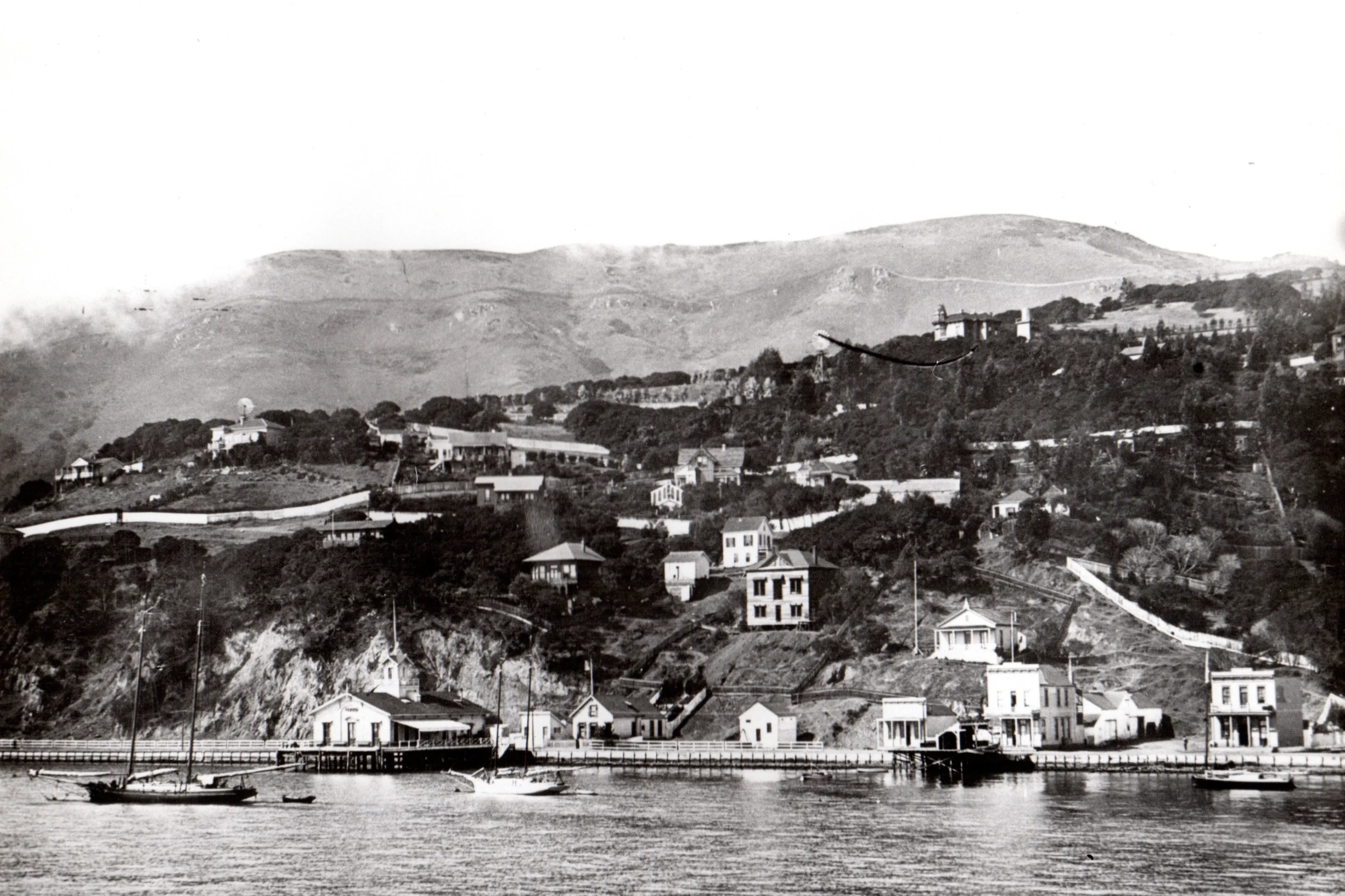
View of Sausalito
Transcript
Lou Jones: The three things that I think a typical service station operator has to deal with: first is the relationship with the oil company, good, bad, or indifferent. The second thing is the relationship with the public. And then, of course, the third thing is the relationship with the employees. And it's the employees, I guess, that have kept my wife and me more or less young and stimulated that way. We're always having a battle of wits with kids that are 18 to 20, 22 years old, and they won't believe that I have seen it all before, many, many times. They come along with a fresh idea, a new way to con me out of something that's relatively harmless, but they won't believe that I've been there before. That's one of the things we're a little bit terrified about, retiring, because all around us, for instance in our neighborhood at home, it's all old people, and they're going fast, people in our own peer group. So the only relationship we have with young people is the employees at the station, and I've got a fabulous bunch of characters down there too. So that's that. And then, of course, being a neighborhood dealer for 28 years, I've seen a lot of peculiar things come and go with my customers. And then for the oil company, just like today, 28 years is nothing, I'm still fighting. That's about it.
Annie Sutter: When did you come to Sausalito?
Lou Jones: Let's see, it was November 19th, 1957. And the station, when I took it over, it was a mess, it was failing badly, even though it was a comparatively new unit, but the location was fantastic. In fact, I'd commuted to the city back and forth in front of that location for about ten years, well, five years, and never even saw the service station built. My timeline's a total blank that way. And then it was really going downhill.
Annie Sutter: How many years did you say it had been there when you took it?
Lou Jones: Roughly two. I think it had just been built two years previously, but I was the fourth operator in that short span of time.
Annie Sutter: What was there before it was built?
Lou Jones: It was just a huge vacant lot with a creek running through it. And in fact, the creek still runs through it.
Annie Sutter: Oh, I'd like to hear about that, because that's probably the original creek that Richardson took his water from.
Lou Jones: Right, because all that water that comes down from up the canyon, which is very pure stuff. In fact, Fred Now, one of the real old timers in the canyon, he gets his drinking water from it. That's one of the things I've got to find out. I'd like to go up and go through all the caves up there that actually have iron doors, barricaded. When you open them, you go back in there and all you can see is a black pool of water for as far as the eye can see.
Annie Sutter: Who put the iron doors on them?
Lou Jones: I don't know. It was done a long, long time ago. But Dave Hodgson was the one who seemed to know quite a bit about it. I think that's off of Sausalito Boulevard someplace, way up at the top.
Annie Sutter: But you never went to look?
Lou Jones: No, never had the time. But I'd just love to go into that, because with all this that's been going on with the highway since the big slide up there, they tell me that water problem is still going to cause them trouble if they have a real wet winter. This was talking to one of the superintendents with the contractors doing all the work up there, and according to him, if the drains they put in ever plug up, the mess will start all over again, because of the tremendous amount of water up in that hill. But anyhow, it comes right down the creek, right through the middle of the station.
Annie Sutter: How does it come? Is it under the ground?
Lou Jones: Well, at my service station there's quite a bit of underground flow. In fact, to sink the tanks, they had to fill them with gasoline and sink them to hold them down while they poured the slab over, because they were floating in fresh water.
Annie Sutter: Is this water contained in anything, or just an underground stream?
Lou Jones: Just a huge underground stream.
Annie Sutter: Where does it come out?
Waitress: Do you want to order, or should I come back in a few minutes?
Annie Sutter: Okay. You were talking about the water underneath the station.
Lou Jones: That's where it comes out. It would have been natural spillage under the old Nunes Boatworks. And when they built the Portofino, across the street from his apartment house, the water problem was such that, in the concrete walls they poured for the lower deck, they had to put in huge drain tile to slip the water away from the creek. Water flows in and around and under my station all year long. In fact, the asphalt paving at my station usually goes bad in the summertime, not in the winter, and the water is still under there, close enough to the surface that these huge trucks turning around all the time just keep tearing it up. And then there's water that runs down the hill along 2nd Street. And in the lot next to me there used to be a Chinese laundry. Are you familiar with that?
Annie Sutter: What was around there when you came?
Lou Jones: Well, it was a Chinese laundry, and then there was nothing up on the corner of Valley Street at the time that I can recall. There might have been a small building there. But when they cleared it and started to build 300 Valley, which is the office complex there, the Chinese laundry, and the lot next to me, which I didn't know at the time, had been using well water all the time. They had a huge well and were using well water. And when they were clearing off the lot up above them, they ran across the well with a caterpillar tractor, and the tractor hit it and punched it down. The hydraulic action just punched the water up into the Chinese laundry, and about a seven or eight inch tide of water just came roaring through the laundry. The Chinese came roaring out, cats and everything else. But the whole area is just saturated with water, and it still runs all year long. It comes down 2nd Street, comes under my station. It doesn't drain, I don't notice any drainage in the storm sewers coming down Main. But that one on 2nd Street, that drains all year long.
Annie Sutter: What else was down there when you came? What other buildings?
Lou Jones: Well, the Nunes Boatworks, across the street.
Annie Sutter: I'd like to hear about that.
Lou Jones: That was, in a way, a really nice place. Let's see, there was Jim, I can't remember his last name, and his dog George, who was such a character. And his brother Hanson, that was it, his brother had a boat he anchored down there. And then Mac was the other one who had a boat anchored down there, two party boats. In fact, I just ran across Mac at Petrini's about two weeks ago.
Annie Sutter: What boat did he have?
Lou Jones: Oh, lord, I'll have to pass out.
Annie Sutter: Was that the Idabel?
Lou Jones: Yeah, yeah. And he's running out of, I guess, Crusoe's now. But he had a real swell deal going down there. They had that at Gate Harbor, and they had quite a few boats down there for pleasure. You remember the Nunes family?
Annie Sutter: Oh, yes.
Lou Jones: Ernie, he's gone now. And his sister still lives up on 3rd Street, about the middle of the block. And there was this fellow Campbell, who married one of the Jims. He was in on the building too. Campbell, I guess, was an old-time Chevrolet dealer. And then you had Big John, who worked for the street department of Sausalito. He was the foreman over there. And in fact, the last boat I saw built there of any consequence was the powerboat for Coke Lucky, for Murray Coke, one of the Coke brothers in Corte Madera. And for some reason the design never worked out, it never ran properly, they could never get it up to speed, or whatever it was.
Annie Sutter: Well, it was being torn down pretty quickly after you got there then, wasn't it?
Lou Jones: Yes, that was, let's see, that would have been in the early 60s, around '63, '64, somewhere around there.
Annie Sutter: Oh, I think it was earlier than that, when the Portofino went up and the Nunes yard was torn down. You, of course, were right there when that happened.
Lou Jones: Yes, that was one of the most pleasant interludes we ever had at the service station, because the Nunes Boatworks, which were huge sheds, were gone, and we could see out over the bay. And they still had quite a few large ships coming through Raccoon Straits. Every once in a while you'd be working and you'd look up and there'd be a huge tanker or something coming through the straits, and you'd just stop what you're doing and watch it. It was really something to be able to see that view out there all the time. I guess it lasted for, oh, maybe about a year, year and a half, and then the building was erected and blocked everything off again. But it sure was enjoyable while it lasted, I'll tell you that. That's, then of course, the Ernie Nunes, he was the one who designed, what was that small boat he designed?
Annie Sutter: Bear.
Lou Jones: Bear. And then he moved into the huge old warehouse next door to the station, which, incidentally, is going to be torn down. I don't know if anybody's got any pictures of it, but it would be a good idea to get some.
Annie Sutter: Is it a fact that that's going?
Lou Jones: Eventually, because it's condemned, the city won't allow anything in it. But it won't be long. He moved in there and started building his kits.
Annie Sutter: Mercurys.
Lou Jones: Yeah, Mercurys in there. And then the last person in there was a sculptor who moved down to Gate 5 Road, but he built huge things, and he lived in there, and that's when the city cracked down. They wouldn't allow anybody to live in the place.
Annie Sutter: What else was around down there?
Lou Jones: Well, let's see, when I moved in, coming to the station just about that time, Al Leet, who incidentally owned the property the station was built on, I was in the process of leasing out on the Golden Gate Market.
Annie Sutter: Was that a market at that time?
Lou Jones: Yes, it was a market when it came in, yeah.
Annie Sutter: Even called the Golden Gate Market?
Lou Jones: Mm-hmm, that's right. Then across the street from the Juanita's corner, on the corner of Sally's lot, was a couple of bungalows.
Annie Sutter: They're not still there?
Lou Jones: No, no, they were wrecked a long time ago. But there were those two small bungalows, because I remember Billy, who was our parking lot attendant for so long, he used to live in one of them. And then I lived in the corner one. And then there was, let's see what else was there at the time or wasn't there, 300 Valley wasn't there, that office complex. Then that 22 2nd Street, that big horrible green apartment, that was built right around that time. Oh, and then that one right behind the station, that three-story triplex, six units, that was built after. That was just part of the vacant lot that went right around the corner. Then one of the things that was up on the corner where the vacant lot is now was the Glass Company, and Old Red, what was his name, I forget, he ran the Glass Company. Huge redheaded fellow, no stranger to the booze either. The glass shop was right next door to the plant, right on the corner. The most fantastic mirrors in the world were made there, in a completely dusty, dirty atmosphere, but this guy turned out beautiful, perfect mirrors. People never could understand how he did it.
Annie Sutter: Off the record. Let's see what we've got to take, Historical Society.
Lou Jones: Pardon?
Annie Sutter: Those are the two that are on 2nd Street.
Lou Jones: Well, they were there when I was there.
Annie Sutter: What went on there?
Lou Jones: I'm trying to remember who the painter is that came in. It was Asbury Painting that did the beautiful paint job on it, Luke Asbury and his wife Susie. They were just more or less neglected before that. I remember the two bungalows on the corner were painted hideous red, almost matched the laundromat across the street. And the reason I remember that, one time some fellow pulled up in front of the laundromat, left his dog sitting in the car with the engine running, and the dog was seated up behind the steering wheel. Huge dog, stood up and looked like he was driving the vehicle. And all of a sudden something let go, the vehicle rolled across 2nd Street and punched into the boards on the side of the house on the corner of 2nd and Main, with this dog still sitting behind the steering wheel.
Annie Sutter: Was it one of Sally's bungalows that got punched into?
Lou Jones: Yeah, broke a couple of the boards on the outside of it. Those were the two that were wrecked to give them more parking space. And then she had Asbury Paint come in, and they extensively painted the inside and outside.
Annie Sutter: Those were residences, they were always?
Lou Jones: Right, yeah, those two. And I don't know whether they painted the one on the waterfront, the one that's been remodeled, that she used to live in. But those two on 2nd Street.
Annie Sutter: What was in the building where Meats and Bounds is now?
Lou Jones: Meats and Bounds, there was, one time, a bar and a coffee house. Two of the fellows who opened it, one of them was a law book salesman, he's back doing that in Nevada as far as I know. And the other fellow was a huge, tall fellow, looked kind of like, who's that guy who played Lucas McCain?
Annie Sutter: O'Connor? Connors?
Lou Jones: Chuck Connors?
Annie Sutter: Yeah.
Lou Jones: Dead image for him. The two of them were partners in this Old Town Coffee House, and it was open for a couple of years. That's when they first started bringing back steam beer, Anchor Steam Beer, because it was in that coffee house, the Old Town Coffee House. And I don't know whether Mr. Lee owned that building or not at the time, I think he did. There was a building in between those that he had to wreck in order to make a loop around for the parking lot. The Old Town Coffee Shop, that was a coffee house, it was pretty good, it went broke. Too much out on the check, nobody would pay the bills. There was this fellow, Dave, Dave was his name, and he wore a bowler hat all the time, he had a dished-in nose. And when they split up, he went back to Nevada selling law books. And the other fellow used to be the manager of the Tin Angel for Peggy Tote Markets, when she had that place going on the waterfront over in the city. That was there where Meats and Bounds was. Then, at my station, where the lube bays are, it was a duplex, and then in front of that was Wally Kibbe's card shop. He had an exclusive on Marty Link's Christmas cards. It was just a frame building covered with masonite on the outside. It was cool. Wally Kibbe was there, and Nan, she's an artist here.
Annie Sutter: Fowler?
Lou Jones: Huh?
Annie Sutter: Fowler?
Lou Jones: No, not Fowler. No, it definitely wasn't Nan Fowler. No. It was her and Molly, they were together for a number of years. She had a friend, Calla Fleming, an older lady who worked for them. She more or less helped out in the card shop, worked full time there. She had been a model in New York at one time, and I guess she'd tangled with the alcohol fame and all that stuff, but she had one of the most beautiful faces I've ever seen on a woman in my life. She and her husband lived just off that street that goes to Mt. Tam, by the 2 a.m. Club up there in Montford, just off of Montford. Something here about a year or so ago triggered it off, and I called up to find out if they were still there. Her husband, John, she answered the phone, and I had quite a talk with her over the phone. And then two weeks later, she died. That's how close I came to not being able to talk to her anymore. She used to have a woman who lived on the waterfront, who had one of these long Scotch wigs, and she used to babysit for the pug there, she had one of these little schnauzers. So if Cal came to work at the card shop, she'd take her schnauzer down there and leave it off at this woman's house. This woman was a dour-looking little Scotswoman, very pleasant, but fantastic people.
Annie Sutter: Well, did you not live here at all?
Lou Jones: No, I always lived in Corte Madera.
Annie Sutter: Oh, I didn't realize that. When you bought the station, you lived in Corte Madera?
Lou Jones: Right. The reason we lived in Corte Madera was because you have a lot less fog there than you do down here. The climate is nothing at all like it is in San Francisco summertime. The first summer we worked there, yeah, I wore long underwear, June, July, August, right on through September.
Annie Sutter: Where did you come from? Were you born there?
Lou Jones: No, no, I was born in Washington, but I lived almost all my life in San Francisco, raised there.
Annie Sutter: Where'd you go to high school?
Lou Jones: Oh, Poly, Washington, Polytechnic, in Washington. It was sad to pick up the paper and see all that about squatters and Polytechnic. And then Presidio Junior High. And then I really started in the service station business with my father, on Howard Street, when I started the service station business. And I took it over completely after that. And I had a partner, we went into the garage business, and we sold the lease of the garage so both of us could make down payments on homes over here. He had already moved from the county, so I saw the house and fell in love with it.
Annie Sutter: And was this station your first job on your own?
Lou Jones: Right. We had been partners over there in the parking lot, one of those things where the bid was escalated every year, every five years when it came up for renewal. I knew that only one of us could survive if that happened, so I pulled out and went back into the service station business. In some respects I wish I hadn't. If I'd gone into anything else at that age, I'd probably be pretty successfully retired right now. But then, on the other hand, it wouldn't have been as interesting.
Annie Sutter: Well, you got very close to a lot of your customers. Who comes to mind as an interesting character of Sausalito?
Lou Jones: You'd be better off if you asked who doesn't. I could probably name five individuals, and that would be it. In Sausalito, people are all characters, I mean, to the extent that they're different than people are anywhere else.
Annie Sutter: Why is that?
Lou Jones: I don't know. I'd say one thing is the money seems to flow a lot freer, for one thing. It's more or less an easy come, easy go atmosphere, as far as working hard goes. But the thing of it is, they have my philosophy too, and that is, if you need money, go out and make more. And that's what I've seen people do, start out in one or two jobs, nothing, and progressively work their way up the line to totally get what they want. It's their ability to sense things. It's a pretty free and easy society. It's nothing like a typical bedroom community. First place, people come over here, they move over, and in six or seven weeks or months the cost of living catches up with them and they have to go back to the city. That's why you have such a huge turnover. Somebody told me one time there was about two hundred rental units a month or something like that turned over, I don't know, I've never gone out of my way to check that figure. I know it's, you pick up the phone and all of a sudden it's disconnected and they're gone. There's people I know who've moved back east and gone up in jobs, like I was telling you the other day, Miss Sausalito's abandoned, they just throw up their future and come out here and start all over again. I've seen that happen a number of times. It seems to be the bay, and of course the boats, most of them had boats, and the sense of humor. There seems to be far more of a sense of humor.
Annie Sutter: Think of a couple of funny stories?
Lou Jones: Oh, we were thinking about one the other day. I won't mention the gentleman's name, but he had more or less a roving eye for the ladies. He was married and had three children. And I happened to read one evening in the paper about the dissolutions filed in the Independent Journal, and their names were listed. So he came in the next morning, drove in on the pumps to get gas on his way to work, and I remarked, I said, "I'm sorry to see you're breaking up." And he says, "What do you mean, breaking up?" I said, "Well, I see you filed for dissolution of your marriage." He says, "That's news to me." I said, "Well, I saw it in the paper last night." So he says, "Well, I'll be right back." He slammed into the car and did a wheelie out. About ten minutes later he came back, and he says, "You know something, Louie? You're right. She just threw me out of the house." Things like that. And then, of course, the gentleman that lived up at the top of 4th Street, he had a party going. This woman came up and couldn't find a place to park, so he said, "Well, I'll take your car and go park it." And he had this huge, great, dumb dog. So he gets in the car, and the brakes failed completely. He rode that car clear down the hill to Valley Street, banged off the wall where it turns, went straight down Valley Street and right through those two garages at the end of Valley Street, and right over the rail, down to the city beach, upside down. He crawled out, the dog was mangled up, the dog came running by the station, blood, we didn't know what the heck was going on, but then we found out what it was all about.
Annie Sutter: But he wasn't hurt?
Lou Jones: No, minor injuries. The scope of the car was demolished, just trying to do a good turn for a guest.
Annie Sutter: Speaking of dogs, before I forget, let's talk about the famous Ziggy.
Lou Jones: Oh, Ziggy. That brings up something else, the mannequin too. Ziggy, I guess, was when the station was rebuilt, that was in 1971 when they remodeled it. Bill picked this dog up someplace down on the Bridgeway. According to Bill Erskine, who worked for me for 14 years, he went in to pick this dog up because he thought the dog was being abused. There was a hassle over the ownership, but Bill prevailed, and he brought the dog down at the time they were remodeling the lot. We were on the corner in a little shack, running the whole operation, tow trucks and all. Ziggy was roaming around the lot, and then after the station was built, Bill, who lived across the street on 3rd and Main, on the top floor of the duplex, he'd tie the dog up over there, because I didn't want the dog running around, I was afraid he'd get killed. All the neighborhood dogs would pass that dog and test him, see how far he could come out on that leash. They'd torment him and torment him, all day long, day in and day out. So finally I told Bill, bring him over here, we'll just have to train him to stop it. Every dog from then on that ever crossed that lot, the minute they stepped on the lot, he had them. And I've never seen a dog whip two or three others in a fight the way he did.
Annie Sutter: Well, with him, was he a little bit of a psychopath when it came to dogs?
Lou Jones: Because he was young when all this tormenting was going on, there was no question about it, if you let Ziggy fight, he would kill the dog. So Bill and I were perpetually in the middle of the dog fights, pulling dogs this way and that way, and Ziggy.
Annie Sutter: Would he only fight dogs that stepped onto his lot, or would he fight them across the street too?
Lou Jones: We trained him pretty good. I'd been out walking with him, and he'd seen dogs, and he would just go nose-to-nose like a dog and leave them. He'd get back to the station, and that same dog stepped on the lot, and that was a different proposition.
Annie Sutter: And if he was on the sidewalk, it was okay?
Lou Jones: Yeah, if he kept his foot off the lot, it was fine. But if he put his foot on the lot, that was different. If they walked across the lot, if they cut the corner, and you know how a dog will do it, trotting across the corner on dog's business, Ziggy would see him, and that was it. I've run a half a block down the middle of 2nd Street, going towards Richardson, trying to kick Ziggy and grab another dog to split up two dogs fighting.
Annie Sutter: Did you ever get bit?
Lou Jones: Yeah, never did. He wouldn't go for you.
Annie Sutter: Did you end up owning him?
Lou Jones: No. That was when Bill got, oh, let's see, into his cups a little bit or whatever, he quit and got fired, and Bill decided to leave town for a while. He left the dog with his mother. But the service station was Ziggy's home, so every morning his mother had to let that dog out, and he'd come down right to the station and spend all day there. And then at night, one of the fellows that worked for him would either take him home, or they'd point him up the hill and tell him to go home, and he'd go home. But he'd come down to the station. The night that he died, he'd been down at the station all day long, it was a Tuesday night. And he was old, his hindquarters were giving out, which is typical of that type of dog, shepherd. But he was trying to play, and he died in his sleep that night.
But we started training him with tires. You know, where you throw a ball, we always threw tires for Ziggy. He could take a whole tire in his mouth. He had a neck on him you wouldn't believe, the muscles in that dog's neck. The biggest tire he ever got up to, they've changed tire sizes and designations so many times, right now it would be equivalent to about a G78-15 radial tire. We'd throw him up in the air and bounce it, and he'd catch it on the bounce, six or seven feet up, he'd jump up and grab the tire on the way down. In fact, he wore his canine teeth down to the point where we had to start cutting down the size of the tires, and we had to watch it, the tire guys would bring his tires, we'd tell them, pick up a tire for Ziggy, one that's got no wire in it, and preferably a radial this size. They'd keep it until they got a good tire, and they'd bring it down for him to play with.
Annie Sutter: Did he ever go for people?
Lou Jones: Never did. One time he scared a couple of boys. My son was partly responsible for that. My son could stand eight or ten feet away from Ziggy, and he'd look at Ziggy and just curl his lip, and Ziggy would jump up and growl at him. Never bit, never bit a person, never did. Another one was, I'd take my fingers, just point them at him from six or seven feet away, and he'd jump. The only time I ever got hurt by him was I'd bent over to pick up a ball at the same time he jumped, and he caught me right in the knees, I thought I was going to pass out. But he never bit a person. In fact, some woman, a lady customer getting gas, saw him fight a dog and reported the fight. She turned him in, because I had tow trucks at the time for AAA, and she told AAA about it, that we had a vicious dog down there. So they sent a man to represent that area, told him to come down, and he told me at the station, "You have to get rid of that dog." I said, "Why?" He said, "Well, the dog's vicious." I said, "The dog's not vicious, as far as the dog's concerned that's a different story, but people don't let their dogs off leash. But," I said, "if it comes to a question of getting rid of the dog or the tow trucks..." "Oh, wait a minute, wait a minute." "That's the way it's going to be." "Okay, you can keep the dog, just keep him under control." I said, "He's always been under control. If a dog comes across the lot and the woman sees him jump the dog, that's a different story, but he's never bitten a human, never even attacked one."
Annie Sutter: Did you ever have him as a guard dog for the station?
Lou Jones: Well, Ziggy looked like a guard dog, but Ziggy was not a guard dog. Ziggy was just the opposite, he was very friendly. And I've still got people coming from all over the United States, tourists who come back to Sausalito, asking, "What happened to the dog?" We've still got pictures up on the board in my wife's office and at the station, and people still ask what happened to that police dog, because he really was a genuine looker. And that's why, when people ask, "Well, are you going to get another dog?" No way, there's nobody who can ever fill that dog's shoes. Ziggy was crazy, but he fit right in.
Annie Sutter: Did he ever harm a cat, chase cats or anything like that?
Lou Jones: This little boy got rather frightened the first time, there were two of them, he did the same thing my son would do, held his fingers up, and Ziggy did his usual jump in the air. He never grabbed, never put his hands on him, but it scared me because I'd never seen him do that before. So I went over to the boy, the boy was frightened, but not a mark on him, the dog hadn't touched him. So the next time you come to the station, I told him, remember, don't put your hands out that way. If you want to pet him, just put your hand on his head.
Annie Sutter: Did that mean he was going to start to play?
Lou Jones: This was teasing, oh yeah, he was going to start to play one way or another, or you'd point at him like that. But it was a look on your face too, by the way, he was full of it. My son would just curl his lip and he'd jump, never bite, just come up like that. Or when he had a tire in his mouth and we wanted him to let go of it, the only person who could ever make him let go of the tire was Bill. I never could. I'd grab hold of the tire, put my thumb against his nose, and push his nose clear back between his eyes almost, and all he'd do is growl, sounded like he was going to tear me limb from limb, but he never let go of the tire. But Bill could just say, "Ziggy, let go of the tire," and that would be the end of it. I never could, and nobody else could.
I've had more belly laughs out of that station, things that just, you really get hysterical about. One time, this guy and this young lady drove up in front of the office in a little Austin Healey Sprite, which is a tiny car. Ziggy was out in the yard and came roaming over to the station. The young lady had gone into the service station to get cigarettes, and Ziggy went up to the driver's side, where the fellow was waiting. He stuck his head completely through the window, which was open, and this fellow turned around and the dog's face was about two inches away from his. He almost went through the convertible top of the car and screamed. I just stood there and howled. It took me about two minutes to calm the fellow down, he thought he'd had it. Ziggy had a huge head on him, with that big black nose just staring in his face. I guess he thought a bear was coming through the window after him.
And then there was, when we had that old duplex, one of the girls lived up on the top floor, oh, that brings up another one, she had a pet chicken, a white-legged chicken. That chicken would roost in the trees around the service station at night, but in the daytime, my wife would be in the office doing books, and the chicken would come in and jump up on the desk and sit right on her adding machine. There was one day we didn't know where the chicken was, but the women's restroom door was slightly ajar, and this woman pulled up alongside the station building, jumped out, and just as she put her hand on the doorknob to push the door wider, here comes this chicken strutting out of the women's restroom. If I could have had a camera and seen the look on that woman's face, she couldn't believe what was going on. And two or three of us were just standing around cracking up.
But then there's the thing about when Peggy Tote Watkins came to the station one day, and she still had a mannequin in the back of the car. For some reason, I don't know why, I made her an offer, I wanted to buy it. I think it was ten or fifteen dollars, but it was a full-size female mannequin. So I got a black sleazy chiffon dress, and this friend of mine and I went over to Sears and got some lingerie to put underneath the dress. I told them I wanted a brassiere with the largest cup that I could get. So when the lady clerk came over, I told her, I want a brassiere with a huge cup, I said, I want the biggest cup you've got. She says, "What size is your wife?" I said, "It's not for my wife, it's for my dummy." She says, "Well, that's an awful way to talk about your wife." And, anyhow, we found an old red fox collar, black slouch hat, high-heeled patent leather pumps. So we dressed her up, and then we'd wheel the cigarette machine out in front of the station alongside the office door, and prop her up against it with her arms. She'd just be standing there, and people would come down 2nd Street and catch a look at her out of the corner of their eye, and they'd go through that intersection completely staring at that mannequin, not even watching where they were going. We had tourists come in who wanted nothing but to have their picture taken with that mannequin. She looked like the world's worst tramp off the streets, but old Frank, who used to work for Phillip, who had the Christmas tree lot, the old lumber yard on the other side of Anderson, he attacked her one day, putting his arms around her and everything, and he knocked her down and broke her in the middle. So I took her home to patch her up, had her standing on the ironing board, my wife and I were taping her midriff up. We went in to have dinner, left her standing up top of my bed, and my cat jumped up on the ironing board and knocked her down. She busted her face up and everything, and that was the end of it. We had her, I guess, for almost a year. She got to be quite a conversation piece too. I don't know, someplace I probably still have pictures of her.
Annie Sutter: Did you name her something?
Lou Jones: No, just Floozy.
Annie Sutter: Do you think she brought you business?
Lou Jones: No, but she sure caused a lot of comments, I'll tell you that. But now, if the oil company saw anything like that, they'd have a conniption fit. Things were a little easier to get along with back then, even with Mobil Oil, but now I couldn't even put a plant in the office, they wouldn't allow it.
Which, just like the other day, one of the young lads was on duty, all alone. These people drove in and parked alongside the station. The guy jumps out and comes over to him and says, "I want to buy six quarts of oil," and started this typical fast-change routine. The kid says he knew right away what it was, a couple of professionals working him over. He says he was bound and determined they weren't going to walk out of there with ten dollars of his money. So he went through it very carefully, got it all worked out, and he says, "And I got the six dollars for the oil." And I looked at him, and everybody else looked at him, six dollars for the oil? The oil's two dollars a quart, that's twelve dollars. He put his hand to his forehead, he was so put out with himself. But it's embarrassing, and it was funny, but you're so careful not to lose the ten dollars in the shuffle, that's usually what the attendant winds up with, minus ten dollars.
Annie Sutter: What kind of shuffle?
Lou Jones: Well, they'll come in with a $20 bill, and they'll buy $3 worth of gasoline or something like that.
Annie Sutter: This is a standard con?
Lou Jones: Mm-hmm, oh, yeah. So then the thing is, before the transaction's completed, you'll give them the change. But then, let's see if I can figure this one out. You give them the change before the deal's done, and then he comes up with the change, "Well, wait a minute, I gave you $20, you give me this, I've got ten ones here, give me a ten." And by the time you get through with it, they've skinned you out of the $10, you usually wind up minus ten dollars. It usually takes two of them, they gang up on you at the cash register. Once in a while one will try it alone, but they start double-talking. And the tip-off is, before you've completed the transaction, giving them their change. They'll give you the $20 bill, say it kicks out to, let's say, $5 worth of gasoline, and before you give them the change for the $25, "well, here, I've got a ten, ten ones, I can't figure it out myself, it's pretty slick." Ten ones, you get the change for that, then, "okay, I give you so much and everything, now I'm giving you my $20 back." What happens is you give them the $20 back, but you've also given them the $10.
Tell them, whenever these people hit you, the first thing you want to do, before you start making any change with them, is get their money out of their pockets first, because they'll pull out a roll of bills, and they'll want to give you the change and complete the transaction, close the cash register door. Then say, "Okay, now how much did you change?" And that blows it right there, they'll change their mind and walk out. But they'll try.
Annie Sutter: What are some other gas station scams?
Lou Jones: Oh, the other one, this is typical, it just happened last week. The guy will come in and order a certain amount of gasoline, and either order it in a low voice, and the attendant doesn't repeat it in a loud enough voice to get it firmly planted, or he'll change his order. He'll say, "Give me $5," when he comes in initially, they won't roll the window down, so they turn it outward at you. Then you put in $5 because you figure that's what he said, and then they'll roll the window down and hand you a dollar bill, "Well, that's all I asked for." Well, when it happens to me, I tell them to roll the window down so I can hear them, otherwise I won't wait on them. This fellow had gotten $5 worth of gasoline and said he only asked for a dollar's worth, because my gas was too high. Well, that was the tip-off, he came in there deliberately to do it, for the simple reason that I don't have a self-serve island, but my full-serve prices are lower than anybody else's in Marin County. And I informed him of that. I said, "You drove in here to the full-serve island, you wanted to be waited on, so you don't give me that dollar-gasoline story, you got $5 worth of gasoline." Well, he says, "You can drag it out if you want to." I said, "You can't, there's nothing you can do about it." And it was a Volkswagen besides, an old VW. So I told him, "All right, I'll tell you what I'll do, I'll split the difference for you, you give me two and a half, and then you go, and I don't want to see you in the station again." Well, he said, "That's the way you feel about it, obviously why we should have any hard feelings, just because the..." and I said, "That's not it, I knew you were in here deliberately to do that. If you hadn't brought up the difference about the prices, I wasn't... neither wise, but you drove into a full-serve unit, you drove up to a full-serve pump, you ordered five bucks worth of gasoline, as far as I'm concerned, you're going out of here with two and a half for nothing, and I'll never see you in the station again, that's tipping." But as far as customers go, I'm a neighborhood station, and tourist business is besides that. I depend upon the people that live behind the station, in the neighborhood or in the town. Those people all know me, and I know them. And anybody that doesn't want to come into my station, there's usually a good reason for it. Most always it's because something unreasonable was requested or demanded and refused. And then you're into your liability problems.
Annie Sutter: What was it like during the gas crunch?
Lou Jones: Well, we did a beautiful job during the gas crunch. I had people, people still compliment us on the way we took care of them. I never lost a customer over that. Boy, wait a minute, I lost one, and the reason I lost him was because he would not get out of bed in time. I'd hold the pumps open for him so he could get up at 9 o'clock and still come in there, and I told him, "There's no reason why you can't get in line with all these other good people that live in Sausalito." We used to run them clear up Main Street, because the police asked us to put them that way, so the line would form way up Valley Street, where it ran into Main, that's about five blocks above the station. I'd stand out there, I'd have four attendants working the pump island, I'd be directing them to whichever one opened up.
Annie Sutter: Would you only take your regulars?
Lou Jones: Most always. We always took our regulars, but we had our ways of taking care of them.
Annie Sutter: What?
Lou Jones: Well, there was no one who was a regular customer at my station without gasoline, I'll tell you that.
Annie Sutter: Would you throw a stranger out of the line?
Lou Jones: No, you couldn't do that. But the thing is, the people who were strangers, by the first energy crunch we just flat-out limited the amount of gasoline we could give. And it got pretty sticky sometimes, because it would be a customer or a salesman, a good customer of mine, right alongside filling his tank up, and I'd only allow this other fellow to have five gallons, and he'd say, "Why can't I fill mine up?" So then when we started running into too much flack that way, people would come in and leave their cars for service. They couldn't get an oil change every day, but they'd take out their gas and fill it up. I always held back a couple hundred gallons every day, and if anybody got in a bind, it was available, come in, leave your car, go around the block, and we'd take care of it. We'd make it look like it was on the lube rack, but I'll tell you, you put a car on the pump islands at 11 or 12 o'clock with all the other pumps locked up, unlock it, and people would smell the gas fumes and all of a sudden you'd get hit from four or five different directions. "Gas? Pump of gas?" "Nope, this fellow dropped his car off here this morning to get some work done, and I told him I'd fill the tank up after I closed it off." Well, there wasn't much they could say about it.
But I know I had a reporter, I think it was from KPIX, come down pretty hard.
Annie Sutter: Okay if I tell this in my article?
Lou Jones: Oh sure, I don't mind. The media, we had a lot of attention from the media all the time, all the dealers did, but this woman was very aggressive and very unpleasant, and the fact of the matter is she really did a number on the interview, made it look awful bad. That taught me a lesson, from there on out I was very careful, didn't say much at all. But what it stemmed from was she asked me right out, "You got these pumps open to anybody that's driving along?" I said, "No, we don't, we can't, I don't have enough gasoline to supply everybody that's driving." I said, "I'm not going to, for a person that's been doing business with me for 10 or 15 years, tell them, I'm sorry, this complete stranger got your gasoline this morning, therefore you cannot get any, I said, I'm not going to do that." Well, then she told me flat out, she said, "Well, I'd better not ever come in here for gasoline and be turned down because I'm not a regular customer of yours." I said, "You know something, lady, if you went into your regular service station, which you probably have over in San Francisco, and he told you he couldn't give you gas because he ran out, you'd be the first one to jump six feet up in the air and start screaming like a panther." And I just turned around and walked off and left her standing there, because her attitude was completely unreasonable. But I think, by and large, every dealer took care of his people.
Annie Sutter: Do you think that was a true gas crunch, or was that contrived?
Lou Jones: Oh, I think, the funny part of it was, contrived, I don't know, I have my suspicions. But all I know is that the day, a week before, I had two marketing reps for Mobil Oil, a new one and the old one, and I asked them, because we'd heard rumors, everybody in the papers about gas being short, both of them assured me positively, no way, nothing, we haven't heard a word. Memorial Day weekend was coming up, I turned in my gasoline order, and I could not get it. Mobil Oil had two leased trucks and trailers, and they locked the doors and refused to let them roll for that whole Memorial Day weekend. And because I had smaller tanks, I was out of gas, I couldn't get it. Everybody's driving around, typically two or three gallons in the tank, give me $5 worth of gasoline, very few people ran with a full tank, but the minute they found out gasoline was scarce, everybody topped their tanks off, and that must have soaked up, oh, I'd say maybe 150, 200 million gallons of gasoline, it went just like that, just to fill tanks. People have to realize that even now, with refineries, the difference between having gasoline, plenty of it, and driving into a service station and not being able to get it, the lines again, it's only a three percent drop in supply, that's all it is, so it could happen any time. I know one thing, after the first energy crunch, Mobil changed the leases, that's the first time they started charging us rental for the back rooms. No, well, I don't know.
A cab pulled up alongside the restroom, a couple of people were in it, and they sat there. All of a sudden this lady came around and I gave her the key to one of the restrooms. She got back in the cab, and somebody turned the light switch on over my head, and I couldn't resist, I went roaring out there, up to the cab driver, and said, "Hey, do you leave the meter running when you have a pit stop?" He didn't even know what to say, wouldn't roll the window down. She'd been in the lavatory, she started to laugh like hell, she said something, but I couldn't get it, I was laughing so hard. It just floored him, he couldn't come up with an answer, he didn't know whether to tell me yeah or no or what.
Annie Sutter: Well, let's see. Do you have any trouble with misuse of the johns?
Lou Jones: Very little. Once in a while you run into a very unpleasant situation, fortunately for all of us they're few and far between. The only thing is, I would like to put coin-operated locks on the lavatories, because out of every 50 people that use those restrooms, I doubt there's five of them that are our customers.
Annie Sutter: But you're the restroom for this side of town?
Lou Jones: It's the only public restroom that's available.
Annie Sutter: But you have to have a key to them, don't you?
Lou Jones: We keep them locked up, we watch who goes in and out of them.
Annie Sutter: But you'll still give a key even if a person isn't buying gas?
Lou Jones: Yeah, we've never denied anyone that, unless it's like the kids, we have instructions at night, once those lavatories are cleaned and locked up, stay away from them. That's where most of your attendants get killed, holdups, restrooms.
Annie Sutter: Have you had any holdups?
Lou Jones: Never been held up.
Annie Sutter: Why? What do you attribute that to?
Lou Jones: The fact that we have a floor safe, mounted solid, with a slotted top on it, and we always keep pouring the money down it all day long, and there's no key at the station, we don't leave money around.
Annie Sutter: Now your wife works in the office, does she? Has she always done that? How many hours does she put in there?
Lou Jones: Well now it runs about, oh, about six hours a day.
Annie Sutter: Every day?
Lou Jones: Yep.
Annie Sutter: So she's working harder than you are?
Lou Jones: Yep. Well, when I'm there, when I'm gone. But this is just the way the load of the bookkeeping, the government forms, and the stuff you have to keep up on. There used to be an hour a day when she'd be on her way home, she'd come down with me, I'd open the station up at 7 o'clock, and she'd be on her way home by 10, no problem. Now, no way, she has to stay till about 1 o'clock, 2:30. And she's the bookkeeper, she does all the taxes and everything else, and the bookkeeping involved in the withholding, the FICA, and the sales tax is out of sight.
Annie Sutter: Is her name Edna?
Lou Jones: Mm-hmm. I tried my darndest to get her to come with me, but I wanted you to meet her, because they're both lovely ladies, you know. She just, she's got a lot to do and she won't do it.
Annie Sutter: What do you think of the new Chart House?
Lou Jones: Well, I've never been in it, but there's one thing about it, it's got to be the nicest bunch of people I've ever met in my life in a business atmosphere. The contractors they hire, the carpenters, the people that work for the Chart House. I only had one, one of the managers, he didn't last very long, he was the only unpleasant one, but these people at the top are just wonderful. The only thing is they bug me about parking all the time, and I can't do anything for them, there's no way, I've got less parking in the new station since they rebuilt it. In the old one I could park 15, 16 cars, now I could park 27, 30 cars in the old place, the way the lot was laid out. Shoot, they want me to take care of their employees, there's no way I can do it on a regular basis, because sometimes the work gets busy. I do this much, as far as taking care of the parking situation, I park all my employees on the lot, so there's four cars every day parked on the lot, five including mine, so at least those aren't crowding people out of stalls on the street. But by the time I do that, that leaves me just about 10 or 11 stalls for cars we're working on, and sometimes we don't have room, I hate like heck to turn down a job because we're short on parking.
Annie Sutter: What do you think of it from the Sausalito point of view, the historical changes? Did you like it? Would you rather see Sally's there as it was?
Lou Jones: Well, Sally's, of course, was history, part of old San Francisco, which I was acquainted with, I mean I knew of her past, and it was so unique, and then the people that she had working for her were different. Most of them were not near as nice as the Chart House people.
Annie Sutter: Oh, really?
Lou Jones: Well, I think it was because she was pretty hard to work for.
Annie Sutter: Did you like her?
Lou Jones: I never got that close to her, for the simple reason that when the bar was open and stuff like that, I never drank while I worked, and I consistently, over the years, refused to go over there to have a drink with Sally. For the simple reason that I wanted to keep all my fingers, when you're working on machinery you don't drink. But over the years, one of the things I really disliked about Sally was the way she treated her employees, and I never approved of that, we were on opposite ends of the pole that way. I believe when you have good people, you pay them well and you take care of them, and she was just the opposite. There are stories about her getting angry at somebody, going in at 2 o'clock in the morning and firing half the kitchen crew. It's true, it happened not once or twice. The fact of the matter is, when she ran into trouble with chefs, the union told her, "You mess with these two, and that's the last black-hat chef you're getting out of the union." So these two Germans came in as the new chefs, and I said, "I'll bet you won't be there long enough for me to, you won't last six weeks." And I was dead right.
Well, that's the only thing, outside of that. I think this would be better off the record, though, as it involves Sally. As a personality she was fantastic, I think she was good for the town in that respect, she attracted people's attention to it. There were her little deals too, like the so-called outside area that's now roofed over and part of the restaurant, which was supposed to not be part of it. And that railroad building that sits on the corner in a semi-finished condition, that was a deal between her, I think she provided the land, he was somehow, the way I understood it, he was to move it over, he paid the cost of the moving, and she was to give him rent-free, I think for a fantastic length of time, like 10 or 15 years, rent-free, and the building was to be turned over to her eventually. And now, the irony of it, she passed on, and he bought the lot from her estate. Otherwise that eyesore wouldn't be sitting there in Old Town, it's not part of Old Town's history, it doesn't belong there, it's not part of the railroad over there.
Annie Sutter: I'm going to ask you what you think of Sausalito today, and how it compares to the Sausalito when you came.
Lou Jones: Well, as far as the two, I wish I could roll the clock back. It was much easier. I'd like to go back to before the flower children invasion, that was all right, that was fantastic, we got along with those people all right. But it was the hippies, so I'd like to go back the way Sausalito was before the Portofino was built, and the old boat yard was across the way, with all the headaches those boat owners caused me, every time I turned around somebody was standing there wanting two spark plugs, can't get clean, and with all the party boats and everything, I'd still like to have it that way. The way these buildings are now, people come in, the cost of living is so high, all these young people are so grim, pursuing their jobs, trying to get money to live, and if they don't make it they're gone, and it's not a permanent type of situation anymore. You don't have a chance to build up any kind of rapport with a person. A person comes in and gets service from you, it takes six or seven months to get to know them, for them to get to know you and have confidence in you, and they can become a little bit of a customer, and then all the other good things go with it, the kidding, the jokes, all the stuff that makes it worthwhile. But these people, you never get to know them that way, they're driving many cars, or whatever it is, and they never go into the back end, and you never get to know them, and they're here today, gone tomorrow, it's just rush, rush, rush. And of course I don't approve of the drug traffic at all.
Annie Sutter: The what?
Lou Jones: The drug trafficking that goes on in Sausalito.
[Unidentified Voice]: You want a dog? You can have millions of them. Oh boy, try and buy these things, they don't sell this stuff. What are you going to use those for?
Lou Jones: When you put a receiver in a radio-controlled airplane, it has to have a certain length of antenna, it's a long wire, it has to be 32 inches long.
Annie Sutter: Are you into radio-controlled airplanes?
Lou Jones: Oh yeah, gliders, gliders.
Annie Sutter: Tell me about that for your story.
Lou Jones: Oh, that's just a fascinating thing, you get to build them and you get to fly them. We go up to Four Corners, up from Mount Tam, and just toss them off the side of the hill there, and fly them by the hour. It's like watching a bird, but it's a bird that you created, and you can control it a little bit. Bringing it in for a landing is something else, sometimes it crashes, sometimes you land it. But you're up there, quiet, on the slopes of Mount Tam, beautiful bay view. Where we fly you can see all of this side, Sausalito, Mill Valley, Tiburon, over there. On the other side you can look right through the slot, clear out to the Farallones and the ocean.
Annie Sutter: And what are your gliders made out of?
Lou Jones: Kits, wood, balsa predominantly, and very thin plywood.
Annie Sutter: Do they have spinnaker wings?
Lou Jones: Spinnaker? No, they're just long, built-up wings.
Annie Sutter: Oh, it isn't fabric?
Lou Jones: Well, we cover them with plastic, heat-shrink plastic, called Monokote. You put it on, then you go along with an iron or a heat gun, and you shrink it.
Annie Sutter: And did I hear that you're into toy trains?
Lou Jones: I was. My wife didn't approve of it either, she said that's for old people. In fact, the other day I just put everything in a big box and put it up in the closet, out of sight. This is much better. Besides that, there's the exercise, up the hill and down the hill, up the hill and down the hill. When you launch a glider, with what they call a high-start, it's just like a big rubber band, that thing comes down, comes down 400 feet in one direction, the glider's going to land 400 feet in the other direction, so you've got to walk here and there, so you get your exercise, and that's a good thing. But no, I prefer the older Sausalito, getting back to the town.
Annie Sutter: Yeah, you haven't said much about downtown. Where did you used to go? Where did you go for entertainment or for food downtown?
Lou Jones: Okay. I used to go, well, there's another thing, you asked if I like to be in my house by 5 o'clock. Well, years and years ago I allowed neighbors to talk me into running for the town council in Corte Madera, and I served on it for four years. I never missed a meeting, and I never, ever abstained from voting. But the last two years I couldn't even eat dinner before I left for the meetings, because my stomach was upset so badly. And the result of it is it's left me with a complete inability to go out at night. I cannot, the minute, even with my family, if we're going to a show, or going out to dinner, two or three o'clock in the afternoon my stomach starts to roll with nerves, because the last two years we were on the council it was a split three-to-two council, and it was bitterly fought, everything we pushed through was voted on and bitterly fought. So I just never go downtown at night. I've been to Flint's Landing for lunch, I remember the old Flamingo restaurant on the other side, it's the Ondine now, it used to be the Flamingo, it was a gay bar there, a gay place, and we went to lunch there, it was a pretty good place to eat lunch. And then there's the Alta Mira, and the Food Factory, but that's about it. I've never been anywhere in Sausalito at night, I don't want to go anywhere, I won't even go to my association meetings at night.
Annie Sutter: You've never been involved in social politics?
Lou Jones: Don't want any part of politics, period. I've had it. I learned one thing, when you sit on the town council, every time you vote you must remember you're voting for somebody and you're voting against somebody, and sooner or later the somebodies you voted against are going to catch up with you. And I'm not one of those people, compromise comes hard for me, I take a stand and I believe in it, and I'll stay with it regardless of the opposition, and you get bruised a lot with that kind of attitude, and I couldn't roll with it. Another thing too about politics, I don't lie, and there are times when you have to refrain from telling the truth, and I'm not that way, so I've stayed clear away from it, any part of it.
Annie Sutter: Jumping back, tell me more about Jimmy Hanson the fisherman and his dog George.
Lou Jones: One of the funniest things my wife and I ever saw happen involved Jimmy Hanson. After the Portofino was built he was more or less the caretaker, I guess they let him sleep in the boiler room, and he'd putter around, maybe they gave him a few dollars, I don't know, 10 or 15 bucks a month. But they had that awning out in front of the Portofino, and they had the mailbox sitting over there at that time, it didn't used to be in front of my station, it was over there, and it just so happened, well, this lady, she'd left her car at my pump island, went across the street to mail a letter. Well, the awning had a huge puddle of water collected, must have had two or three gallons of water. So just about the time she mailed the letter and stepped back, Jim had come around the corner on the second floor above her with a big push broom, reached over, and like that, he pushed all that water, and it just drenched that lady, her hair hung down. And Jim was pretty old and couldn't control his reflexes, and he just automatically threw back the broom and did it a second time. My wife and I saw that, and this woman's gray hair was just hanging down in strings, her coat was soaking wet, she was drenched with somewhere between three and five gallons of water. So she came up to the station and we took rags and were drying her off, all the time trying to keep from busting up laughing at her. In fact, she even started to laugh. All of a sudden, here comes Jim, runs over, shakes his finger at her, "Lady, I'm sorry, but you shouldn't have been there, it was her fault." And then, of course, that started all of us laughing. But old Jim was very shabbily treated by his brother, and he was laying in the boiler room, and it was after he lost his boat, his boat sunk. When George died, the dog died, of course Jim was lost in a way, because that dog was part of him.
Annie Sutter: Did he go uptown and drink with him, I heard?
Lou Jones: Oh yeah, you'd always see George, I never was in a bar where he was, but you'd always see George walking along the seawall, or Jim, and the dog, slowly, both of them walked very slow, down the seawall downtown, and we'd see him coming by us, you'd see him all over town.
Annie Sutter: Did George actually drink? The dog?
Lou Jones: I never saw that, and I never heard anything, I've heard that he drank beer in Petaluma, he might have done that, because we had a dog, my granddad, when he had his bar, had a dog that drank beer out of a saucer, so that doesn't surprise me.
Annie Sutter: Is that one of your memories of Jim Hanson?
Lou Jones: Yeah, but then he was going downhill practically over there, and one of the ladies who had an apartment there got very irate about it. She called up Jim's brother, and she just tore into him up one side and down the other. "You ought to be ashamed of yourself, people have money, all kinds of it," she said, "if you're going to let this man sleep down there in that cold deal in that boiler room, and you're not doing anything about it, I'm going to." She said, "I know he's a veteran and he's entitled to some benefits." So they got moving on it, and she stayed right with it, she kept right on it, and they got him transferred up to Yountville. And Yountville is an old veterans' home, and all those old buddies up there, friends of Jim, he could talk over old times, and they have a beer bar, what a way to go. And this is the way he served out his remaining days, up in Yountville. But if it hadn't been for that one lady, he'd have died down there in the basement someplace at the Portofino. His brother could have cared less.
Annie Sutter: That was the one that had the party boat?
Lou Jones: Oh yeah.
Annie Sutter: Was the Annabelle his brother's boat?
Lou Jones: No, no. There were two boats down there, Mac had one.
Annie Sutter: Oh, I thought Mac had, I thought it was Hanson's brother.
Lou Jones: Oh, I see, it wasn't, no, Mac had the...
Annie Sutter: What else do you remember about Shelter Cove and the fishermen down there?
Lou Jones: Oh, I know one thing, remember I mentioned that duplex we had behind the station? Tom was an old skipper, alcoholic, and he lived behind the building, drank very heavily, and he was on Mac's boat bringing it in, he'd skipper once in a while for Mac when Mac wanted a day off. He came in, and he dropped dead coming in, I guess he banged the dock slightly, but he died right there. I was furious because nobody would do anything for him, I mean the guy was going through a heart attack, and evidently they just stood around and watched him die, nobody moved to help him. He was one of the old-timers on the dock.
Annie Sutter: Who else?
Lou Jones: One of the things, you know, that's strange, we all know that Sally Stanford ran a house in San Francisco, a very elaborate, very ornate house over on Pine Street. But also, the woman who ran the, this is something that's very strange to me, the one who ran the biggest call-house operation, through telephones, was a woman called Dolly Fine. She was Mrs. Weber, she's the one who bought the place where the Cote d'Azur is built. She owned all that land there.
Annie Sutter: That's funny, both of them bought land in Old Town Sausalito.
Lou Jones: Do you remember her? All I know is, the only thing I knew about her was, one of my father's lady friends worked for the telephone company, and she happened to tell me one time that whenever the police shut Dolly Fine's operation down, the phone company always saved her phone number for her, never took it away.
Annie Sutter: Was this before the Cote d'Azur was built?
Lou Jones: Oh, yeah, that was way before, this goes back to the early days of San Francisco, I'd say before the war, although Sally's house was in operation then too.
Annie Sutter: Did you read her book, The Lady of the House?
Lou Jones: I had a guy, well, there was a place called Seven Seas, down on Taylor, I mean Geary and Taylor, right around the corner, and a lot of merchant marine, Hawaiians, came in there, and they hit the beach with three, four thousand dollars, hazard pay and all that stuff, merchant seamen. This one guy went up to her place, Sally's place, and was there, I think, for something like three or four days, never left the place, finest food, girls, everything. He says, "You know something? If the next ship sunk under me, I could care less, I lived it all." But evidently it was a fantastic place. It's funny that both of them should wind up owning extensive property in Old Town.
Fred Now, of course, he was one of the original four in the waterfront strike in 1934, do people know that? His son Sid is back in Wisconsin now.
Lou Jones: And then, did you see that painting that I gave to the, well, let's see, I had the painting, but we gave it to the Historical Society, that Kate Cassandra painted of the old Plaza Bar?
Annie Sutter: Oh, I saw that, yeah, everybody in it's dead. How were you involved with that?
Lou Jones: Well, Kate gave it to me. That was another thing, one of the things, back in the old days when I had my old service station, one day I got the brilliant idea of allowing artists to use my front window for an exhibit. Whoops. The first one that was in there was Hart Graham, and he had something crazy that he'd made out of reams and reams of copper wire, strung all throughout the window, and I'd give him a month, and Dale Diamond had some paintings in there too. Oh, there were several artists that I met who had paintings in the station.
I sent away, did I show you this Pension League program? Why don't you let the tape run for a minute, I've got to remember something. We started with this Plaza Bar that used to be there. There were several times in the past that I would swap services, actually swap tires or batteries or whatever, for the artist's work, the painting. Well, this is how I got that painting, Kate Cassandra, in fact I've got two paintings of hers yet, and this was right after her separation, and that's the way we even settled the bill for the gasoline and stuff like that. And this one of the Plaza Bar, there was just no place I could put it in my house, it just didn't go, I didn't have a game room or anything like that it would fit into. So I got to talking to Jim Muldoon, he said, "Let's talk to the Historical Society and see what we can do about that." So they got the painting. It's of the Plaza Bar, and all the people who were regulars there at the time, watching the TV set, she painted that. And the other one I got is a beautiful painting, still life, a vase of flowers, it's beautiful, my wife fell in love with that. But then I stopped it, the last swap I made was for a photograph of a mountain, a beautiful photograph, and I swapped two tires for it, this fellow, this is right around the first energy crunch, he'd done a number of pictures that were the centerfold for the old Chronicle, this world, the slick, the predecessor to Image, California Living.
Annie Sutter: California Living?
Lou Jones: Yeah, and in fact it was a young lady, she had a lot of pictures in there too. But the reason I quit was because there was a hard and fast deal, a person would come in for two tires and they knew exactly what they were going to get, but there was no way that there was a price I could grab hold of, you can't put a price on talent. Sometimes they'd come up with figures, well, this is worth $500, and I wouldn't have gone out and spent 50 bucks for it. I got burned a couple of times, and I just told my wife, I've done all I'm going to do for the art world.
Annie Sutter: But you let them display in your windows?
Lou Jones: Oh yeah, that went on for about a year. I was trying to think of some of the other ones, I think this Nan that I mentioned had paintings in there, and one of them was associated with Wally Kibbe. And I know Art Grant was in there a couple of times. I had photographs, we even had to build a framework so we could screen it, the sun would ruin the paintings, so we came in there in the morning.
But this, I don't know if you're familiar with Georgia Longini, the photographer? She's quite good with children. In fact, I've got a huge, bigger than this, mirror of photographs of my children that she did for me, and they're just random, laid out, different sizes. She takes them out in the wild, she takes the kids out, usually with pets or something, my boys up in a tree. I don't know whether she was ever in the station or not, but she lived just down the street, right across from the Old Town Coffeehouse.
And I'm trying to think of some of the other people that were, I wish I could remember the last name of the fellow that owned the Glass Company, I'll find it in the files. He'd come in one day with a broken window out of my lube bay doors, they had these 27-inch panes, you know, he'd come down there and he was chipping out the broken glass, and his eyes were so bad behind the glasses, he couldn't see, he cut a gash in his arm, you wouldn't believe it, blood was all over everywhere. But he just wrapped a bandage around it, nothing wrong, and went on with his window work and went on about his business. But this, when he died, is why she kept the glass business going for a while, I guess, to run the stock out and the mirrors, he had a fantastic amount of mirrors, I think I've still got a mirror of his at home someplace, beautiful mirrors.
People can understand why, we're downhill from half of the Waldo Grade, the whole southern half of Sausalito, the whole northern half of the Golden Gate Bridge, we take care of that whole crowd. The Shepherd and myself are the only full-serve stations from the other end of the bridge till you get clear to the other side of the Richardson Bridge. He's got two bays, and I've got three, and we take care of all of this repair work. I'm up at the end of town, people coming into that end of town with flats, running on the flat, blown radiator hoses, coasting into town out of gas, well, they're proud of themselves when they can make that one-mile slope in gear, and we intercept them, otherwise they'd wind up a piece of junk on four wheels somewhere between here and there, where they run out of steam. We wind up on the flat level part of the waterfront.
Annie Sutter: And you say you save the highway patrol a lot of trouble?
Lou Jones: Save the city a lot of headaches, it's not the highway patrol, these are people that break down on the road, the bridge pushes them off and sends them down to us, but they don't catch one out of ten, the rest are just, it would wind up somewhere on the waterfront, this side of Princess. Also, like I pointed out to you before, my restroom is the only public restroom on that whole side of town, that station is necessary, it's a repair depot, emergency, and God knows how many people get off to work in the morning with dead batteries and stuff, we have service calls and get them out of the way.
Yeah, because I know there's money, people that leave change down at the station for their kids to pick up on their way to school. Some guy comes in and gives me a ten dollar bill, gives me five dollars worth of gas, my wife would be down for the other five bucks worth of gas later. Now later on we keep track of all of that. I'm always forgetting my card, and the boys let me drive away and come back later and pay.
Annie Sutter: Oh sure, that's part of the game, that goes on all the time.
Lou Jones: I know, that's something, but we do all of that, it's surprising how little hassle we get. On their way through town, she, publicity-wise, she had the knack, she got more free space in the papers than most people can get deliberately, painfully. And so she did attract, there's no question about it, she attracted a lot of tourists to Sausalito, no question at all. Also, people came over to Sausalito to invest, with me, spent big bucks, and that sales tax all stayed in the economy. The benefits, peripheral expenditures, we got a lot of it, people parking, doing this and that, when I'm over there getting a drink at 2 o'clock in the morning.
