
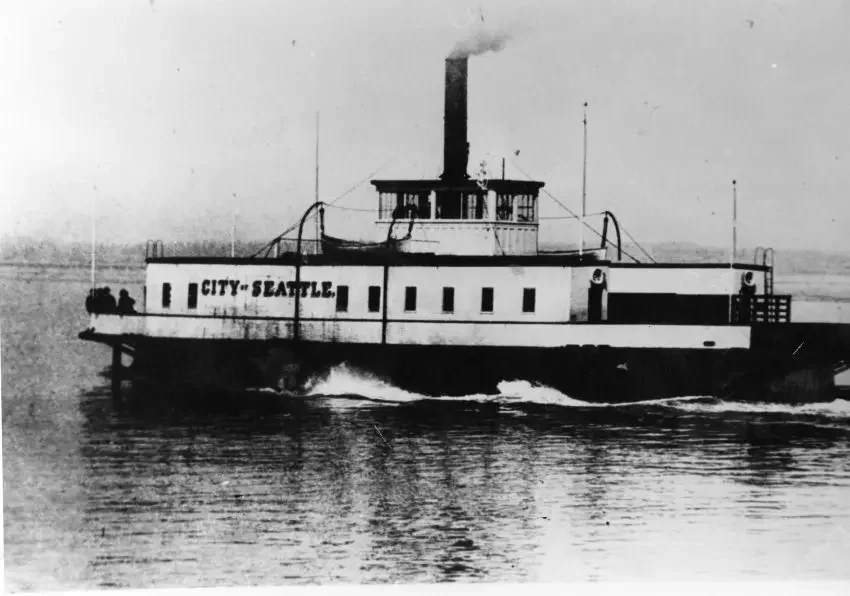
A photograph of the steam ferryboat "City of Seattle," 1940s. Photo is mounted on pasteboard with rings for hanging, indicating use in an exhibit.
Transcript
Alexis Tellis, interviewed by Betsy Stroman
August 22nd, 2006 | Temporal Coverage: 1950 to 1969
Betsy Stroman: Oh, before we get started, I need to have this. Okay, we're at the Seafood Peddler in San Rafael. This is Betsy Stroman, and I'm here with Alexis Tellis. Alexis is going to tell us something, probably about how he happened to come to Sausalito, his life in Sausalito, and his adventures in Sausalito. Go ahead and get started, okay?
Alexis Tellis: I was in the Navy, and I was transferred, so about 1951, I was transferred from Saipan to the Naval Supply Center in Oakland. While I was stationed there, I would come over to San Francisco on weekends, and I went to the hungry i, where Nan Fowler was entertaining. Nan invited me to come to a party in Sausalito on the Vallejo, which was owned by Gordon Onslow Ford and Yanko Varda. They each had one end of the Vallejo, and Varda would give parties on his end. So this was a Varda party, and that was followed the next day by sailing on the bay, which was a Sunday ritual that Varda followed. Okay, stop.
Alexis Tellis: Then after that, I was still at the Naval Supply Center in Oakland, and I came over to San Francisco in my spare time. Since I had been in the construction business, I went to work as a volunteer building the Buddhist temple on Washington Street in Chinatown, and I did that for a while. I had also done some acting on Saipan, and an opportunity came to join a little acting company that had been formed to entertain at military bases. It wasn't a military activity, but it was an activity that hired itself out. I acted with them in a few productions, including Blithe Spirit, where I played George Condeman, the head of the family. After that, I tried out for the Actors' Workshop, which was a predecessor of ACT, and I joined them when they were located on Divisadero Street. I performed in several of their productions while still working at the Naval Supply Center in Oakland during the day and acting at night. So then I started going to the Varda houseboat from time to time on weekends, going sailing, and got to know it very well. Okay, stop.
Alexis Tellis: My wife Mimi and my two sons, Gregory and Christopher, had lived for a year in southern France. They came back to San Francisco, and we moved into an apartment near the Actors' Workshop on Divisadero Street. After that we moved to Corte Madera. Shortly thereafter, Jean Varda went to spend a year in Greece with his new wife, Chrissa, and through the assistance of Francis Anchin, my family and I were able to rent the Vallejo. We lived on the Vallejo for a year, probably about 1952. We became infatuated with the idea of a houseboat. Warren Newton had brought in the Issaquah and beached it near where the Gate 6 Co-op is now, so we moved onto the Issaquah. During that time, I inherited Varda's Sakri, since he'd built himself a new boat. Mimi and I and the two boys, one summer, about 1952, set sail for the Delta.
Alexis Tellis: On the way up, we went to the port of Vallejo and came across a very large abandoned ferry boat, which had transported shipyard workers from Vallejo to Mare Island. Its name was the City of Seattle. After we got back to Sausalito, I contacted the ferry company that owned the City of Seattle and made an arrangement to purchase it. I bought it, towed her to a shipyard in San Francisco, did some repairs to the bottom, then towed her to Sausalito and moored her north of the Arques shipyard, fairly close to where she sits today.
Alexis Tellis: I then found out who owned the underwater lot we were sitting on, because the Sausalito Land and Ferry Company had subdivided all of Richardson Bay into streets and lots, even though there was nothing but water there. Those lots were of record and are still of record, and some were in private hands. I found the name of the person who owned the lot we were sitting on, who was living in the state of Washington, and I wrote to him and purchased that underwater lot for something like five thousand dollars. Over the next year or two, through a series of planning hearings, I was given permission to build.
Alexis Tellis: The next thing I did after acquiring the lot was try to find out exactly where the corners of the lot were, since they were in the middle of the bay. It turned out that two of the corners were in the middle of a road George Kappas had built to access his marina, which lay beyond his houseboat harbor, so part of his road now belonged to us.
Betsy Stroman: This was an underwater road?
Alexis Tellis: No, he'd filled it in. He used to haul automobiles and all kinds of junk from the city and dump it in the bay there, and he built that road out. It's the main road that goes right past the bait and tackle shop, and it makes a left turn. We were right on that spit that ran north to south. So with this happy discovery, we had access to our lot. I'm not sure what the permit process was, but we built a pier from the parking lot out to our block, close enough, maybe sixty or seventy feet from the end of the block, and it was there that we moored the City of Seattle. The City of Seattle at that time had a wooden hull that leaked, but other than that it was in pretty good shape. In recent years, my son, who now owns the City of Seattle with his mother, put a concrete hull under it and refloated it, so it's now a fine, very large floating houseboat.
Betsy Stroman: Okay. Now, what do you want me to tell you? That's how I got into Sausalito.
Betsy Stroman: That's how you got into Sausalito. How many years were you in Sausalito?
Alexis Tellis: I guess thirteen.
Betsy Stroman: Okay. Let me ask you more about those underwater lots. I have a special interest in that because we're doing an article on the underwater lots for the Historical Society newsletter. You said the Sausalito Land and Ferry Company had subdivided into streets and lots?
Alexis Tellis: Subdivided, yeah.
Betsy Stroman: Subdivided? I didn't know that. I've seen an 1893 map that shows all the subdivisions, but I didn't know the Sausalito Land and Ferry Company did that. When did they do it?
Alexis Tellis: I don't know. I thought the land all belonged to the state of California, and that they had the underwater lots, and that they'd sold them at some point.
Betsy Stroman: The state of California sold them?
Alexis Tellis: Well, they may have sold the parcel to the Sausalito Land and Ferry Company, and then that company laid out this plan, this map, that showed all the streets which never existed.
Betsy Stroman: Right, right. There's been a lot of issue over that, because I think the Gate 6 1/2 Harbor was on some of those streets. Right now, at Waldo Point, there's some pending legislation to try to swap ownership of various private lots so the Waldo Point houseboats are legally there. And they did something like that before with Kappas, I think.
Alexis Tellis: So you're the lawyer?
Betsy Stroman: No, I don't understand it at all. We're trying to sort this out. Do you know a guy named, I'm trying to remember his name, Larry Clinton, who lives on Gate 6 1/2? He writes for the Floating Times, and he's writing an article for the Historical Society about this. He and I just met yesterday, and we were talking about it.
Alexis Tellis: Well, if somebody digs, they'll be able to find out what's on the streets that shouldn't be. We aren't. We're at Yellow Ferry Harbor, and we're not on the streets.
Betsy Stroman: You're not on the streets? You're on streets that you own, right?
Alexis Tellis: No, we're on a block that we own. There's a street just to the south of us, just south of where the Yellow Ferry Harbor is, and I wouldn't swear that the boats on the right-hand side of that dock don't extend onto that street.
Betsy Stroman: But that's how it happened. I've actually been there.
Alexis Tellis: Kappas missed the street when he put in that spit, so he's not entirely in the street, he's partly on the lots. He surveyed it with his finger, that was his surveying instrument. But the area to the south of Yellow Ferry Harbor is the street. It may not be perfectly defined, but where Kappas's road is, that's pretty much the street, until it makes the turn. Going out from the bait and tackle shop, it's pretty much the street. To the right of that, I don't think there's a subdivision. I think it's all subdivided to the north from there.
Betsy Stroman: Yeah, I don't remember anything to the right. So anyway, we talked about how you happened to come to the City of Seattle and Yellow Ferry Harbor. Can you describe some of the people you knew there, without confusing yourself with the dates?
Alexis Tellis: Let me give you a more graphic picture of how it happened. We were living on the Issaquah, and we hadn't yet purchased the land, but we liked it so much we figured we'd like to get a house of our own. So we piled into Varda's little sailboat to sail up to the Delta, because we'd been up there before with Wally and Frances Nays, camping in the Delta. On the way up, we saw this ferry boat sitting in a berth across from Mare Island. It was obviously unoccupied, so when we got back, we looked up the ownership and found out it belonged to the Vallejo Ferry Company, and got hold of the owner. One thing led to another, and we bought it and hauled it down.
Alexis Tellis: I don't know at what point we bought the underwater block, but we brought a barge in. We tied the City of Seattle up at the Army Engineers' pier, where the Bay Model is. I think we must have already owned the lot by then. We got a barge from up in the Delta and brought it down and sunk it on the block, leading from Kappas's road out a couple hundred feet. The block is, I don't know, two hundred and forty feet long or something like that. So we sank it, and then we brought our ferry boat over and tied it to the end of it, and that's how it started. We weren't living on it yet, we were still living on the Issaquah. Eventually the City of Seattle sank.
Betsy Stroman: The Issaquah?
Alexis Tellis: No, no, the City of Seattle sank. Some time after we'd moved on. We did some fixing up, we had Lloyd Flood, an architect, design the upper part, and we built out a lot of that. I think we moved onto it, and then it sank. But it didn't go over the main deck, because even at high tide the water wasn't as high as the distance from the bottom of the keel to the deck. On high tide there'd be water lapping, maybe sometimes onto the deck, but just under it, and on low tide it would be high and dry. We lived there, and then Mimi lived there alone with the boys. I moved off for a while, and then, eventually, it was floated. A new hull was put under it, and that's where it is now. I'm kind of rambling.
Betsy Stroman: No, that's fine. So that's the story of the Yellow Ferry.
Alexis Tellis: Yeah, okay.
Betsy Stroman: And he had a marine architect design it? Who was that?
Alexis Tellis: Topher, Christopher, my son, designed the hull. It was built, it's a very interesting story and I wasn't there for it, so you'd better get more information from Christopher, but the barge was built right out by where the City of Seattle is. Then it was towed over to Arques's shipyard, and it sank. Then the City of Seattle was towed over there and floated in over it, and the barge was refloated and lifted it up. I think that's the way it worked. I wasn't in on that operation, so Topher can tell you the details. He's got pictures.
Betsy Stroman: Okay.
Alexis Tellis: Then the bottom, this is an interesting story, the whole hull was cut off and taken out of the barge before it was refloated, and it was hauled off and sunk under the Richardson Bay Bridge, where it was subsequently discovered by some official who objected strenuously, so we had to go fish it out of there. It had sat under the Richardson Bay Bridge for quite a while, because somehow, at some point in the process, the hull was completely cut away from the main deck.
Alexis Tellis: The main deck, incidentally, when the Navy had the City of Seattle, they were getting these vessels to transport shipyard workers, and they brought this one down from Washington and put it in dry dock to inspect it, and discovered the hull was just a mass of dry rot. So they ended up building a whole new hull on that boat, brand new timber, so that when we got it, it had virtually new timbers on it and was a beautiful shape. The planking wasn't in good shape, but the hull was. The main deck had been replaced with all new beams and three-inch fir decking, beautiful, and that's still there. When the hull was cut away, what you ended up with were the cross beams, which were new, and this beautiful deck, which was sanded, and all the tar joints and bolt holes were filled in with some kind of epoxy material. So when you look at it now, you see these black lines, sanded down.
Betsy Stroman: I don't remember that. A long time ago the black lines were tar-filled.
Alexis Tellis: Right, and then on top of that was this epoxy. You can see all the round holes where the pegs or bolts were driven that held it to the joists.
Betsy Stroman: Do you know approximately what year the boat dates from?
Alexis Tellis: Yeah, about 1898. It's an old one, rebuilt. They were desperate during the war to get transportation for the workers, so they got what they could, went up to Seattle, found this one, bought it, brought it down. They put a bag under it, I guess, the way you usually do with those things, a polyethylene bag to keep it from leaking while towing it down. They took the bag off, and it still leaked, but they did their best to patch it.
Betsy Stroman: What else? If you want to tell me about life in Sausalito, with Varda and Gordon Onslow Ford and the people you knew there, Nan Fowler. That was an interesting period in Sausalito, though I know that's a very general question.
Alexis Tellis: Well, you know how Varda got there?
Betsy Stroman: No.
Alexis Tellis: Varda was living in Monterey, in Big Sur. He'd built a couple of little buildings on the pier at Monterey, used as restaurants or gift shops, and he lived in Monterey. He was originally from Greece, then lived in France, and then came over and worked at Black Mountain College, down south, in North Carolina. Albert Lanier went there, and Ruth Asawa went there. It was an art college. You can look up Black Mountain College. He was one of the faculty, and there were a lot of other interesting people on the faculty. Then, I don't know why, he went to Monterey and had a barn, which he fixed up with his sunflowers and the usual thing, and it was a social center in Big Sur for a while. I'm trying to think what brought him to Sausalito. I can't remember. Victor di Suvero contended that.
Betsy Stroman: Who's Victor di Suvero?
Alexis Tellis: D, small i, S-U-V-E-R-O.
Betsy Stroman: Was he a painter who painted rulers?
Alexis Tellis: No, I don't know who painted the rulers. But Victor had a wife named Henrietta, and he lived in Sausalito for a long time.
Betsy Stroman: Is he still alive?
Alexis Tellis: Oh, yeah, he's living in Arizona now, I've been there, I can't remember exactly where. Henrietta di Suvero was a San Francisco model, and Victor married her. I don't know where Victor came from, but he was very much a part of the Varda scene, and very much a part of Sausalito for a while.
Betsy Stroman: How did I get onto the subject of Victor? I was asking you about life in Sausalito, and you were mentioning Varda.
Alexis Tellis: Well, do you know about the masques?
Betsy Stroman: No, tell me about the masques.
Alexis Tellis: Varda would go away sometimes for six months, back to Greece or over to France, and when he'd come back there would be a gigantic party on the waterfront, where they'd roast something on a spit. The parties were given sometimes on the Vallejo, sometimes on the ancient barge. Victor and George Hitchcock would write a play, a masque, and then the whole bunch of Varda's friends and admirers, men and women, would gather together and rehearse the parts. When Varda would return, there'd be a big fire on the waterfront, a big party, food and drink, and the masque. A lot of people would make costumes and props, and there would be actors, of whom I was one on a couple of occasions. Victor and George Hitchcock would write these things, and they were wonderful. They're sort of silly, but the scripts are still around, they do exist.
Betsy Stroman: Where would you find the scripts, do you know?
Alexis Tellis: I'd call George Hitchcock.
Betsy Stroman: Do you know him?
Alexis Tellis: No.
Betsy Stroman: You don't? I'm lucky I found you. Tell me about George Hitchcock.
Alexis Tellis: Well, he lived in Sausalito, and he was a writer. I don't know what he did for a living, I can't remember. But he was around there for a long time, and I might have a couple of those scripts, I'll look.
Betsy Stroman: I'd love to see them. I'm surprised the library doesn't have them.
Alexis Tellis: Well, they may, I've never looked.
Betsy Stroman: Well, look.
Alexis Tellis: Okay. There were quite a few, though I only remember two or three. I think one was being performed when I first came to Sausalito, but I'm not sure. Have you ever heard of Virginia Varda? I think she was married to him for a while, and she had a boat in the Kappas area that burned down, a barge. One of the masques was done on that. Another one I was in was done on the tip of Strawberry Point, there was a big campout and party for Varda, and a masque was done there. And another one was done on the ancient barge.
Betsy Stroman: Does it have a name?
Alexis Tellis: I don't think it has a name, but it's still there. I remember those three. I'll look around and see if I can lay my hands on the scripts, but you probably have better luck. I doubt the library would have them, but they'd be under Hitchcock, so I'd look for that.
Betsy Stroman: Okay, I'll look for that.
Alexis Tellis: Usually they were for his return, from wherever he'd been traveling. It wasn't always his return, I think it was for a couple of birthdays too. It was a wonderful era. When he died, a barge was brought in and beached, a big barge, and a memorial service was held on it. Then one of Varda's boats, his last one, the Perfidia, was sailed out through the gate, and his ashes were scattered in the ocean. At that funeral there were probably a hundred and fifty people, and as I stood at the entrance to the barge at the end of the funeral, people went by and you kept hearing them say, well, he really loved me the best. Everybody wanted a piece of this man because he was such a wonderful person. Then a whole lot of them descended on the Vallejo and helped themselves to silverware, plates, fabric, and mementos, to take and keep a piece of Varda. It was very upsetting, but the funeral itself was good.
Alexis Tellis: I can't remember what barge it was, Victor would know, but we had to get it in there at high tide and nobody was sure it would work. The night before, it was moored alongside Clipper Yacht, and when the tide was right, we got a small boat and managed to get it into Ancho Beach, which is where the ceremony was held. On those Sunday sails of his, a whole bevy of people would show up, entertainers, regular people like Victor and myself, and some girls who came all the time, and we'd all pile on the boat. When the tide was right, we'd sail off, usually over to San Francisco and back. Every once in a while the boat would get becalmed, and when a motorboat came by, Varda would say, give us a tow, and if you give us a tow, we will give you a girl. Of course the boat was covered with girls and guys, and he got a lot of tows, but he didn't give away any girls.
Betsy Stroman: I have a memory of seeing pictures with beautiful sails, all beautifully painted.
Alexis Tellis: Yeah, he designed them and made the sails himself, using different colored fabrics for the panels. He always had a big eye on the front of the boat and a sun on the sail, so you could see through the fog.
Betsy Stroman: In those days, as you know, in Sausalito, the waterfront people and the hill people were two different clans. I don't know if there was any enmity, but there was certainly a lot of conversation about the hill dwellers. In Los Angeles there's a place called Laurel Canyon, have you heard of that? Laurel Canyon used to have a little newspaper, and I think their slogan was, flatlanders were all right, but you wouldn't want your daughter to marry one of them. That's kind of the attitude the hill people had toward the houseboat dwellers.
Alexis Tellis: There was some story about the houseboat dwellers that I've forgotten, but there were some very elegant houseboat dwellers.
Betsy Stroman: I'm thinking there was great creativity and some elegance. Was there a total separation between the hill and the houseboat dwellers?
Alexis Tellis: Well, it was kind of like the other side of the tracks. The hill dwellers didn't sit around worrying about the houseboat dwellers, and vice versa, they knew they were separate clans. The houseboat dwellers particularly knew that the hill dwellers were separate. The hill dwellers probably paid a lot less attention to the houseboat dwellers than the houseboat dwellers gave them credit for. I remember when my sons went to school, they went to Marin Country Day School when it was at Bothin Camp. It started out in a camp, out in the woods toward the beaches. They had the idea of starting it, and they had the campus but didn't have anything there yet, so they started out there. They had horses, it was quite wonderful. Just one year out there, and then they moved over to the waterfront. I remember some Sausalito schoolteacher expressing total astonishment that a waterfront kid would be going to Marin Country Day School, to him that was just inconceivable. These were sort of the forgotten children, and they were wonderful. Did you know Kim Kerrig? Bob Kerrig was a waterfront character, and he had a son named Kim, great people. I don't know what happened to Kim.
Betsy Stroman: How old are you?
Alexis Tellis: Sixty-four.
Betsy Stroman: That's my age. What year were you born?
Alexis Tellis: Forty-one.
Betsy Stroman: I was born in '41 too, I'm sixty-four.
Alexis Tellis: Oh, that's my wife's age, not mine. She was born in '41 too. No, I'm eighty-two, almost eighty-three. I forget what I was talking about.
Betsy Stroman: You were talking about Kim Kerrig and Bob Kerrig. This is all very interesting, though it's kind of disjointed.
Alexis Tellis: Disjointed is fine, I'm just looking for stories, and you sort of put them together. If you follow a few of these leads, you can get somewhere. Tell me about the Anchins.
Betsy Stroman: Tell me about the Anchins.
Alexis Tellis: Well, Frances came up from Big Sur too, and she was married to some guy whose name I can't remember, before she married Ashton, later. Anyway, she was married to this guy and lived down in Big Sur, near Varda's place down there. She came up here and met Bob Anchin, and I don't know if he was married, but he was living on da Silva Island, with Hilaire Belloc, in a little house he'd built there.
Betsy Stroman: Where is da Silva Island?
Alexis Tellis: It's at the north end of Richardson Bay, as you go along the freeway, going north, over Richardson Bay, there's a bridge over a tributary of Richardson Bay, and da Silva Island is right there.
Betsy Stroman: Oh, sure, I know, there are new condos there now, right? They built some stuff there.
Alexis Tellis: Yeah, they didn't have any condos there when Hilaire Belloc was living there, he owned it. I don't know if he lived in Sausalito or just lived there. He lived on da Silva Island. You know who he is, he's a writer.
Betsy Stroman: Not him, his father.
Alexis Tellis: Oh, his father was Hilaire Belloc, the very famous British writer. That's who I was thinking of. He wrote poetry and all kinds of things, and so this Hilaire was sort of a cast-off son. He had some cousin out here.
Betsy Stroman: Where did he live?
Alexis Tellis: His cousin was Hope and her family, I can't remember their last name, but they owned a huge shopping center over in Walnut Creek, in the East Bay. Somehow they got together and got married.
Betsy Stroman: Hope and Hilaire got married? But they were cousins?
Alexis Tellis: Yeah, they still got married. They had a child who caused a great deal of trouble, and I think part of the property they owned, buying the shopping center, was that da Silva Island came as an add-on. So Bob Anchin talked Hilaire into letting him build a house there. I don't know who built the house Hilaire lived in, but Hilaire and Hope lived in the main house on da Silva Island, which is still there, a nice house. Some years later Hope died. Martin is their son, Martin Belloc, and he got into all kinds of trouble. Hilaire died, and that's the story. They were interesting people, particularly Hilaire, and he fell in with Varda and this whole crowd and helped wherever he could. Anyway, I'm off the track now, get me back on track.
Betsy Stroman: I think I was just letting you go where you wanted to go. I'd asked you about the Anchins.
Alexis Tellis: You've got to talk to Victor. He'll know.
Betsy Stroman: Okay, but he's in Arizona, you said?
Alexis Tellis: That's all right, he comes over. He'd love to talk to you, I'm sure. I can't find my address book at the moment, but somebody will have his address.
Betsy Stroman: Do you know how to spell his name?
Alexis Tellis: D, small i, S-U-V-E-R-O. He's at the core of all of this stuff.
Betsy Stroman: So, where was I? I had asked you to tell me about the Anchins.
Alexis Tellis: Right, and we got off onto Frances Ashton, who was married to Ney, I don't know if he was an architect or what, but he was somebody. John Ney designed houses for Eichler, that's Ney's son, actually stepson. I don't know what John Ney did, but Frances married John Ney, and they bought a barge about the same time Varda bought his, and hauled it in and beached it. I don't know where Ney went off to, but at some point Bob Anchin arrived and moved on board. He never married Frances, or maybe he did, because her name became Anchin. And they adopted two children that Ney had fathered, John and his sister, Haven, whose last name I can't think of at the moment. So Bob Anchin and Frances and the two kids lived there, on that houseboat, which I have my eye on right now.
Betsy Stroman: Is that right?
Alexis Tellis: Because John will inherit it, and I'm going to try to buy it from him. Haven was a very pretty girl, I don't know what happened to her, but she probably has a family somewhere by now. Frances is still there. They were next door to Varda, so they became very close to him, and that's why, when I rented Varda's boat, I rented it through her, because she was handling it for him.
Betsy Stroman: Okay, what's next? Well, what's your end product?
Alexis Tellis: My end product is really just getting stories. My fantasy is that I'm going to do a book of Sausalito voices.
Betsy Stroman: Okay, well, when you get an outline of this material and any related material, then send it to me and let me go over it, it'll suggest things I can write out. I'll write some little paragraphs and mail them back to you, I won't mess with your manuscript, but I'll write separate little paragraphs and send them back so you can incorporate them any way you want.
Alexis Tellis: As this thing gets built, you should try to get to George and Victor, and Frances is still there, though she gradually got mad at me and at Mimi. I don't even know the basis of it, I'd heard something about a long-standing feud.
Betsy Stroman: Is that resolved?
Alexis Tellis: No, no, she got bitter.
Betsy Stroman: Do you know Phil Frank?
Alexis Tellis: Oh, yes, Phil's the one who got us off in this direction. You know my son, he does Antenna.
Betsy Stroman: I've known his name for years, and I read that he recently sold the Antenna, I think it got sold.
Alexis Tellis: Yeah, got sold, but that didn't mean he left, he's still involved, some bigger entity owns it now. Was Chris Hardman part of his world?
Betsy Stroman: Yeah, of course, Phil has his studio there.
Alexis Tellis: Right, in the City of Seattle, in the pilot house. The Vallejo has a whole bunch of internet types on it now, and Eric Gullickson is the principal one, and I don't foresee that changing at all. But as I said, the ancient barge, it doesn't have a name for some reason, is the one I'd love to buy. I live in a house up here now.
Betsy Stroman: Oh, you do? And you want to get back on the water?
Alexis Tellis: Well, I have my office on the water, and I'd love to get back on a houseboat.
Betsy Stroman: Well, this is your story, and I don't really know where to take it right now, so if you want to stop this now, that's fine.
Alexis Tellis: What would be best is if you write up notes and send them to me, and maybe get some other people, and I'll definitely have Frances give whatever I get.
Betsy Stroman: Get as much as you can and put it together, then send it to me, and I'll think of stuff.
Alexis Tellis: Okay, that would be terrific. I'll show it to my son and pass it around a little. You should talk to Nan Fowler.
Betsy Stroman: That's what I was thinking. Where is she now?
Alexis Tellis: She was in Sausalito, I don't know where she is now. Do you know a woman named Barbara Leonard Duncan? I think she was called Nerd Duncan.
Betsy Stroman: I think I do. Who is she?
Alexis Tellis: She was an artist. She lived on Edwards and then on Prospect, and now she lives on the Pirate, a boat down there. She knew Nan Fowler.
Betsy Stroman: I don't know her.
Alexis Tellis: Well, you really should try to find George Hitchcock. He's the one who did some of these scripts, some of these masques. He was teaching English at a big California college down south. Eva Hitchcock was his wife, and he was a very close friend of Victor's. You should really talk to Victor, he may have written something about this stuff. I don't know where Léon Roegier is, he's another one. He lives in Sausalito, I think, on Cloudview or something. His wife is Susan, I think, though I'm not sure. If it's Léon, he might have a brother, Andre, I think, that's who I was thinking of. But Léon knew much more than Andre. Léon's the one who lived on the waterfront, and Andre is the one I've met, his wife too. And then there's Jacques Overhoff, I don't know if he's still around, he's Dutch, but he was very much involved in all this. Gordon died, unfortunately.
Betsy Stroman: Gordon Onslow Ford?
Alexis Tellis: Yeah.
Betsy Stroman: What were you doing then? Were you working?
Alexis Tellis: Building, houses, all over South San Francisco and Marin. Then I worked for Walter Landor for a while, I built his ferry boat. Have you ever heard of it?
Betsy Stroman: Yes, I knew he had a ferry boat, and I knew there was a lawyer who had an office there.
Alexis Tellis: I can't remember what happened to him, he met a bad end, I think, but I can't even think of his name. That was a long, fascinating story, buying that boat and fixing it up. I did the whole thing, I bought it, I rebuilt it for him, had my office on it for a long time. It was a well-known San Francisco boat, the Klamath.
Betsy Stroman: Oh, okay, the Klamath. It's amazing the things one forgets. What's the focus of your story?
Alexis Tellis: I'm not interviewing you for a story in particular, I'm interviewing you because we're collecting oral histories for the Historical Society. Your name came up because we're doing an issue for the newsletter, but I don't have anything in particular in mind.
Betsy Stroman: I see, so it's just the history of Sausalito, details of the history.
Alexis Tellis: Yeah, people who lived in Sausalito for a long time and had interesting connections. There's a couple of anecdotes I wanted to tell you. Did you ever hear the story about the San Francisco television announcer who wanted to interview Sally Stanford about her career?
Betsy Stroman: That's a great story.
Alexis Tellis: The Sunset Women's Club was coming down hard on Sally at this particular time, and some TV station from San Francisco called her and said they'd like to talk about her past, the bordello. One of the questions was, what happened to the girls who worked for you? And she said, well, they've gone all kinds of places, housewives up in the country, on ranches, all sorts of things. In fact, some of them were members of the Star Spangled Women's Club.
Betsy Stroman: You heard this story? I've heard people say that was the case, but I didn't know Sally said that herself.
Alexis Tellis: Oh, yeah, I don't think any of them ever were, but there were rumors she'd been blackballed.
Betsy Stroman: I heard she'd been blackballed because the women were afraid she'd come in and identify them, the women who already belonged there.
Alexis Tellis: Well, I think that just grew. I don't think any of them ever had anything to do with her, she just said that to get even with those women. Sausalito was pretty colorful. Did you ever hear about the expedition Sally mounted in response to DeVere Baker?
Betsy Stroman: Do you remember the name of his ship?
Alexis Tellis: I don't recall it, but he had a boat that he sailed out through the gate, wanting to prove that some remote Pacific island had originally been populated by natives from North America. He put this boat together and sailed out the gate, thinking they'd drift across the Pacific to this island, but about fifty miles offshore the Coast Guard rescued him and brought him back. So Sally, in response, decided to sail a boat from Sausalito to Belvedere, to prove that Belvedere had really been originally inhabited by Sausalitans.
Betsy Stroman: She had a great sense of humor. I don't know if she ever did it, I can't imagine her on a sailboat, with all her fancy clothes.
Alexis Tellis: But Sausalito was quite a place. Anyway, Varda, I don't know how he happened to come here, I've heard the story but I've forgotten, but he teamed up with Gordon Onslow Ford and got Gordon to buy the Vallejo. Gordon was to have one end, and Varda the other. The Vallejo was located up at the Arques shipyard, I guess, and Gordon bought the land where the Vallejo now sits, right there at Gate 5.
Betsy Stroman: Underwater lots?
Alexis Tellis: No, it was a land lot that had water. Varda's job was to bring the boat over from the shipyard to the berth, and he brought it in with his end out and Gordon's end in, and that's the way it stayed. Gordon was furious, but that's the way it was, Varda had the outer end, Gordon had the shore end.
Betsy Stroman: Did you know Gordon? Have you ever seen his house?
Alexis Tellis: Gordon died, but he built the most beautiful house. Warren Callister designed a house for Gordon out in the country somewhere, and it's absolutely beautiful, still there.
Betsy Stroman: Did Alan Watts move in there afterward?
Alexis Tellis: Probably, he may have lived there at some point. Alan Watts lived on the Vallejo too.
Betsy Stroman: Oh, I thought you were talking about the Vallejo.
Alexis Tellis: No, I was talking about Gordon's house out in the country. Alan moved into Gordon's apartment after Gordon moved off, and then, I don't know, other people moved on eventually. Saltzman, I remember that.
Betsy Stroman: You have a good memory.
Alexis Tellis: I don't know why I remember that. I think Orly Lindgren may have started the remodeling of the Vallejo, and the Sausalito architect Donlyn did the plans. Then Eric came along and bought it, I'm not sure who from, maybe Orly, and Don, and then Harry bought it from him. Anyway, that doesn't matter, he lives on it now with a bunch of guys. But I'm not interested in the Vallejo, I'm interested in the barge. Tell him that you talked to me, and if the barge is ever available, Alexis would love to buy it.
Betsy Stroman: Okay.
Alexis Tellis: I suppose John's thought is that after Frances goes, he'll move onto it and rent his house, but who knows. I don't mind letting him know there's a buyer out there. In the meantime, I've got plenty of house, so I'm building another cottage right now.
