
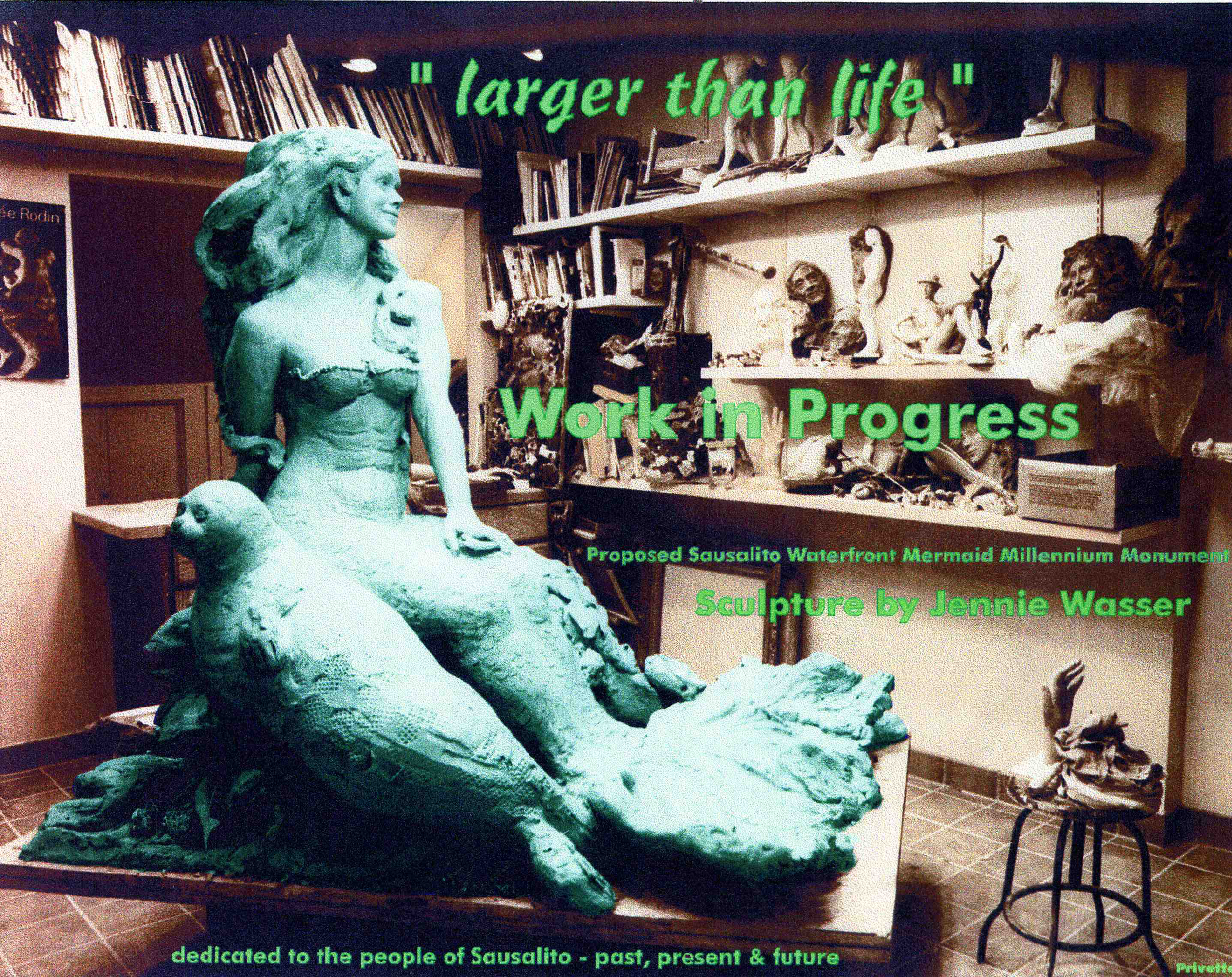
Promotional piece for proposed Sausalito Waterfront Mermaid Millenium Monument.
Transcript
Jacqueline Glassner, interviewed by Betsy Stroman | July 6th, 2006 | Temporal Coverage: 1890 to 2006
Betsy Stroman: This is Betsy Stroman. I'm here with Jacqueline Glassner, a resident of Alameda, who has kindly come over to Sausalito, to Peter Nivergeldt's house at 510 Main Street. Jacqueline is a Wasser descendant. Her grandmother was Margaret Wasser Dow. Is that correct?
Jacqueline Glassner: Yes.
Betsy Stroman: And Margaret Wasser Dow died about three years ago. She owned a barn over in Mill Valley. I guess you were raised in Mill Valley?
Jacqueline Glassner: I was.
Betsy Stroman: Did you still have a lot of family living on Pine Street in Sausalito when you were a young child?
Jacqueline Glassner: Yeah, actually, that was probably the sad part for me now, because our family was so large. But it was interesting that in my great-grandfather's family, the Wasser family, there were 14 children, and of those who married, most of them only had one child. So I don't know if that was a consequence of them feeling 14 was too many, or what. But then gradually everybody started passing away. I think my fondest memories, my mother's and my grandmother's, were our family get-togethers, because we would just have so many people. And my grandmother was this great host. I remember, in order to accommodate everybody, in her house in Mill Valley she would take tables and set them on sawhorses and have them running down her hallway and then teeing into her living room. So that was fun.
Betsy Stroman: Do you remember going to Sausalito, though?
Jacqueline Glassner: Yes.
Betsy Stroman: Yeah, okay. And who was living in Sausalito when you were coming over here?
Jacqueline Glassner: Basically, the women in the family who didn't marry, who hadn't passed away: Ada, Agnes, Mabel, and Florence.
Betsy Stroman: Tell me about Ada. Who was she?
Jacqueline Glassner: Ada Brown. I don't know a lot about her background. She was very sweet, very sweet-looking. Agnes, on the other hand, just because of age, looked frightening to me, I don't know. But it was nice, because they all took care of each other somehow, and it was nice that they had that place to live. I think the story I like to tell about the family is that my great-great-grandfather was the chief engineer on the ferry boats out of Sausalito. And, of course, there were a lot of ships that would anchor in the bay here waiting to unload in San Francisco. So he would invite these seafaring people up to his house, hoping to marry off his unwed daughters, because he had fourteen children, nine of whom were women and five of whom were men. Actually, one of them, Mary Alice, married an English sea captain, and in those days, it was interesting, she was able to travel with him, as well as Amy, my extended cousin, when she was a baby, and they just had really interesting journeys in those early days. But, of course, quite a few of the women remained spinsters, and that was sort of it.
Betsy Stroman: Why do you think so many women remained spinsters?
Jacqueline Glassner: I'm not sure.
Betsy Stroman: Sure.
Jacqueline Glassner: I heard a story, and Peter might be able to confirm it, told a number of times, that Mabel, for example, was very much into music and had wanted to go study in New York. And I'm sure it was more a money issue than her parents not wanting her to go, because she had a friend who had traveled to do that. And from the way the story was told, she had gone to the symphony, or some musical event in San Francisco, with a gentleman. And that evening her sister Bertha, who was a librarian, passed away. And the family made her feel that if she had been home, it wouldn't have happened, which was really sad. So, I think, in a way, that may have affected Mabel's choice, or situation, not to marry. But I always thought that was sort of sad.
Betsy Stroman: But she never said anything like that, did she?
Jacqueline Glassner: No. No.
Betsy Stroman: What do you know about Bertha, if anything? She must have been quite a bit older, I guess.
Jacqueline Glassner: I don't know, because she passed away before my time. Just the articles that have been written about the family, and that's about it.
Betsy Stroman: Now, do you know whether Mabel went to college? Did any of the girls go to college?
Jacqueline Glassner: No. No.
Betsy Stroman: They went to Tam High?
Jacqueline Glassner: No, that was before Tam High existed. I think my grandmother was in the first graduating class of Tam High, I believe.
Betsy Stroman: So did these women go to high school, or what did they do for education after grade school?
Jacqueline Glassner: You know, again, I really don't know. Unfortunately, my grandmother was the historian for the family, and I just know that they were all very much into music. From what I've been told, and what I've read about the family, they had one of the first pianos in Sausalito. My great-great-grandfather was musically inclined, and I think that in those days, at least, that family concentrated on that enjoyment to keep everybody at home, from that strain, you know. The parties would be there, and they would do little plays and play music and things like that, but that's what they did for enjoyment. Mabel taught music. I can't recall if it was Ada or Alice who was very good as a seamstress, and that's about the extent of it. I don't remember.
Betsy Stroman: Now, Florence, do you have any recollections of Florence? Did you know her at all?
Jacqueline Glassner: This is another story you'll have to confirm with her son, Tom, who's still alive. But evidently, she and her husband had a very, very long engagement, many, many years, and got married, and then soon thereafter her husband passed away. Tom and Florence moved into the family home, and because Tom was surrounded by all these women and had no male figure, they thought it would be important for him to have that exposure. So they sent him to what was then the San Rafael Military Academy. And then he kind of followed in the footsteps of his maternal uncles and became a railroad engineer, and did that until his retirement. He's living in Portola now.
Betsy Stroman: Which is called a railroad town.
Jacqueline Glassner: I don't know. Yeah, it's sort of bleak, in my opinion, but he likes it. He's in his 90s now, but well into at least his 70s, if not his 80s, he enjoyed skiing. Reno was very close, so that was very close. He would go to Reno and ski, and that sort of thing.
Betsy Stroman: And he didn't marry.
Jacqueline Glassner: He didn't marry.
Betsy Stroman: Do you know anything about a Rutherford? I ran into a Rutherford when I was doing some research, who got married really, really young and then divorced. Was that his father? You don't know?
Jacqueline Glassner: No, I don't know. So, again, I really don't know too much about that side of the family.
Betsy Stroman: Did Mabel ever talk about the library with you?
Jacqueline Glassner: Actually, only to the extent that she really loved her job. She really loved it, and I think her job, other than her sisters, was her entire life. I remember, when I was young, going to the library there, and this was when she and her sisters had handwritten all the cards that you check out books with, things like that, which was probably a huge project.
Betsy Stroman: You mean they wrote the name of the book on each of the cards?
Jacqueline Glassner: Yeah, it was like their way of keeping track of the books. I mean, the libraries had those, but they were typed or something as I got older, but these were actually handwritten. And then, of course, now everything's computerized. But she really liked that. I remember, too, that when I was younger she had this really cute convertible roadster, and I don't know what kind it was, but she'd put the top down and come and pick up my sister and me. There was a little theater in Sausalito, and we would go and see those productions. So that was fun.
Betsy Stroman: What were those productions like? I've just heard little bits about that.
Jacqueline Glassner: You know, I don't even remember, but it was a community theater and, obviously, shows appropriate for young children.
Betsy Stroman: Right, right, right.
Jacqueline Glassner: But that's one of my memories of Mabel.
Betsy Stroman: Just make sure that it's playing.
Jacqueline Glassner: I think the other distinct recollection I have of Mabel is that she felt exceedingly strongly about where the library should be located.
Betsy Stroman: All right, tell me about that.
Jacqueline Glassner: She really felt it should be where the Spinnaker restaurant is. She felt it should be easily accessible to the old, the young, anybody, and not somewhere that was difficult to access. She really tried to advance that, but obviously it didn't get very far. But that was her dream.
Betsy Stroman: That was her dream, and she spoke about it a lot?
Jacqueline Glassner: Yeah, actually, because she really didn't quite understand why other people didn't get that that's where it should be. I saw a letter from her to the newspaper talking about it and how important it was. And I've heard other people say that she never forgave Robin Sweeney, who was our mayor for a while, for opposing that.
Betsy Stroman: Did you ever hear about her involvement with the Catholic Church, or with being an organist for the church, for Star of the Sea?
Jacqueline Glassner: Only to the extent that, I mean, I never went with her. I think that was before my time. But, yeah, she did that, and also occasionally for weddings at other churches.
Betsy Stroman: Do you remember the name Father Valentini? Did she ever mention him to you?
Jacqueline Glassner: Yeah, she talked about him. It was like he was one of her heroes, I think.
Betsy Stroman: Why was that?
Jacqueline Glassner: Well, I'm not really sure, but she always spoke very highly of him, and he was involved with the library initially. I just got the feeling that she admired him very much, for whatever reasons. I don't know, because I didn't know him.
Betsy Stroman: Did she tell you anything about how she used to go over in his carriage, horse and carriage, on Sundays to Belina's to play the organ?
Jacqueline Glassner: No, but my grandmother talked about that, and I just thought, wow, that was quite a trip, you know.
Betsy Stroman: That would have been quite something. But she never mentioned that to you?
Jacqueline Glassner: No.
Betsy Stroman: Did she ever talk about the history of the library at all with you?
Jacqueline Glassner: No.
Betsy Stroman: Did she ever talk about any of the other trustees who worked for the library?
Jacqueline Glassner: No. By the time I was old enough for those to be questions I might have asked, or discussions that might have come up, she was already past that part of her career.
Betsy Stroman: Do you remember, toward the end of her career, whether she was saying anything about being ready to retire, or being tired of all this, or anything?
Jacqueline Glassner: I don't think she wanted to retire, and that's why I think, although it was beyond that point. When she was 90 or 95, maybe 90, my mother, my grandmother, and I decided to give her a big birthday party. So we would go to her house, and one of us would sit there and distract her with conversation, and the other one would grab her telephone book and go upstairs and write down the names of people and their addresses to invite to this party. They had this very nice article in the Marin Scope, and there was also, I believe, an article in the Independent Journal, and the banner read, Mabel Wasser Turns 90. We just thought this was going to be it, because she never wanted anybody to know how old she was, and we really were afraid of what was going to happen. But people started calling her and saying, oh, you're 90, I can't believe it, you know. So then it kind of made it a little bit better. But I don't think she was really happy that people found out how old she was.
Betsy Stroman: Was she under pressure to retire? Was that a problem?
Jacqueline Glassner: I don't know, probably, because I think it was getting more into the time when, well, she hadn't gone to school to become a librarian, and different systems were coming into the forefront, and she just wasn't up on that. So I'm pretty sure that she was older, too. I mean, she had been there, what, 27 or 28 years?
Betsy Stroman: 33 years, I think. She was probably 78 when she retired, which strikes me as old enough.
Jacqueline Glassner: Right, yeah.
Betsy Stroman: Did you ever hear the name Mrs. Wyatt?
Jacqueline Glassner: No.
Betsy Stroman: She was the president of the board for 40 years.
Jacqueline Glassner: Wow. She never talked about her. I'm sure she did to my grandmother, and perhaps to my mother, but...
Betsy Stroman: Yeah. Okay.
Betsy Stroman: Are there any stories you remember about Thomas Wasser that you haven't mentioned?
Jacqueline Glassner: My great-great-grandfather?
Betsy Stroman: Yeah.
Jacqueline Glassner: I think the only other one that was repeated many times was about his invention. He shared the information with who he thought was a friend, and the friend filed the patent. So that was pretty distressing to the family.
Betsy Stroman: Did she ever talk about the arts community? Did she have any friends in the arts community that you were aware of?
Jacqueline Glassner: Not that I recall. I mean, she had lots of people who would come up to the house, but I don't recall specifically if they were involved in the arts.
Betsy Stroman: The reason I'm asking is that during the '50s, I think, they started displaying art by the artists of Sausalito, and they developed a really close relationship. All of the artists were bringing in their work, and I think they were very grateful, because it gave them a place to show their work. They had an art center that they disbanded, and they gave her what was left in the treasury at the art center to buy books. It seemed like it was just a very close relationship, and I just wondered if she ever mentioned that.
Jacqueline Glassner: No.
Betsy Stroman: Did you ever hear of somebody named Enid Foster?
Jacqueline Glassner: Yes.
Betsy Stroman: Okay, what do you remember about that?
Jacqueline Glassner: Just the name. Just the name.
Betsy Stroman: Okay.
Jacqueline Glassner: Again, these were names that I remember my grandmother talking about, and it's really too bad, because my grandmother wrote down a lot of things and tried to. When she was living with Mabel, Mabel got to the point where we were all afraid of her living by herself, because she would go turn on the water in the kitchen and forget, and go work in the garden, and then her kitchen would be flooded. Or she was getting very frail, and she would wear like three sweaters, and she would bend over her gas stove, and we were afraid she would ignite or something. So my grandmother moved in with her to help provide some oversight, and I've lost my train of thought, but anyway, I think it's just...
Betsy Stroman: Well, she learned a lot while she was living there?
Jacqueline Glassner: Yeah, exactly, and she tried to write down certain information. Both Mabel, I remember, and my grandmother said that there were some historical facts that get distorted, so it's good if you can write it down and get it right.
Betsy Stroman: So anyway, she seemed to have a great sense of history. One of the things she did was, every month, she would just write a little summary of what had been going on in the library that month. It's been very helpful to me. I get the flavor of her years at the library in a way I don't get for any other years. But she stopped doing it the last three years, or else they got lost. I can't find them, so I was just curious what had happened during those last three years.
Jacqueline Glassner: I couldn't say.
Betsy Stroman: But anyway, I have... This is the end of the tape.
