
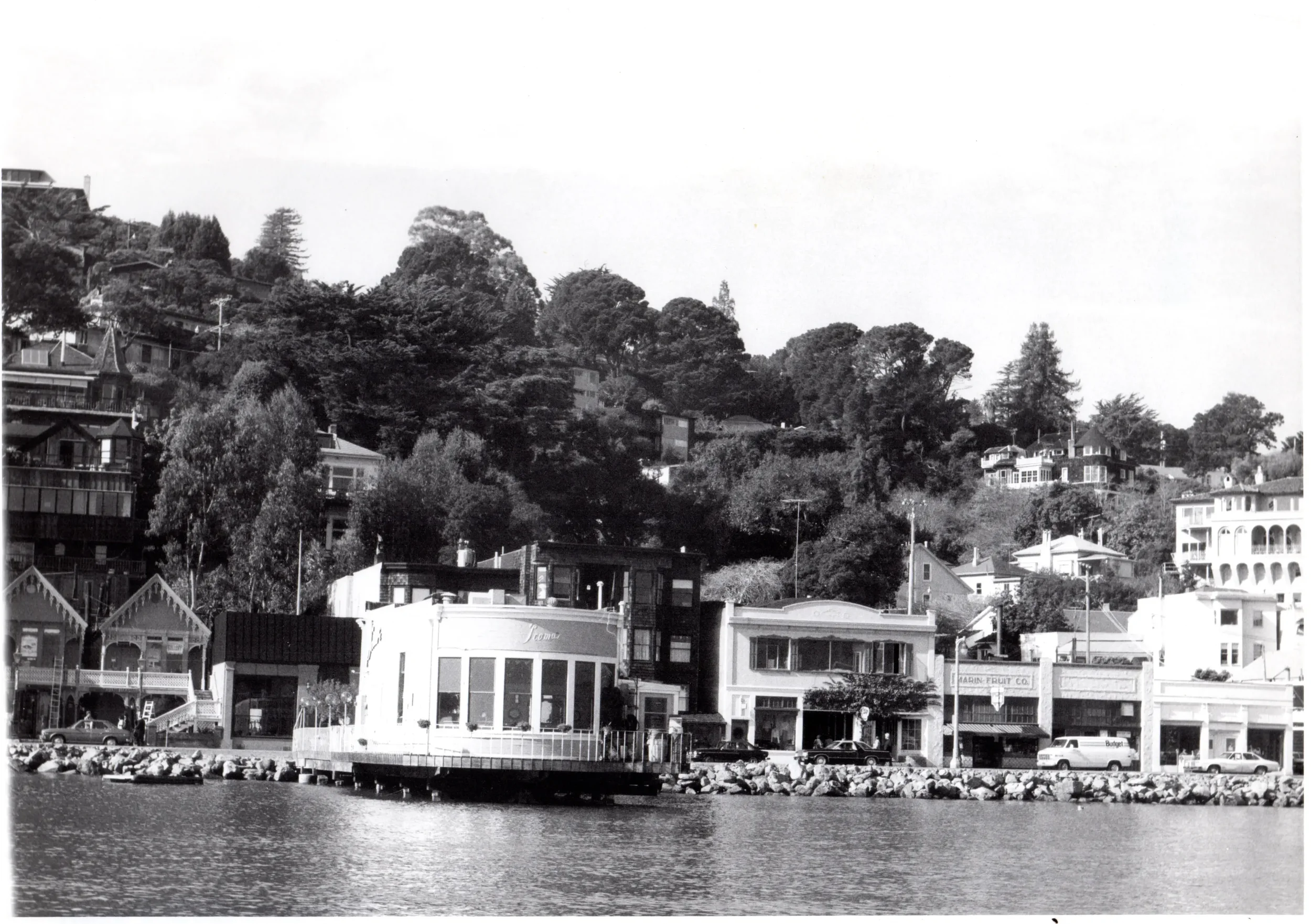
Aerial view of Sausalito
Transcript
Maggie Hazell-Rosen, interviewed by Betsy Stroman | September 10th, 2007 | Temporal Coverage: 1954 to 2007
Betsy Stroman: The microphone wasn't on. I had the machine on, but not the microphone. So, anyway.
Maggie Hazell-Rosen's Husband: Which is the microphone?
Betsy Stroman: The microphone is right here, and there's a little switch here. The red has to be showing for the microphone to be working, and the red wasn't showing.
Betsy Stroman: Okay, so why don't you say something? We'll just make sure this is working. Say something.
Maggie Hazell-Rosen: Oh, as it says on this paper, Sausalito was a small town, and the artists who lived there were not, most of them were not known yet anywhere but in Sausalito. We had a few that were, like Walt Kuhlman, who was the teacher for California Fine Arts. But otherwise, my association with the artists was going to the Glad Hand, where everybody seemed to go for a job.
Betsy Stroman: For a job, okay. Did you have a job there?
Maggie Hazell-Rosen: No, I didn't have a job, but my husband at the time and I would go to the Glad Hand and talk to whoever was behind the bar, because it was one of the artists, like Walt, or Serge Trubach.
Betsy Stroman: Right. Did you know about...?
Maggie Hazell-Rosen: Yeah, I know about...
Betsy Stroman: Serge?
Maggie Hazell-Rosen: Yeah, I know about Serge.
Betsy Stroman: Well, we'll talk about Serge.
Maggie Hazell-Rosen's Husband: We can, yeah.
Betsy Stroman: But before we get to these artists, tell me about the Glad Hand. That was the Tin Angel before it was the Glad Hand, right? Were you there when it was the Tin Angel?
Maggie Hazell-Rosen: Yes, I do remember it, but I wasn't going to it at the same time.
Maggie Hazell-Rosen's Husband: I think the Tin Angel was on a corner, when you came down the hill into Sausalito.
Betsy Stroman: It wasn't there? I thought the Glad Hand had been the Tin Angel before it became the Glad Hand.
Maggie Hazell-Rosen's Husband: Maybe it was.
Maggie Hazell-Rosen: But there was a coffee house as you came down the hill into Sausalito.
Betsy Stroman: Is that what you're talking about? A coffee house in Sausalito as you came down the hill?
Maggie Hazell-Rosen's Husband: I didn't know anything as a coffee house.
Maggie Hazell-Rosen's Husband: But anyway, well, you know how the road takes a curve like that to Bridgeway, we used to walk along there. I guess I did see a coffee house, but I wouldn't go there, that wasn't my place to go. I like where Maggie describes the artists who had to work for a living, they were selling art, and they all had these jobs at the Glad Hand. Walking, coming with your waiter, Jack Jefferson was behind the bar, and somebody else, he lived over at town tables, somebody else was cooking, and they were all, so all the artists were working at the Glad Hand, and it was a hangout, and they had their art hanging there too.
Betsy Stroman: Didn't the artists have their art hanging at the Glad Hand?
Maggie Hazell-Rosen: Yes, some, I don't know what I had there, but I remember taking things there. I lived across the...
Betsy Stroman: Oh, you did? Okay.
Maggie Hazell-Rosen: On Bridgeway.
Betsy Stroman: Okay, 515?
Maggie Hazell-Rosen: Okay.
Betsy Stroman: Is that building still there?
Maggie Hazell-Rosen: Yes.
Betsy Stroman: Where you lived is still there?
Maggie Hazell-Rosen: Oh, yes.
Betsy Stroman: Okay.
Maggie Hazell-Rosen: It's a two-story.
Betsy Stroman: Two separate apartment buildings.
Maggie Hazell-Rosen: And they, as the articles said about them, they all knew one another, and they were the water people, not the hill people. Although some were dentists, not an artist, but a dentist, and he used to get paid with paintings.
Betsy Stroman: Who was your dentist who got paid with paintings?
Maggie Hazell-Rosen: Oh, well, Del Smith was there, and he was the dentist.
Maggie Hazell-Rosen's Husband: And he remained a dentist until he retired, and they'd moved, about 40 years, and he got paid...
Betsy Stroman: In paintings?
Maggie Hazell-Rosen's Husband: Sometimes.
Betsy Stroman: What was, Nan Fowler, do you know the name Nan Fowler?
Maggie Hazell-Rosen: Oh, sure, yeah. Nan Fowler, yeah.
Maggie Hazell-Rosen's Husband: Well, Del Smith's office was filled with Nan Fowler's work, he had all her teeth fixed, and he had these very nice Nan Fowlers. She's still living up in Sonoma County.
Betsy Stroman: Is she able to talk?
Maggie Hazell-Rosen's Husband: I don't know.
Betsy Stroman: You don't know?
Maggie Hazell-Rosen's Husband: I just know she must be in her mid-80s, too.
Betsy Stroman: I'd like to talk to her, if I can find her. I understand she lives in Sonoma County.
Maggie Hazell-Rosen's Husband: I heard that too. I don't know.
Betsy Stroman: Okay.
Betsy Stroman: You say in your... We have all got in front of us an article that appeared in 1979 in the Independent Journal, the IJ, about Maggie Hazell-Rosen and her experience with the art festivals.
Maggie Hazell-Rosen: And I didn't realize it was that long ago.
Betsy Stroman: Yeah, but the article also speaks of the people you had worked with in the '50s, all the other artists, because this 1979 article was written in connection with a retrospective exhibit. Do you remember that exhibit?
Maggie Hazell-Rosen: No.
Maggie Hazell-Rosen's Husband: Well, I remember it.
Betsy Stroman: Okay. I'm sorry, I didn't quite understand how you described the...
Maggie Hazell-Rosen: Is it printed here? Just a second, let me...
Betsy Stroman: Your husband's trying to explain it, but if we both talk, then we can't...
Betsy Stroman: What I'm saying here is, I'm asking you about a show that occurred in the late 1970s, and you were at that show.
Maggie Hazell-Rosen: Yes.
Betsy Stroman: And a lot of artists, they're listed here, had their art exhibited at that show.
Maggie Hazell-Rosen's Husband: In the 1970s, 1979.
Betsy Stroman: 1979, right. I'm just saying that the painting over there, the metal piece here, was in the window of the gallery, they used that as a, which was very nice, that they took her painting as the kind of representative.
Maggie Hazell-Rosen: Right, but I remember the show vaguely, but they're only an old artist, but it was a real retrospective, all these people drawing and painting socially, though.
Betsy Stroman: And where was that show?
Maggie Hazell-Rosen: It was somewhere downtown, somewhere, I don't remember where, I think the article says, but I've forgotten.
Maggie Hazell-Rosen's Husband: It may have been, no, I was going to say the Rose Bernardi Gallery, which was in North Sausalito. Annette Rose, her ex-husband...
Betsy Stroman: And Bea Bernardi?
Maggie Hazell-Rosen's Husband: And Bea Bernardi.
Betsy Stroman: Oh, they had a gallery?
Maggie Hazell-Rosen's Husband: They had a gallery, the Rose Bernardi Gallery, which Bea bankrolled because she had money, and Tim Rose did framing. But they had a very nice gallery, and they showed Maggie and a number of Sausalito and Marin artists. That was in the middle, late '70s, before Annette got into politics.
Betsy Stroman: Oh, right, right, yeah.
Betsy Stroman: When you came to Sausalito, Maggie?
Maggie Hazell-Rosen: Yes, I'm listening.
Betsy Stroman: You talk about there being a separate group of artists down by the waterfront, and one of them was Varda.
Maggie Hazell-Rosen: Varda. Oh, yes, he had his own studio.
Betsy Stroman: And were the painters who painted on the waterfront separate, pretty much, from the painters who lived...?
Maggie Hazell-Rosen: Well, if there were any chance to show anywhere, they'd all come.
Betsy Stroman: Okay, okay.
Maggie Hazell-Rosen: They were desperate to show their work.
Betsy Stroman: My understanding is that they weren't a separate group, I think.
Maggie Hazell-Rosen: They were not, you say?
Betsy Stroman: No, my understanding is that they were all pretty much mixed. I think the distinction was more between people who lived near the water and people who were more affluent, who lived up in the hills.
Maggie Hazell-Rosen: Right, right.
Betsy Stroman: Just as it is now.
Maggie Hazell-Rosen: As it is now, yeah.
Betsy Stroman: Tell me, did you have a studio when you were working in Sausalito?
Maggie Hazell-Rosen: I don't think I had any studio until I moved here.
Betsy Stroman: And when did you move here?
Maggie Hazell-Rosen: '57.
Betsy Stroman: '57.
Maggie Hazell-Rosen: I told you I'm not very good at remembering anything like that.
Maggie Hazell-Rosen's Husband: You moved here in '57. She did, 50 years ago.
Betsy Stroman: Good thinking.
Maggie Hazell-Rosen's Husband: But she didn't have a studio, worked at all.
Maggie Hazell-Rosen: I didn't switch from abstract to figure, I stayed with both things.
Betsy Stroman: Right.
Betsy Stroman: What I'm wondering about is, you mentioned the ICB building when we talked.
Maggie Hazell-Rosen's Husband: Yeah, she had a studio there.
Betsy Stroman: When did she get her studio in the ICB?
Maggie Hazell-Rosen's Husband: She started about, I guess, 20, 25 years ago.
Betsy Stroman: Oh, really? So that would have been the early '80s.
Maggie Hazell-Rosen's Husband: Okay. And she had it for about 15 years.
Maggie Hazell-Rosen: I have just given up trying to sew anything, it's just a lot of work.
Betsy Stroman: Uh-huh.
Maggie Hazell-Rosen: And no return for all the work, sort of, you know. And all of the artists in that area are not active. I never see any shows mentioned in newspapers like the Mill Valley Record and whatever the Sausalito one is now.
Betsy Stroman: Marinscope.
Maggie Hazell-Rosen: Marinscope, yeah.
Betsy Stroman: The Pacific Sun reviews shows, I think.
Maggie Hazell-Rosen: Oh, really? Okay. But I just, I'm saying that there isn't much reviewing in Marin.
Betsy Stroman: Right, right.
Maggie Hazell-Rosen's Husband: She was a reviewer, and other people, a woman named Ada Garfinkel, who was not a social media person, who did a lot of reviewing.
Maggie Hazell-Rosen: But I don't see any special reviews in the Marin papers.
Betsy Stroman: Was Leah, excuse me, Leah Schwartz?
Maggie Hazell-Rosen's Husband: No, Leah Schwartz was a name that, what's his name, mentioned to me, Jack Beck.
Betsy Stroman: So did you know Leah Schwartz?
Maggie Hazell-Rosen: Oh, yes, we were very close.
Betsy Stroman: Were you? And when did she, when was she painting in Sausalito?
Maggie Hazell-Rosen: She, no, actually, Leah was not...
Maggie Hazell-Rosen's Husband: Leah Schwartz has a big enough house across the street, the third story, it's a three-level house, because it was a studio.
Betsy Stroman: Okay.
Maggie Hazell-Rosen's Husband: She has stopped painting. She lives across the street, she lived next door, that's a whole story, that's how I came out here. Leah and Herman Schwartz were my dear friends from New York, and I used to come out here in the '50s to visit them, next door, that's how I met...
Betsy Stroman: Oh, okay, who was living here?
Maggie Hazell-Rosen's Husband: By that time the Schwartzes were across the street.
Betsy Stroman: I see.
Maggie Hazell-Rosen's Husband: And we were married in their home, actually.
Betsy Stroman: So but Leah was a painter?
Maggie Hazell-Rosen: I've seen her flowers that she does.
Betsy Stroman: I don't know if I've seen the book.
Maggie Hazell-Rosen: My husband had his book published, paintings, I'll show it to you. It's a very interesting book.
Maggie Hazell-Rosen: Eventually, the quality of the show did get so that I didn't want to be in it anymore.
Betsy Stroman: This is in Sausalito?
Maggie Hazell-Rosen: I can't think of the names of people anymore, there are very few of them around.
Betsy Stroman: I looked at the names in the article, Serge died.
Maggie Hazell-Rosen: I don't know who's around besides Walt Kuhlman.
Betsy Stroman: I talked to Kay Cassandra, I called her. Kay Cassandra, does that name ring a bell?
Maggie Hazell-Rosen: No.
Betsy Stroman: I knew she was alive, so I called her, but she'd had a stroke, and didn't feel she could remember anything, so I didn't get any information from her.
Betsy Stroman: Now, who owned the Glad Hand? Do you remember who owned the Glad Hand?
Maggie Hazell-Rosen: It'll come to me.
Betsy Stroman: It wasn't Peggy Tolk Watkins, was it?
Maggie Hazell-Rosen: No.
Betsy Stroman: No, okay.
Maggie Hazell-Rosen: It wasn't. It was a man, I think a couple of boys.
Betsy Stroman: Okay, you don't remember their names?
Maggie Hazell-Rosen: And yes, I should have them, because I knew them very well. But I think one of them died, and the other one is, I don't know where.
Betsy Stroman: Oh, well, memory is not the greatest.
Maggie Hazell-Rosen's Husband: Even if she had a better memory, it's a long time ago.
Betsy Stroman: Right, right.
Maggie Hazell-Rosen: I have totally forgotten.
Betsy Stroman: Okay, well, you tell me whatever you remember.
Maggie Hazell-Rosen's Husband: Whatever she remembers, is what she's told me.
Betsy Stroman: Okay.
Betsy Stroman: Did you know, do you remember Elizabeth Enquist?
Maggie Hazell-Rosen: Elizabeth Enquist? I remember her, but she wasn't a friend of mine or anything.
Betsy Stroman: Because she had been in Sausalito in the late '30s. She opened a gallery in the late '30s, before the war, and I think it closed during the war. But you never met her?
Maggie Hazell-Rosen: Her name doesn't ring a bell.
Betsy Stroman: Okay.
Betsy Stroman: Tell me about your, what do you remember about your involvement with the art festivals, just generally, doesn't need to be, do you know what was the first year?
Maggie Hazell-Rosen's Husband: Well, the first art festival of sorts was in 1949, and that was a man named Byrne Porter, who ran the Contemporary Gallery.
Betsy Stroman: I've actually written about it, it's here in that article. But then in 1952, they really started what seemed to become the art festival. It was out where the Spinnaker restaurant is now, and it was out there through 1954, I think, and then it moved over to the Bank of America, and that's when Maggie became involved. So she moved to Sausalito, later, in '54, and she left in '57, for two years, I think, she was very much involved. Another person who was involved, who you can't talk to, was a potter named David Morris.
Maggie Hazell-Rosen's Husband: David and Helen Morris were potters.
Betsy Stroman: I think somebody told me about them.
Maggie Hazell-Rosen's Husband: And they were, we have a number of their works, and they were very active in discussion.
Betsy Stroman: Okay, but they're both deceased?
Maggie Hazell-Rosen's Husband: Okay.
Betsy Stroman: Where did they live? Maggie, where did David and Helen Morris, when they lived in Sausalito, where were they?
Maggie Hazell-Rosen: Where were they?
Maggie Hazell-Rosen's Husband: They worked for Edith Heath.
Betsy Stroman: Oh, they worked for Edith Heath?
Maggie Hazell-Rosen's Husband: Oh, they worked for Heath, okay, and they were very...
Maggie Hazell-Rosen: But they had a... David used to complain that she takes credit for everything and never mentions his name and so on, but don't tell anybody, I don't think he would like that.
Maggie Hazell-Rosen's Husband: But I don't know where they did their pottery, somewhere.
Maggie Hazell-Rosen: But I think their son is still making pottery. I don't know where he is. His son, Nick.
Maggie Hazell-Rosen's Husband: And I forget his first name, Nick.
Maggie Hazell-Rosen: Nicky, yeah.
Betsy Stroman: Nicky.
Betsy Stroman: So how did you begin getting involved with the art festival? What do you remember about that?
Maggie Hazell-Rosen: We sort of made it, a bunch of us. Henry Malczewski had an art store, and he used to say to us, why don't you put your things up on that empty lot over there, which was the parking space for the ferry. So we did do that. Serge, and Walt, and I can't think of who else.
Betsy Stroman: Varda? Was Varda's stuff there? Did he show his stuff at that art festival?
Maggie Hazell-Rosen: Yes, he did. That's right, I forgot.
Betsy Stroman: Okay. My article, I wrote about the early art festivals, I've just brought you this article, so you haven't seen it, but I wrote about the early art festivals. And according to this article, in 1956 was when Henry Malczewski and you organized the art festival across the street. I guess, was it by the Bank of America building?
Maggie Hazell-Rosen: Yes.
Maggie Hazell-Rosen's Husband: It hadn't been Bank of America yet, I don't think.
Betsy Stroman: Oh, I think it was, but I'm not sure.
Maggie Hazell-Rosen: But it was across from the Casa Madrona, right?
Maggie Hazell-Rosen's Husband: Yeah, that's where they had it.
Betsy Stroman: Yeah, okay. Tell me about Henry Malczewski, what was he like?
Maggie Hazell-Rosen: Who?
Betsy Stroman: Henry Malczewski.
Maggie Hazell-Rosen: Oh, he was a very nice man, that's all I can say, and he encouraged the artists, but he was selling art supplies.
Betsy Stroman: I see.
Maggie Hazell-Rosen: And he didn't want to see us not have the art festival, because that was...
Betsy Stroman: He also sold toys, didn't he?
Maggie Hazell-Rosen: All over the yard.
Betsy Stroman: Did he also sell toys?
Maggie Hazell-Rosen: Huh?
Betsy Stroman: Did he sell toys?
Maggie Hazell-Rosen: I don't know.
Maggie Hazell-Rosen's Husband: Betsy asked, so you don't know.
Maggie Hazell-Rosen: Only, well, things like crayons.
Betsy Stroman: Oh, I see, it wasn't...
Maggie Hazell-Rosen: It was mainly an art gallery, anyway, I don't know what else they sold.
Betsy Stroman: Okay.
Betsy Stroman: Here's Enid Foster. And Maggie attended some of the famous parties on Varda's houseboat, that she has mentioned to me. Do you want to tell me about the parties on Varda's houseboat?
Maggie Hazell-Rosen: Well, I wasn't invited to most of them, I can't tell you much about them.
Maggie Hazell-Rosen's Husband: But you did, you went to some of the parties.
Betsy Stroman: You told me that you went to some of the parties, and he was famous for having kind of wild parties on his houseboat.
Maggie Hazell-Rosen: Yeah, but I wasn't at any of them that were wild.
Betsy Stroman: You weren't at the wild ones?
Maggie Hazell-Rosen's Husband: Maybe they got wild after you left.
Betsy Stroman: That's probably true. Did you meet interesting people when you went to the parties at his...?
Maggie Hazell-Rosen: They were just the people that were in his... I don't know how to describe it.
Betsy Stroman: Circle of friends?
Maggie Hazell-Rosen: I mean, they were in Sausalito, at the north end of Sausalito, where all of the really arty artists lived.
Betsy Stroman: Oh, arty artists, as opposed to the other artists?
Maggie Hazell-Rosen: Yeah.
Betsy Stroman: So a lot of people, in this article it says, apparently they lived in cheap studio space.
Maggie Hazell-Rosen's Husband: Well, I'd like to read that.
Betsy Stroman: Oh, do you want to read it?
Maggie Hazell-Rosen's Husband: Is that, oh, this is Herb talking. Well, they had, you know, the very reasonable rents, right, houses, small kind of shabby houses were still very cheap, I imagine that the big houses up on the hill were still out of reach among artists, but they seemed to thrive there. I remember visiting Sausalito in the middle '50s, when I first visited the Schwartzes, of course they took me there, and it was a very picturesque, European style. I can picture her but I can't picture her work.
Betsy Stroman: Enid Foster, the bossy woman, tell me about her.
Maggie Hazell-Rosen: I'm trying to think of who it is that Enid always reminded me of, it was a well-known...
Maggie Hazell-Rosen's Husband: I know who she reminded me of.
Maggie Hazell-Rosen: Huh?
Maggie Hazell-Rosen's Husband: Of, oh no, Edith Sitwell?
Maggie Hazell-Rosen: Yeah, Sitwell.
Betsy Stroman: Oh, they called her the Edith Sitwell of Sausalito, or something.
Maggie Hazell-Rosen: She reminded you of these pictures, kind of a, kind of a far out, but I remember at first seeing her walk around the streets, and apparently she had family money that maintained her, and they were...
Maggie Hazell-Rosen's Husband: And Val Bleecker, I remember her walking around, looking out of, a little dizzy, not dizzy.
Betsy Stroman: When was this?
Maggie Hazell-Rosen's Husband: Oh, probably in the '70s.
Betsy Stroman: I see, yeah. So you continued to go over to Sausalito?
Maggie Hazell-Rosen's Husband: Well, we used to.
Betsy Stroman: Because you had your studio there, yeah?
Maggie Hazell-Rosen's Husband: Well, ICB, and also there were shows. There were still galleries, and we used to show people around, of course, anytime you had a visitor, that was one of the first stops.
Betsy Stroman: Yeah, how long...
Maggie Hazell-Rosen's Husband: I'm trying to think of anything that she didn't cover, but whatever she remembers, which isn't, we see, that much, and most of those people, I don't think, mean anything to her anymore.
Maggie Hazell-Rosen: I remember going down to that beach.
Betsy Stroman: Oh, Shell Beach?
Maggie Hazell-Rosen: Yeah.
Betsy Stroman: Tell me about that.
Maggie Hazell-Rosen: Well, it was just going down to a beach.
Maggie Hazell-Rosen's Husband: We left out one of the most colorful artists.
Maggie Hazell-Rosen: And there wasn't much space for anything.
Maggie Hazell-Rosen's Husband: Art Grant.
Betsy Stroman: Oh, tell me about Art Grant.
Maggie Hazell-Rosen: You had to carry your own easels and display stuff every time.
Betsy Stroman: Oh, you mean this is for the shows that were down at Shell Beach?
Maggie Hazell-Rosen: Yeah.
Betsy Stroman: You say there wasn't much space, and you had to carry your own easel...
Maggie Hazell-Rosen: Carry the work down every day.
Betsy Stroman: Oh, and take it back?
Maggie Hazell-Rosen: ...what to put it on, too.
Betsy Stroman: Yeah, right.
Maggie Hazell-Rosen: The whole setup had to be taken down at night and cleared off, and then the next morning you would go down again with all your stuff.
Betsy Stroman: So you exhibited during those early years at Shell Beach?
Maggie Hazell-Rosen: Yeah, right, I did.
Betsy Stroman: And do you remember anything that happened? For instance, there was a show there, I think.
Maggie Hazell-Rosen's Husband: Oh, one year there was, Walter Keane and his girlfriend, what was her name?
Betsy Stroman: Oh, the Keanes, yeah.
Maggie Hazell-Rosen: Huh?
Betsy Stroman: Maggie also knew Walter Keane.
Maggie Hazell-Rosen's Husband: With the big eyes.
Betsy Stroman: With the big eyes. And she knew Walter and Margaret Keane before they became famous, or infamous.
Maggie Hazell-Rosen: He never exhibited anything, but he always said he would be exhibiting next time, or something like that. But he liked to be involved, and I don't know, it's just...
Betsy Stroman: Well, Maggie told me that she remembers when Margaret Keane thought up the idea of Big Eyes.
Maggie Hazell-Rosen: Oh, Margaret Keane thought it up, right, she was the one who thought it up, that this would be a gimmick, and all the artists became envious when they hit the jackpot.
Betsy Stroman: Right, right.
Maggie Hazell-Rosen: No, but Art Grant, I want to get back to him, because he was one of the most colorful of the Sausalito people. He lived on that little beach with the Jack London house.
Betsy Stroman: Yeah.
Maggie Hazell-Rosen: And you go, there's a little boardwalk, you go, and that's where Art lived for a long time.
Maggie Hazell-Rosen's Husband: Now, we maintained a relationship with Art until he died.
Betsy Stroman: When did he die?
Maggie Hazell-Rosen's Husband: He died about ten to fifteen years ago.
Maggie Hazell-Rosen: We thought it was pretty thrilling.
Maggie Hazell-Rosen's Husband: And he married, they made it lively, he married an artist named Catherine Lonigan, who took the name, I guess her painting name was KK Free.
Betsy Stroman: KK Free?
Maggie Hazell-Rosen's Husband: Yeah, she got divorced, and changed her name to Free.
Maggie Hazell-Rosen: It became Free.
Maggie Hazell-Rosen: And she was quite an artist. She had a little, and then Art bought a little house way up in Mill Valley, and he had all of his stuff there. You know, he was the junk artist, he could take anything and make a piece of art out of it. He was a very creative guy, very funny, very warm.
Maggie Hazell-Rosen's Husband: I remember when I first came here, we went to a show, Maggie was very active in the San Francisco Women Artists, San Francisco. I remember we went to a show they had at the San Francisco Museum, because the women artists used to meet there, and they were allowed one show a year, and he comes in, and I hear this booming voice, 'Kosher power!' That was the time of Black Power, the late '60s. Anyway, Art was a very creative guy, and he did some very interesting work with just flotsam and stuff that he would pick up, and, all right.
Betsy Stroman: You don't have anything of his here, do you?
Maggie Hazell-Rosen: No.
Betsy Stroman: No, okay.
Maggie Hazell-Rosen: That I know of.
Betsy Stroman: Serge Trubach was a character?
Maggie Hazell-Rosen's Husband: He'd been, he'd come from the East, and he'd been part of the art scene in Rockport, Massachusetts, and Greenwich Village. Then he came out here, and he thought of himself as a cut above the rest.
Betsy Stroman: Oh, is that right?
Maggie Hazell-Rosen's Husband: As I recall, because after all, he was from the Village, and all the New York school, or whatever. But he always felt that he never achieved, well, it's true, he never achieved any real success. And he lived above, on Bridgeway, across from here.
Betsy Stroman: Oh, the Trieste?
Maggie Hazell-Rosen's Husband: No, it was called the Iron Pot.
Betsy Stroman: Oh, where was that?
Maggie Hazell-Rosen's Husband: Not the Iron Pot...
Betsy Stroman: On Princess Street?
Maggie Hazell-Rosen's Husband: No, it was across from the Glad Hand.
Betsy Stroman: Okay.
Maggie Hazell-Rosen's Husband: There was a coffee shop, and I forget the name of it. It was a famous one.
Betsy Stroman: Well, I've just sort of gotten out of all these things. Have you talked to Walt Kuhlman? No, I'm trying to get him, and he's not enthusiastic about being talked to.
Betsy Stroman: And I apparently, okay, Maggie, I've just given you this article, that you, it was an interview with you about 30 years ago, and does it spark any recollections for you?
Maggie Hazell-Rosen: I think I had one, didn't I?
Betsy Stroman: Yeah, you did, it's this one right here.
Maggie Hazell-Rosen: Yeah.
Betsy Stroman: And do you remember, does this prompt any recollections for you about your life during those years? Does this make you remember anything more about your life as an artist in Sausalito?
Maggie Hazell-Rosen: Actually, no.
Betsy Stroman: Okay.
Maggie Hazell-Rosen: It's sort of covered very well.
Betsy Stroman: Okay, well, that may be the case, we may have sort of covered most of it.
Maggie Hazell-Rosen: Yeah.
Betsy Stroman: Well, that was a good article, I think.
Maggie Hazell-Rosen's Husband: It was a good article.
Betsy Stroman: Yeah, it really told the story.
Maggie Hazell-Rosen: Okay.
Betsy Stroman: Well, there's no need to keep pushing, then, but go ahead.
Maggie Hazell-Rosen's Husband: Absolutely.
Betsy Stroman: Are you writing another lecture?
Maggie Hazell-Rosen's Husband: I think I'll erase all that later. But my view of it is that even if nothing's done with this for the next 20 years, at least we have the story down. But I really would like to do something with it, and I'm just trying to figure out what to do.
Betsy Stroman: And the thing is that Maggie is, you know, the last of the Mohicans.
Maggie Hazell-Rosen's Husband: Absolutely. I mean, there's Walt Coleman, but he's very reserved.
Betsy Stroman: Right, right.
Maggie Hazell-Rosen's Husband: He's not the world's friendliest.
Betsy Stroman: No, I've heard that.
Maggie Hazell-Rosen's Husband: Yeah, and Walt is the only other one. Nan Fowler may be, I thought that was her condition...
Betsy Stroman: She's right, she may be very vibrant. I mean, Maggie is at a point now where, you know, she'll be 89 in February. Her memory and her mentation are pretty good, considering her age, but she is slowing down physically and mentally, so it's very difficult, you have very few sources, which is why I'm wandering around trying to pick.
Maggie Hazell-Rosen's Husband: I mean, ten years ago, you would have had more, some of these people would probably still be around.
Betsy Stroman: So it's very difficult, it's like almost after the fact. It may be impossible, I don't know, I may decide it is.
Maggie Hazell-Rosen's Husband: It may be, because you just don't have enough. I mean, if you had ten people with fairly good memories at the time, that would be something.
Betsy Stroman: Actually, Leah Schwartz lived in Sausalito in the '40s.
Maggie Hazell-Rosen's Husband: But see, Leah is unapproachable, she's getting gaga, she's not painting anymore, she's not talking to anybody.
Maggie Hazell-Rosen: She's been my friend, you know, from New York, I met her in '48.
Maggie Hazell-Rosen's Husband: I met her husband in '45. But he's ill, he's in a nursing home, and she's become a kind of hermit.
Betsy Stroman: Again, a very private person, and I think I'd ask her if she has any memories she'd share.
Maggie Hazell-Rosen's Husband: But she was there in the '40s, she was in Sausalito in the '40s. Herman met Leah at a party in 1947.
Betsy Stroman: When was this written?
Maggie Hazell-Rosen's Husband: I have totally forgotten. I wrote that just a few weeks ago. He had finished his first year at Harvard Medical School. See, he and I were at CCAC school together, that's where we met.
Betsy Stroman: That's very nice.
Maggie Hazell-Rosen's Husband: And after his first year, he came out, he was here during the war, working. He was a teaching assistant at Berkeley, in Botany. Anyway, he came out on vacation, he had a summer off, and he met Leah at a party in New York. And then she followed him to Boston. And then they got married in 1952. He was a resident at Mount Sinai in New York City.
Betsy Stroman: So, she remembers Sausalito in the '40s. Now, whether she'd share it with you, I don't know, because she's not talking.
Maggie Hazell-Rosen's Husband: I guess you'd just have to pull it out of her.
Betsy Stroman: I'll ask her.
Maggie Hazell-Rosen's Husband: I'll pull it out of her. Do you want me to pull it out of her?
Betsy Stroman: It's all right, I don't need it. I'll ask her whether she would sit down with me.
Maggie Hazell-Rosen's Husband: Yeah, I mean, that would be great.
Betsy Stroman: The chances are...
Maggie Hazell-Rosen's Husband: She won't.
Betsy Stroman: She won't?
Maggie Hazell-Rosen's Husband: Yeah, yeah.
Betsy Stroman: Well, I don't have any expectations. At least, she's 87, she's not that old, and her memory is pretty good, so I'll ask her.
Maggie Hazell-Rosen's Husband: Okay.
Betsy Stroman: Maggie, do you remember anything about raising children in Sausalito? What was that like, sending your children to Central School?
Maggie Hazell-Rosen: Well, it was just like any other school to me. I didn't think that there were many children there who were children of artists.
Betsy Stroman: They were, you say, not many?
Maggie Hazell-Rosen: And, well, Serge had one daughter, and she was very nice, and that's about the only other person I had any relationship with. And, oh dear, Jack McClard and his wife, Dorothy McClard, became good friends.
Maggie Hazell-Rosen's Husband: They lived up on the hill, and they had two boys who were good friends with Mark.
Betsy Stroman: Okay, I know one of those boys, Peter McClard.
Maggie Hazell-Rosen's Husband: Oh, McClard, yeah, okay, you're talking about them. Jack and Dorothy McClard were good friends of ours, and of course they both died.
Betsy Stroman: Right.
Maggie Hazell-Rosen's Husband: But we knew, Peter used to play with her children.
Betsy Stroman: Oh, okay.
Maggie Hazell-Rosen's Husband: Peter and his brother David.
Maggie Hazell-Rosen: David, I think, the other one, I don't know.
Maggie Hazell-Rosen's Husband: I've met him, but I don't know his name.
Maggie Hazell-Rosen: I'm trying to think of the other man and his wife. Jack McClard was not an artist, but he was friendly with artists.
Betsy Stroman: Never mind.
Maggie Hazell-Rosen: He was a colorful, sensitive character.
Betsy Stroman: Tell me about Jack McClard, what was colorful about him?
Maggie Hazell-Rosen: He was, what's the word I want, a piece of work, he was a fascinating guy.
Betsy Stroman: What did he do, was he a contractor?
Maggie Hazell-Rosen's Husband: Well, no, he was, excuse me, I have a memory like, let's see, nothing. I think he worked on the docks, he did something, because he worked for the Department of Defense in Bordeaux.
Betsy Stroman: That's right, because I knew Peter had spent some time in Europe.
Maggie Hazell-Rosen's Husband: And then he came back, and I think he continued working for the government in the East Bay. Then he retired, and he worked for the parking lot in Sausalito. And he was, what did he drink, and he was a hunter. He was a Southern boy, from Arkansas.
Betsy Stroman: Oh, okay.
Maggie Hazell-Rosen's Husband: And every year he'd go to a ranch in Texas, where they controlled the deer population, and he was allowed to shoot one or two deer, and he'd come and invite us over for venison dinner. And he'd fill goblets with scotch, and of course he loved good wine, cordial wine. And he had, now, he had a little house up on Atwood.
Betsy Stroman: Is that where you are?
Maggie Hazell-Rosen's Husband: No, we're on Lower Crescent, and Peter has built a house on Central that backs onto Lower Crescent.
Betsy Stroman: What did they do with his parents' house?
Maggie Hazell-Rosen's Husband: They sold it, I think.
Betsy Stroman: Oh, they did sell it?
Maggie Hazell-Rosen's Husband: I think, yeah. But I understand that Jack and Dorothy bought that house when he was overseas. He was in, I think, the Merchant Marine. And they bought the house in 1942 or 1943.
Betsy Stroman: I see.
Maggie Hazell-Rosen's Husband: And it was a little house near the tennis court.
Betsy Stroman: Oh, okay, there's a tennis court there?
Maggie Hazell-Rosen's Husband: It's up from where you pass old Sally Stanford's, that's Main Street, where the market is.
Betsy Stroman: Yeah, Golden Gate Market.
Maggie Hazell-Rosen's Husband: Richardson is the street.
Betsy Stroman: So if you go past Golden Gate Market, if you went right up the hill, that's where it is.
Maggie Hazell-Rosen's Husband: We had some great dinners there, he was such a character.
Maggie Hazell-Rosen's Husband: I didn't know the boys well, I met them, but Maggie's children were the boys who were his friends at one time.
Betsy Stroman: I knew that's why he has a soft place, in the city, we get our cars fixed by him, we buy our cars from him actually, he buys Saabs after they've been on leases, and he sells them to us.
Betsy Stroman: I remember going to Jack's funeral, and seeing Dorothy there, and she had, outside.
Maggie Hazell-Rosen's Husband: Yeah, she did him also. When she was there, she was out of it.
Betsy Stroman: Yeah.
Maggie Hazell-Rosen's Husband: She was a nurse, originally.
Betsy Stroman: Oh, yeah.
Maggie Hazell-Rosen's Husband: Well, McClard's, now, they would have been able to tell you about Sausalito in the '40s. And Maggie's children, son, and she was a den mother, and McClard was a, and Jack planted, helped him plant...
Betsy Stroman: Anyway, this is Louie's book, thank you.
