
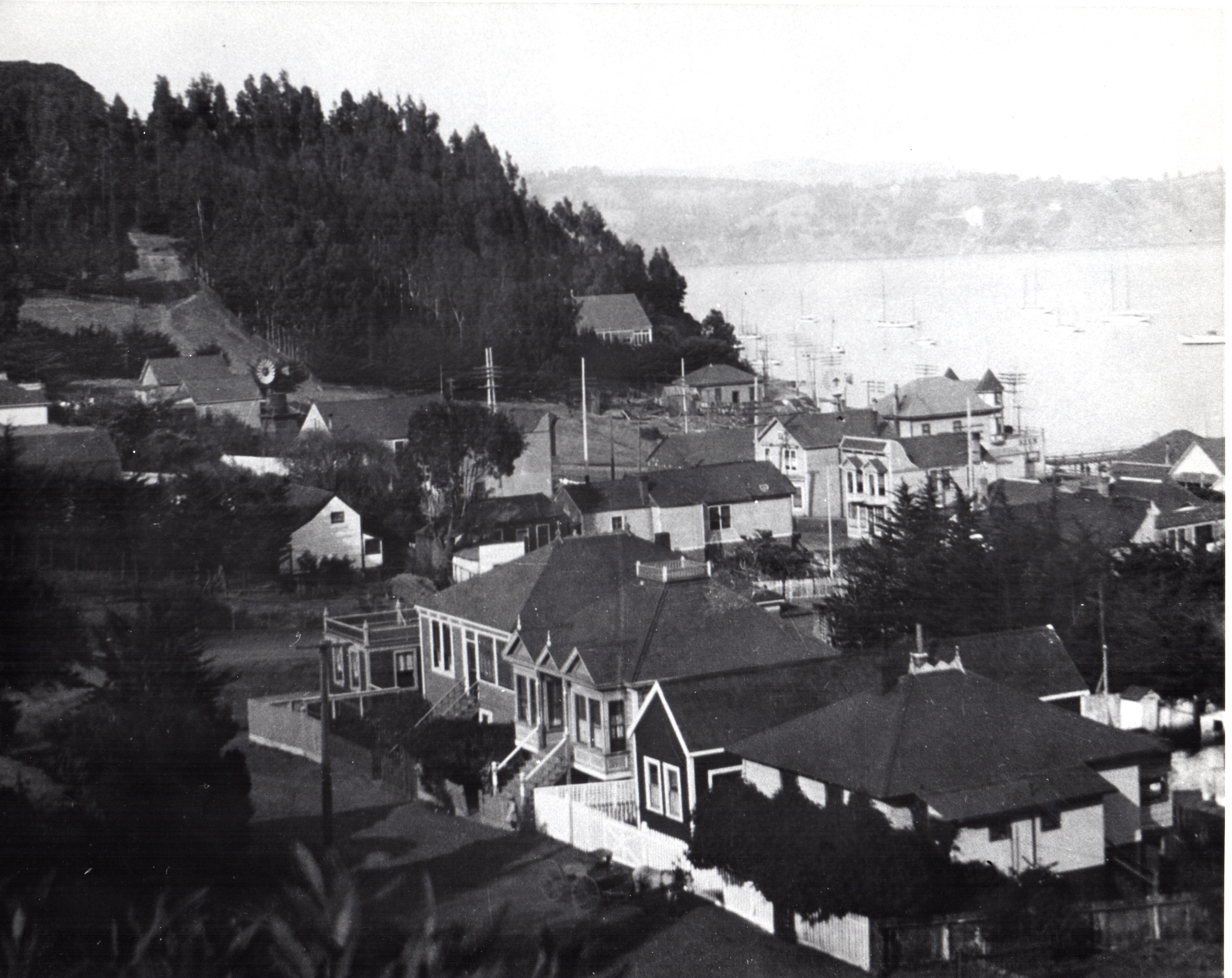
Aerial view of Sausalito
Transcript
Bill Kirsch, interviewed by Betsy Stroman | November 15th, 2007 | Temporal Coverage: 1950 to 2007
Betsy Stroman: This is Betsy Stroman with Bill Kirsch at 240 Redwood Highway, at his beautiful houseboat behind the heliport, and Bill has a poster that he brought to show me that he's going to explain to me. Bill, why don't you tell me what this is?
Bill Kirsch: Well, we were a bunch of artists who were dissatisfied with the Chamber of Commerce, dissatisfied with the way they ran the art festival, and we decided to take it over ourselves. And we did. This was the first one we put on, in 1966. I remember we charged, I think, 50 cents to get in, and we made fifteen thousand dollars that year. And I just read in the paper this morning that this year's festival made four hundred thousand dollars, and everybody's happy about it.
Betsy Stroman: So, where was it, the year you took it over? In Central School?
Bill Kirsch: No, it was down by the bank.
Betsy Stroman: Oh, okay. And this was '66?
Bill Kirsch: '66, okay.
Betsy Stroman: And that's where it had been ten years earlier, I think?
Bill Kirsch: Yeah, well, it hadn't been in the schoolyard yet.
Betsy Stroman: Oh, okay, the schoolyard still belonged to the school.
Bill Kirsch: So we put it on for several years down here. We made these triangular things, we made the backdrop for the paintings and all that, and that's the way we arranged them down there. I can let you take this and copy it, if you want to.
Betsy Stroman: I'd like to.
Bill Kirsch: Yeah, because I haven't read this in a long time. I don't know what it says anymore. What else can I tell you?
Betsy Stroman: Well, I read that somebody named Henry Malchesty, and the Mart, the place called the Mart, had taken the lead in running the art show between '58 and '60, and that he died in '60, and at that point I guess the Chamber of Commerce took it over. Is that your recollection?
Bill Kirsch: Right. Well, I used to work for Henry, in his frame shop. I framed pictures for him for a while. He was an interesting character. He was a left-wing guy from the University of Chicago. He used to carry a copy of one of Lenin's books in his hip pocket, but a wonderful man.
Betsy Stroman: Yeah, he was heavily involved. He had an art store downtown, where the drug store is now. And you worked for him?
Bill Kirsch: Yeah.
Betsy Stroman: Why don't you tell me a little bit about him? I've never really met anybody who knew him before.
Bill Kirsch: Well, he was a wonderful guy. He was basically a socialist, and thought all corporations were hogs with all four feet in the trough. And, pretty much, his style was, if you couldn't afford to pay him, that was okay, he would let you slide. He was pretty much like that about anything to do with money, and so everybody took advantage of it, but he didn't care. He had the art store downtown, and he framed pictures and sold art supplies. And then he got sick and all of a sudden died.
Betsy Stroman: Did you, was there gallery space in there?
Bill Kirsch: Well, not really, there wasn't really much gallery space. It was kind of a small store. It was more of a store.
Betsy Stroman: I had heard that it was sort of a gathering spot for left-wing types.
Bill Kirsch: Well, we used to gather at Dave Morris's studio, which was down a little ways on the waterfront.
Betsy Stroman: From his...?
Bill Kirsch: He was a potter.
Betsy Stroman: He was a potter?
Bill Kirsch: And he was one of the first potters for Heath.
Betsy Stroman: Was his name... did he do Maya Pot? Was that the name of his store?
Bill Kirsch: Maya Pottery.
Betsy Stroman: La Paz?
Bill Kirsch: Oh, La Paz, right, yeah.
Betsy Stroman: Oh, so he had been with Heath, and then he went out on his own?
Bill Kirsch: He had been with Heath, and then went on his own, yeah. And they just finished developing his old place, he moved from, there's a yacht sales business where his studio was downtown now, and then he moved to just above Larkspur Landing. There's a place they're fixing up now. In fact, there are two houses, giant houses, under construction, and there used to be a little lane that went back into his place, up in the hill there.
Betsy Stroman: His place burned at some point, didn't it? The one in Sausalito?
Bill Kirsch: Yes, and it was after that.
Betsy Stroman: And that was the one at Gate, where downtown was that, in Gate 5?
Bill Kirsch: No, it wasn't in Gate 5, it was downtown.
Betsy Stroman: Downtown, yeah, okay. And then he moved out to where you were describing?
Bill Kirsch: Yes, out near Loxbury, and that's where he lived when he...
Betsy Stroman: I see, I see.
Bill Kirsch: Until he died, yeah.
Betsy Stroman: And that was a gathering spot for whom? For you, among others, I guess?
Bill Kirsch: Well, yeah. It was kind of a left-wing crowd.
Betsy Stroman: Who was in that left-wing crowd?
Bill Kirsch: Well, George Hoffman.
Betsy Stroman: Right.
Bill Kirsch: Dave Morris. Myself. Geez, I don't know, I can't remember the names anymore.
Betsy Stroman: What about George Hitchcock?
Bill Kirsch: Yep, George Hitchcock.
Betsy Stroman: Another guy who used to own the Ondine's, what's his name?
Bill Kirsch: Oh, Werber?
Betsy Stroman: No, that was the guy who owned the Trident. Upstairs was the Ondine's.
Bill Kirsch: His name was George Gutekunst.
Betsy Stroman: Oh, okay, I don't know that name.
Bill Kirsch: Gutekunst was one of the guys who used to hang out with the left-wingers. He was a card-carrying communist.
Betsy Stroman: Gutekunst, okay.
Bill Kirsch: Gutekunst, yeah.
Betsy Stroman: Did you ever run into any pushback from the community about your left-wing activities?
Bill Kirsch: No.
Betsy Stroman: No one cared?
Bill Kirsch: No. Not around here.
Betsy Stroman: Right, right.
Betsy Stroman: I'd sort of like to hear a little bit about, I don't mind getting distracted if you don't, but I'd like to hear a little more about Hoffman, who wrote a wonderful book about Sausalito.
Bill Kirsch: George?
Betsy Stroman: Did you read the book?
Bill Kirsch: Yeah, I have it. Because, see, I'm an architect, and he interested me because he could build anything out of anything and had no formal training. So I used to kind of admire him, and I used to be his neighbor on Spring Street. He lived up on Woodward. He built his house, I bet you, for less than a thousand dollars. It was just all found objects and leftover stuff that he would collect and save, and build things with. His wife's name was Mary, and she was very supportive. She was a librarian.
Betsy Stroman: Well, the book he wrote, yeah, I've got his book.
Bill Kirsch: The book he wrote, I haven't read it for years, but it was an interesting book. He eventually evolved into a home inspection service. He worked at the hardware store for many years, when it was downtown.
Betsy Stroman: Were you trained as an architect when you came here?
Bill Kirsch: Mm-hmm.
Betsy Stroman: And where?
Bill Kirsch: Well, I had gone to architecture school, and I got drafted in 1950, and I was going to school at the time. So I took a deferment test, which gave me a year to decide what I wanted to do. So I went to the Navy and asked if they had a program. They said no, but the Marines had one. So I went to the Marines, and they told me about a program called Platoon Leader Class. If I signed up for their program, I had to go to camp for two summers, and then I could graduate. They'd let me graduate, and then I had to serve three years of active duty. Well, I had six years of school left, so that was a pretty good deal, I thought. So I did that. So when I came back, that was 1958, that's when I moved here, when I got out of the Marine Corps. I sailed with the 7th Fleet in the Pacific, and then I came back here and started my apprenticeship as an architect.
Betsy Stroman: As an architect?
Bill Kirsch: Yeah.
Betsy Stroman: Where did you come from?
Bill Kirsch: Cincinnati.
Betsy Stroman: Cincinnati. And who did you apprentice with when you started architecture?
Bill Kirsch: Well, Wurster, Bernardi, and Emmons.
Betsy Stroman: Bill Wurster? Who was the dean at Cal at the time?
Bill Kirsch: Right. Yeah.
Betsy Stroman: And where did you go to architecture school?
Bill Kirsch: Cincinnati.
Betsy Stroman: Okay. You came here in '58, and I haven't found out much, but B. Seidler gave me a form that you'd filled out for an exhibit they did, I think, around '92. And that was the statement you made. It was about a painting you'd done, Custer's Horse.
Bill Kirsch: Right.
Betsy Stroman: And that's much later than the period I'm looking at. Were you painting in the '50s and '60s?
Bill Kirsch: Yeah.
Betsy Stroman: Yeah. Is there any of that around anywhere?
Bill Kirsch: Well, yeah, I've got some of it. A lot of it I used to show all over the country.
Betsy Stroman: Oh, did you?
Bill Kirsch: It got bought. Because, yeah, I've got paintings all over the place.
Betsy Stroman: How long did you live in Sausalito before you first moved?
Bill Kirsch: Let me see. I moved to San Rafael when my wife got pregnant with our third child, and we'd outgrown the house on Spring Street. I lived there for, I think, about five years. Then she and I went our separate ways, and I moved back to Sausalito.
Betsy Stroman: In about '63 or so? When did you move out of Sausalito? You moved in, in '58, originally.
Bill Kirsch: Yes.
Betsy Stroman: And then you left, when?
Bill Kirsch: Well, I have to recreate it. Let me think.
Betsy Stroman: That's okay. Just roughly.
Bill Kirsch: Probably, I think I was in Sausalito, and then I moved to San Rafael, and lived there until '66. I was still affiliated with Sausalito and its art scene the whole time. She had a fourth child, and then we went our separate ways, and I came back to Sausalito and lived on the waterfront.
Betsy Stroman: And that's about '66?
Bill Kirsch: That was about '68.
Betsy Stroman: Okay. And that's when Varda was alive, Alan Watts was alive, and various and sundry people surrounding them. Do you have names?
Bill Kirsch: Oh yeah, I have a lot of names.
Betsy Stroman: Jim Morrison, or June Morrison? June Morrison's a name I just came across, and I don't know much about her. Actually, I don't have her on my list, because I was just reading about her today. Tell me about her. Was that Jim Morrison's wife?
Bill Kirsch: No, no. Bill Garner was another one, he was a sculptor.
Betsy Stroman: June Morrison, what did she do?
Bill Kirsch: She was a painter.
Betsy Stroman: Painter, okay.
Bill Kirsch: She ended up marrying a Spanish prince and moved to Spain.
Betsy Stroman: Forever?
Bill Kirsch: She's dead now.
Betsy Stroman: Oh, okay.
Betsy Stroman: Michael Bry?
Bill Kirsch: Yeah, I ran into that name.
Betsy Stroman: Michael Bry was a photographer, wasn't he?
Bill Kirsch: Yeah.
Betsy Stroman: He was involved in the festival. And Al Garvey? Oh, you know where I've got some names? I have a list here of names that showed in that exhibit, from different eras. Michael Bry's on there.
Bill Kirsch: Yeah.
Betsy Stroman: And Garvey's on there. And I don't remember when it was. Michael Bry, Bill Dempster...
Bill Kirsch: Yeah, he was a cartoonist.
Betsy Stroman: Enid Foster was a painter. Bill Frank's a cartoonist. Garvey, he made serigraphs.
Bill Kirsch: Who did?
Betsy Stroman: Al Garvey.
Bill Kirsch: Oh, made serigraphs, okay. I've got one inside. I went and talked to him the other day, but he's not remembering much these days. He's over at the Redwoods.
Betsy Stroman: Is he doing okay in town?
Bill Kirsch: Did you talk to him?
Betsy Stroman: Mm-hmm. Monday.
Bill Kirsch: I haven't talked to Tim Rose yet.
Betsy Stroman: I was going to wait for you to do that.
Bill Kirsch: Yeah, I guess.
Betsy Stroman: But that's not a complete list. Those are just the people whose art pieces they found to show. A lot of these people have works up in City Hall.
Bill Kirsch: Right, I was looking at those this morning.
Betsy Stroman: Al Seabrian?
Bill Kirsch: He just died recently.
Betsy Stroman: I know. Al did the seal down in the bay.
Bill Kirsch: Right. He did a piece that I have here, called Bringing in the Sheaves.
Betsy Stroman: That sculpture?
Bill Kirsch: Yeah.
Betsy Stroman: You want to see it?
Bill Kirsch: Sure, yeah.
Betsy Stroman: We just paused to go look at a piece of sculpture called Bringing in the Sheaves, and you were saying that Al was a good friend of yours.
Bill Kirsch: Yes. Well, he was a sculptor in the true sense of the word. He didn't give a hoot about anything else. He loved white Carrara marble. He loved to carve. Will Carlson is another guy who should be on here, who has a bunch of his stuff. He lived in Sausalito for years, and then he moved. He was kind of an itinerant sculptor. He would leave and go someplace, live there for a year or two, and create sculpture for the people. He went and lived with Ivan Albright for a while.
Betsy Stroman: Who's that?
Bill Kirsch: Ivan Albright's an American painter, painted a picture of Dorian Gray. I've got a book of Ivan's in there. He's from Woodstock, Vermont. Their neighbors were the Rockefellers, so that's the kind of place it was. Al went there to build a stone wall, and he did sculpture, and I saw one of the last paintings Ivan ever did, in his studio, when he was painting. He'd painted on something for years, and Al was living there. Then he would leave and go to Willits, where he built a stone fireplace for a client, a friend of ours whose house I designed. He did the fireplace, it was a magnificent piece of sculpture. Wherever he went, he carved and left something. He ended up in Sheridan, Oregon, that's where he died. Michael Rice and I just went up there two weeks ago and went through his things, at his request. He'd asked that we, in particular, take care of his affairs. Michael took his boxes and boxes of correspondence, drawings and writings and so on, that he'd compiled all his life, down to Palm Springs, and they're sorting through it, because there's probably a book in it or something.
Betsy Stroman: Oh, I bet, yeah.
Bill Kirsch: So that's pretty much Al's story.
Betsy Stroman: What about Michael Rice, who's he?
Bill Kirsch: Michael Rice is a local sculptor. He used to live up here, but now he lives in Palm Springs. He was in New York when Al was in Vermont. He had a studio in New York. What he did a lot of was cast a lot of other people's work. But he's from Belvedere, and he used to live around here.
Betsy Stroman: You made a statement to me when I talked to you on the phone. You said something about what a wonderful time it was to live here. I think we were talking about the late '50s and '60s, and you said there was as much going on as the Left Bank in Paris in the '30s. I don't know if the quality of the work was the same, but that's at least my recollection of what you said. I wondered if you could elaborate on that a little bit.
Bill Kirsch: Well, when I first moved to Sausalito, in the '50s, it was an artist's town. It was considered San Francisco's Left Bank.
Betsy Stroman: San Francisco's Left Bank?
Bill Kirsch: Yeah.
Betsy Stroman: Okay.
Bill Kirsch: And it was vital, like Montmartre had been with the Impressionists. Everybody was living around here. The shipyards had just ceased to be shipyards, and it was a vast bohemian wasteland that had been taken over by artists.
Betsy Stroman: And did anybody own that, at least nominally?
Bill Kirsch: Well, yeah, Don Arques was the guy who nominally owned it, and he allowed it to go on like that, because there was no pressure from developers, no pressure from the city, no pressure from anybody to transform it into anything. Well, then, as time went on, there were more and more people, and more and more stuff in the bay, and there was no regulation of sewage or anything of the sort, and it just got to be too much and too unhealthy. So they started to organize it. It organized itself out of existence for the artist, but it's much more pleasant to be around, aesthetically. But for a while there, it was a true bohemia. You could live there for nothing. You could work. You didn't have to support yourself. You didn't have to pay rent. You could do anything you wanted. So it attracted a lot of artists.
Betsy Stroman: So would you say, by and large, that the people living there weren't just people who didn't want to...
Bill Kirsch: No, they were creative, by and large.
Betsy Stroman: Yeah.
Bill Kirsch: Shel Silverstein lived there.
Betsy Stroman: He was...
Bill Kirsch: He's... Larry Moyer was still on his boat. Varda lived there. Alan Watts. Phil Frank. I built a studio on the waterfront down there during that period.
Betsy Stroman: Were you living on the waterfront then, too?
Bill Kirsch: Yeah.
Betsy Stroman: But you built a studio that was separate from your living place?
Bill Kirsch: It was right across from Varda's place, that's where my studio was. We had, well, I should try and remember the artists who were here. We had writers, Don Carpenter, Evan Connell.
Betsy Stroman: Okay, tell me about Don Carpenter.
Bill Kirsch: Well, he was with, Neil Davis was another one, he was a barkeep, but he was kind of responsible for creating an atmosphere where everyone could hang out.
Betsy Stroman: You mean at the No Name?
Bill Kirsch: No Name Bar, yeah. Don Carpenter, Evan Connell, they both were writers, and they used to hang out down there. I don't really know a lot about them, I know what they've written, but mostly it was just a constant dialogue. When you go in there, everyone's sitting around talking. The only thing I remember about Carpenter is Carpenter would say, by God, to be a writer you have to sit down every day and write, you can't just wing it, you've got to sit down and write. And apparently that's the way he wrote. But he wrote a lot of screenplays, mostly, that's what he wrote. And then Sterling Hayden lived there downtown for a while, on a railroad car. Lindsey Cage was a guy who, he wasn't a sculptor himself, but he was, because he was a welder. He had worked in the shipyards during the war and kind of held court down there.
Betsy Stroman: He held court at the No Name?
Bill Kirsch: No, down at the waterfront.
Betsy Stroman: Down at the waterfront.
Bill Kirsch: I've seen one of his fireplaces that he's done.
Betsy Stroman: Oh, have you?
Bill Kirsch: Yeah, or a stove, I can't remember which. Bill Garner was a sculptor who made objects out of junk, and he would collect junk and weld it all together into something.
Betsy Stroman: Was it big?
Bill Kirsch: Yeah. He did a fireplace for a house I designed one time that was huge, and the house burned down. It was the only thing that survived. It fell through two stories and was still intact.
Betsy Stroman: Oh, is that right? Where was that?
Bill Kirsch: Mill Valley.
Betsy Stroman: It seems to me I've seen a lot of fireplaces. They seemed to be something people spent a lot of time on during that period.
Bill Kirsch: Well, you could sell it. I had another guy who made me a fireplace out of Buick bumpers. He almost killed himself doing it, because he got a whiff of the chrome. He went to the hospital and almost died.
Betsy Stroman: Chrome does that to you, huh?
Bill Kirsch: Yeah. His name was John Lewis.
Betsy Stroman: Oh, I know, Art Grant did junk art, but he did it with small things.
Bill Kirsch: That's right, his was, I mean, the ones I've seen were like that.
Betsy Stroman: Yeah.
Bill Kirsch: Well, he was more of a character than an artist.
Betsy Stroman: Okay.
Bill Kirsch: He did art, and his stuff was charming, but he didn't pretend he was an artist. He was more of a character.
Betsy Stroman: Oh, okay. All right. Because I've had artists who have shown me his work. There's a woman named Leah Schwartz over there.
Bill Kirsch: Leah Schwartz, yeah.
Betsy Stroman: Yeah, I was over at her house, and she was showing me something Art Grant had done. She really thought it was quite great.
Bill Kirsch: Well, yeah, some of his stuff was really nice, yeah.
Betsy Stroman: Did you have any involvement with the Arts Center on Nevada Street?
Bill Kirsch: Yeah.
Betsy Stroman: Tell me about that.
Bill Kirsch: Well, it had been a school, and after we put on successful art festivals, we created a board of directors and started an arts center there. It went on for several years, and finally what happened was, I decided they had too big a bureaucracy and too many people arguing with each other, and they needed to reduce the board of directors, so I resigned.
Betsy Stroman: Oh, you were on the board?
Bill Kirsch: I was on the board, yeah. And I had heard that after five years the city said they needed it as a parking lot, so they razed it.
Betsy Stroman: Was that your sense, that there was some city, I mean, what was your sense of why the city took that action?
Bill Kirsch: Well, I don't know. The art center was viable and fun, but it was temporary. Everybody knew it was temporary.
Betsy Stroman: Was there a sense that times had changed and there was no longer room for an art center in Sausalito?
Bill Kirsch: Probably.
Betsy Stroman: And do you think the artists felt that way?
Bill Kirsch: Yeah, probably. When that was happening, a lot of the artists had already moved away from here, because it was already too expensive.
Betsy Stroman: Okay.
Bill Kirsch: That's the reason Al ended up in Oregon and places like that, because it was really kind of pricey to live around here.
Betsy Stroman: What about the street people coming in from the Haight into the waterfront? Was that having any impact on creativity among the artists?
Bill Kirsch: No, it didn't.
Betsy Stroman: No?
Bill Kirsch: No, the artists were all sympathetic to it, and considered them their brothers and all that, but I didn't really get the impression that there was any influence.
Betsy Stroman: Now, there was one woman, did you know Nan Foster?
Bill Kirsch: Yeah.
Betsy Stroman: Yeah, she made, what was her name?
Bill Kirsch: Nan Fowler.
Betsy Stroman: Fowler, Fowler, yeah, she made a remark somewhere about Gate 5 Road being taken over by druggies who were trying to score.
Bill Kirsch: Well, kind of, yeah, but I don't think that had much to do with it. That's true, it did disintegrate for a while, and there was a lot of meth going around, and meth just wipes you out, so there was a whole bunch of people who got into meth and sort of spiraled downhill for a while, but then it stopped.
Betsy Stroman: Did you know Edith Foster? That's how I got Foster on the trail. Tell me about her, if you remember.
Bill Kirsch: Well, she was kind of the grand dame of the art world around here for a while. She was older than we were. She was more experienced, and a very, very good painter. Showed her work locally. Loved by all.
Betsy Stroman: Where did people show their work, other than at the art festival?
Bill Kirsch: Well, there used to be a whole bunch of galleries up and down Bridgeway.
Betsy Stroman: And this was during your time, when you were there?
Bill Kirsch: Yeah.
Betsy Stroman: I don't really know about them.
Bill Kirsch: Well, starting down where Horizons is, which used to be the Trident, right across the street from there, there was a gallery. I don't remember its name anymore, but there was a gallery there. There was a couple of galleries on that side of the street, down before Princess Street, on the corner. The circular building used to be Purity Market, and next door to that was the hardware store. There were a couple of galleries on the other side of the street, across from the hotel. There was a gallery upstairs, above the Tides Bookstore.
Betsy Stroman: Oh, there was? Okay. Do you know whose gallery that was?
Bill Kirsch: No, I don't. I had a show there one time, but I don't remember who ran it.
Betsy Stroman: The Tides also exhibited art, didn't they?
Bill Kirsch: Yeah.
Betsy Stroman: Go ahead.
Bill Kirsch: The art was in the stair hall, because they didn't have any wall space, it was all for books.
Betsy Stroman: Oh, I see. Wouldn't they have openings and things there?
Bill Kirsch: Yeah.
Betsy Stroman: Maybe upstairs and in the stairs?
Bill Kirsch: They were upstairs at the opening. That was part of the Tides. It was connected with the Tides.
Betsy Stroman: Tell me about the role the Tides played in the community.
Bill Kirsch: Well, Herb Beckman was, I think the thing that tied everybody together was radical politics. I think everybody was considered radical. Herb Beckman was like that, and they believed in free expression, they believed in creativity, no holds barred, that kind of thing, and they fostered that through what they did. He published books as well as sold books. He's got a place over in San Francisco where he used to, I don't know, I've lost track of him.
Betsy Stroman: I found him. He's in Montana now.
Bill Kirsch: He's in Montana?
Betsy Stroman: Yeah, and I wrote him a letter actually, gave him a list of people, and it's a list I've been using to talk to people. I haven't found Neil Davis yet.
Bill Kirsch: He's in Sebastopol.
Betsy Stroman: Okay, I need to find Neil Davis. He's writing these days.
Bill Kirsch: What's he writing about?
Betsy Stroman: I don't know.
Bill Kirsch: Yeah? Good chance I don't know.
Betsy Stroman: Now, how about Victor de Sobrero? Did you know him at all?
Bill Kirsch: Yeah.
Betsy Stroman: Tell me about...
Bill Kirsch: Well, Victor wasn't an artist, his brother was an artist.
Betsy Stroman: Like Mark?
Bill Kirsch: Mark de Sobrero. Victor was kind of a con man. He lived on the waterfront. He promoted, he tried to turn this building here into a, the Grateful Dead used to use this as a rehearsal hall downstairs.
Betsy Stroman: Not, you mean, this building, you mean the white building over here?
Bill Kirsch: The white building in front of you, at the heliport.
Betsy Stroman: Yeah.
Bill Kirsch: And Victor tried to convert the upstairs into a club. I was his architect, but it never went anywhere.
Betsy Stroman: When was that? Mid-60s or something?
Bill Kirsch: Probably the '70s. I just gave the owner of the property a rendering that I made, we were going to turn it into a kind of waterfront joint, with old wood and rough stuff. I gave him a picture I'd drawn of it recently. But I think it was the '70s. Victor was involved, as was George Hitchcock, in writing some masques, these performances that they did, often in connection with Varda coming back from a trip or something.
Betsy Stroman: Were you involved in any of those?
Bill Kirsch: No, that may have been before, it wasn't before you came, I guess, throughout that period. There were so many people circling around Varda all the time, because he was a charming guy. He was more of a charming guy than he was an artist. He lived in Paris during the Impressionists and knew some of them. But the thing about Varda was, he built a sailboat and had Sunday sails. I've got a picture, sit at his long table, and discover that he would have the crew of Jacques Cousteau for lunch, or he would have a guy who played chess with Bertrand Russell. That kind of thing, that was kind of his charm. He had a ballet troupe living on the roof. I used to look out of my studio every morning and watch the ballerinas dance.
Betsy Stroman: Was that for a long time, or just a brief period?
Bill Kirsch: It was a brief period, yeah. Everybody came and went. There was a lot of moving around during that time.
Betsy Stroman: Did you know Alan Watts?
Bill Kirsch: Yeah.
Betsy Stroman: Were you involved with any of his...?
Bill Kirsch: I used to go to his seminars once in a while, and my daughter used to date his son.
Betsy Stroman: Where were his seminars? Were they on the Vallejo?
Bill Kirsch: Yeah.
Betsy Stroman: And what was he talking about?
Bill Kirsch: Almost anything.
Betsy Stroman: Almost anything. Have you ever read his books?
Bill Kirsch: No.
Betsy Stroman: Well...
Bill Kirsch: I didn't do that.
Betsy Stroman: Yeah, you really ought to, because that's kind of how he, he was really pretty much of an alcoholic.
Bill Kirsch: Yeah, I heard that.
Bill Kirsch: But he was a wonderful writer, and an inspiration for that era, really. My wife had read Alan Watts before she moved here from New York. And she moved in with me, and here all of a sudden Alan Watts lived right across the alley from us. We used to call the alley that went up and down by Cider Studio, Guru Alley, because all the gurus of the world came up and down to visit Alan.
Betsy Stroman: It was right next to the Vallejo, and you were just across from them?
Bill Kirsch: I was across from the Vallejo, yeah.
Betsy Stroman: Guru Alley, okay. Who were the gurus of the world?
Bill Kirsch: Well, Krishnamurti was one of them.
Betsy Stroman: Did you meet these people?
Bill Kirsch: No, I just kind of watched them drive up in their car, in their silver car. Krishnamurti was the most interesting one I ever saw disembark. He drove up in a silver Jaguar with a lady with silver hair and a silver suit, and he had a silver suit on and a silver tie, and they got out of the car, and there was this kind of silvery-looking couple walking over. That was interesting to see.
Betsy Stroman: Did you ever know Gordon Onslow Ford, who lived in Inverness?
Bill Kirsch: Well, I didn't know him.
Betsy Stroman: No, he was an architect too, and he lived in Inverness.
Bill Kirsch: He owned the property that the Vallejo was on, but I didn't really know him. He was a painter and an architect.
Betsy Stroman: I didn't know he was an architect.
Bill Kirsch: He was an architect as well? Yeah, yeah.
Betsy Stroman: Okay.
Bill Kirsch: Englishman.
Betsy Stroman: Right, yeah.
Betsy Stroman: How about, there's a place called Druid Heights over in Mill Valley. Did you have any involvement with that?
Bill Kirsch: Well, I used to go over there to parties and stuff. There was a lot of exchange between Sausalito and Druid Heights.
Betsy Stroman: Yeah, Druid Heights was built by Roger Somers.
Bill Kirsch: And Alan Watts had a place over there, and I think his children still have something to do with it. I'm not sure.
Betsy Stroman: Whose children?
Bill Kirsch: Alan's children. They had been promoting tapes that he had made during his lifetime, for a while after his death. They still may, I don't know.
Betsy Stroman: The library has the complete tapes, so they probably got them from him. You might be interested in listening to his talks, because he was quite good.
Bill Kirsch: I think I got one, I have one little tape that I ordered. He was quite fascinating to listen to.
Betsy Stroman: How did you do that? There was a guy named James Broughton. Did you ever have any contact with him?
Bill Kirsch: Well, yeah, I never did, actually. He was an author, and he wrote, what the hell did he write, he did films. He did a film over at Hollow Heights, and he wrote a best-selling book during that period. What the heck was it called, I'll think of it in a minute.
Betsy Stroman: I have a book of his, but it wasn't a bestseller. What was it?
Bill Kirsch: It was just a biographical thing that I read. It was something like One Fool of a Cuckoo's Nest. It wasn't that, but it was...
Betsy Stroman: Something with that kind of a play on words?
Bill Kirsch: Yeah.
Betsy Stroman: Zen and the Art of Motorcycle Maintenance?
Bill Kirsch: No, that was somebody else. But yeah, I know that book. Something like that title, maybe.
Betsy Stroman: I'm almost certain it wasn't that, but it could have been.
Bill Kirsch: I don't think so. It might not have been, but it had a catchy title like that. He went down to Big Sur for a while. Dennis Murphy was another one, and Michael Murphy.
Betsy Stroman: Was Dennis Murphy Michael Murphy's brother?
Bill Kirsch: Dennis founded Esalen.
Betsy Stroman: I thought Michael did.
Bill Kirsch: Dennis wrote a bestseller. He wrote the book The Sergeant.
Betsy Stroman: Was there an interaction between what was happening in Big Sur and what was happening in Sausalito?
Bill Kirsch: Somewhat.
Betsy Stroman: Henry Miller came up from time to time, didn't he? Did you ever meet him?
Bill Kirsch: Yeah, I met him down in Big Sur. What's now Esalen used to be called the Hot Springs. Henry Miller and Joan Baez and a bunch of people like that lived down there at the time, before they'd achieved any fame of any kind. Henry was famous, but Joan Baez wasn't. But Henry was kind of a violent guy. He had a wife named Eve at the time, and he would often rough her up. I didn't really like that so much, and he drank a lot too.
Betsy Stroman: Did everybody drink a lot?
Bill Kirsch: Yes. That seemed to be part of the scene.
Betsy Stroman: Did you know somebody named Gerd Stern?
Bill Kirsch: Gerd Stern is a poet, yeah.
Betsy Stroman: What was his role? Did he have a role in the community here beyond that?
Bill Kirsch: He had a barge down in the gates, and he wrote poetry and hung out and did what everybody else did. I think he was involved with the poetry section of an art festival one year.
Betsy Stroman: That's when I saw a picture of him, I think. Well, there was a thing called the Wild Wild West Show. It was going to be put on in San Francisco, and a lot of the artists from around here, and from over there, kind of joined forces to put it on. Did you know about it?
Bill Kirsch: Well, I don't know. It never happened.
Betsy Stroman: It never happened, yeah.
Bill Kirsch: They were going to take over the whole park, and refurbish the windmills, and a whole bunch of things like that. But I think what happened was they had such a grand vision that it got too big for them, and they couldn't pull it off.
Betsy Stroman: I've never heard of this, but there were people in Sausalito working together with people from San Francisco?
Bill Kirsch: Yeah, I was involved.
Betsy Stroman: You were involved?
Bill Kirsch: And my project was going to, I was going to find the money to put the windmills back together again, because they were both without sails. This must have been late '60s, early '70s.
Betsy Stroman: But you said this was the Left Bank of San Francisco. There was also a Left Bank of San Francisco in San Francisco, I would assume. What would be, North Beach?
Bill Kirsch: North Beach, yeah.
Betsy Stroman: Did you have any contact with Kenneth Rexroth?
Bill Kirsch: No.
Betsy Stroman: Did you ever hear of somebody named Byrne Porter?
Bill Kirsch: No.
Betsy Stroman: He was a guy who started a gallery called the Contemporary Gallery in Sausalito, in the late '40s, and it only lasted a few years, but he also was in a very interesting line of work, I would expect.
Bill Kirsch: Well, I was going to say, all this time that I was involved in this, I mean, I was working, I wasn't...
Betsy Stroman: You were an architect.
Bill Kirsch: I was an architect, yeah.
Betsy Stroman: In the city, with Mr. Bernardi?
Bill Kirsch: In the city, yeah. Well, and eventually I was in practice for myself, which I'm still in practice for myself. But a lot of this stuff that went on, went on during the day, when I was at work.
Betsy Stroman: Right, right. So you'd come home and learn about it at night?
Bill Kirsch: Yeah, right. Well, and I was engaged in the art world, and I would know these people, and hear their stories.
Betsy Stroman: I feel like I could listen to you forever, but your time is probably somewhat limited, so what would you say are some of the high points about that era, and the artists in that era, that you'd like me to hear about, that you'd be willing to talk about?
Bill Kirsch: Well, I guess probably the most important thing was the amount of people who were here and creative. That was a constant, a concentrated amount of people, and to a certain extent there still are, but they're scattered around in the houseboats now, and they aren't really living a bohemian life like they did then.
Betsy Stroman: That's the reason, bohemian, there's no rent.
Bill Kirsch: Yeah, no rent. A kind of scruffy existence, money didn't matter. Where the Spinnaker was, that used to be the sand spit out there, and we used to have rallies out there, political rallies, left-wing political rallies and stuff like that, and then everybody would disappear into the woodwork. But they'd get together and discuss these things, and there isn't that anymore. There isn't any getting together. Sally Stanford was another one who was kind of central, having a place where she was, you know, a character, and she welcomed artists and people like that. But there really isn't anything sympathetic to that right now.
Betsy Stroman: In a larger sense, was the Glad Hand a place like that?
Bill Kirsch: Yeah, the Glad Hand, and Amazon, those guys are now at Stinson Beach.
Betsy Stroman: I've talked to them. They were very helpful.
Bill Kirsch: Did you talk to them?
Betsy Stroman: Yeah. They have a huge number of clippings, as well as everything else. I really think you should talk to Tim Rose, because he and Annette were married at the time, and they had a gallery.
Bill Kirsch: Rose Bernardi.
Betsy Stroman: I need to do that. I will call him in a second.
Bill Kirsch: Theodore Bernardi. He was Wurster's partner. Wurster, Bernardi, and Emmons.
Betsy Stroman: Right. But I think the Bernardi who was in that gallery was Rose Bernardi, was my assumption. Or B. Bernardi.
Bill Kirsch: B, wasn't it? Yeah, his wife.
Betsy Stroman: Yeah, yeah, yeah, the weaver.
Bill Kirsch: Yeah.
Betsy Stroman: Okay, let's see if we can keep it here. I was just trying to read these names, to see if, I mean, they may have named names. I'm looking at some names that are very familiar. Mary Lindheim and Alice Scarborough. Did you know her?
Bill Kirsch: Yeah, Michael Bry, and there was a guy named Martin Metal, who shared a studio with Mary Lindheim at one point, down at the Jack Lundin house, I think, and I've seen a picture of the two of them. I cannot find anything about them. I used to go, I don't know, she might have shared that space with somebody, but she moved from there up into the uplands in Mill Valley.
Betsy Stroman: You went to Bolinas, or something, didn't you?
Bill Kirsch: Yeah, I think so. Eventually I think she went to Bolinas. She was married to a guy who fought in the Israeli underground.
Betsy Stroman: Oh, really? Who was that?
Bill Kirsch: Her husband, Lindheim. He was with the Irgun, the Israeli underground that fought for Israel's right to exist, before it was Israel.
Betsy Stroman: Sort of the story of Exodus, maybe.
Bill Kirsch: So that's typical of the kind of people, there were guys who fought in the Lincoln Brigade, in the Spanish Civil War, who were hanging around here. So that's kind of who I hung out with, all those people.
Betsy Stroman: There was one doctor I read about, who was a doctor in Sausalito, who left to fight, or to do medical work with the Loyalists, and I don't know, his name, I think it was E-L-O-E-S-S-E-R, or something like that, but I don't know if he came back.
Bill Kirsch: Well, there was Dr. Hipp.
Betsy Stroman: Oh, you mean Hippocrates?
Bill Kirsch: Yeah.
Betsy Stroman: Had he been with the Loyalists?
Bill Kirsch: No, he's in Sausalito.
Betsy Stroman: Right, yeah, but had he gone to Spain?
Bill Kirsch: No, I don't know.
Betsy Stroman: Tell me about, when was he here? He's still here, isn't he?
Bill Kirsch: He's still here, yeah. I just saw him the other day.
Betsy Stroman: Oh, okay. Yeah, he's a nice guy, Gene Schoenfeld.
Bill Kirsch: Right, right, yeah.
Betsy Stroman: And he was somebody who was a character around that time?
Bill Kirsch: Well, he had a column in the paper called Dr. Hippocrates.
Betsy Stroman: I remember, yeah, that was a little later, I think.
Bill Kirsch: Yeah.
Betsy Stroman: How about, do you know somebody named June Schwartz? Did you ever run into her?
Bill Kirsch: June Schwartz?
Betsy Stroman: Yeah.
Bill Kirsch: She was a potter who does really beautiful stuff, but she lives up in the hills. I've heard about her from people, but I don't know her.
Betsy Stroman: You didn't know her? And let's see, oh, Hilary Belloc, did you know him at all?
Bill Kirsch: Well, Hilary owned the property over on Silver Island.
Betsy Stroman: Silver Island.
Bill Kirsch: Right.
Betsy Stroman: Yeah. Was he involved in the community there?
Bill Kirsch: Yeah, he used to, well, he was wonderful. He would go around and leave money in an envelope for certain people. He used to leave Al Seabrian money in an envelope. He used to leave Nan Fowler money in an envelope. That's what he did. He hung out at the No Name Bar and was involved with everything. He wasn't an artist himself, but he was a supporter, and would give everybody money.
Betsy Stroman: That's great.
Bill Kirsch: Yeah, that's just sort of what he believed in, these artists. He just invested in them. Well, Bob Anshen, who I also worked for, built a house over on Silver Island for his girlfriend. It's gotten torn down since, but that was a wonderful house. Everything was a piece of art in that house. The plumbing was all art, and the windows were art, and everything. It's a tragedy that it's gone.
Betsy Stroman: Are there pictures of it around anywhere?
Bill Kirsch: Probably. It was right on the water. What it had been was a little cabin, and he was living with a woman at the time, and she went away on a trip for three months, and when she came back, he presented her with the house. That's the story behind the house. But it was built on Hilary's land.
Betsy Stroman: But that was okay with Hilary?
Bill Kirsch: That was okay with Hilary. Margo St. James used to live over there, too.
Betsy Stroman: Oh, did she live over there? Did somebody build her a house too?
Bill Kirsch: No.
Betsy Stroman: Did she live in the same house?
Bill Kirsch: She lived in the same house that Hilary lived in. Well, he just thought these people were fun, colorful, and he enjoyed them. And he had lots of money.
Betsy Stroman: Lots of money.
Bill Kirsch: I don't know how much, but apparently plenty.
Betsy Stroman: Did you ever run into somebody named Elizabeth Enquist?
Bill Kirsch: No.
Betsy Stroman: She was an artist here in the late '30s and '40s, and then I saw a picture of her as a real estate agent in the '60s.
Bill Kirsch: Oh, really?
Betsy Stroman: She apparently has a couple of pieces in the Museum of Modern Art, and a couple of pieces at the Historical Society, too. She's clearly an accomplished artist, but couldn't make a living with it.
Bill Kirsch: Yeah, probably. That's what happens. What I did is, I used to have two crates, and one was on the road all the time. I had shows in New York, shows in Chicago, everywhere. There was always a crate ready to go, and always a crate on the road. But it got so tiresome, dealing with that element of the art world, and I was doing everything myself.
Betsy Stroman: So how did you do this and be an architect at the same time?
Bill Kirsch: Oh, Saturdays, Sundays, and nights.
Betsy Stroman: So you went to these shows yourself?
Bill Kirsch: No, I didn't go to any of them, but I sent paintings, and had a dialogue with a bunch of museum directors, curators. But it just, after a while, it wore me out. I just said, I don't want to do this, I actually want to paint, I don't want to sell that stuff.
Betsy Stroman: So you're still painting?
Bill Kirsch: Yeah, I'm in the midst of designing myself a studio. It's a barge, up in San Rafael, and I'm going to haul it down to Sausalito when it's done. That's what I'm going to paint on.
Betsy Stroman: Good, good.
Bill Kirsch: Well, I could go on, but do you want to...
Betsy Stroman: How about, let's see, did you ever run into someone, oh, I know, there's a woman named, I'm not going to remember the name, never mind. Did you know a guy named Phil Perloff? He was a doctor, and he lived here in the '60s, and he's given me a lot of names.
Betsy Stroman: Did you know Ned Pankin?
Bill Kirsch: Yeah.
Betsy Stroman: Let's see, what did you know about Ned Pankin?
Bill Kirsch: I didn't know him well. Was he a painter?
Betsy Stroman: He was a painter, I'm pretty sure, but I don't know much about him.
Bill Kirsch: I can't remember. I know the name.
Betsy Stroman: Okay. And let's see. Oh, the Giorgettis, did you know them?
Bill Kirsch: No.
Betsy Stroman: No. Guido Giorgetti was a painter. He was friends with George Hoffman. They used to hang out together on Caledonia Street, or something.
Betsy Stroman: And do you know Edith Heath at all?
Bill Kirsch: Yeah.
Betsy Stroman: Is she still alive?
Bill Kirsch: No, she died about a year ago, I think.
Betsy Stroman: That's what I thought. Or two years ago, maybe.
Bill Kirsch: Yeah. Well, I know they're expanding it now.
Betsy Stroman: Yeah.
Betsy Stroman: Oh, here's the name, Dunia Litchenko. Did you ever know of her?
Bill Kirsch: Somebody named Dunia Litchenko? Well, I'm not sure. Was she a female painter?
Betsy Stroman: I think so, yeah. I think she was Polish.
Bill Kirsch: I knew her. Yeah, I did know her. She was a pretty good painter, too. She had a place downtown, above one of the stores.
Betsy Stroman: Okay, this is what I was told, no one else has been able to corroborate this, but Phil Perloff told me she had a studio, or a little store where she sold her stuff, over the Trident, or on the second floor of whatever that building was.
Bill Kirsch: Well, it wasn't at the Trident, but it was on Princess Street.
Betsy Stroman: Oh, okay.
Bill Kirsch: On the corner of Princess, above, I think, above the jeweler, the one on the corner there.
Betsy Stroman: Oh, okay. Yeah. So she was there then?
Bill Kirsch: I think so. There was never any studio above the Trident.
Betsy Stroman: Oh, okay.
Bill Kirsch: That was always the Ondine's.
Betsy Stroman: Okay. In fact, it was the Ondine's before it was the Trident.
Bill Kirsch: Yeah.
Betsy Stroman: So it was always a restaurant, in other words.
Bill Kirsch: Yeah, yeah.
Betsy Stroman: Well, maybe it may have been something before I got here, but I didn't know about it.
Bill Kirsch: Yeah, it had been...
Betsy Stroman: That's George, or something, before whoever you're talking about bought it. Werber bought it?
Bill Kirsch: Could be, I don't know.
Betsy Stroman: Werber never owned it, he just leased it.
Bill Kirsch: Leased it, yeah.
Betsy Stroman: Well, along Bridgeway there had been quite a few buildings that got torn down.
Bill Kirsch: And artists were in those buildings?
Betsy Stroman: I don't know.
Bill Kirsch: You don't know.
Betsy Stroman: Okay. Now, when Tim Rose, let me think, a guy named John, he had the art store before Tim Rose had it. His name was John something or other. It was downtown, across from the square. I don't think he's alive either, anymore.
Bill Kirsch: Well, I may have heard of him. Is that under the Casa Madrona space?
Betsy Stroman: Yeah.
Bill Kirsch: And there was a Japanese gallery there at some point?
Betsy Stroman: Yeah, I've heard about that from the person who told me about that.
Bill Kirsch: Okay.
Betsy Stroman: Yeah, I don't know much about it. She told me a little bit.
Bill Kirsch: Yeah.
Betsy Stroman: Warren Zimmer, did you know him at all?
Bill Kirsch: Warren Zimmer? I think he was a commercial artist. No, I didn't know him.
Betsy Stroman: And Kay Cassandra?
Bill Kirsch: Kay Cassandra? I knew of her, but I didn't really know her.
Betsy Stroman: Bill Dorman?
Bill Kirsch: I knew him, yeah. He was odd, he was the person who looked the least like an artist, that guy. Bill Dorman, he did not look like an artist. He looked like a truck driver. But he was a good artist. You just never would have guessed he was an artist to look at him.
Betsy Stroman: That's funny.
Bill Kirsch: Leo Prokorean ran the Kettle.
Betsy Stroman: That's where that mural was, that Bill Dempster did.
Bill Kirsch: Yeah, right.
Betsy Stroman: Did you ever go in the Kettle?
Bill Kirsch: Yeah.
Betsy Stroman: Was that a place where artists hung out?
Bill Kirsch: It was a good place. Well, everybody's picture was on the wall of the Kettle. I have those pictures. Al Engle had them.
Betsy Stroman: How about Bill Conover and the Village Fair? Did that play a role in the artists' world?
Bill Kirsch: No, I don't think so. I can't remember much. The Village Fair used to change shops all the time, people would come and go. I don't really remember much about it, other than, I think they had some space for Sausalito artists to hang their work at some point.
Betsy Stroman: They might have.
Bill Kirsch: I don't know. I might have been off having children and taking care of business.
Betsy Stroman: I thought you were pretty busy.
Bill Kirsch: I've got five daughters.
Betsy Stroman: That's incredible.
Bill Kirsch: They're all grown, they're all great.
Betsy Stroman: Oh, that's good. Nice. Max Pollock is a name I don't remember anything about. Was that your name? Max Pollock?
Bill Kirsch: Yeah.
Betsy Stroman: Okay. And Piero Caro, did you know him at all?
Bill Kirsch: Piero Caro?
Betsy Stroman: Pierre Carreau?
Bill Kirsch: Oh yeah, Pierre, yeah. He was another interesting guy. He had been, what was he, Secretary of Transportation in the FDR administration.
Betsy Stroman: Are you kidding? I didn't know that.
Bill Kirsch: Yeah, from Illinois.
Betsy Stroman: But he was a federal Secretary of Transportation?
Bill Kirsch: And he was from Chicago, and quite a gentleman, very gentlemanly. He would hold court, people would ask him for advice. He wasn't a painter or an artist of any sort, but he lived the life that everybody else lived, around in the gates in those days. He was a wonderful guy.
Betsy Stroman: I had no idea he had that degree of eminence.
Bill Kirsch: He might have written stuff, but I didn't know exactly what he wrote.
Betsy Stroman: Yeah, that's interesting. Then I saw a name, Lena Perra, does that ring any bells with you?
Bill Kirsch: Lena?
Betsy Stroman: Perra.
Bill Kirsch: No.
Betsy Stroman: Okay, how about Ruth Costello, did you mention her?
Bill Kirsch: Yeah, you did mention her.
Betsy Stroman: What did you tell me about her? What was she married to?
Bill Kirsch: A writer. A very good writer from around here. I can't remember his name either, at the moment, but she used to be married to him. She lived on a houseboat, and she was an arranger of things, I guess you'd say. I don't know that she did any art particularly.
Betsy Stroman: What do you mean? Parties?
Bill Kirsch: Yeah, events. She was married to a writer, what the hell was his name, I can't remember. Tim might, ask Tim.
Betsy Stroman: Okay. And you've seen the House Book, the recent House Book, haven't you?
Bill Kirsch: Yes. Very well done.
Betsy Stroman: I own it, I bought it, and I need to look at it again.
Bill Kirsch: Very well done.
Betsy Stroman: Were you involved with KPFA, there were all sorts of KPFA projects around here, fundraisers for KPFA?
Bill Kirsch: No, I was never involved in that.
Betsy Stroman: Okay. And did you have a sense of the hill and the waterfront being split, and there being any separatism or animosity between the hill people and the people on the waterfront?
Bill Kirsch: Well, yeah, the hill people didn't want to look down and see this, they didn't want to look at this stuff, they wanted it to disappear.
Betsy Stroman: Is that the sense that you had? You mean they wanted the art community to disappear?
Bill Kirsch: Yeah.
Betsy Stroman: All right, that's interesting.
Bill Kirsch: Well, it was such a mess. I should show you, I've got slides. I'm going to get together with Larry Moyer, we're going to exchange notes. But I've got a lot of slides that show the old Gate 5. My wife Felicity said, when she first came here from New York, she loved it, but she thought it was Dogpatch.
Betsy Stroman: Yeah, I know about Dogpatch.
Bill Kirsch: Yeah, she thought it was Dogpatch.
Betsy Stroman: Well, it was.
Bill Kirsch: You had to walk across three or four boats to get to yours.
Betsy Stroman: Right, right. Hong Kong is what somebody said to me.
Bill Kirsch: Well, it could have been Hong Kong.
Betsy Stroman: Yeah.
Betsy Stroman: Was there any support for the artists from the well-to-do people in Sausalito? Did they buy art?
Bill Kirsch: Well, not that I know of. Eventually I got to know some people who lived on the hill, because they were attorneys, and they were interested in what we were interested in, and they'd go to the events we went to. But I don't think generally the hill people liked us very much. We were just too messy for them.
Betsy Stroman: I got that feeling. Annette Rose is the first person who actually united the hill people and the artists, as a supervisor.
Bill Kirsch: As an important person.
Betsy Stroman: Yeah.
Betsy Stroman: Did you have anything to do with the Little Theatre, or were you involved with it at all?
Bill Kirsch: No, but Peter Wells, who had been, he now owns the Albion River Inn, he was involved in the Little Theatre, very much involved. And he was also the first maitre d' at Horizons, or not Horizons, the Trident. The Trident used to be a jazz club before it was a rock and roll place. Peter was involved with that. He's an Englishman too.
Betsy Stroman: And he owns a little river inn?
Bill Kirsch: Yeah, Albion River Inn.
Betsy Stroman: Albion River Inn.
Bill Kirsch: He could tell you about the theater. I didn't really know much about the theater.
Betsy Stroman: Did you know a guy named Harry Partch? Was that a name you...?
Bill Kirsch: I don't remember the name.
Betsy Stroman: He was a musician. He wrote his own, he had his own instruments made, and he did a really fabulous performance of something called Edictus, in '54, out where the Spinnaker is now. Gordon Onslow Ford did the sets, and there was a place called the Gate 5 something that manufactured or made these instruments that were played for this music. It's sort of a footnote in musical history.
Bill Kirsch: Well, yeah, I was going to say, that sounds like what was going on around here.
Betsy Stroman: Do you remember any other things like that?
Bill Kirsch: No. Well, the atmosphere was such that if you turned a corner and looked real closely, you were likely to see something. But there was so much of it that you just kind of missed some of it.
Betsy Stroman: Well, anything else?
Bill Kirsch: Well, I can't think of anything at the moment, but you can call me anytime you want.
Betsy Stroman: Thank you.
Bill Kirsch: I'm going to get off now, and then we'll talk for a second.
