
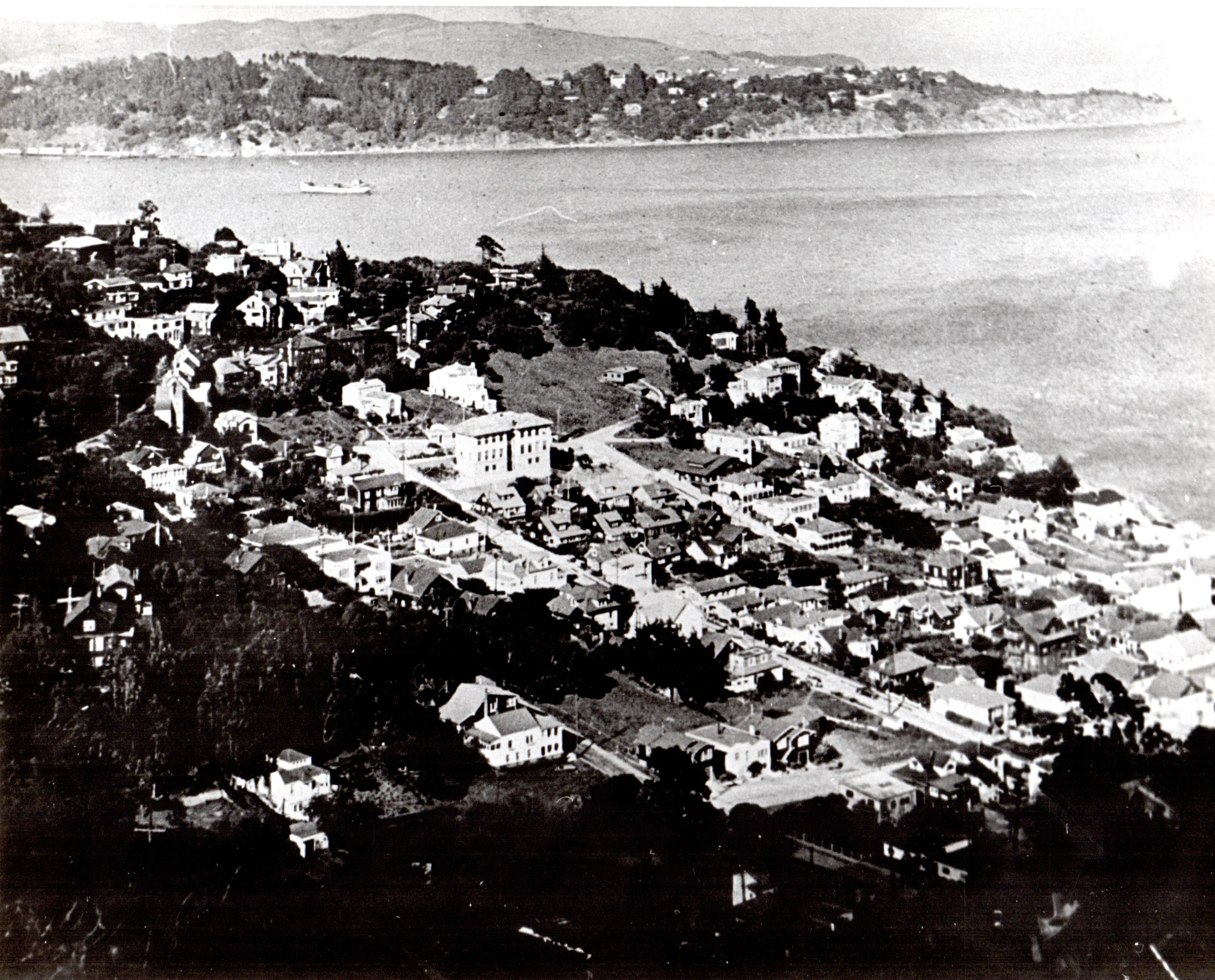
View of Sausalito
Transcript
Tim Rose, interviewed by Betsy Stroman | December 6, 2007 | Temporal Coverage: 1964 to 1969
Betsy Stroman: So, anyway, I'm here with Tim Rose, finally, at the Café Trieste, and Tim's going to tell me a little bit about, I guess, the art scene in Sausalito, from the time you arrived in '64. I believe it was '64 that you arrived, wasn't it?
Tim Rose: That's right. Yeah.
Betsy Stroman: And I have a bunch of questions, but if you'd like to just talk, that's as good a way to do it.
Tim Rose: I think that the notes I gave you provide something of an outline for the thoughts I've had prior to getting together with you. Living in Sausalito in the period that we did, from 1964 to 1969, was a very exciting place. We'd originally been intending to go from the East Coast, where we began, to Seattle, and we ended up staying here overnight and then deciding never to leave. My wife Annette and I both got jobs in the city, and then found a place to live, because we didn't have a car, and at that time it was possible to take the Greyhound into the city, come back in the evening, there was not a ferry, and go shopping, go out to a restaurant, go to a walk-through movie theater, go to a terrific bookstore, get our shoes fixed, buy meat, go to a bakery, all within a two-block radius of downtown Sausalito. At the same time, the people that we met had similar interests to ours, in the fact that they were artists, and, to my amazement, some of them were making a living as an artist, which was...
Betsy Stroman: You were working, what, in a bank?
Tim Rose: Yeah, clerk in a bank. And this was like an eye-opening experience to me. And then, as time went on, we met more and more artists, and my professional career began with me showing up one Saturday morning at the Bank of America parking lot, where an art festival, whatever that was, was going to be happening, and setting some things down on a card table. At the end of the weekend, the woman who owned Handcrafts from Europe had bought one of my pieces, and I remember that, I don't remember her name, so poignantly, that it was like an aha moment. And, uh, forty years later I'm doing commissions for cities and lobbies and courthouses and things like that with the work that I'm doing. So the beginnings of that was in Sausalito, where there was a little theater, there was the No Name Bar with artists and writers and ne'er-do-wells talking, there was a bookstore, a gentleman named Casey Sonnabend was a photographer in those days, and he worked in the bookstore and filled our heads with dreams.
Betsy Stroman: Like what kinds of dreams?
Tim Rose: Just the possibility of exploring things visually, and that it was an all-right kind of a deal. I would write my friends on the East Coast that we had left that it's possible in California, where somehow it didn't seem possible on the East Coast, to work in an office and be an artist. This was something that I didn't know was possible, and that was like an epiphany for me. Then, as time went on, we moved from the apartment that we had across from the Andean, in Trident, because we had an opportunity to manage the Sausalito Hotel, and became more involved in the civic life of the city, in the sense that we were sort of managers of a business and sat on committees and things like that. At the time, the art festival was being led by not the Chamber of Commerce, but an outfit called Bill Remag.
Betsy Stroman: Oh, Sausalito Arts and Merchants.
Tim Rose: Sausalito Artists and Merchants Association.
Betsy Stroman: And it was just Bill, wasn't it?
Tim Rose: Yeah, essentially. And the artists didn't like the way it was run, so they took it over and decided to call it the Sausalito Arts Association, for and about artists. And the profits from the gate would go towards creating a Sausalito arts center. And so we signed on, I remember, and I was the secretary to the outfit right at the beginning, and I would be a roustabout that would help build the flats, because we had to provide flats, since the artists would never show outdoors, and it wasn't like an art festival today, where the artists all arrive with trucks and trailers and pop-up tents and holding backgrounds and things like that. It was all a new kind of concept at that time. And we would take over the downtown, much to the discouragement of the merchants, and much to the disagreement of the homeowners, because we would plug up the entire town for the weekend. And it was a terrific success. I think I remember the year that I ran it, we raised the entrance fee. The artists didn't pay anything to get in, to show. We raised the fee to the public from $1.50 to $2, and that included entertainment. And it was a great life, you got to do whatever you wanted, and you keep the remains. So we left for Europe in 1968 and came back in '72, and the art center had blown up. The school had taken back their own property, and it was a change of the era. It wasn't as amenable. So we adjusted to that. The change was that there wasn't a center anymore. You could find a place to have breakfast, but it wasn't downtown anymore, it was someplace else. The bookstore closed soon after that. The grocery store is now a multi-store outfit. The Glad Hand restaurant is owned by a chain. The hardware store is up Highway 101. All these bakeries stayed around for a while, and the bookstore got sold, first to a chain, and then it went bankrupt, and now there's no bookstore in town except for a secondhand bookstore. So that kind of center just dissipated. Closest thing to it is the Industrial Center Building, where I had my studio, and a lot of the artists who worked in the building lived in Sausalito, but more and more the artists live all over the county and just come to that building to work. But I think a lot of the artistic character in the sixties, and prior to that, that we came in '64 and found in place, was based on the fact that it was geography, the downtown was a living organism, a resident. And when I see a banner up now at Christmastime saying "Support your downtown, the stores," if they have to plead for the people that live in the town to come down and search this downtown, they have to have something for us to buy besides a T-shirt or a decorative print, I don't know what else they sell downtown, because I never go down there.
Betsy Stroman: But that's what you think drew creative people to the town?
Tim Rose: Well, there's probably more than that. There was a downtown, the setting, the waterfront, proximity to a metropolitan area like San Francisco, and a wealthy potential customer base on the hillside. There was a wonderful complex of shops called the Village Fair, which was a landmark in its time. The concept of turning a multi-level parking garage, which was to have served the non-existent ferry, originally, for people that wanted to park their cars and take an old ferry boat to San Francisco before the Golden Gate Bridge, just turned into shops, and there were galleries and small little curio shops that drew a lot of people, and a lot of tourists. So it was a tourist area because of that at the time, and that sort of sparked a little bit of interest on weekends.
Betsy Stroman: Where did you sell your art, other than at an art festival?
Tim Rose: There were four local galleries at the time that we'd have relationships with. I remember there was a Shelby Gallery, and then another woman, who was a friend of Neil Davis's, had a gallery above the No Name Bar, she was a printmaker. Creative Arts was an art supply store on El Portal, and I remember the owner of that store, we were making papier-mâché jewelry, and I sold papier-mâché jewelry through that store. There's various kinds of deals that you make. And then Saga of Finland, a clothing store, she purchased a work to hang in her store, and that was like a public artwork to me for the first time. So that's the kind of thing, in small increments, you build up a career, and these are the kinds of things that get it going. And then, through networking with other artists, you learn another way of doing business, which is to submit your work and slides to competitive shows, and the juror would be a well-known curator or a museum director or gallery owner. When you get in the competitive show, not often selling things, you add to your resume that you were in this show and that this curator was the judge. So that would give you credibility, and then you'd go into the city and look for a gallery representative. That's part of the stepping stones of doing it. Also, the art festival concept in those days was an entry-level, not a lifestyle-level, way of showing art. So you would show in an outdoor art festival with the hopes of making some sales, but also, this is before any kind of open studios event ever happened, it would give a gallery owner the ability to go down the aisles and look over artwork and approach artists for representation in a non-threatening way. So that was a good entry point. The concept of open studios by artists came much later, when the gallery scene changed, instead of taking 30% or 40%, they started taking 50%, and essentially going into competition with their own artists, because they were taking as much off the top as the artists were making. And with artists not being able to make a lot of money in the galleries, something happened, what happened was open studios. We began it in '68, when we left Sausalito, and it started there, in the Industrial Center Building, with five artists being in one studio, opening for the weekend, and the other artists watching our traffic and saying, can we get in on this? And now there's sixty-five artists showing. Three years later, San Francisco started open studio events, with a nonprofit, with the idea that artists can sell their own work in their own place where it's made, and make deals. And then the thing called the internet happened, but that was much later. So these are ways that artists can express themselves and make a living at the same time.
Betsy Stroman: What about the art, when you, I mean, I've been looking at people like, well, the abstract expressionists, and then the surrealists, and the Dadaists, and all of these new things that were going on. And then I talked to Tyson the other day, and he was talking about sort of the struggle, the conflict between trying to do something new and trying to make something that sells. Is that something that's always a problem for most artists?
Tim Rose: It isn't really. I think it's an atmosphere and creativity that allows an artist to become. And whether they do it in their back room, or whether they do it in a school, or whether they rent out a studio space to do it, is the way that they do it. If they set out to make a living by it, they're in deep trouble. The concept of schools of art, the abstract expressionist movement in San Francisco was born out of a specific time and a specific institution. The time was the returning vets from Korea, from the Second World War, and these guys were pretty pissed off. They were in school on the GI Bill, they didn't have to worry about anything, and they were really pissed off, and they started throwing the paint at the candidates. Same time, a woman who was the head of the Art Institute in San Francisco found them, and she said, this is a real group of people, and she went actively out to promote them.
Betsy Stroman: Who are you talking about, Grace Morley?
Tim Rose: I don't know her name, actually. But she was a force to be reckoned with at the Art Institute, and she put the San Francisco abstract expressionist movement on the map. In Europe, there are schools of art also, one of my inspirations is Kandinsky, and he, for a long time, was in the Blue Rider School, you know, in Switzerland and Germany.
Betsy Stroman: What was the Blue Rider School?
Tim Rose: You don't know?
Betsy Stroman: Okay.
Tim Rose: I don't know specifically, but a lot of the themes were about a horseback rider and a lot of blue. But they would produce journals of poetry with illustrations, woodcuts, and things like that, and the artists would use that as thematic material for their paintings and things like that. This is something I think born of an academic lifestyle in Europe, where you have the Dadaist movement and the expressionists and things like that. It may have been born out of the café society, post-World War I café society, where the artists would get together and exchange ideas in the very famous cafés in Paris. And to translate that to Sausalito, there really was never a school, other than, let's do it our own way. Now there's a marine landscape school of painting, and it's headquartered on the Industrial Center Building, where you go through the building on an open studio weekend, and out of sixty-five artists, twenty of them are doing marine landscapes. Who knows? I think it was just a general expression of creativity, and had a lot to do at the time with the Haight-Ashbury, when that was going on, and the experience of freedom of expression there. There was a little bit of psychedelic art that had a lot to do with drug-taking and the kind of detail work that you can get when you're really smashed on drugs. But that came and went, and I think that, in general, it just wasn't the center of thematic or technical endeavor, it was just a general atmosphere of creativity.
Betsy Stroman: Okay, so people were all doing their own thing. There was no...
Tim Rose: Yeah.
Betsy Stroman: And that's probably the way it's always been, hasn't it, in Sausalito?
Tim Rose: Yeah. In Sausalito, yeah.
Betsy Stroman: And if we could just go to Varda for a minute, because you were mentioning that when you first came here, he had an impact on you somehow, he was just encouraging everybody to be creative, I would assume, not to do his thing.
Tim Rose: He lived on a houseboat at the north end of town, which was a pretty big barrier in those days if you didn't have a car. And I had become aware of him, the other friends that we had were in the houseboat community at Gate Six, so we would sort of shuttle back and forth. And when I came to know Varda, it was because one of the friends on our houseboat, who owned a houseboat, was his ex-wife, and then she rented it to another couple who became good friends of his.
Betsy Stroman: You didn't rent from his ex-wife, you rented from somebody else, who was...
Tim Rose: Yeah, no, we just knew this other person. And I'm trying to remember what caused... Because I think we went on a sail with him, and in an effort to unfreeze a pulley, I slid down and cut my leg. But that was another trip, I'm trying to think of how I met him. But in '66 or something like that, he hired me and Jim McKinley and other artists to make his boat, the Cythera. The Cythera hull itself is a 30-foot metal lifeboat. He had a young man come along and put wooden gunwales around the edge to start the job, but he didn't want this guy working on the boat, so he hired Jim and me, and we spent six months essentially making the boat for him into a sailboat. And there were wonderful stories. In order to make the keel, he had decided that he would have a cement keel, and so he hired a concrete pump to go the hundred yards from the parking lot to his sailboat, and he spent the morning finding old pieces of iron to throw in the bottom of the sailboat from this junk that he had. And then the guy arrived with the hoses, but there was a jog in the gangway out to his place where he couldn't see the level of the concrete, so he had his young dancer, who was staying with him, standing out there at the jog to signal the driver when to start and stop the pump. Karen, as a dancer, would always wear diaphanous clothing, so she was there, Varda was at the end, in the boat, and the concrete truck driver was there, and at the time that we wanted to stop the flow, the sun had come up just enough so that it shone right through Karen, and this truck driver was just transfixed, and he could not have raised his arm to close off the pump. So we had to throw the pump over the side and put some concrete in the bay until he could get the idea that this was time to stop. And also, because we were working for Varda, Jim and I automatically brought our little lunch bags, and we were going to sit there and have a sandwich, and Varda said, no, if you're going to work for me, I will feed you, and this is the kind of way he was. So we would stop work and sit down, and he'd have cooked a meal for us. And people like the truck driver, the cement truck driver, who was just as bewildered at the end of this as he was at the beginning, sat down and had lunch with us and listened like a tennis ball all afternoon. At the same time, you might have a UNESCO representative sitting next to Lawrence Halprin at the lunch, and just stories and things like that would happen. And I, to this day, quote "the hand of man must show" in my artwork, as a carryover from him. Jim and I were carefully trying to carve out the curve on some of the boats that we were doing, and Varda came back with his groceries from lunch shopping and said, no, no, you're taking much too long with this. And Jim said, well, we're trying to do a really careful job. He said, no, and he took this great big piece of wood, looked at the outside of the boat, took an adze, and just whacked away at this piece of lumber, and then put it back on. And he says, there, that's the way it goes. And I said, "Varda, that looks like shit." He says, the hand of man must show in our work of art, continue. And so he would tell stories like that that would keep us going. And he was getting on in years, one day he was so enthralled with the work that we were doing, he forgot about that self-same job and walked straight off the end of the pier into the water without making the turn. Luckily the tide was relatively out, he was standing there, at his knees, with two shopping bags, and we had to rescue him from that. So he had his moments. And I remember the day he came back and said, "Work will continue, I've just gotten an increase in my credit card. We will buy a planer." He was sort of living hand to mouth, at the behest of his sponsors and things like that, but his lifestyle was so extravagant and wonderful, not extravagant in the financial way, but in the way of his color and his character, that, again, during the same time, I was working on a show that I was going to be having at the end of May, which was opening day, and working on his boat. So I felt like I had permission as an artist to do these two things as a lifestyle choice.
Betsy Stroman: You were doing mobiles at that time, or were you doing something else?
Tim Rose: I was always doing mobiles. I had gotten a book when I was in junior high, I mean, in 1950, 1955, something like that, when Calder was really popular. There were lots of books out on mobiles, and my mother had given me a book on mobiles, and I dutifully did all the examples, and then I forgot about all of them. But when I got my first apartment, and I was putting things in it that I was making, one or two of the things hung from a string and moved. And Tyson came by and visited from North Carolina, I was living in Washington, D.C. He was a friend of my roommate's; he came through, and we became friends, and he and I put together a broken glass mobile for this half-basement house in D.C., and that's where he and I met. Life went on; I would see him, I went up to New York to visit Tyson a couple of times, and then we decided, I got married, there were some more years, and in between leaving Washington, D.C. and driving a car to California, we had to go south across the United States because it was wintertime. He, at that time, had been called back to his family in Salisbury, North Carolina, to run the women's apparel store, like a J.C. Penney store. And so I saw this highway sign saying "Salisbury," and pulled off at eight in the morning, and we went and had coffee, and he was opening the store, and I walked in and said, "Hi, Ty," and we had lunch, and stayed, had dinner, and then we were on our way. So when I got to California, I kept in touch with him, and two years after we were out here I would write Tyson, saying, come to California, you don't have to work anymore, it's a great place to be an artist. And he showed up the morning that we were running the art festival in '68, and took over my studio while I was in Europe, and kept on the tradition of the open studio at Christmastime, and went to College of Marin on his GI Bill to get his degree in art. And then he went on to run the Sausalito Art Festival when it had gone into a period of decline, and the city had taken it back, and the city did not want it, so they hired a director, and Tyson filled the role, because the mandate was to improve the art, involve the merchants, and involve the volunteer organizations in town, and he did all three of those. His only mistake was he had a T-shirt that said "Artists Coordinator," and he gave to the head of the Chamber of Commerce the event directorship, or something like that. And the guy with the T-shirt that said "director" on it looked at Tyson and said, we can do this without him, and fired him.
Betsy Stroman: I heard that he had asked for a raise. That's what Jack Beck told me, and he got fired, but who knows.
Tim Rose: No, it wasn't that. Well, he did ask for a raise, because he would have made the job so much better, but it was the T-shirt. I chided him about the T-shirt, I said, don't ever give away "director" on the T-shirt.
Betsy Stroman: How about Enid Foster? I know that she lived, did she live in the apartment house that you people managed? Was that the story?
Tim Rose: Yeah, when we managed the Sausalito Hotel, the other property that the developer owned was the Del Monte Apartments, which is up the steps in the center of town, I guess it still exists, and Enid was one of the tenants there. I heard that she was an heiress to Tiffany, but I can't confirm that, and she was the epitome of an eccentric woman. To have a martini at her house would be half gin, half sherry, and a slice of Bermuda onion. And she would essentially decorate the town with her drawings and her paintings, she was very creative, always drawing. She would do the Tides Bookstore windows in exchange for purchasing art books, art reproduction books, which she then gave to the city, if you go to the city library now, you see all the books donated by her. She was voracious as a student of the arts, and very adamant about the artistic life, and would make pronouncements and things, like "Barleywood." And we would be twenty-five-year-old kids just staring up at her in awe. And again, this is the kind of person that we met in this town, that was around town, whether she was at the Tides, or at the coffee shop, or as a friend for dinner or something like that, that you would just love to hear her stories. And the city found some of the work that she made, and I guess some of it's around still.
Betsy Stroman: Yeah, there's one piece, I think, a couple pieces, in the city.
Tim Rose: Yeah. Yeah.
Betsy Stroman: She was a good artist?
Tim Rose: I think so. She had another friend who was a primitive artist, Val Bleeker, and Val earned her living teaching kids. I would say that Enid's work was more mythological, illustrative, narrative kind of a thing, with collage and pencil and oil painting. Val did these very simple paintings that you would call primitive, in the sense that they didn't have a lot of modeling to them, they were flat shapes, flat figures on backgrounds. But they were sort of a...
Betsy Stroman: Alice B. Toklas and Gertrude Stein?
Tim Rose: Yeah, a Gertrude Stein couple, with Enid being the tough one and Val being the little follower trailing along behind her. But they were wonderful people, very generous, and serious artists, in the sense that that was their lifestyle. This is a concept that was not available to me, either growing up in Arlington, Virginia, or when I was going to school in Washington, D.C. The beginnings of a movement in Washington was a coffee shop called the Coffee and Confusion, where they would read poetry at night, beat poetry, and that was as close as I got to it. But out here, it was just, every store had art in it. Every store had art in it in Sausalito, and the stores were sort of locally owned, and they supported the artists and showed their art, or they'd be loaning money to the artists on credit until they made a sale, or they'd be involved in that part of the community.
Betsy Stroman: Who were some of the merchants who were involved in that, that you remember in particular?
Tim Rose: Well, the people at Ollie's Bakery, you know, always were giving artists something on the cuff. There was a grocery store, I'm going to call it Willie's, but it was called Marin Fruit or something like that, and apparently he lent money to everybody. Yeah, the Tides Bookstore always had an exhibition going. Glad Hand Restaurant, which is now Scoma's, always had artwork up. Those are the kinds of places that you could have little shows.
Betsy Stroman: Yeah. What happened at the Tides? I mean, in terms of community, as I understand it, there was an upstairs room where there was a gallery space, or some kind of mezzanine or something, and there would be meetings there and things. Is that wrong?
Tim Rose: There was an apartment upstairs that Casey lived in, Casey Sonnabend was an artist who was a photographer, and he lived up there. Then something happened, I think it was during the time that we were in Europe, and I think it had to do with the owner's personal life.
Betsy Stroman: You mean Herm Beckman?
Tim Rose: Yeah, and when we got back, the store was being sold, and the property was being split. Herb's ex-wife was now at Book Depot, so you'd have to ask her for more specific information than that.
Betsy Stroman: I actually have made contact with her, we're still...
Tim Rose: But you don't remember there being, when you were around, poetry readings and things like that at the Tides?
Betsy Stroman: I sort of thought there were.
Tim Rose: Upstairs, above the No Name Bar, there was a gallery for a while.
Betsy Stroman: Oh, okay.
Tim Rose: And that may have been the place. I'm trying to remember the woman's name who was the owner of that, um, Diane, I can't think of her last name.
Betsy Stroman: Oh, I will probably find that name.
Tim Rose: Yeah, her first name is Diane, she's an artist and a printmaker.
Betsy Stroman: Yeah, and there was an upstairs...
Tim Rose: That's above the No Name.
Betsy Stroman: Above the No Name.
Tim Rose: But I can't remember an avid use of the Tides Bookstore upstairs, it could have been, but I just didn't know. I wasn't around when it was happening.
Betsy Stroman: What about the Shelby Library, I mean, the Shelby Gallery. Where was that?
Tim Rose: Shelby started out in the Village Fair. He was an artist, he was going to, as an artist, own a gallery so that he wouldn't have to pay commissions on sales, and he would also show local artists. And he did that, and then he moved, when he wanted a bigger space, onto the Bridgeway, and showed and sold my work. And he was always going to paint again, he was always going to paint again.
Betsy Stroman: And he's, you know, I've known lots of people that get sidetracked, and Shelby got sidetracked.
Tim Rose: Into being a gallery owner.
Betsy Stroman: Into being a gallery owner.
Tim Rose: Poor guy, he sells his gallery, he's going to paint, six months later he has a stroke. He's doing fine, but I don't know if he's painting now or not. He has a good friend, Joe Jockla, who we represented for years, who has seen him and keeps up with Shelby.
Betsy Stroman: When you say "we," you mean at the Rose Bernardi Gallery? You say you represented...
Tim Rose: No, no, Shelby represented him. Shelby represented him and became good friends with Joe Jockla, who was an artist. And as far as I know, to this day they're still friends, and Shelby may be painting again, even though he's confined to a wheelchair.
Betsy Stroman: You mentioned in your letter Jane Pocker, and I'm sort of curious about her, mainly because she was right near my daughter, and I was thinking I could go see her.
Tim Rose: Yeah, Jane Pocker was a Mill Valley printmaker, silkscreen artist, who would show locally also. She's one of the people that would always be around. And the year that she was on the Sausalito Art Association, and the year that I volunteered to do the festival, I had her volunteer with me to help me, I knew I couldn't do it alone. And she was this very wonderful, generous printmaker who, I can't remember the cause, but when the first word of ecology and environmentalism and wasting of natural resources came into being, she had a huge crisis of conscience about paper and wasting it, and became a social worker, and stopped doing art, and moved to the city, and is retired now.
Betsy Stroman: Amazing.
Tim Rose: Amazing.
Betsy Stroman: Did you ever run into somebody named Kay Cassander, or was she probably before your time?
Tim Rose: I've heard the name, but I don't know her.
Betsy Stroman: Because she became a psychologist, and I'm just, what about, there was a studio where Diane Karasik worked, that was down in the...
Tim Rose: Yeah, that's right, at Galilee Harbor.
Betsy Stroman: Yeah, were you involved in that studio at all?
Tim Rose: No. The morning the bulldozers were there, but that was it. This is what caused Art Zone, if you remember.
Betsy Stroman: Yeah, I read about Art Zone, yeah.
Tim Rose: Okay, that's what caused Art Zone. Stewart Brand also had a friend who was a carpenter or something in that building. His story is that the owner of the property wanted to put up the building that he has now, and his lawyer gave him two options, he says, you can bulldoze it now and we'll pay the fine, or you can go through the permit process, paying me for ten years, and build a building later. He chose to bulldoze the building and eat the fine and put up his building. And the cost was that Stewart Brand, who had lived in town but was more of a world citizen, decided, I've got to become involved in my own community. So he hired Annette to start Art Zone, which was to inventory the resources of the waterfront in Sausalito, with the idea that they had worth and it could become a political force to be reckoned with. And he funded it. That was the beginning of her political career, to get houseboat communities legalized as low-cost housing. And first her husband ran for city council. A hard man is good to find.
Betsy Stroman: Yeah, I remember that, yeah.
Tim Rose: And he would rather do plays than he would be on the council. So Annette got involved in it, and became very knowledgeable about Sausalito city permitting and politics, and was willing to talk to people. And so she ran and got in, and stayed in for about two or three terms at the city, and then moved up to the Board of Supervisors. So that was the beginning, that bulldozer caused her to start a political career.
Betsy Stroman: I see. Okay. What about music, poetry, and theater? If you can say anything briefly about what was going on in those three areas.
Tim Rose: I don't know that much. When we first got to town, the Trident Restaurant, which is very, very popular, and to this day has had a great reputation for bringing in jazz, was a place where you could just go in, sit down, have a drink, and listen to terrific jazz. The No Name Bar did not have any music, because we were too busy drinking. There was a little theater in town, if you contact Kayla Kahn, she knows a lot about this little theater. There were two theaters downtown Sausalito, and there was very active poetry, poetry, maybe at the Tides Bookstore, the poetry reading business wasn't really happening, as far as I know, but I could be wrong.
Betsy Stroman: It was happening earlier, I think.
Tim Rose: Could be, yeah.
Betsy Stroman: Does the name Gerd Stern ring a bell?
Tim Rose: No, okay.
Betsy Stroman: In the fifties, I think, is when they were doing that.
Tim Rose: Yeah, that was when I was in D.C., and that's when the coffee shops that would have beat poetry read in them was a big deal.
Betsy Stroman: I hate to go through all these people, but I'm just wondering if you could, just a few people, tell me your recollection about them.
Tim Rose: You have a list?
Betsy Stroman: Oh, I wrote a letter, actually, to Herb Beckman, but you don't need to go through all of those, I'm just thinking a few people, like Serge Choubac, if you could sort of comment.
Tim Rose: I kind of knew him, but peripherally. He was again another artist who lived right at the corner of Princess and Bridgeway, and painted Matisse's and Chagalls. He was a little bit European, a little bit derivative for us new guys. They're all here, you got Walt Kuhlman, who was the grandfather in the Industrial Center Building. He was the only other guy there when I really had a studio, when I moved in.
Betsy Stroman: Oh, is that right?
Tim Rose: Yeah, on the third floor. That was what year, '60?
Betsy Stroman: Did you move in in '60?
Tim Rose: Like '65, probably. Walt Kuhlman was already in the building, on the third floor, and it was a football field of empty warehouse storage area, not even defined. At one end of the building was a sailmaker, that was one-third of the building. The other end of it was a Luxo Lamp warehouse, which was another third, and the middle of the building was a void, except for some partitions. And I was at the No Name Bar, and a guy at the next table announced that he was having a studio put in at the Industrial Center Building, but couldn't afford the $135 rent for the month, which is now $1,350, and needed some help. And I said, well, I'll go in for $35 a month. And then my wife said, you don't even have $35. And so I got a sponsor for a summer, the deal was, a co-worker of Annette's at the museum agreed to pay my three-month rent, and the idea was she'd come to the studio and pick out a mobile at the end of the summer. And that began that.
Betsy Stroman: There was a woman, Leah Schwartz, was she in there at that time?
Tim Rose: No, she painted out of her home in Mill Valley.
Betsy Stroman: Because I did interview her, and at one point she shared a space with Kuhlman, but she said it was a very short time.
Tim Rose: Okay, yeah, could have, and she wasn't aware of it. Albert, that's her name.
Betsy Stroman: So did the number of people who came to the ICB building grow rapidly?
Tim Rose: Mostly on the third floor, which had high ceilings, and there was no security. The second floor was offices, and people could lock them up. The first floor was mostly drive-in warehouse, except for a couple of spaces. So the growth was on the third floor. After the guy I shared with, who I didn't get along with, decided he would move to L.A., and I didn't want the space, or something, I took another space, kitty-corner, and had the building make the walls, because there weren't any walls, and moved in there. After that, Walt Kuhlman moved kitty-corner across the way. Then another, he had a big area, he divided it in half with another artist, I'm going to say his last name was Diamond, moved in. Then a guy named George Sumner, who nobody had ever heard of, moved in. And so it grew incrementally over that time. At one point there was a great big printmaking studio in that third-floor area, which was doing silkscreens using day-glow inks, and this was during the Haight-Ashbury time, with acid kind of colors, and they would work twenty-four seven, and we had to walk a couple of the guys up and down the hall because of drug overdoses. But it was a happening place, twenty-four hours a day. So that was probably where it was at, in terms of the art world.
Betsy Stroman: And then you'd take breaks over at the No Name and the...
Tim Rose: Yeah. Now, Bill Dorman had a studio across the street from the Trident, in a little apartment there, and he did these little watercolors, 8x10 landscapes of the Sausalito waterfront, and sold the same one probably a hundred times. Did a good job on it; he got practice in that. Leo Krikorian owned a coffee shop at the corner of Princess and Bridgeway, sold it, and went to Europe and lived in Paris for about fifteen years. Came back, and I'm not sure he's still with us. Ann Fowler was the popular painter of the time, she would do these very easy-to-look-at landscapes, and people would sort of look down their noses or something like that at them, but she made a lot of money.
Betsy Stroman: How did she sell them, by the way?
Tim Rose: Through the restaurants and galleries.
Betsy Stroman: Yeah.
Tim Rose: Everybody had an Ann Fowler. Edith Heath, of course, she's ceramic, she was the artist of the couple, and they essentially turned from production potters doing stoneware to a factory that's distributed worldwide, because one of the outlets was the Trade Fair store, where the ferry comes in now, which was a huge free-cost-plus shopping outfit.
Betsy Stroman: Let me ask you about that, somebody told me, I think it was Tyson, who told me that he interviewed Edith Heath at one point, and she said that she thought that where they sold their stuff outside, where I think Bill Conover also sold furniture, artists started also selling stuff out there. She thought that might have been the genesis of the art festivals. Does that ring a bell with you?
Tim Rose: I've never heard that story. The Art Festival, one of the first ones, Varda was on, now Gabrielson Park. And apparently, whatever happened, Varda arrived by boat, and the big party began. But I don't know what started that art festival, in particular.
Betsy Stroman: Did you ever have any connection with Victor di Suvero?
Tim Rose: Through Varda, yeah.
Betsy Stroman: Okay, because I've been talking to him, that's how...
Tim Rose: He's a very, very close friend. He's the brother of Marcus, he was our cousin, or something like that. Shel Silverstein, I didn't think of him as a Sausalito artist. He was a good friend of Larry Moyer's. Sally Stanford was the person who hired Tyson, she was on the city council, and they were all against it, and Sally Stanford made a speech that Tyson could quote, something to the effect of, if you want to have a meal, you hire a chef instead of a bureaucrat, and here's an artist, and the other guy was a professional administrator. And so Sally said something to do with her bordello, if you want somebody to come, you don't hire a clerk to stand at the door, you hire a guy who knows what he's doing.
Betsy Stroman: Georgie Mary Hoffman?
Tim Rose: I think they were more collectors and supporters of the arts.
Betsy Stroman: They'll come over, vaguely familiar. Elizabeth Inquist?
Tim Rose: He did the furniture, made furniture.
Betsy Stroman: Okay. Elizabeth Inquist?
Tim Rose: I don't know.
Betsy Stroman: Judy Stone?
Tim Rose: No.
Betsy Stroman: Michael Rougier?
Tim Rose: Don't know.
Betsy Stroman: Mary Lindheim? You did know Mary Lindheim?
Tim Rose: She was great. She did terrazzo kind of collages and things like that, and I carry with me a mantra that she said, that if you can see the pieces in a collage, it isn't working until they become designed. Now, if you're making a sort of a junk sculpture, and you still see the pliers and the stuff like that in it, it isn't working until it turns into a human being or a critter or whatever it is. So in her case, with terrazzo kind of tabletops, if you could see the tiles, it wasn't working yet, you had to see the design.
Betsy Stroman: Did she teach around here, or...
Tim Rose: I don't know how she made her living. She was just working. Martin Metal, I don't know. Dunya Jerniko, I don't know. Jack Beck, I'd stay away from. Barbara Duncan, kind of remember her, she was an illustrator. B. Sidler is a saint.
Betsy Stroman: Tell me about that.
Tim Rose: She is with the Oslado Foundation.
Betsy Stroman: Yeah, all right, let's talk about that.
Tim Rose: Of course, and that's doing that now. Neil Davis...
Betsy Stroman: Oh, I didn't know that.
Tim Rose: Neil Davis, I think, began it, to support local art, and it's been a very quiet organization that has helped artists, and that's really all I know, that she's just been the saint, the steady hand on it. You'll have to ask Annette more about it. Len Canson was an artist who was just in Sausalito forever, painted abstract expressionist type things, kind of decorative, had a studio in the Industrial Center Building, and exhibited, sold his work on Caledonia Street in the frame shop there, he's a good friend of Walt Kuhlman's, but I don't know too much more about him. Nell Melcher was a friend of Ann Fowler, if I remember. Oh, no, Nell Melcher's the watercolors, realistic watercolors, lived in Sampson Beach. Was a very quiet artist, and then really got some terrific photorealistic watercoloring techniques down. She was making money hand over fist, then started reproducing her work, and it went down. I don't know what happened to her. Red Raymond, don't know. Al Seabrian is Bill Kirsch's great friend, who's dead now, I think. He's the Sausalito seal, and the foundation sells his work. Maya Angelou, I've heard the name, but not in Sausalito. Leonard Wood, no. Vern Porter, no. June Schwartz, no. Hilary Bellock, poet. Max Pollock, don't know. Piero Caro, I think, was one of the owners of the boat that Varda and Alan Watts owned, no, he was not that, it was another boat, and I can't remember which one it was.
Betsy Stroman: Bill Kirsch?
Tim Rose: Of course, I know him very well, he's in town. Lena Perra, they were wonderful ceramicists that lived in the south end of town, and essentially were just one of these rock-solid craftspeople that would show at the local art festivals and be socialists and things like that. Bea Bernardi was at the opposite end of the spectrum, because her husband was this world-famous architect, and yet she was a weaver, and serious about her drawing and crafts and things like that, and supported the arts, you can't believe. I mean, obviously, when we got back from Europe, her niece owned a store called Aquarius Arts that we bought.
Betsy Stroman: Aquarius Arts?
Tim Rose: Yeah, it was the age of Aquarius, that was over. Now it's called the Rose Bernardi Gallery, in honor of her.
Betsy Stroman: Oh, I see, you bought that?
Tim Rose: Yeah, I changed the name to Rose Bernardi.
Betsy Stroman: Was she involved with the gallery? Did the family own it?
Tim Rose: Oh, I see, and then we got back, it just so happened her niece had gotten pregnant and wanted out, so they made it very easy for us to acquire this frame shop, art gallery, frame shop, and what became an art supply store.
Betsy Stroman: Ruth Costello?
Tim Rose: Name is familiar, I can't think of what it is. Helen and David Morris were great people. There's a restaurant now, in Marksburg Landing, with a great big chimney, and then there's a development that's going up the hill. If you got onto that property, you'd go over a hill to a little lake about the size of this coffee shop, and they had a Japanese house on the other side of that little pond, and they made exquisite pottery.
Betsy Stroman: I heard about their pottery, and I heard they moved somewhere, but I didn't know where.
Tim Rose: I just, they moved out. They're all dead now.
Betsy Stroman: Harriet and Rodenbush?
Tim Rose: I don't know.
Betsy Stroman: Okay, well, that's terrific, thank you, what a trip back in time. Let's see, what else did I...
Tim Rose: There were these barges, floating dry docks that somebody had snuck into Richardson Bay and let sink. Nobody could move them.
Betsy Stroman: Who would let him do that?
Tim Rose: I'm trying to remember his name, yeah. And then they were just sitting out there, so they decided to have a party out there for five hundred people. And they had this great committee of moneyed people and artists, it was one of these things that could only work in Sausalito. The moneyed people donated the money, and the artists did all the work. And so we were in charge of creating a firebird out of felt.
Betsy Stroman: A firebird out of felt?
Tim Rose: Because that was going to be part of the ceremony. And that's only the beginning, it went on and on and on, in the preparations, with all kinds of processions and activities. There were speedboats that would take us out to the party and back, these were things that artists would never be able to afford, we'd be rowing back and forth. It was a night just like tonight, it was overcast and rainy. And for the rehearsal, we had Varda on the boat, and I said, "Varda, your birthday party's going to be rained out." And he looked up at the sky and said, "No, it'll be fine, there's three days of rain, and then there are three days of clear. We will have clear weather." And there was clear weather. But this was, get Victor di Suvero going on that party, because he was the ramrod of it, and put together that whole crew.
Betsy Stroman: Where were they getting all the money from?
Tim Rose: These were individuals that were wealthy, that liked Varda's lifestyle, and would go to his parties. Varda would go out every Sunday on his sailboat, and he would surround himself with beautiful dancers, and then UNESCO ambassadors, and the heads of corporations, and Mazzella Box and Walter Landor and his clients. It would be a wonderful bohemian adventure. So they would get good financial support for these projects, and then the artists would execute them all, yeah, their settings and their props and stuff like that. The only thing that happened that was bad was that they made the chili the day before, and some of it had ramifications by the next morning.
Betsy Stroman: What did I hear about that? Oh, I know, Mimi told me about that. She said it was lamb stew, and everybody had the same recipe, and they poured it all together, and one of them was headlong.
Tim Rose: Well, we were a lot younger, and we had stronger stomachs in those days, yeah.
Betsy Stroman: All right.
