
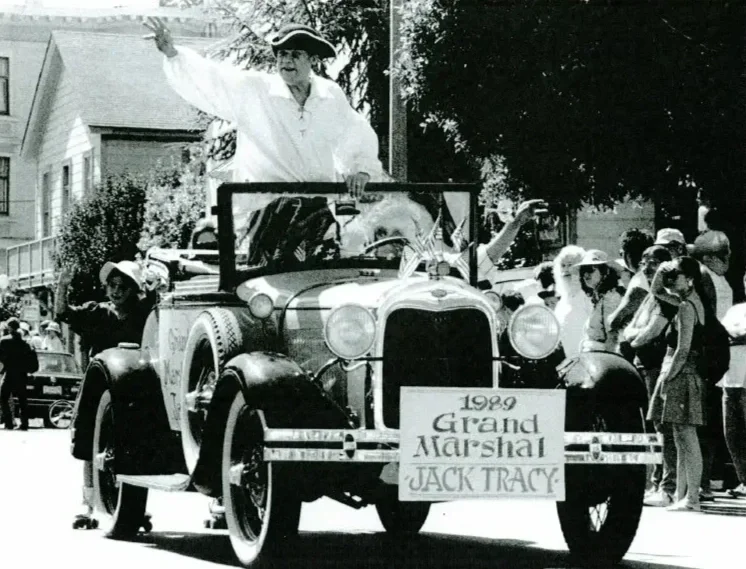
Black and white, 8" x 10", photograph of Jack Tracy, as Grand Marshall in the 1989 July 4th Parade.
Transcript
Jack Tracy, interviewed by Stephanie Wicks | November 7th, 1990 | Temporal Coverage: 1975 to 1990
Stephanie Wicks: Today is Wednesday, November 7th, 1990, and this is an interview with Jack Tracy discussing the development of the Sausalito Historical Society. The interviewer is Stephanie Wicks.
Stephanie Wicks: And I'll let him talk. Well, Jack, why don't we start by talking about the Sausalito Historical Society, how it was founded and how it came about.
Jack Tracy: All right. It's really very simple. I founded it in 1975, but what led me to it is maybe more important. I saw real estate developers destroying the town, cutting trees, and I made my mind up one morning and said, to hell with this. So I walked down Caledonia Street.
Stephanie Wicks: What year was this?
Jack Tracy: 1975.
Jack Tracy: And the first person I met was Ed Coudere, who owned the Sausalito Moving and Storage Company. And I said, I want five bucks. And he said, what for? I said, I'm founding a historical society. So he gave me a check. Next guy was Ed Long, an accountant on Caledonia Street. Ed, five bucks. That's the basis of it. We now have roughly seven hundred members.
Stephanie Wicks: You went around and just told them what you wanted to do?
Jack Tracy: Yeah. And at that time the mayor of Sausalito was Everett Heinemann, who was historically inclined, still is, he's a board member. And when this building was purchased by the city, where the city hall is today, 420 Litho Street, he said, could you put on a display for the opening of the building? And I said, sure. So we got about ten or twelve people, men and women, worked our tails off. It was only supposed to last an hour, starting at ten. Donuts, coffee, the Army band. You know, once you've been through the building, you've been through the building. Up here, nothing had been done, everything had been done down below. We did the best we could, we begged, stole, borrowed anything we could find regarding the history of this town. Everything went well, except it was very nicely done, and we didn't close the exhibit until seven o'clock that night. And hundreds of people came.
Stephanie Wicks: From all over Sausalito, later on?
Jack Tracy: From all over Sausalito.
Stephanie Wicks: From ten in the morning until seven at night?
Jack Tracy: So I think what happened is that the hundred who were there originally had never seen any of this before, which is true. They went home and started calling people, and it just kept going around in circles.
Jack Tracy: So a short time after that, the mayor approached me, I was walking home, and he said, how can I help you? I said, permanent space, no money, I take no money from the city. So he said, well, let's go. So we walked up here, and he says, what do you want? I said, this room. Right now, filled up right away. And he says, you need more space? I said, yeah. And a guy by the name of Ben Pulsifer, and I said, I need more space. And he says, well, what do you want? I said, I'll take that room. And Ben was right here with a sledgehammer, and we broke through it. That's how it came about. And every mayor has been supportive, Buddy DeBruin, Sally Stanford, she dedicated the Victorian Room. We have the art gallery out here.
Stephanie Wicks: People are very, very generous.
Jack Tracy: Because they really care for it. Those who come and go so quick don't ever even know what's going on, but those who live here do. So that's the basis of it.
Stephanie Wicks: So your collection here is a collection that was all donated to you?
Jack Tracy: Primarily. People came and said, this is part of Sausalito, you should have it.
Stephanie Wicks: That's right.
Jack Tracy: Artifacts, documents, and a number of things. We started oral histories in conjunction with the library downstairs. I'm not very strong on meetings, because you can get bogged down in meetings where you lose all the enthusiasm, so my meetings are normally exceptionally short. Get over what the problem is and get rid of it, that seems to work very well, at least as far as I'm concerned. During the bicentennial we raised sixteen thousand dollars in private money for the full restoration of the fountain downtown in the park, which has since been destroyed, which I haven't even started working on yet. Mary Ann Sears, strong supporter. We raised money privately, not city money, but private money, we control our own assets. On the North Street steps, all the light bulbs had been broken and the steps cracked, we did all of that, and formed a historic district from the Casa Madrona to Horizons, up Princess Street, certified by the Department of Interior. That's very hard to come by, believe me.
Stephanie Wicks: So the Historical Society is a private society, separate from the city government?
Jack Tracy: Correct.
Stephanie Wicks: And it is supported by private individuals?
Jack Tracy: Right, not by any city money. I had been requested various times by certain city officials to take money, and I've always said no.
Stephanie Wicks: And your reasoning for that?
Jack Tracy: You control your own destiny. You don't owe anybody anything. If your membership has a complaint, let them yell it out. The Marinship Exhibit at the Bay Model, which is private again, we raised four hundred thousand dollars.
Stephanie Wicks: That's a lot of money.
Jack Tracy: December 7th is my key day. Everything donated again, well, it had to be labor, you know, things like that. But I believe in doing things that leave an imprint for the future, educationally primarily, and not to forget, not to forget.
Stephanie Wicks: If there were one aspect of the historical society that you would say not to forget, what would that be?
Jack Tracy: We have thousands of photographs and thousands of documents, they're all indexed, most of them, not all, but most, ninety percent anyway, for the future. Research, we do a great deal of that for people. And when I was talking to you about the yellow bus book, and when those letters come back to me, I'm amazed with the letters, because...
Stephanie Wicks: The letters from the children.
Jack Tracy: From the children, yeah. Because someone comes here, black, white, Hispanic, I don't care, just so they learn. And they'll say, did people really live like that, when they look at the Victorian Room. And some of the teachers, who normally are two or three teachers with these groups because there's normally about forty kids, boys and girls, you know, this high and all that, and I'd say, yeah. And he'd say, can we sit here? I said, sure, that's what it's for, touch, feel, sit. Otherwise, how will you know? And every mayor since 1975 has strongly supported the society.
Stephanie Wicks: Now, you started out with just this one room.
Jack Tracy: With absolutely nothing.
Stephanie Wicks: And then you decided to do the Victorian Room.
Jack Tracy: Uh-huh.
Stephanie Wicks: Now, where did all of the furniture come from for the Victorian Room?
Jack Tracy: A lot of it was, Sally Stanford's piano is in there, a gift. Some of the French families, the Barrettys, some things we did purchase.
Stephanie Wicks: But was that your idea, to do a Victorian room?
Jack Tracy: Yeah, a period room.
Stephanie Wicks: A period room, right.
Jack Tracy: Mabel Wasser, who was a music teacher, her family heavy on the library, when she passed away she left me the clavier, you know, the one that doesn't make any sounds, a practice piano, in their will. Photographs, I'd say the majority of all the paintings, maybe we have a hundred or so here, are all originals from the 1950s, all gifts. It's quite a nice collection. The Oakland Museum of Art actually has photographed most of them.
Stephanie Wicks: For their records?
Jack Tracy: For their records, yeah.
Stephanie Wicks: So then you have interrelationships with other museums as well.
Jack Tracy: Oh yeah, yeah, very heavy, yeah.
Stephanie Wicks: The Oakland, how about San Francisco?
Jack Tracy: Oh, the California Historical Society, right, Smithsonian, the Bancroft Library, Oakland Museum of Art, all over, to be quite frank with you, Canada, Alaska, Paris, and on and on.
Stephanie Wicks: When you started the Historical Society, what was your favorite aspect of it? As people started bringing things in, were you more encouraged by the photographs you were receiving, or did you get personal letters and diaries, say from families from the turn of the century here?
Jack Tracy: A few, not very many, those are very difficult to come by, photographs. A woman, the Beauregard family, which is French, I forget her name now, I think it's Ruth, doesn't matter, but she approached me one day, her family were heavy up in years now, but very, very sharp, and one of the best oral histories I have is of her father, which her family has requested copies of, which we got. But she said, there's a photo manual on the mantel in my dad's living room. And she said, if you're interested, come by, because they only lived a couple of blocks from where I live. And I did, and it was the original photographs of 1910 of Sausalito. Original. This guy Sutherland must have been dating one of the kids and brought the photographic album over and left it, and it sat there for sixty years. I have it, it's right there.
Stephanie Wicks: That's amazing.
Jack Tracy: Yeah, I'm not kidding. And so things just come like that. Hugo Voigt the other day brought me the vertebrae from a whale that he found at Point Reyes. And sometimes I come and open up the museum and stuff will just be lying outside with a note for me. Sometimes they don't even know who gave them, I mean, I don't know.
Jack Tracy: And this is an interesting example, on the Marinship thing now, Captain Walter Jaffe, he's the commander of the reserve fleet in Suisun Bay, and I don't know how he knew about me, to be honest with you, and he called and said, I found the Mission Santa Ynez. And I hadn't done very much research on that particular vessel, which was built here, though, in Sausalito. It's the only one I know of that's still in existence, one of the ninety-three built between 1942 and 1945. And they were getting ready to, fortunately it had been put in the middle of the fleet, there were seventy-five ships over there in the bay, so no one ever stripped it, the outside ones, but not in the middle. But the time had come for it to be sent to Taiwan for scrap, they get one point two million dollars for the whole thing.
Stephanie Wicks: Oh, my goodness.
Jack Tracy: Yeah, forget about anything else though, that's just for the whole ship. And he said, come on over. So I got, I don't know, ten guys and gals, Cindy Roby, Liz Robinson, Charlie Merrill, Steve Osborne, Chief Bogle, any number of very dedicated men too. So we went over, William Kent the third, Fred Drexler, any number. And they had moved her out to the perimeter, so we went over and looked, and we were dumbfounded, it was just like a wrench on the deck, like a guy had just put it down. A coffee cup in the mess hall, the chart room, radio room, engine room, captain's deck, the whole bit. We were all nuts, we couldn't believe what we'd found, lifeboats, life preservers, boards, paddles, engine telegraph, wheels, any number of things, we were dumbfounded. The guys all went nuts because we couldn't believe what we were looking at, because nothing had been taken. So of course we took everything we could possibly take right away, which wasn't much, because we didn't know what we were getting into. So then I sent another couple of crews over.
Jack Tracy: But to show you how things worked there, and with due regard to the Maritime Commission of the United States, Jaffe, the men don't like the ships being sent to Taiwan, so he stripped her too, and had it all brought over at no cost to us for the exhibit, everything, the heavy stuff that had been molded, to the hull. And that's a lot of work, believe me. So there's a feeling that reproduces itself somehow, people who really care about what they're doing. So he's putting out a book on the Santa Ynez. So when I researched the Santa Ynez, and I'm not digressing, because I sponsor it, so that's how it comes about. But when I researched it, every time a ship was launched at Marinship, there were ninety-three, mostly tankers, fifteen Liberties, but the rest were tankers, a woman was the one who cracked the bottle. So I don't know how I got this one, but I got the first bottle from the Richardson, which was the first ship, and it was in perfect condition. And I said, this is impossible, I have a picture showing her cracking it. But what they did, they wrapped the bottle in mesh and seventy-five yards of red, white, and blue ribbon, so they broke the bottle, but it looked like it had never been broken. And the man who gave that to us, his wife, who's long gone now, she was the first sponsor, and he kept that model.
Jack Tracy: So anyway, getting back to the Mission Santa Ynez, when I researched that, it came about that Louise Davies, of Davies Hall in San Francisco, she was the sponsor of the Santa Ynez. So I had a reception dinner at the Casa Madrona in her honor. We had a hundred or so, and she said it was the first time she'd cracked a bottle in a long time, because she's getting up there. But the point is, she had a hell of a good time, very nice lady. And then a couple weeks later she sent me five thousand dollars. It just comes like that, it works two ways, it's a two-way street, but that's not unusual with me. Bechtel Corporation, they've given me over a hundred thousand dollars, some individuals, seventy-five, eighty thousand dollars.
Stephanie Wicks: My goodness.
Stephanie Wicks: Fireman's Fund?
Jack Tracy: Yes, I don't know how the hell it came to them, twenty-five grand, I didn't ask for it.
Stephanie Wicks: And this was for the Marinship exhibit?
Jack Tracy: Uh-huh. And then artifacts from individual Bechtel employees pertaining to this exhibit, just Ken Bechtel, his sons, they were adopted, that really shouldn't be put in there I guess, but they had the original watercolor paintings of the Marinship book, that book right there, one lives in Yuba City, the other lives in Idaho, each one had two of the paintings donated, and each one gave twenty-five grand too. They're young people, sure, but I think part of it is that they realize the importance, it's not so much preserving the past, it's showing where things come from and how life develops. Because I hate museums where you say, don't touch, what's the point of having it then? Touch it, pick the glass up, sit down on the couch. I'm very strong on that.
Stephanie Wicks: So you've taken your findings and your beliefs from the Historical Society and put them into the Marinship Exhibit also.
Jack Tracy: That's correct. We all have video, it's all set up, the construction is completed, they're putting the exhibits together. I went over there the other day, a couple of days ago I guess, and they have the portholes that Jaffe got off the Santa Ynez, and the wheel, and all that.
Stephanie Wicks: And people will be able to go in and touch these things?
Jack Tracy: Darn right.
Stephanie Wicks: That's wonderful.
Jack Tracy: Darn right, that's wonderful, because I do not believe in this don't touch stuff. Feel it, get your hands on it, I'm very strong on that. Of course I get myself in trouble too sometimes. But so what? That's how I am, I can't do much about it. This wheel right there, the big one, that was a gift from a woman in Sebastopol.
Jack Tracy: The ferry boat Eureka at the Hyde Street Pier is celebrating its hundredth anniversary this year. That wheel came from the Eureka, I shall donate it to the Eureka.
Stephanie Wicks: That's off of the Eureka? How did she come by it?
Jack Tracy: Apparently her husband, you see, they had to change it because that's a big wheel and it would take two guys to move it, so they converted the Eureka to diesel, you could run it with a little wheel. So they took the big wheel off. And he was working on the Eureka for some reason, I don't know, the name's Bats. And she called me and said her husband had been refinishing this thing, and she said she'd heard about me, I don't really know, to be honest with you. And she said, I would like you to have it. And I said, well, I'll do the best I can. So I had one of my sons-in-law go up to Sebastopol and he picked it up and brought it back. Now you see those notches on the handle there, to the left? That should actually be straight up, that means your keel is dead center. The other ones you see are plain. So they notched the wheel, that means you're going straight ahead.
Stephanie Wicks: That's interesting, I never knew that.
Stephanie Wicks: What do you think are some of your special finds as far as the history of Sausalito?
Jack Tracy: Our photographic collection is fantastic. And actually our documents, exceptionally, because when City Hall moved from down on Bridgeway to this building, and I already told you Everett Heinemann was mayor at the time, and this was in '75.
Stephanie Wicks: Yeah.
Jack Tracy: They were throwing out everything. Now some of the old-timers, if that's the word you want to use, there had been some city managers who had no relationship to Sausalito, and they would just throw things out. The old-timers, though, working for the city, would find what he threw out and then hide it someplace. Yeah, I'm not kidding now, believe me, because they knew the value.
Stephanie Wicks: Yeah, because it was part of them.
Jack Tracy: It was part of them. Yeah, it was part of them.
Stephanie Wicks: That star up there, the copper one, in this case, second case over?
Jack Tracy: Oh, yes. That used to hang outside City Hall. This was before radios, and when that was hung outside City Hall, it meant for the police department to stop, because there was a message for them.
Stephanie Wicks: That was hidden?
Jack Tracy: That was hidden, so that was their side.
Stephanie Wicks: Now how many people know about that? That's incredible.
Jack Tracy: Well, there was this woman, Wilma Young, and she worked for the city for years. She hid it between the pages in a book. He had thrown it out, he didn't think it was valuable.
Stephanie Wicks: That's amazing, so it's a long process, wonderful story.
Jack Tracy: Wonderful story, true story too. All those hats from the fire department, collected over the years, from Sausalito No. 1 all the way up. Police department stamps, maps. And a lot of this stuff, when they moved, was thrown into a dumpster outside City Hall down on Bridgeway. And the mayor said, if you want anything, take it. I took everything, naturally, the original council chairs, everything.
Stephanie Wicks: It was all being destroyed, yeah, who wanted it?
Jack Tracy: That's amazing, it's the truth.
Stephanie Wicks: So some of these chairs right here are the original council chairs?
Jack Tracy: Four of them, yeah, there should be five, but I've only found four. And the joke is, I had a Pontiac station wagon, I'd put the chairs in it, and I went in to get more stuff with some other guys, and we were taking it out to put into the car, and somebody was taking a chair out of the car. I stopped that one quick enough, I'll tell you.
Jack Tracy: It's really important how you feel about your community. And with the mobility of people today, they're losing their own, I don't want to say roots, but basically that's the truth, they don't know where to go. And they're moving too fast, where the hell they're going to, I don't know. But they're not doing anything to protect their future, because they're always running as fast as they can run. And I'm more for slow down.
Jack Tracy: There was a woman, Lucretia Little, she's long gone now, but she was the city clerk of Mill Valley for, oh, I don't know how many years, feisty redhead, and she collected many, many things, and before her death she called me, I think she died of cancer, and said, I really want you to have things. She left me a fantastic library, and original maps of the first railroad from Sausalito, from 1875 to Cazadero. I have a whole set, in the state of California they're still trying to get them off me, but they're not going to. All on linen and everything. If I unrolled all the maps, they'd go from this wall to that wall.
Stephanie Wicks: And the maps were made on linen cloth?
Jack Tracy: Waxed linen.
Stephanie Wicks: Waxed linen, I've never heard of that.
Jack Tracy: Yeah, yeah, that's the original format of the map. We have original maps. This one here is the first map we have, Sausalito, 1851, this little one here to the left. I had a phone call from a guy in San Rafael who worked with, I forget who, a savings and loan I guess, and he said he was going through the vault and saw this map, and that particular map, it's original. And he said, I thought you might be interested. And I said, I am. 1851.
Stephanie Wicks: He found this in a vault, and he just donated it?
Stephanie Wicks: I'm curious about something, when you acquire something like an original map, like this...
Jack Tracy: Oh, you mean the process?
Stephanie Wicks: The process of acquiring something.
Jack Tracy: Oh, it's very simple, we work on the Library of Congress standards. So if you were to give me something right now, we would put it in the accession book. Now the accession book is numbered, and you start, these guys I know at the Lowie Museum in Berkeley, Cal, never change a process once you start it, they said it doesn't matter what process you use, but never change it. So you have a number, and you say, like, this is 1990, so the first thing you get in 1990 would be 90-1. That number goes on the back of whatever item you have. But that's only the beginning, the big problem is the indexing of the subject, that's what those files are, and those files relate to these files, so it's a cross thing. Thousands of hours.
Stephanie Wicks: My goodness, you do have some wonderful photographs up here, just absolutely wonderful photographs.
Jack Tracy: You're not even looking at the tip of the iceberg.
Stephanie Wicks: And you catalog each one?
Jack Tracy: Each one, yeah.
Stephanie Wicks: Do you ever think that you'll expand, I mean, this area?
Jack Tracy: I don't know where we can go, you seem like you've got a lot of stuff up here. Yeah, I'm remodeling this room.
Stephanie Wicks: Oh, you are?
Jack Tracy: Oh, yeah, I have to, I'm running out of space. Many of my members want me to buy a building for a few million, but I don't know, and have a real, hang a plaque outside and say, you know, the Sausalito Historical Society. Yeah, but I don't know, because the city is good to me in many ways too. I walked in one morning, my telephone had been installed, I didn't ask for it.
Stephanie Wicks: That's nice, that's nice, so they've taken care of you.
Jack Tracy: So they do what they can do, and I understand that, but I don't take anything from them either, and they know it.
Stephanie Wicks: I'm curious about something like that, I'm outspoken too, obviously.
Stephanie Wicks: Now, I am aware of the book Sausalito, The First Hundred Years.
Jack Tracy: Yeah.
Stephanie Wicks: How many books on Sausalito have been written from a historical aspect that you have participated in?
Jack Tracy: None. Sausalito, The First Hundred Years was the very first book, as far as history goes. George Hoffman wrote a book, Sausalito, with dollar signs on it, on the first page. And then Chuck Wollenberg, he's a good guy, I've lectured with him many, many times, he's a professor, nice guy, I liked him very much, and he wrote a book on Marinship, I did the foreword on it. He only printed two thousand, that's not enough, I printed five thousand of Moments in Time, that's a beautiful book, it's out of print, I'm not going to reprint it. It took a lot of time. But no, no one else has. I get a little scared sometimes because I have to go to court this week sometime, I guess, as an expert witness and all that nonsense, and they keep reusing the book as a source.
Stephanie Wicks: Oh, you're kidding, now why are you being called to court?
Jack Tracy: There's a legal problem, and that's where they, the expert, they say I am, so they'll take my word on what I know, on the historical aspects of it.
Stephanie Wicks: Well, it's interesting only from the standpoint that there aren't that many people left, to be honest with you.
Jack Tracy: And they refer back to Moments in Time as a legitimate basis for what they're looking for.
Stephanie Wicks: Got it.
Jack Tracy: So some of them will all of a sudden say, well, I hope you've documented all of that, and I say, that's quite simple, call my publisher, pass the buck. But Wayne and Linda Binet, and actually I owe them a great deal, because they wouldn't let me off the hook, so to speak, to write that book.
Stephanie Wicks: Was that Sausalito, The First Hundred Years, how did it come about, the book, how did it come about? Or did you get your notes from years and years?
Jack Tracy: Yeah, so Wayne, one morning, we came to an agreement, like when I said, ten o'clock sharp. Wayne and I came to this agreement, and they bugged me heavy, I got a tape recorder and I taped a lot of stuff, just right off the top of my head, and then documented it. But we came to this agreement, which I've never forgotten. He said, whatever days we decided on, I forget, nine o'clock sharp, Jack. And I'd be there at eight-thirty, no, he'd pick me up at the house actually. And I think maybe over the three or four years it took us to do it, maybe we missed a day, but not much more. At their studio on Sausalito Boulevard, their home is up here, but down below is their studio, which is maybe fifty feet long, eighteen-foot-high ceilings, twenty-five feet wide maybe, something like that. And we would do the text, that wasn't that difficult, but matching the photographs to the text was a pain in the neck. So we'd have all these walls loaded with photos, and pick them out, and if we didn't have the one we wanted we'd go search for it someplace, and that took, I don't know how many hundreds of hours.
Stephanie Wicks: What's the date on your earliest Sausalito photograph? Would it be 1800s?
Jack Tracy: Oh yeah, it would be about 1850, that's the earliest one I have, yeah, I've never taken it off the wall, in fact. It's that one over there, where the Valhalla is, see the map, the big map? Go down from the top on the left side, third one, that's Old Town someplace around there.
Stephanie Wicks: Nothing's there?
Jack Tracy: Nope, just the cove. That's what I do when I bring the kids, Sally Stanford and I had an agreement, she never would argue with me, because we'd just get in a fight, but I'd take the kids down on the yellow bus, we'd park in the parking lot there, and take them out on the boardwalk, tell them all to shut up and close their eyes and make believe, when they opened them there was nothing there except the water, and you could hear the Indians walking on the beach. Blew their mind.
Stephanie Wicks: The idea of Indians walking on a beach in Sausalito is a little mind-boggling.
Jack Tracy: Well, there was an Indian village right there, there were four villages. The Marin Theatre was the biggest, though.
Stephanie Wicks: Was the Marin Theatre right here? There was an Indian village there?
Jack Tracy: Yeah. If you were going up Pine Street and you hit the Marin Theater, you'll find a little gap of land there. There was this archaeologist in 1910, Nelson, and Phoebe Apperson Hearst gave a sum of money, must have been considerable, to the University of California to explore Indian villages surrounding San Francisco Bay in general, not particularly here, so he found four villages in Marin, one was on Main Street West in Sausalito, the other one was at Pine and Caledonia today, and the other one was over near, well, that's debatable, another one was Manzanita. But anyway, he excavated the one where the Marin Theater was, it wasn't there then.
Stephanie Wicks: Was the Marin Theater there?
Jack Tracy: No, the Marin Theater is 1914, I'm talking about 1910. And most of the artifacts he found were shell mounds, you see shells popping up after a heavy rain, they all come from this particular area near a creek, always keep in mind the Indian villages were always near fresh water. And mortars, pestles, scrapers, arrow points, most of the artifacts found were broken, because a shell mound is normally a garbage dump, you break something and throw it out. So some years ago, Steve Bogle knows a lot about this too, we had a heavy rain, and they had torn down a house where the parking lot is in back of the Marin Theater today.
Stephanie Wicks: There was a house there?
Jack Tracy: And they tore it down, and a local architect was going to level the whole thing off and put in a level parking lot. Well, of course it's not there, because we stopped that. But because of the rain, and Nelson had only excavated back so far, about eighteen feet down, one of the guys called me, I know what day it was, it was a Sunday, because Jim Burton was at my home, and said, I think we found a dead body. And I said, okay, fine, I'll be right there.
Stephanie Wicks: Amazing.
Jack Tracy: And what they had found were two burial sites of the Miwok Indians. But on a burial site, nothing's broken, so everything was in perfect condition. And, you know how small towns are, before I knew it the coroner of Marin County is down here because I had found a dead body.
Stephanie Wicks: They thought it was recent?
Jack Tracy: Yeah, five hundred years ago. So anyway, we stopped all that. And then people from the Miwok tribes in California came down.
Stephanie Wicks: That's an interesting story, so you found a burial ground.
Jack Tracy: Two. Then the coroner comes down and says, fill it up. My youngest son had already stolen a couple pieces that we had found, which are here, but the rest was buried up. So then we had the Miwok tribes come down and all that.
Stephanie Wicks: That's an interesting story.
Jack Tracy: There was an Indian young man, maybe twenty-five, thirty, just something like a young buck, you thought of him as a chieftain, he was here, and a beautiful young woman, and a priestess, beautiful woman, and then a very elderly woman. And they all sat right there at that table, and it was strictly communication. And Liz Robinson was my secretary at that time, she was here with me, thank God, no one else would ever believe me. And I said, let's just talk, which we did. And then I said, do you mind if I tape you? My publisher had given me a Sony recorder which was exceptionally sensitive, very small, like a package of cigarettes. So we sat and talked, and I said, do you mind if I tape? And the priestess, beautiful woman, said, well, some things should be taped and some things should not be. And I just let that go right out of my head. And so we taped, and they told me many, many things. And Liz was listening too. And they were here for maybe an hour or two, I forget. And when they left, Liz said, well, let's play the tape. Tape was blank. And I knew it was okay, because I had been using it, so I played it back, said, one, two, three, four, five, playback, one, two, three, four, five. The tape was blank, though, on that conversation.
Jack Tracy: So there was this woman, I don't know if she's still alive or not, Alma Briggs I think, yeah, Carmel area, yeah. And she came by for some reason shortly afterward, and I told her this story I'm telling you, and she said, oh, think nothing of it, happens all the time. Because she said she had a group of people she knew who were photographers in Africa, and they were photographing tribal dancing and stuff, and their equipment was top-notch, so they took it back to be developed, blank, absolutely nothing. So there is this magic that exists, there is something there. So I looked into it, and I've met with them many, many times. But their thinking is something like this, that when I'm talking to you, it's direct, but if I'm talking into a camera or a photograph, we're breaking a bond, it's not direct. Whether this is so or not, I don't know, but there seems to be a feeling along that line.
Stephanie Wicks: Do you remember anything they said about the burial grounds, did they have feelings about it?
Jack Tracy: Oh, yeah, we stopped it. That's why you have to drive up on that thing, because the whole thing is dedicated. We did that too. And then they had a religious ceremony there, when they found portions of burial mounds, and reburied them there, right on the same spot.
Stephanie Wicks: So now we're talking about the area behind the Marin Theater.
Jack Tracy: Behind the Marin Theater.
Stephanie Wicks: That's a parking lot.
Jack Tracy: Yeah, but underneath it is the burial mound.
Stephanie Wicks: So it's asphalt over there.
Jack Tracy: That's right, and people can't park on it.
Stephanie Wicks: But you haven't disturbed the burial.
Jack Tracy: Right, right, see, and no one can build.
Stephanie Wicks: It'll just remain like that.
Jack Tracy: They wanted to level it, you see, right down to Pine Street. We stopped it. Period. We do many things like that too.
Stephanie Wicks: That must have been very exciting to find that.
Jack Tracy: Nelson missed it by about five feet. He did, he got bones and everything, but he never got the burials. And all the stuff he got is over at the Lowie Museum in Berkeley.
Stephanie Wicks: That's definitely, what a day, the police department, fire department, oh my goodness, they thought it was a fresh body, huh?
Jack Tracy: No, the coroner did. Steve Bogle's a history buff too, you know.
Stephanie Wicks: Are there any descendants of the Miwoks still living here in Sausalito?
Jack Tracy: Not any of them, most of them were, I can be off my dates, I won't give it, but there was a heavy smallpox epidemic and thousands of them died in Marin County, thousands. And a lot of it also comes about because of venereal disease, syphilis, they had no immunity, the white man, it just ramped. And a friend of mine, Beach Alexander, who is responsible for the restoration of the Sonoma Plaza, they had the same problem up there, it just ramped. But most of it is venereal disease, that's all I can tell you, because it just spreads, they had no immunity to it. And the only one they ever had was Ishi.
Stephanie Wicks: Oh, now I've heard of Ishi.
Jack Tracy: Yeah, they found him in Sacramento.
Stephanie Wicks: Didn't he roam around in San Francisco?
Jack Tracy: No, Sacramento. And he was brought down to UC Berkeley.
Stephanie Wicks: Right, right, okay.
Jack Tracy: And I'm trying to think of the guy, Kroeber.
Stephanie Wicks: Kroeber, yeah, Professor Kroeber.
Jack Tracy: Right, and they tried to teach him everything they could, and they did quite well. And in exchange, if you want to use that word, he told them how he was raised as a boy, making arrowheads and such.
Stephanie Wicks: And he wasn't from Sausalito?
Jack Tracy: No, but there were different Miwok tribes, there was the Coast tribe, Inland tribe, Mountain tribe, he would be Inland, and so they have a very fine collection there on him, very fine, and he was there for many years until he died. But that's the only firsthand information I've ever really heard of the rest of them, except these people who were here were descendants of Miwoks, that I know.
Stephanie Wicks: You never heard from them again then, after that incident?
Jack Tracy: Oh yes, many times.
Stephanie Wicks: So you stay in touch with them?
Jack Tracy: Sure.
Stephanie Wicks: How marvelous.
Jack Tracy: Oh yeah. They explained to me a word, I forget what it is right now, but it's a combination of Spanish and Indian, and the word in English would be fire engine, fire is the steam, engine is the movement, two words combined. And the other thing that was interesting too is that the grandmother raised the children, not the mother.
Stephanie Wicks: Still today?
Jack Tracy: No, not particularly. And the older woman said that when a child was named, whatever the name would be, it would be the grandfather who would walk around a fire, and then come to a decision as to what name the child would have.
Stephanie Wicks: Very interesting.
Jack Tracy: Yeah, very interesting, and this is all truthful. It's a fact, that's what they told me.
Stephanie Wicks: That's great, so you have actual access then to descendants of actual Miwoks that may have lived around here.
Jack Tracy: Yeah.
Stephanie Wicks: That's amazing.
Jack Tracy: Yeah, I emphasize again to you, people are exceptionally generous to us, and I never know what the hell I'm going to get. Just like the vertebrae there, I'd been talking about it for, I don't know, several months, and then he said he saw me coming to work the other day and said, now's the time for me to bring it over. So he walked over with me.
Jack Tracy: We also do things like the Coulter book, we sponsored that, that was expensive, twenty-six grand. James Coulter, the son of William Coulter, called, I don't remember why exactly, and then somebody told me that Coulter's son was still alive, in Emeryville, and I called him, and he's up in years, very much so. This was years back now, four, five, six years ago, I forget. And I told Jim that nothing's ever been done on your dad, and I have a lot of information on him too. And he says, I know, I've been wanting to do it for years. And I said, look, you're going to die, if you don't do it now, you're not going to get it done. So he says, go ahead and do it. And I said, I will. He says, I'll pay for it.
Stephanie Wicks: So you did?
Jack Tracy: Mm-hmm.
Stephanie Wicks: Where did you get your bottles? I was looking at them.
Jack Tracy: Oh, I have a diver, David Benoit, he's the senior diver for PG&E. And most of these are from, I had a project going on for the last few years, under Ondine's, or Horizons today. It was the first San Francisco Yacht Club, built in 1897, and around two o'clock in the morning, the guys must have had a big party on Saturday night, the building burnt down Sunday at two a.m. And it had always bugged Dave and me where the original club was. Well, I could figure that one out, I'm pretty good at research. So for a few years, he's still at it too, he would dive. We found the original yacht club under all that mud, twenty-four feet deep. I have a good display in the other room on it, 1865, cloverleaf soda, you find a lot of stuff, boy, I'll tell you. And he's very good, very thorough. So when the earthquake hit in October last year, he was under on a dive, and he comes up and sees things kind of moving, and he says, I'm going to go back into the water, which he did. He's a good man.
Stephanie Wicks: That's amazing.
Jack Tracy: No, we have many, many, I don't use people unless I need them, I don't believe in this business of taking people's time just to have people. If there's a project that needs fulfilling, that's good, and it works. So when I call, I seldom ever get a no. You follow my thinking here? Because there are so many organizations, well, we're open from eleven, come once a week, you can't accomplish anything. So I don't.
Stephanie Wicks: Are you basically here by yourself now?
Jack Tracy: No, I have people come and go depending on how I need them. The hardest thing today, of course, and this has changed, this is not good news, ten years ago you had more volunteers and knew what to do with them. Today everybody's paying off their second mortgage, believe me, I really mean that. And it's not just here, it's most any place that depends on volunteers. So what the future brings, I do not really know. But we're pretty stable, very conservative, our membership is very strong.
Stephanie Wicks: How many members do you have?
Jack Tracy: About seven hundred.
Stephanie Wicks: Seven hundred members, that's a lot for a small town.
Jack Tracy: That's as big as Marin's campus. No, I'm not kidding, it's the truth. And it fluctuates, because people come, and it seems when someone leaves someone joins, so it seems to balance out. And the thing I find most interesting, I've never raised our dues, which are basically seven dollars and fifty cents a year for a married couple, five dollars single, and yet consistently, I don't ask, I really don't, I'm not that way, still send me a couple hundred dollars.
Stephanie Wicks: The following was a taped interview with Jack Tracy, who heads the Sausalito Historical Society. The interview took place on Wednesday, November 7th, 1990. He was interviewed as he sat at his desk at the Historical Society room, located on the top floor of the Sausalito City Council building. The interviewer was Stephanie Wicks. This ends side two, tape one. The tapes will be continued.
Stephanie Wicks: This is the continuing interview with Jack Tracy. Today is Thursday, November 11th, 1990.
Jack Tracy: Okay.
Stephanie Wicks: So, Jack, we're here in your home today, and I think this is just fantastic. You know what I wanted to ask you about today? Some of these things are interesting that I have.
Jack Tracy: Mochica artifacts, actually, they're pre-Inca.
Stephanie Wicks: Pre-Inca, where did those come from?
Jack Tracy: A gift, many years ago, and the woman who left them to me, Mrs. Evans, yeah.
Stephanie Wicks: And was she a Sausalito family?
Jack Tracy: No, I don't think so. She was with, her husband was a doctor with Standard Oil, I think, in Cerro de Pasco. And when he left Peru, the Indians gave these things to him as a gift. They're over five hundred years old, I think.
Stephanie Wicks: Now what are we talking, these pieces here?
Jack Tracy: Yeah, these pieces here.
Stephanie Wicks: Right, you follow what I'm saying? Take that off.
Jack Tracy: Careful, it would have been like something a woman would have worn on her breast, this particular piece.
Stephanie Wicks: That particular piece, see, this, it's not perfect, it's broken.
Jack Tracy: Right.
Stephanie Wicks: Oh, and I see the holes here.
Jack Tracy: You got it.
Stephanie Wicks: There. Yeah. That's the Inca?
Jack Tracy: Oh, yeah, Mochica, actually, which is pre-Inca.
Stephanie Wicks: That's magnificent.
Jack Tracy: And I have others. Don't, we won't drop this.
Stephanie Wicks: No, we do not drop that, we will not drop that, okay.
Stephanie Wicks: So are most of your treasures here from gifts from people, or are these treasures that you went out and found?
Jack Tracy: This is all personal property. Please sit, please sit. No, these are things I have collected personally. And my books are very good, they're mostly first editions. My paintings are all originals.
Stephanie Wicks: Naturally. Are they Val Leaker's, right behind you, the white horse?
Jack Tracy: Val Leaker, that's wonderful, that's really beautiful, yeah, good friend, that cost me a few bucks.
Stephanie Wicks: Okay.
Jack Tracy: Well, it was one of them, Gail Cole, to your left.
Stephanie Wicks: Was she a Sausalito artist?
Jack Tracy: No, I don't think so. But I bought it because it's like my first son, it's abstract, of course. I had a duplex over on Bonita Street, Jan and I, and we had some very dear friends, the Rosses, and we went to this auction, and it's kind of a fun story. Everybody was out, I don't know, doing something, and the auction came up, and I think I paid three hundred dollars for that one, at that time, that's a long time ago. And everybody went to the bar, and the painting came up, I didn't leave.
Stephanie Wicks: You were the only one left?
Jack Tracy: So I bid for it and got it, it's like my first son. That's why I bought it, actually. And so when I was leaving, this woman with mink or fox or whatever, I have all those things, said, well, I was going to bid on that. I said, I'm sorry, Charlie, you just lost.
Stephanie Wicks: I bet she was mad.
Jack Tracy: She was pissed off, I'll tell you that. But they all went to the bar, you understand? As long as you understand. But that's my son, that painting there, he'll get it.
Stephanie Wicks: How many children do you have?
Jack Tracy: Only four.
Stephanie Wicks: Only four? And three grandchildren.
Jack Tracy: Three grandchildren, yeah, four kids, I have two daughters, the daughters are married, my oldest daughter has given me three grandchildren, the latest one, this is fun, a girl.
Stephanie Wicks: A little girl?
Jack Tracy: Yeah, because the first two were boys. And he doesn't even know that, but that's why I bought that painting.
Stephanie Wicks: You mean you've never told your oldest son?
Jack Tracy: He'll get it. This is where I live.
Stephanie Wicks: Are these Victorian chairs?
Jack Tracy: Yeah.
Stephanie Wicks: They're beautiful.
Jack Tracy: Originals, naturally.
Stephanie Wicks: Are they passed on from your family or Janet's family?
Jack Tracy: No, Janet's family is the French, and we mix furniture and stuff because I like different things.
Stephanie Wicks: That's beautiful, Victorian, that's beautiful.
Jack Tracy: The loveseat there is my great-great-grandfather's, Conahan, Irish.
Stephanie Wicks: Irish, you're an Irishman, I didn't realize that, Jack.
Jack Tracy: Yeah, you're an Irishman.
Stephanie Wicks: An Irishman from San Francisco?
Jack Tracy: My father was.
Stephanie Wicks: My goodness.
Jack Tracy: And his mother was, and his father was, so they came over and settled here.
Stephanie Wicks: So you're part of, like...
Jack Tracy: No, San Francisco.
Stephanie Wicks: Oh, in San Francisco, so you're part of the original Irish heritage of the San Francisco Bay Area, huh?
Jack Tracy: Yeah, I've heard about the Irish in San Francisco. Yeah, we're stubborn bastards.
Stephanie Wicks: Is Janet Irish also?
Jack Tracy: Oh, totally.
Stephanie Wicks: Totally?
Jack Tracy: I am half Irish and Pennsylvania Dutch from the Revolutionary War.
Stephanie Wicks: Oh my goodness, we go back a ways.
Jack Tracy: That's the truth.
Stephanie Wicks: What was it like growing up in San Francisco?
Jack Tracy: I was born in the Richmond district, it was mostly Jewish and Irish, most of my friends were Jewish and Irish. Now I know it's all Oriental, but that's how I grew up.
Stephanie Wicks: Has it changed that much, that particular area of the Richmond?
Jack Tracy: Oh yeah, it's all Oriental, I think. And it's hard to understand, because at that time, when I grew up, you could just walk around the corner and find a friend or a mother or something and say, I'm hungry, it was very close-knit. How it is today, I really don't know, that's a long time ago, but that's the truth.
Stephanie Wicks: It was a very close neighborhood?
Jack Tracy: Very close, yeah, community-oriented. You just walk around the corner and say, Mrs. Sarlon, could I have something, you know them, it's just around the corner. But I don't know, Jan, my wife, I love her, says it's sure different, she knows it too.
Jack Tracy: My grandmother on the other side who lived in Seacliff, never figured out how she made money, but the house still stands, overlooking the Golden Gate, she was a millionaire, that's the truth. And her husband died, and I don't know how the hell she got the money, but I think she just gave it away to the kids and said, get the hell out of my sight. I really believed that. But, beautiful.
Jack Tracy: Stevie, go down the hall, on the left side there'll be two photographs, four photographs, but I want the two up. No, no, no, no. Oh, those are mine. Right here? Yeah, oh. Now, take the ones with the gold frame, these two, the little ones? No, wrong ones, the big ones, yeah, two of them. That's Grandma Tracy and her husband. Now turn it around and you'll find, Mary Conan Anne Tracy died 1940, and John Joseph Tracy.
Stephanie Wicks: That's wrong actually, he didn't die in 1903.
Jack Tracy: Yeah, he did. You know what he did? He fell down the stairs.
Stephanie Wicks: My goodness, he died in 1903? He was a young man.
Jack Tracy: Yes, ma'am.
Stephanie Wicks: Did she ever remarry, I take it?
Jack Tracy: No, he died before the earthquake.
Stephanie Wicks: That's right, he died. Never tell, never tell anybody you've been here.
Stephanie Wicks: You're the last of the Tracys?
Jack Tracy: Yeah, they're all dead.
Stephanie Wicks: So your sons are not...
Jack Tracy: But I have two sons, right, to carry on the name, but they haven't married yet, I'm gonna get them off their ass, I'll tell you that. I got rid of the girls, do you understand what I'm trying to say?
Stephanie Wicks: Yeah.
Jack Tracy: Do you enjoy this place? Let me grab this off you, we've got you all tangled up here.
Stephanie Wicks: Yeah. So you never met your grandfather then, your grandmother, she just...
Jack Tracy: I was born in 1928.
Stephanie Wicks: So if he died in 1903, no, you never met him.
Jack Tracy: No, hell no.
Stephanie Wicks: Does the house still stand, the house is still there in the Seacliff area, in San Francisco?
Jack Tracy: Sure, she built it.
Stephanie Wicks: But it's not in your family anymore? She sold it?
Jack Tracy: Um, no.
Stephanie Wicks: That's, so it's not like a family...
Jack Tracy: Oh no, I didn't mean that. In the living room, exceptionally formal, it was almost like a mausoleum to me as a kid, and a big fireplace, marbles, lots of marbles, I donated most of it away. And her coffin was in front of the fireplace when she died. They don't do it anymore at home, put it right there, but that's what I remember, yeah, the coffin was right in front of the fireplace in the living room.
Stephanie Wicks: Well she was around when Alma Spreckels was around. Did you know Alma Spreckels?
Jack Tracy: I don't know, to be honest with you, but you saw the picture, she had a stubborn chin and I've got one too. And there was a Steinway piano in that part of it, I guess. My favorite room was the library on the second story, you saw the whole bay, and I'd go up there and sit, and she'd, maybe that's where I got some of this.
Stephanie Wicks: No, I don't think so.
Jack Tracy: But she had a library and some nice sofas, very tiny, not a big room, cut this room in half, or even a third. And I don't know, we'd just go up and the view was there and we'd sit and read a little bit.
Stephanie Wicks: Those were happy times, it sounds like.
Jack Tracy: Oh, San Francisco.
Stephanie Wicks: San Francisco, what was San Francisco like when you were a young man? What were the political situations like?
Jack Tracy: Well, you see, that's where you, I don't think this is connected. You can, no, it's, this is connected, you can just let go there, it's all right, okay. Well, I'm a split personality in a way, because my dad did not like hunting, fishing, anything outdoors, strictly San Francisco, a city man, he was a city guy. My mother, country.
Stephanie Wicks: So did you have two homes then, did you have one?
Jack Tracy: Oh no, no, we were all together, but my point is that my mother taught me about many things, and my father taught me about other things.
Stephanie Wicks: What did your dad do?
Jack Tracy: Well, he saw the picture, that's his mother. My dad was very determined, whatever he did, San Francisco, he never wanted to leave.
Jack Tracy: My mother talked with, they had come from, whatever, revolution, but they were country people, my father was city people, there's a distinction.
Stephanie Wicks: What's this you're saying about revolution, your mom was part, what was her family name?
Jack Tracy: No, no, no, I'm not saying it properly. My dad, if I could move him off his ass to go anyplace, it would only be San Francisco. My mother would go, I'm going fishing. So I have my heart between city and country.
Stephanie Wicks: Well, I think you found a little of both right here in Sausalito Hill.
Jack Tracy: I'm trying, I'm trying. And I want to pass it on to my children too. And I can remember that sometimes my mother, she had twelve brothers and sisters.
Stephanie Wicks: Oh, she came from a large family?
Jack Tracy: No, country now, I'm in country, okay. And my father hated driving, he cracked the car up, I think. But that's not really an important thing. We always kept a mattress in the car, and my mother drove a Citroën.
Stephanie Wicks: You kept a mattress in the car?
Jack Tracy: Yeah, because if we got in, my mother was very strong to support her brothers and sisters, there were thirteen of them, and bring food, this is Depression period, thirties, because she died in '42, so it's asked me to be around there. I don't know how my father got the dough, but he did, he'd pack the goddamn car up, clothing, cans of food, just distribute it. So we had a two-lane fog around Sacramento, my dad would pull out the mattress and would throw it on the other side of the road, and sleep, because you couldn't see anything, and next morning mom would get up or whatever, I forget, it was a long time ago, and this is all truthful. And she'd say, okay, let's go. And then we'd go to one cousin or brother, I don't know. And I don't know how my father got the dough, but he did distribute food, clothing, most important, clothing, to a lot of kids. And mom would just say, Cliff, you wouldn't have this, Lewis, you wouldn't have that.
Stephanie Wicks: So you have a lot of aunts and uncles, are they all still around?
Jack Tracy: They're all dead, all thirteen kids are gone now. But I don't let my father down. That was at rare times.
Stephanie Wicks: Sounds like it. What was your first job in San Francisco?
Jack Tracy: Well, that's kind of fun in a way, this goes back to the Irish. My father's brother, Mervin, he's dead too, married a few times, I'm not too hard on Mary, once is enough, but his wife had a position with the federal government, Civic Center, and we were all broke, really, no lie, federal building, Civic Center, first job. I don't even recall, but it was many, many years ago, that was my first job though, and I've worked ever since.
Stephanie Wicks: You worked at the federal building?
Jack Tracy: Oh yeah, yeah, they paid me, I don't even know what they paid me.
Stephanie Wicks: What did you do?
Jack Tracy: File things.
Stephanie Wicks: Oh, you were a filing clerk?
Jack Tracy: Yeah, I don't know what they were saying to you, but that's the truth, you were a filing clerk. I learned a lot though. And then I worked for Outfoot Williams Brothers, they're still in business in San Francisco, and I did all right there, and then I went into the Army of course for a couple of years, and that worked out. And then after I left the Army, I went to USF, University of San Francisco, and then, actually this is kind of a joke, my half-brother, George Klein, we started a business in Orange County, Klein Electronics, did pretty well, I saved as much as I could. But I also had four kids, remember, lost two by the way.
Stephanie Wicks: Oh my goodness, I didn't realize that.
Jack Tracy: No, the first two, Jan and I had, we lost two, so I said let's adopt them, and then I don't know what the hell went wrong, but the other four just popped out, don't ask me, because I don't know, I don't understand it, but we lost the first two, I picked one up right out of the bathroom.
Stephanie Wicks: Oh.
Jack Tracy: Jan was so upset, because we thought, you know, something was wrong with us. And then, shit, the other four just pop out, I don't know, Jan says it's nature or something, I don't know, but that's the truth. But it was scary picking up that thing in the bathroom, the tile floor, yellow. Isn't that funny how he remembers?
Stephanie Wicks: You're preaching to me, huh? You understand?
Jack Tracy: I don't understand, Jan didn't, I didn't, we didn't know anything, hell, I didn't even know that much, and she says, pick it up. So I did and took it to the doctor. The doctor said, do you want to know what it's going to be, the one I picked up? No, that's it, I said no. And then Jan just, pushes him out, amazing. And she has a quality though, joyfulness with my children, and I don't always agree, but one of the brats will call, and they'll say something, I don't know what it is, it doesn't really matter, and she'll say something like, we'll take care of that, and she does that consistently, and I get so pissed off.
Stephanie Wicks: She's a good mom.
Jack Tracy: She's a good mom, you know, mother, mom, she loves me, I love them too, but she's always got joy, and I'm strong in that, and maybe I'm talking too much, maybe that's the Irish in her, she's full Irish.
Stephanie Wicks: She's full Irish?
Jack Tracy: I'm half Irish.
Stephanie Wicks: You're half Irish?
Jack Tracy: Dutch, I take it from your mother's side, yeah. But she always gives joy to the kids, don't worry about it, we'll take care of it, and then who takes care of it? I can't get her back. But, no, she's great, just great. I don't listen.
Stephanie Wicks: When did you meet Janet?
Jack Tracy: You really want to know?
Stephanie Wicks: Yeah.
Jack Tracy: No, you'll laugh.
Stephanie Wicks: No, I won't laugh.
Jack Tracy: Okay, I'll try to keep a straight face. It's a funny story. Well, in a way, my aunt Glenda's, it's very hard to explain, but remember what I'm trying to say about city and country? Okay, I'm in city now, I'm in Pacific Heights, I have some cousins, very social, very, even today, I didn't particularly care for them. I had an aunt drive us, she's dead, they're all dead. She asked me to go to a residence in Pacific Heights, and my aunt said, would you take me? I said, yeah, I didn't want to go, I don't like them, they're all dead too, divorced, remarried, I don't believe that shit, I never will, I don't think. So I took her, and we're someplace on Pacific Avenue, I don't know, and I took her there. So, okay, I'm in the parlor, or whatever you want to call it. And this woman walks in, that's my wife.
Jack Tracy: And Jan was in a red velvet dress, that did it. So my aunt was there, the eldest of the family, and...
Stephanie Wicks: Did she introduce you?
Jack Tracy: No, no, I introduced myself. But that's not my point. So I knew it. So I said, okay, Aunt Gladys, I'll take you home to the Victoria Hotel on Bush Street or whatever. And I said, somebody introduced me to her, I said, you wait for me. And she took my aunt back to her hotel, came back to Pacific Heights for a, old stuffy bores, to leave a message. And she says, somebody else asked me to take me out, this is Janet. And I said, oh, then why are you waiting? And that's the truth, I'm just telling you the truth, it doesn't matter. And she said, well, you said wait. And I said, well, I'm back, you know, what the hell more can a guy do. So my cousin Jane said, we're going to Trader Vic's, this is the part you're not gonna like, so I said, that's stuff, after I got back at her, I dumped my aunt off at the hotel, and we went to Trader Vic's, but I didn't have, I thought I had enough money but I really didn't, I'd never met her before now, and she had to slip me money under the table to pay the goddamn bill. And then, you know what I did? I got into a fight with a guy. And at the same time, I asked her to marry me. This is all in one night.
Stephanie Wicks: What night?
Jack Tracy: One night. And she said yes, well, she said, just think about it. But it happened. And I said, I can't do anything because I'm broke, and you'll have to wait a while for a ring. So I gave her an engagement ring, I had an MG or something, on the way to Palo Alto for some metal or something, and I gave her the ring then, and that's, we're still together.
Stephanie Wicks: That's a lovely story.
Jack Tracy: But it's true.
Stephanie Wicks: That's lovely, it all happened in one night.
Jack Tracy: You know.
Stephanie Wicks: Well, that just proves there is such a thing as love at first sight, right?
Jack Tracy: I think so, if you feel it, there's something there, definitely, yeah, she said she waited, she said, I have another guy waiting for me, but I said I'd wait for you. But that's the truth, that's the truth.
Stephanie Wicks: So both of you are these San Francisco kids, these city kids from San Francisco, and you ended up coming to Sausalito.
Jack Tracy: Well, that's because of my half-brother, when he started the business in Sausalito, George Klein, Klein Electronics, and we did pretty well, we're still in business actually. But that's not really the important thing, because we've had bad times too, nothing's ever perfect, and believe me, everybody has problems, I know that, but I'm very stubborn and Janet is stubborn too, and we're two stubborn people, but we also have something that I feel is important, is that we stay together. And I have so many friends from different places, married, unmarried, unmarried, I don't know where the hell they're going. This room shows you where I am.
Stephanie Wicks: It's a lovely room, it's a very settled room.
Jack Tracy: Yeah, I like that, it's a very settled room, we just sometimes sit right there on the floor, light the fire and all that. But I think you have to, no, I forgot to tell you something.
Stephanie Wicks: That personal, like...
Jack Tracy: Okay, question one, are you Catholic?
Stephanie Wicks: I am.
Jack Tracy: I am too. Do you want kids?
Stephanie Wicks: Yes, I do too.
Jack Tracy: Okay, that settles it, it's that simple.
Stephanie Wicks: But you solved the problem. What was Janet's maiden name?
Jack Tracy: Foley. Her father was a Superior Court judge, San Francisco.
Stephanie Wicks: My goodness.
Jack Tracy: He was very generous to me, not when he was alive, his wife Ruth had died, he remarried, but when he died, this is off the record please, he left us a little money, not a hell of a lot, but the important thing here is that in his will, I'm talking city, wholesalers, here we go back city.
Stephanie Wicks: Back to the city.
Jack Tracy: Yeah, okay, he said, I have only one daughter, Janet, he was very much into his daughter, did not want you hurting his daughter.
Stephanie Wicks: Yeah, you got it, that's the important thing to understand.
Jack Tracy: Yeah.
Stephanie Wicks: Was she an only child?
Jack Tracy: She was an only child, yep.
Stephanie Wicks: Uh-oh.
Jack Tracy: Well, that's it, he wanted to make sure you were good enough for her. Well, yeah, but his second wife had a daughter too, and another one too, but he made it very specific, I have one, that's very important, if you think about it, because I think about that myself, with my own children, that you recognize them and respect them, and to hell with what anybody else says, and I get myself in trouble here, and it's important, recognition, because I think without that you lose dignity.
Stephanie Wicks: Yeah, I think so, I really do.
Jack Tracy: I really do. I see that at the museum, Jan and I had mass the other day, and there were a couple of women and a man in front of me and they turned around and talked to me and said they have things they want to give. Point is recognition, that they don't want them just destroyed. So that's why the museums, do you realize we raised four hundred thousand bucks?
Stephanie Wicks: Four hundred thousand dollars?
Jack Tracy: Yeah, it's a lot of dough.
Stephanie Wicks: For the Maritime Museum? You raised that for the Maritime Museum?
Jack Tracy: The San Francisco Maritime Museum? No, no, no, no, I'm sorry, no, the Marinship.
Stephanie Wicks: Okay, that's a lot of dough.
Jack Tracy: That's an awful lot of money, and that's hard to come by, it's taken me five years, that's a lot of time. But it doesn't really matter if I drop dead right now in front of you, there'll be something there for people to see. And I'm strong on education, I really am.
Stephanie Wicks: Yes, you've said that before, yes, and I believe it, I believe that you are.
Jack Tracy: Oh, no, I'm not sure of some kind of direction to go, because I'm not sure of the wordage here, but a lot of people are out just to make a buck for themselves, I'm not, they have their own personal agendas.
Stephanie Wicks: Yeah, you got it.
Jack Tracy: Thank you, thank you, really, because I've had a lot of assholes who really would like to rake off, they can't rape me.
Stephanie Wicks: Good for you, Jack, good for you.
Stephanie Wicks: I'm curious about something.
Jack Tracy: Okay, what's that?
Stephanie Wicks: When you and Janet, when you would go back and forth from San Francisco to Sausalito, how did you travel? The bridge, I take it, was built by this time?
Jack Tracy: No, I lived here.
Stephanie Wicks: The bridge was not built? You lived here before the Golden Gate Bridge was built?
Jack Tracy: No, no. Oh, we got married in, let's see, because I came here in '54.
Stephanie Wicks: Well, the bridge would have been built by then.
Jack Tracy: Yeah, it was '37 when the bridge was built.
Stephanie Wicks: Right.
Jack Tracy: And then I married Jan in '55.
Stephanie Wicks: So you just drove back and forth.
Jack Tracy: I had a business down on Princess Street.
Stephanie Wicks: So you were living here.
Jack Tracy: Yeah, we had a beautiful cottage up on Pine Avenue, ninety bucks a month, a ninety-dollar-a-month cottage in Sausalito, with a view of Mount Tam.
Stephanie Wicks: We enjoyed that, that must be someone's very expensive home now.
Jack Tracy: Yeah, it sold for, I don't know, three hundred times what we paid.
Stephanie Wicks: What was it like in the early days being on Princess Street?
Jack Tracy: Quiet.
Stephanie Wicks: Quiet? Now Debbie, who works at City Hall, her father, he had a store there on Princess Street, his grandfather, no, his father had a plumbing store.
Jack Tracy: A plumbing store, Polaris, I have the original documents.
Stephanie Wicks: So were you like next door to him on Princess Street, or you were downstairs?
Jack Tracy: No, no, no, we're going up Princess Street, go to the right, that's where the store was, and we worked hard.
Stephanie Wicks: None of the original stores are still there, are they? Everything has changed, all tourist-oriented. Before it was more community-oriented?
Jack Tracy: No.
Stephanie Wicks: Princess Street was not like a community shopping street like Caledonia?
Jack Tracy: No, no, I'm trying to figure out the right words for you. Okay, a guy gets up in the morning, takes a shower, shaves, whatever, gets dressed, walks down Princess Street to get to the ferry boat to go to San Francisco. So the merchants on Princess Street, whatever they were, and I know what I'm talking about, they would open their shops at eight o'clock in the morning to catch the guys or gals, mostly guys, leaving for work, and be there when they came back that night. You'd walk across to Bridgeway, today, originally Water Street, get on the goddamn ferry boat, go to work in San Francisco, get the same boat back, or one boat, and return and go up Princess Street and pick up whatever the hell they wanted to do. And they'd drop in at a bar or two, and all that stuff, which is natural. Very simple.
Stephanie Wicks: Simple work.
Jack Tracy: Very simple, no term, but like fifty-four.
Stephanie Wicks: Fifty-four.
Stephanie Wicks: I'm curious about something.
Jack Tracy: Okay, just say it.
Stephanie Wicks: Are the families, say the families that you knew in the fifties, of the families, the Sausalito families that you knew in the fifties when you were on Princess Street, are any of those families still here today?
Jack Tracy: No, they're all gone, most all gone, all dead.
Stephanie Wicks: So there aren't any really old people?
Jack Tracy: Oh, no, there are a few. Fred Perry, he's been here for so long, yeah, but there also are some others, there are still original Sausalito families here.
Stephanie Wicks: Yeah, what are their names? Who are these people? Write these down, off the top of your head.
Jack Tracy: Elliot, Elliot is the name of the family.
Stephanie Wicks: The Elliots?
Jack Tracy: Elliots, the Elliots. I have to get a cigarette.
Stephanie Wicks: Okay, here, let me unhook you here. I don't want you walking off to get a cigarette with this on, you hear?
Jack Tracy: Elliot's, Perry, I'm not sure about that. But also, Harry Cheney.
Stephanie Wicks: Who?
Jack Tracy: Harold. Well, I'll figure it out.
Stephanie Wicks: Okay, I'll figure it out. I'm taking up too much of your time.
Jack Tracy: Yeah, me too. Parachini.
Stephanie Wicks: Parachini? What kind of a name is Parachini?
Jack Tracy: Portuguese.
Stephanie Wicks: Portuguese?
Jack Tracy: Or Italian, they all get mixed up.
Stephanie Wicks: Yeah, do you have matches for your cigarette here?
Jack Tracy: I have matches. No, I'm just trying to say, Marie Pasconucci.
Stephanie Wicks: Pasconucci, that sounds Portuguese.
Jack Tracy: That definitely sounds Portuguese. Actually it's Italian.
Stephanie Wicks: Oh, it's Italian, shows you what I know about Italian and Portuguese names.
Jack Tracy: Well, no, they only get screwed up. And they're still living here in Sausalito. Well, as of church two weeks ago, Marie was in front of me, so I'm pretty sure they're still there. Frank's dead too, you lose them, I'll tell you that. And it's scary, because the kids can't afford to live here, and that concerns my wife and me. So what I'm doing, I'm going to put all my property and other things, living trust, primarily for the children, because the boys, if they can't figure it out, that's the problem. But, I believe that it's important, burn this house down, they can go camp outside with a tent, I have enough land. But that's not really my point either. My point is security, because the kids can't afford it, and I have friends, many friends.
Stephanie Wicks: Local people here in town?
Jack Tracy: Oh, all over the place, goddammit, and they're moving from here to there. The kids can't afford to inherit a family home, is basically what it gets down to, I guess, I don't know, frankly.
Stephanie Wicks: Yeah, that's true. So you'd say roughly maybe four or five original Sausalito families are still here?
Jack Tracy: Oh, we've got more than that. I can give you a few. Write it. Okay, Minion, Conyer.
Stephanie Wicks: Minion?
Jack Tracy: Minion, Conyer, Glendron, French, original, good woman, she talked a hell of a lot, but she's honest though, Elliot, Gigant. But Fred Perry, you're not so sure about, huh?
Stephanie Wicks: Oh, no.
Jack Tracy: He's okay, he just always lies.
Stephanie Wicks: Oh, he just always lies, okay. That must be very interesting, being with the, you know, the aspects of the historical society that were put in touch with the original families.
Jack Tracy: Oh yeah, that's fascinating.
Stephanie Wicks: That must have been a real...
Jack Tracy: It still is, no lie.
Stephanie Wicks: I could see where that would be really important.
Jack Tracy: What's interesting is that she never, okay, I'm not blowing my horn now, believe me, we put the book out that cost me sixty thousand bucks for that book, and it's out of print, by the way.
Stephanie Wicks: And you were talking about that the other day.
Jack Tracy: Yeah, and the publishers want to do that thing.
Stephanie Wicks: What is it, Jack, you have the rights, they can't do anything unless you give them the okay?
Jack Tracy: Yeah, and I'm a very stubborn Irishman too, and now they want to do the paperback thing, I don't know, we'll discuss it in January. But I don't know, that wasn't my intention, see, because the idea of the book wasn't for tourists.
Stephanie Wicks: Right.
Jack Tracy: It was for people who live here, who understand.
Stephanie Wicks: A historical documentary.
Jack Tracy: Yeah.
Stephanie Wicks: Of their history of where they live.
Jack Tracy: Yeah, that's simple.
Stephanie Wicks: Well, if you stop the rights to publication, then you've made the book a historical book.
Jack Tracy: The judge took it off me, it was Superior Court, I could have killed her, she took the book?
Stephanie Wicks: Judge Savage, this is when you went to court recently?
Jack Tracy: Oh, Friday.
Stephanie Wicks: You don't want to say why you're in court, you don't have to.
Jack Tracy: I didn't say I wouldn't. You've been talking about this court date.
Stephanie Wicks: Oh, that's just a pain in the ass. I had no idea why you were going to court.
Jack Tracy: Of, they called me a legal, no, expert authority.
Stephanie Wicks: And I told, with your book?
Jack Tracy: No, that's a separate subject now. And I said, who could be an expert?
Stephanie Wicks: You gave them trouble, Jack, when you went to court.
Jack Tracy: Yeah, the judge said, you can't cross-examine the attorneys. Well, they cross-examined me, why can't I cross-examine them? I'm a very stubborn man.
Stephanie Wicks: Well, did the book play a very important part in your testimony?
Jack Tracy: Apparently.
Stephanie Wicks: So the book became evidence?
Jack Tracy: Yes, the judge asked for it and I had to give it to her.
Stephanie Wicks: My goodness, scary.
Jack Tracy: Very scary.
Stephanie Wicks: Something that you did for history has now become evidence, that's amazing.
Jack Tracy: Scared the shit out of me.
Stephanie Wicks: That is a little scary, I can see it. One hour on a witness stand?
Jack Tracy: Oh my goodness. Oh my God.
Stephanie Wicks: What were they questioning you? Did they ask you questions about just the book in general, where you got your information?
Jack Tracy: Oh no, that was only evidence, the subject matter was completely different, and I really can't talk about it.
Stephanie Wicks: Yeah, I don't think you should, probably you shouldn't, because the decision has not been made.
Jack Tracy: But that's a hell of a long time on the witness stand, under oath, one hour full.
Stephanie Wicks: That's bugged me. Well, it's nice that you were able to put together Sausalito, The First Hundred Years, because it has been...
Jack Tracy: My reasoning there was not so much for, well, wrong wordage. My reasoning was to leave something, that's all.
Stephanie Wicks: There's nothing wrong with that, that was just part of you being the historical society, you want to leave something. That's historical.
Jack Tracy: Yeah, kind of, you know. And also I'm very strong on kids, that they know where the hell they come from. And I've got another book in the making, haven't finished it yet, Yellow Bus, maybe I told you about that.
Stephanie Wicks: Yeah.
Jack Tracy: Kids are important to me, because they must know where they come from, and I'm very strong on that, and I get myself in a lot of trouble, I really do, I tell them go to hell, well, my thinking is you must try to pass on things in the best manner you can, with the best knowledge you have. I'm very strong in the best way.
Stephanie Wicks: You're laughing at me.
Jack Tracy: No, I think, no, I agree with you. Do you understand what I'm trying to say?
Stephanie Wicks: I think that the children of today are basically the future of tomorrow.
Jack Tracy: Oh, god damn right. And I have friends that are bankrolled up in UC and all that, and they say, well, the kids won't care, bullshit, teach them, let them know, whether it's good or bad, I do not care, but teach them. And I am so strong in this, and I get myself in a hell of a lot of trouble if I'm not getting that one. Because I believe in it, I really do. I have kids come in at the museum and they're hungry for knowledge, I'll give them anything without charge, but if some lawyer is going to make money off me, I'm going to make money off him, I'll tell you.
Stephanie Wicks: Am I talking out of line?
Jack Tracy: No, you're not talking out of line.
Stephanie Wicks: Going over to another aspect, yeah, give me that, ash. Sure. When I was upstairs waiting for you today...
Jack Tracy: Oh, I'm sorry, I missed that.
Stephanie Wicks: No, that's okay, I was looking at that map.
Jack Tracy: Which one?
Stephanie Wicks: That's outside, and it has all of the streets.
Jack Tracy: Oh yeah, it's original. You know how I found that damn thing?
Stephanie Wicks: Where'd you find that map? That's a great map.
Jack Tracy: You know what the joke is? There was this woman, Elsie Mazzini, she was president of the Marin County Historical Society, and part of her family was Sanchez, you can read all about it. Big woman, much larger than you.
Stephanie Wicks: Oh, thank you, Jack.
Jack Tracy: Well, no, she was a big woman. And she ran the historical site there for, I don't know how many years, and the Board of Supervisors of Marin was closing the whole damn thing down because they wanted the property, the Boyd Museum, that's what they wanted, I know what they wanted. However, that's not really my point. We went to many things together, she's dead. But one day I was up there, and Elsie was doing what she always liked to do, and said that they'd found this map in the basement. It was under glass, exactly like what you see upstairs.
Stephanie Wicks: Framed, just like that?
Jack Tracy: Just like that, no question about it, and they found it in their basement, and by accident, I don't even recall who, but somebody walked in and said, hello Jack, I said hi, and he had a pickup truck, so we picked it up. It's the original map, 1869 or something.
Stephanie Wicks: How do they think they got it in their basement?
Jack Tracy: She didn't know, it was in the museum, they didn't know what to do with it, and they said, do you want it? And I said, yeah.
Stephanie Wicks: What museum?
Jack Tracy: Boyd Museum, Marin County Historical Center. They found it in the basement, just the way it is there today. And she said, I don't know what you're gonna do with it. Then this other guy comes in, I got a pickup truck, I said, that's nice, let's move it, we did, all in one day.
Stephanie Wicks: That's wonderful, they're very rare.
Jack Tracy: And see, only one there is, with the original signature, most important.
Stephanie Wicks: What I was looking at on that map are the streets. Humboldt Street, as I understand it, is an underwater street.
Jack Tracy: Correct.
Stephanie Wicks: And I wondered if you could talk a little bit about Sausalito's underwater streets.
Jack Tracy: Well, then you have to go back to 1871, with Tidelands. That's a hard one, because most people don't understand them.
Stephanie Wicks: Tidelands?
Jack Tracy: Yeah, Tidelands. The state of California, in 1871, gave water to communities, but it was underwater, Tidelands, that's what I'm talking about. Cities didn't know what the hell to do with it, but they got the water, so they put roads out in the water and named them. It was all water, though, Tidelands, that's the key now. And since they didn't know what to do with the water, they extended streets out into the water, Railroad Avenue, Humboldt, or whatever. But it became the property of the town of Sausalito, later incorporated in 1893, and people started filling in the land and all that. That's how it came about.
Stephanie Wicks: So these underwater streets, the city maintains them, or claims them?
Jack Tracy: No, they're just part of the city, just like where you're sitting, you're part of the city.
Stephanie Wicks: What are some interesting aspects of these underwater streets? Has anyone ever claimed to build on any of these underwater streets?
Jack Tracy: Sure, they fill them in all the time.
Stephanie Wicks: So I could go to City Hall and say I want to build on Humboldt Street?
Jack Tracy: You could, and fill it in and build on it, with the city's permission. Because, you see, Sausalito is interesting from the viewpoint that BCDC had never been involved in anything, and our city today was the first one to stop filling. Many people don't know that. And what is most interesting, of course, is that nobody ever asks anybody from BCDC to do anything until a city or town asks them to do it. We asked them, and that's why they're getting so strong, they're a bunch of assholes, and believe me, I know I am right, I really mean that, because all they're doing is gaining authority for what purpose I'm not sure.
Stephanie Wicks: Why would Sausalito ask BCDC to get involved?
Jack Tracy: Oh, the city would ask BCDC to come and look into something.
Stephanie Wicks: Well, in essence, if the city asked BCDC to do something in Sausalito, that means that they recognize them as a legal entity, right?
Jack Tracy: Yeah, and then that gives them more power.
Stephanie Wicks: So if Sausalito didn't ask them to get involved, then they wouldn't recognize them as a legal entity.
Jack Tracy: You got it, you got it, thank God, you understand.
Stephanie Wicks: It's amazing, it's fact. So then Sausalito has, in essence, along with other small cities that are on the water, given power to this organization.
Jack Tracy: That's right, you got it, it's a pain in the ass.
Stephanie Wicks: Well, then does BCDC have something to do with the underwater streets here?
Jack Tracy: They might think they do. But you got the idea, as long as you understand the concept, and that's hard sometimes, I know, but I've lectured many times, you got it, that's also important.
Stephanie Wicks: Well, is there nothing Sausalito can do because they've already...
Jack Tracy: I'm not sure about that. Because Sausalito's population has increased by a thousand, my figure was seven thousand, we're now down to six thousand, nobody can afford to live here.
Stephanie Wicks: Yeah, it's a beautiful place, but you don't get afforded.
Jack Tracy: Yeah. The interesting point there is that there'll be a change, because the mobility of people today is so quick, that bothers me, I don't know what to do with it. But there is a core of people, don't ask me why, because I'm not quite sure, that maintains stability, they're not going to move one way or the other. I'm not meaning people who are in their eighties or nineties, there is a core here, and that will maintain our community, I really believe that.
Stephanie Wicks: Yeah, I think you're right about that. Where do you live?
Jack Tracy: I'm at Galilee Harbor.
Stephanie Wicks: That's good, how's it going?
Jack Tracy: So far, we're just making it, Jack.
Jack Tracy: That's hard.
Stephanie Wicks: It is.
Jack Tracy: You know, stubbornness is not wrong.
Stephanie Wicks: There are a lot of Irish down there.
Jack Tracy: Huh?
Stephanie Wicks: There are a lot of Irish down there.
Jack Tracy: No, but that's the truth, though, because, shit, fight for what you want.
Stephanie Wicks: That's true, that's true. And I hate phonies.
Jack Tracy: Is that your opinion of BCDC, they're a group of phonies?
Stephanie Wicks: Yeah.
Jack Tracy: No, I think, ego trips.
Stephanie Wicks: Ego trips, yeah, does that make any sense?
Jack Tracy: Yeah, I've met a few of them, most of them have never been on boats either.
Stephanie Wicks: Then what the hell do they have to do with Galilee? What do they have to do with the water?
Jack Tracy: Yeah, shit, no, that irritates me, because Tom Hoover's a good friend, I'm no fool, but you're honest, but phonies, belt them, get rid of them.
Stephanie Wicks: Well, what would you do, belt them?
Jack Tracy: I mean it.
Stephanie Wicks: Well, that's why I was curious about these underwater streets, because...
Jack Tracy: Now, Tidelands, keep that in mind. Now, the important map is map number seven, I have the original also, and that shows where the state gave the rights to these lands. Actually, it was 1868, approved in 1891. My maps are better than the city's, just take my word.
Stephanie Wicks: Are they better than the county's maps?
Jack Tracy: Yep.
Stephanie Wicks: So you basically have the really original maps for this area.
Jack Tracy: Yep.
Stephanie Wicks: Did they want to see those maps when you went to court?
Jack Tracy: I wouldn't let them be released, because I said, if I gave you anything, I might not give them back.
Stephanie Wicks: That's true, so you didn't give them any?
Jack Tracy: That's true, you follow?
Stephanie Wicks: I definitely follow. Why?
Jack Tracy: Reasoning, reasoning.
Stephanie Wicks: Well, if they are wrong on their maps, your maps would prove that they're wrong.
Jack Tracy: True.
Stephanie Wicks: And if you gave them your maps...
Jack Tracy: I might never see them again.
Stephanie Wicks: And your maps could become altered, they could become lost maps.
Jack Tracy: Well, there was this guy on Friday, maybe I still remember him, he superimposed two maps onto one map, he's a son of a bitch. And the attorney said, well, I want you to authenticate this map. I said, sorry, Charlie, I didn't say Charlie, I said, I'm awfully sorry, you've made a mistake here. And he put a date on it, and I said, I have no idea, it's not authenticated, it's without a session number. The judge understood. Then he threw a photograph at me and said, this is 1923, and I looked at it, and they said it came from my museum, I never released it. And then I thought about it in bed with Jan, and I said, shit, it's impossible. I'm thinking of the photographs, they said 1923, but Wells Fargo Bank Center wasn't built until 1925. So he was wrong, but they wanted me to state it was right, I won't do it.
Stephanie Wicks: Good for you.
Jack Tracy: Well, I don't know whether I'm right or wrong, I just say what I think.
Stephanie Wicks: It's very difficult though, scary as hell.
Stephanie Wicks: Now, was Dunphy Park built on the Tidelands?
Jack Tracy: Mm-hmm, that's all filled.
Stephanie Wicks: How did that come about?
Jack Tracy: 1976, spawned issue, built a park, that's about it.
Stephanie Wicks: I take it BCDC wasn't around at that time.
Jack Tracy: No, that's the joke, because you wouldn't have been able to have Dunphy Park.
Stephanie Wicks: Oh, gosh.
Jack Tracy: Yeah, I know, laugh it out, that's funny, that's funny.
Stephanie Wicks: I'm taking up too much of your time.
Jack Tracy: No, this is great, I've always wondered about these things. No, but the joke is, some of these assholes play games, and, I'm not sure of the right words here, but they think, you know, I'm the big authority, I don't give a shit.
Stephanie Wicks: Well, you are.
Jack Tracy: But I don't give a shit, I don't, I say what I think, if you don't like it, tough shit, and when I lecture, I say the same thing, if you don't like hearing me, leave, I don't care, because if you're not honest with yourself, you're no fucking good, and I'm very strong on this. So when you talk with these people in court and stuff, I'm very much like what I'm talking to you now. And whether they like it or not, I don't give a damn. I don't owe them. I just say I'll tell the truth to the best of my knowledge, that's all I can do, and I'm not perfect, but I will not be beholden to any man, or woman, except my wife.
Stephanie Wicks: Yes, I do, yeah.
Jack Tracy: Yeah, as long as you understand the idea, I guess that's the important thing, because I've had too many friends who are beholden, and I will not be one of those, I'll go sock up, right up.
Stephanie Wicks: Well, okay, let's get back to Dunphy Park.
Jack Tracy: Yeah, Dunphy's fun. The interesting thing there is that the design, Earl, you know, Earl Dunphy.
Stephanie Wicks: Right.
Jack Tracy: You should do an interview on him, he's a good friend. But when they built that, that was Sam Hoke, who was heavily involved in that, Chris Klink, but they did the mounds, it was just straight grass, and it makes people feel very, comes a whole July 4th or whatever day, and Leffenwell did the same damn thing in front of City Hall, a little roll, right, not a hell of a lot, but not straight, that's all I'm trying to say, and people like that, they really do, and all the vibes I've had over the years, whatever they are, have always been positive. I'm sorry they tore down the gazebo, I don't know who authorized it.
Stephanie Wicks: How did the gazebo get there?
Jack Tracy: I built it, with a few guys.
Stephanie Wicks: Why did you build a gazebo?
Jack Tracy: 1976, for the centennial, and in my book, I hate mentioning my book, I really do, it's a fine photograph, it was designed by Stephen Hale, architect fellow, and then the city said they would rebuild it, I talked to the finance manager, Traynor, he said the city had allocated eight or nine thousand for it, and I said, I'm awfully sorry, it will cost you three times that much, because most of that stuff was private labor from guys putting it up, most of the money came privately, the lumber given, top quality, and it's a bunch of, well, I haven't opened my mouth yet about why they took the whole thing down.
Stephanie Wicks: Yes.
Jack Tracy: So the city manager apparently, I hope we're not on tape, don't mention the city, don't mention any of this, he approaches the council and says, we've torn it down. They didn't even know what the hell they were doing.
Stephanie Wicks: Oh gosh, didn't they? Just happened?
Jack Tracy: They just went and tore it down.
Stephanie Wicks: Who tore it down?
Jack Tracy: I haven't looked into it yet, I have no idea who tore it down, all I know is that it's not there.
Stephanie Wicks: What would you do? It's very sad too, because it's missed.
Jack Tracy: To me? Well, it's missed to a lot of people.
Stephanie Wicks: I miss it too, it was very pretty, it was designed by a very fine architect. And now, you know what they can't find, the plans.
Stephanie Wicks: I was going to ask you that. The plans for this little thing.
Jack Tracy: Norman Wolschlager, I called, he's retired, he still lives here in town though, and I said, can you find the plans? He said, oh yeah, I know where they are. He was in there, they can't find the plans.
Stephanie Wicks: Where would the plans be?
Jack Tracy: Should be in public works.
Stephanie Wicks: Well, of course, naturally.
Jack Tracy: But they aren't.
Stephanie Wicks: Well then, where are they?
Jack Tracy: Beats the shit out of me. Did you have plans? I only had one set, I gave them to Norman, he doesn't know where they are, well, he said he thought he knew where they were, but he doesn't.
Stephanie Wicks: So in the reshuffling, the plans were lost or misplaced.
Jack Tracy: Do you understand? How can I do, build, so the finance director says, well, we've allocated X dollars, whatever it is, ten thousand, I didn't give a shit, I didn't know it was this money. And he says, maybe we'll do it in 1991, maybe 1992, you figure it out, it will never take place. I haven't opened my mouth on the subject yet.
Stephanie Wicks: Well, in '93, Sausalito will be a hundred years old, maybe the gazebo will be part of the festivities.
Jack Tracy: How do you have a point? I don't have the plans to rebuild it.
Stephanie Wicks: So it would never be rebuilt?
Jack Tracy: I don't think so. To the idea that it was, they said it was deteriorating, that's bullshit, all that lumber was top quality lumber from Williams Lumber Company down here, very old friends, they donated it, I only had two grand, and I talked to Bill's wife, and she said, what are you doing? I'm building the gazebo now, and she says, how much money you got? I think I only had a couple of grand, because I had to do the flagpole and all that kind of thing, and any number of things, and I said, I got a couple of grand. She said, Jack, send me the two grand, charge everything else to us. I have lots of friends like that.
Stephanie Wicks: Those are good friends.
Jack Tracy: That's great, I get it from other places too, but what griped me is still does, it's in my craw. Tear it down and then notify the council that you've destroyed it without their knowledge, that creeps me out.
Stephanie Wicks: Oh, I didn't get that part, it was destroyed and then it was reported that it was destroyed?
Jack Tracy: Yeah, I didn't understand that part of it either, the city manager comes up to the council and says, the thing has been taken down, and I don't know who authorized it, to be honest, I haven't gotten into it, but when I get into it, oh, hell will make a great play.
Stephanie Wicks: Oh, my goodness, well, what would you do?
Jack Tracy: Yeah, no, it's an ugly situation.
Stephanie Wicks: I didn't understand that aspect of it.
Jack Tracy: It's very difficult when people go ahead and do things and they're not authorized by the council. That irritates the shit out of me, it really does, and it has nothing to do with a personal matter, it's more public.
Stephanie Wicks: Oh, there's your phone.
Jack Tracy: Okay, right there, you understand what I'm saying?
Stephanie Wicks: I do understand.
Jack Tracy: That's amazing, see, the important thing is not so much tape or anything, it's to understand.
Stephanie Wicks: Mm-hmm, yeah.
Jack Tracy: I have to go to a meeting, another meeting, I'm tired of it. But the important thing for me is to understand, and a lot of people don't, and I try very hard to make people understand.
Stephanie Wicks: Well, you're coming from a historical aspect of it, that people, maybe they aren't aware of the historical aspect of it. Take, for instance, the example of the gazebo, they weren't aware of the historical aspect of it, so therefore it was expendable.
Jack Tracy: Yeah, maybe.
Stephanie Wicks: And so you're coming more from a historical aspect, so you see the history in the item, and I think what happens is that gets lost. That's why these tapes are so important, because this is the history of that stuff.
Jack Tracy: Well, the tapes, they started the whole thing on the oral tapes, but my point was, on orals, forget me, I don't care about it, my point was to capture a time frame on oral histories, and I forget her name, their concept was completely different, they wanted to zero in on certain things, you can't do that, you must keep it general, so that you have a time frame of whatever period you're dealing in, but you don't say, I just want to talk about X, because you've lost it right there, you've lost it, I can tell you that, and it's very helpful, but it's very difficult, very difficult.
Stephanie Wicks: You like the idea of what you're doing?
Jack Tracy: I like what I'm doing, yes.
Stephanie Wicks: Are you happy with it?
Jack Tracy: I'm happy with it, I'm learning a lot.
Stephanie Wicks: Oh hell, that's the beauty, I'm just learning so much.
Jack Tracy: Oh no, that's the beauty of it, because you never know what the hell is going to happen.
Stephanie Wicks: Can I ask you something? Getting a little bit back to Dunphy Park, why is there, you know that area where the art festival was always done, the area next to Dunphy Park, if that's part of the Tidelands, why wasn't that made part of Dunphy Park?
Jack Tracy: I don't know, there's a problem there, and it has to do with, which I think is getting resolved, but okay, let me think. We're looking at the bay, we have Dowie Harbor over here, we got Dunphy over here, we have a forty-foot strip of land in between. Now you write this thing down, I keep forgetting it, Scove, S-K-O-V, he lives in Hawaii now. That's kind of a funny piece of property that nobody knows about.
Stephanie Wicks: So that would be from Galilee to Dunphy? You know where the parking lot is?
Jack Tracy: Right, but that's unknown property to my knowledge.
Stephanie Wicks: I thought that was what Schoonmaker claimed, that forty-foot strip.
Jack Tracy: So this is a different forty-foot strip, I'm talking Galilee to Dunphy, in between, forty feet. And Scove, S-K-O-V-E, I think it was a council person, didn't last very long and then he split out of town, I think to Hawaii. But that's something to look into, because I don't know, it was always kind of limbo land, who owned it, I don't know. But I do know Scove was involved, and why, I don't know, but he was a developer.
Stephanie Wicks: He was a developer?
Jack Tracy: Yeah, that I do know. Council, what year is it? I don't know, maybe it's in the book, I don't know. But, you living gal, they said pay attention to that forty-foot strip, width forty, not length, but width, all the way to the bay, from Bridgeway.
Stephanie Wicks: Oh, my. Oh, that's interesting, little known fact, huh? Gets back to those underwater tidelands, right?
Jack Tracy: In a way, in a way, it's back to those again. So it's kind of cockeyed, and it's very hard sometimes to figure it out, and I'm not perfect, but that's something to make a note of.
Stephanie Wicks: Yeah, I did, I did. Because I don't know where Scove is.
Jack Tracy: I really don't, he left here, he was a Dutchman, or Danish, I forget, but he didn't last long, but somehow he's involved there, that I do recall.
Stephanie Wicks: But you're right, guidelines, you're right, you're going back.
Jack Tracy: Yeah! So those underwater tidelands are very, very important.
Stephanie Wicks: It's very important to know about those.
Jack Tracy: Well, yeah, they are, because they belong to the city, and the city could sell them if they wished, I guess, I don't really know, but keep your ear open on that one, because the joke is, if you want to call it a joke, Sausalito was the first community in the Bay Area to put a moratorium on landfill.
Stephanie Wicks: First? Oh, wow, the whole Bay Area?
Jack Tracy: And we're back to Tidelands, because every time anybody fills in, you lose part of your...
Stephanie Wicks: You got it, as long as you understand, that's all that's important.
Jack Tracy: And it's hard to protect, because maybe you'll move away.
Stephanie Wicks: Oh, okay, no, I won't.
Jack Tracy: If you move away, then what I'm telling you will be of no importance.
Stephanie Wicks: Okay, got it. But it's nice to understand the idea of Tidelands and how a lot of Sausalito has been built on this theory of Tidelands.
Jack Tracy: True.
Stephanie Wicks: Is the downtown area part of the Tidelands?
Jack Tracy: No, we're pretty good. You and I go out and have a drink at Valhalla, okay, that's solid. We go to Richardson and Bridgeway, walk the waterfront, you get your high-class heels caught on a brick or something, that's all there is, we hit Hula Hands, the old Purity Store, that's all now, here's, we have to watch it, we go left on Princess Street and Bridgeway, that's solid, but across the street, no.
Stephanie Wicks: You're kidding, so that's all fill? Where the park is downtown?
Jack Tracy: Gabrielson Park?
Stephanie Wicks: No, not Gabrielson Park.
Jack Tracy: What park downtown?
Stephanie Wicks: Oh, Vina del Mar, like where the elephants are.
Jack Tracy: That park, that's fill, that's all fill, that didn't exist.
Stephanie Wicks: No?
Jack Tracy: 1904.
Stephanie Wicks: That park was put in there in 1904?
Jack Tracy: Yes, I have photographs that show it.
Stephanie Wicks: So that was just, the water came all the way up to the street?
Jack Tracy: God damn right.
Stephanie Wicks: Oh, I didn't realize that.
Jack Tracy: It would go, you know what the joke was, according to something I read, I don't recall where now, but, okay, old City Hall, Bridgeway, Water Street originally.
Stephanie Wicks: Oh, originally that was called Water Street?
Jack Tracy: Yeah, and why do you think it's Bridgeway? The way to the bridge. And before, it was called Water Street because it was next to the water.
Stephanie Wicks: Thank you, I'm learning, Jack, I'm trying.
Jack Tracy: I'm learning, but I'm learning. Anyway, go back to old City Hall, in the back was the jail, I had the gates. That's not my point, I'm on Bridgeway now, according to today. So the cops would pick up a couple of guys or something from a bar or whorehouse, I don't know, and throw them in the jail, and that's old City Hall now. And the tide came up, what do you think they were sleeping on? Wet mattresses. The water would flood the City Hall on Bridgeway.
Stephanie Wicks: Rises through the floors?
Jack Tracy: Right through. So the guys figured out, I guess eventually, go home, don't get picked up and go into jail, because you'll get flooded. It's that simple, it's honest.
Stephanie Wicks: Why did they move City Hall from Bridgeway to the school?
Jack Tracy: Space. What building on Bridgeway was City Hall? I know it was the Ocojo.
Stephanie Wicks: Ocojo? That was City Hall? That was the old City Hall? There must be an upstairs to Ocojo that I'm not aware of.
Jack Tracy: Oh yeah, where the library was originally, up above. And then Virgil Hollis, he died last week. It went to a central school, you know, where we are today, the city was condemned because of an earthquake in the 1950s, and the city bought the property from the school board, I think I have the original talk I did on that. And it became the City Hall, and the point was space. And the fun thing there is that at that particular time, and this name should not be forgotten truthfully, write Everett Heinemann, mayor, 1975. So the city bought the property, I think it was seven hundred and fifty thousand bucks, but that's not really the point. Everett, and Tieche, his wife, Dutchwoman, very heavily inclined toward history, thank God it happened at that time, I'm not kidding, not at all, believe me, I wouldn't have a museum, it's so difficult without Everett, I don't know. And he said, we're going to have an open house, a hundred people, the army band, one hour, coffee, donuts, all that. And he asked me to do something, because I'd been working on it for years, not quite a year, I don't know. And he said, what do you put on display for the opening of the new City Hall, where we are today? And I have a heavy membership, much greater than I think, accordingly as of yesterday, but anyway that's not the point again. And I said, sure. So I got about ten guys and gals, mostly guys, a few gals, we stole everything we could find in town, I'm not kidding, borrowed, stole, they don't even know some of them, never got back to them. And we took over what today you would call the council chambers. I forget who was the police chief, not important, I said full uniform, either you do it or you don't. And we set up a whole display in the council chambers for that particular moment, ten o'clock in the morning, just take my word on the time, because that's kind of important. And the police people were there, all dressed up, formal and all that stuff, and I had a certain thing that was kind of fun and I still have it, it was an original police stamp of print. And we had a menu, a brochure, each one stood by a police guy, very fussy, very formal too, and very quiet.
Stephanie Wicks: Because you ever hear it? That's different.
Jack Tracy: So it started at ten o'clock, the Army Corps brought their vans and all that, and there was coffee, donuts, all that stuff, then they went to the council chambers, the people who were there, maybe a hundred, not more than a hundred, couldn't be. Once you walk down the floor and have a coffee and a donut, you've seen it all, but they didn't, but once they hit that council chamber, all hell broke loose. I'll never forget it, because I'm at ten o'clock in the morning now, we're supposed to last one hour only, hear me? Pete McKenzie, the city manager, and I still don't really know, old Halibur of course. So the mayor, Everett, keep in mind the two policemen, or four, I forget, full dress though, full formal dress, very stuffy, and he says, can you hold it another hour? This is the mayor now, Everett. And I said, yeah sure. So now we're at eleven. Now I'm at twelve. Pete McKenzie says, shit, let's get some lunch, okay, as long as the police are around, I know it, so that was taken care of, so we had lunch, not very long, I don't think, I'm not a heavy lunch eater. So we get back to the mayor, can we hold to one? He's got a cigarette, what's wrong now, can we hold to three? He says, I'm getting the phones, would it happen? This is wonderful, the first hundred people had never seen any of this stuff before, so when they left, they went home and called their friends. We closed the thing at seven o'clock, that's the truth.
Stephanie Wicks: Wouldn't it be fun to do that again? Could you put that same display up today?
Jack Tracy: We got too many, I only had...
Stephanie Wicks: But if you could, could you remember everything that was there that very first day and recreate that display? Wouldn't that be fun?
Jack Tracy: Yeah.
Stephanie Wicks: You should do that, Jack, you should do that.
Jack Tracy: There was a boy, Richard Frey, his mother's a seamstress, nice lady. Go back, the year I'm talking about, and I was there, and he came in, young, a young boy, and he says, I would like to give you something. I said, no. And he said, don't, work the new City Hall now, he lives on Princess Street, and he said, I found something, and I said, this is really very natural, and he said, I'd like to give it to you, and I said, okay. And he says, but I have to go home, and he was walking. I said, okay, he says, will you wait for me? I said, yeah, which I did, naturally, my first gift that I had. It was a spear he found, actually a whaling spear. He found it above his house on Princess Street. A whaling spear, about this long, iron. And he said, will you wait? I said, shit, yeah. Gifts given truthfully mean a great deal to me. I waited.
Stephanie Wicks: That's great, it's the truth. Does that make any sense to you?
Jack Tracy: Yes. I just definitely think you should do that, you should recreate that display. I've got that, that was the first artifact, and it's in the glass case, primary, and he, you know what he does, he's about twenty-five or thirty, I don't really know, I don't pay attention to age, I pay attention to intelligence. He brings his friends in, that's my spear, I said, no shitting, you haven't got the key, but that's the truth, and that made me very happy.
Stephanie Wicks: That's a nice story, and he still lives here in town?
Jack Tracy: Yeah, and he also works for Lucas Films.
Stephanie Wicks: Oh, my goodness, what's his name again?
Jack Tracy: Frey, F-R-E-Y. He makes fifty grand a year and he seems to like it, but he says they're also very flaky too, because he says, we've known each other too long, but you can't count on them all the time, so I don't know what that means, but that was the first artifact that I received.
Stephanie Wicks: That's great, no, it's an honest story.
Jack Tracy: It's an honest story, but it's a nice honest story.
Stephanie Wicks: Do you have any favorite little tidbit about Sausalito that you want to conclude on this tape, because we're about out of tape on this one, what's a favorite little Sausalito story, you must have a favorite Sausalito story?
Jack Tracy: Boy, I do.
Stephanie Wicks: Okay, what is it? Tell me your favorite Sausalito story.
Jack Tracy: It's on the front page of my book.
Stephanie Wicks: It's on the front page of your book, the story or the photograph?
Jack Tracy: No. Settle in Sausalito, and be happy.
Stephanie Wicks: Settle in Sausalito and be happy, that's your favorite story about Sausalito?
Jack Tracy: First edition, February 12th, 1885.
Stephanie Wicks: That's when that was written?
Jack Tracy: I have all the newspapers.
Stephanie Wicks: Oh, you have all of the Sausalito newspapers?
Jack Tracy: Yeah.
Stephanie Wicks: From the very beginning, from like 1885 till now?
Jack Tracy: Yeah. Well, I've always liked that, that was a glass plate. A woman came in one day, never seen her since, elderly, very elderly, and she said that her brother, someplace around the Valhalla, second street or third street, had found a box or two, three boxes of glass plates. And that image is from one.
Stephanie Wicks: From one, that's wonderful.
Jack Tracy: And this is typical of the time, the guy is trying to make her, and she's trying to say, shut up, you know.
Stephanie Wicks: That's great.
Jack Tracy: I think so, I don't give a shit whether people like her or not, I don't.
Stephanie Wicks: I'm curious about the shipping and the boats that were here, in Sausalito.
Jack Tracy: Okay, you ask questions, throw light on it.
Stephanie Wicks: The Balclutha, is that the same as the Pacific Queen?
Jack Tracy: It's not Balclutha.
Stephanie Wicks: And it's not the Alaskan Star, I guess.
Jack Tracy: That's right, it's the Pacific Queen. I guess the important, he got the damn thing on there.
Stephanie Wicks: Yeah, it's on, go ahead.
Jack Tracy: I have a very fine man, David Benoit, and for the last three or four years he's worked for me as a diver. Now, this might not seem important, but a subject that had always bothered me was the first San Francisco Yacht Club in Sausalito, that's 1878. In 1897, I think, the guys must have had a big bash on Saturday night, and the whole damn building burnt down Sunday morning at two o'clock. And what we know today as New Horizons, or Ondine's, whatever you want to call it, was built the following year. So it had bothered me for several years to find the first club, because it burnt down. So we came to an agreement, it's been many years in the working, and he dives, he's a good diver too, he's with PG&E on their, I don't know, twenty-four-hour service, the cable breaks loose between San Francisco and Marin County, he fixes it. We found it, I have all the artifacts. It was primarily an English club, very social, but young guys, small boats, not large. And I figured it out, I designed it, and it worked out pretty good, and I'm saying English because, give him credit, he kept diving all these years, Gordon gin bottles all over the place, porcelain all over the place, any number of things, anchors, bells, locker room keys, buttons off jackets saying San Francisco Yacht Club, coins, I have all of it. But what is most important, my tribute to him is his consistency, he stays with it, and most of the guys, here I go again, they never seem to want to leave. I keep getting them busy, and if I can do that, I'll tell you. But it's a credit to him, because that's very hard work, twenty-four feet underwater when he dives, mud. So last year, when there was the earthquake, he was diving, and he got his head up, and things were kind of moving, and he says, shit, I'm going to go back down, safer. That's David Benoit, and you'd like him, it's a good man. Most of the men I have who work for me when I need them are good, women are too, the women do other things, they take care of my parties and all that, hors d'oeuvres, champagne, et cetera. But the guys, I don't call on them until I need them, it works better that way, because they know I mean it, because I've seen organizations within Marin County that are asking every day for something, you can't drain a man or a woman, call them when you need them, and if you need them, get up, but don't drain them. You're laughing, why are you laughing?
Stephanie Wicks: I know that's true.
Jack Tracy: What do you mean?
Stephanie Wicks: Well, no, it is true though, just putting anything together, you really do need people that will work with you and not against you, so I do know that.
Stephanie Wicks: But tell me about Sausalito and the ships, tell me about the boats that were here in the fifties.
Jack Tracy: Well, basically speaking, it goes back further than that.
Stephanie Wicks: Well, yeah, obviously.
Jack Tracy: Obviously, yeah.
Stephanie Wicks: Were there smugglers in Sausalito?
Jack Tracy: Oh, shit, yeah.
Stephanie Wicks: Were there speakeasies in Sausalito?
Jack Tracy: Shit, yeah, whorehouses, the whole damn bit.
Stephanie Wicks: Well, I know there were whorehouses, but were there real speakeasies?
Jack Tracy: Sure, what they called them was, hold on, soft drink places, meaning it was a soft drink, but they were actually selling you booze, so they were called soft drink places.
Stephanie Wicks: Prohibition.
Jack Tracy: Prohibition.
Stephanie Wicks: Were you around in Prohibition?
Jack Tracy: I was in San Francisco, I was only born in '28.
Stephanie Wicks: That's right, so you didn't come sneaking over to Sausalito as a young man, did you?
Jack Tracy: Yeah.
Stephanie Wicks: You did? Did you come over to any of these soft drink places?
Jack Tracy: No.
Stephanie Wicks: No?
Jack Tracy: No, there's a reasoning there.
Stephanie Wicks: Yeah? There were soft drink places in San Francisco, I take it?
Jack Tracy: I think my father ran one too, a saloon.
Stephanie Wicks: A saloon?
Jack Tracy: He didn't have a whorehouse.
Stephanie Wicks: Oh, well, that's good, but soft drink, I'm quite sure.
Stephanie Wicks: Did anyone ever find any places like that here in Sausalito, when maybe they were digging out a basement to put in another foundation? Were they able to locate anything like that?
Jack Tracy: I once heard that there was a place under the Valhalla.
Stephanie Wicks: Oh yeah, the trap door.
Jack Tracy: It had a trap door, yeah, you go, you're in the cove.
Stephanie Wicks: Right.
Jack Tracy: Okay, you take a small boat in under the Valhalla, trap door going up into the Valhalla, that's got the booze. Sally Stanford told me that even.
Stephanie Wicks: You can laugh, but do you know where you're sitting? In your house?
Jack Tracy: No, you're sitting where Sally sat.
Stephanie Wicks: Sally Stanford used to come and sit here and talk to you?
Jack Tracy: She was present at my daughter's engagement, already in this room.
Stephanie Wicks: What was Sally Stanford like?
Jack Tracy: Far more generous than most people think. Sausalito was her home. Well, she was a whore, I guess, in San Francisco at one point, but you're sitting where she sat.
Stephanie Wicks: Yeah.
Jack Tracy: Very generous. She had a ranch up in Santa Rosa, and we were up there for a funeral, Sally was there, and my wife, naturally, I seldom leave my wife, seldom, and she says, come on over to the ranch, we weren't that far away, we did. There was a bowl of walnuts, this might not seem important to you, but maybe you'll catch it, so I picked one up and cracked it, and she says, do you like walnuts? I said, do you know what I do? I do, I always do. So for many years, she would have a hundred pounds of walnuts delivered to me at this house.
Stephanie Wicks: That's fine.
Jack Tracy: And I said, well, I can't eat that many. She says, well, give them away then. And I said, I'll eat up that then, I think I still got some down there. Very generous woman. And she had a, it's very hard to explain, she's a big woman. So Jan and I were up at the church, Catholic church, at some party or something, I forget what the hell it was, and somebody was catering to her, I don't cater, and she always kept money in her bra, right here, and she'd say, how much you need? And whoever was asking, she'd say, well, here's a hundred. So I wasn't present at this particular time, I was there, but not at that particular moment. And Sally said to my wife, Jan, does Jack pay any money? She said, well, give him a few hundred. That's Sally.
Stephanie Wicks: And when people were in trouble financially, the waiters or waitresses, whatever the case may be, she took care of them?
Jack Tracy: Unknown factor. Fire department, Sausalito, of course that could be personal interests, I don't know, the guy said we don't have any something, she just sent him a refrigerator and all the pots and pans to fill the whole goddamn fire department. Unknown factor.
Stephanie Wicks: I've never heard that before.
Jack Tracy: Well, I'm telling you it's the truth, because I know so. But what I'm trying to get across, I guess, quiet, stubborn, and we fought, I have a good photograph of her. She liked oil, but that's the truth. And she did things like that for people and never wanted any notoriety, and people don't think of her as a madam and all that, but the only reason she ever sat in the damn barber chair was one reason, she's smart too, because she could watch the cash register.
Stephanie Wicks: Now you're getting closer to it.
Jack Tracy: And I miss her.
Stephanie Wicks: When she took over the Valhalla, did she close down the trap door?
Jack Tracy: No, I think it's not there.
Stephanie Wicks: So you mean at a low tide or at a high tide?
Jack Tracy: No one really knows where the hell it is, but I know, because if I ever tell anybody some of those things...
Stephanie Wicks: Yeah, yeah.
Jack Tracy: But at the museum, I have her piano.
Stephanie Wicks: Right, I remember you pointed that out to me.
Jack Tracy: Yeah, but she was quite a gal.
Stephanie Wicks: Did you know Sterling Hayden when he lived here?
Jack Tracy: Yes.
Stephanie Wicks: What was he like?
Jack Tracy: I was with him, he kind of cracked me up. His place was over in Old Town, right around the Valhalla, we were very close friends, I never know with men sometimes what you call close, we never had any trouble, we saw a great deal of each other.
Stephanie Wicks: Were you here when he brought his sons back here?
Jack Tracy: Yeah, you're interrupting me.
Stephanie Wicks: Oh, I'm sorry.
Jack Tracy: And Sterling was dying, and I was at his place, and Sutter, that area, Peter and him, and the last time I saw him was a few days before he died, and he was in the bed, and then, it's above my desk actually at the museum, his boat, the Wanderer, his wife sent it to me as a gift. And then one day, not too long ago, maybe a year ago, one of the sons said, holy cow, how'd you get that? And I said, why are you here? He said, because my father said so.
Stephanie Wicks: One of Hayden's sons, could it have been Dana?
Jack Tracy: Yeah, he got it. So I have a photograph of the boat, and we're mixed up in many other ways, and I mix around with a lot of guys, and I have, he was a good man, he was a good man, I emphasize this again, I have no trouble with, I don't know what else to say.
Stephanie Wicks: Well, let me go back to my original question. Were you here when he brought the boys back from England? There was that scandal, I guess, about him...
Jack Tracy: Oh, yeah.
Stephanie Wicks: Stealing the kids?
Jack Tracy: Stealing the kids.
Stephanie Wicks: What were they, two boys?
Jack Tracy: Yeah, but that's Red, Africa, and Spike. Red was Spike's wife, and she was on board, and she taught them school on board the Wanderer.
Stephanie Wicks: Right.
Jack Tracy: And he did take them from England.
Stephanie Wicks: He stole them?
Jack Tracy: He told her to go shut up.
Stephanie Wicks: Who was the wife in England? Was she an actress?
Jack Tracy: I don't know, I don't think so. But Spike Africa, Red Africa, they were on board the Wanderer, then they took the cruise to the South Pacific, Red did most of the cooking, naturally a woman should cook, and Spike did the other thing, he navigated, and Sterling, I think he said, just do what I say, but he was going to keep his chance, and he did, I liked it, yeah.
Stephanie Wicks: Is that when he wrote his book?
Jack Tracy: Uh-huh, basically, yeah, I have an original copy from him someplace here, signed by him.
Stephanie Wicks: He played quite heavily in the history of Sausalito, or did he, or am I mistaken?
Jack Tracy: No, no, you're right and wrong, you're right from the standpoint of the name, but you're wrong about the heavy, he was a man of his own mind.
Stephanie Wicks: I gathered that.
Jack Tracy: Yeah, and because when I'd see him at his place or whatever, I almost lost a car that night, he drank heavily, well, we both were drinking, but in fact, I left the car outside in the middle of the street. But he was an honest man, though, and those are hard to come by, he'd spot a lot of phonies, he wasn't phony, I don't know what else to say. I don't know how many people were screwed or what, that's not my business, but he was a good man. Do you know Dana? I do know Dana though, I know the son. But he was a good man, and that's the truth, I don't know, because they're difficult to come by.
Stephanie Wicks: Well, he essentially wasn't raised in this area.
Jack Tracy: Oh, no. But when he came here, his popularity was because of the films that he had been in.
Stephanie Wicks: I think so, yeah.
Jack Tracy: I think the one that did it was Madeline Cole, I forget, I'm not sure, yeah, but he's a big man, I used to see him, yeah. You know what we used to do, I'd have a laugh with him and he'd get mad, and I'd say, what the hell are you laughing about? And he says, well I'm much larger than him. And I said, that's right, but your mind is smaller. That's the truth. We had good times.
Stephanie Wicks: Were there any other Hollywood personalities that lived here in town, that became as familiar with the residents as Sterling Hayden did?
Jack Tracy: No, James Stewart had some films done here, Orson Welles, no. What's the other one with Orson Welles, this woman?
Stephanie Wicks: Oh, Rita Hayworth.
Jack Tracy: Yeah, you're right.
Stephanie Wicks: Did you meet them when they were filming?
Jack Tracy: Yes, and Sally bought the Valhalla, which actually is the wrong spelling, but it's V-A-L-L, and she changed it, or vice versa, I don't know, and got tied up with San Francisco and bought this place in '48. And then they did the film down here on the waterfront.
Stephanie Wicks: That would have been the Orson Welles film.
Jack Tracy: Yeah, Rita Hayworth, you're right, you're right.
Stephanie Wicks: So did they hang out at the Valhalla, Orson Welles, Rita Hayworth?
Jack Tracy: Oh no, the place was a dump.
Stephanie Wicks: Oh, it was a dump, okay.
Jack Tracy: Indeed. But they did that, and Lucas has been around, doing different things, but, Jesus Christ, how time goes by.
Stephanie Wicks: Did you meet Stewart when he was here?
Jack Tracy: No, I saw him, but I didn't meet him.
Jack Tracy: I already told you about the museum and all that, I guess I told you we raised four hundred thousand dollars.
Stephanie Wicks: Yeah, you're proud of that, a lot of dough, boy, you're proud of that one.
Jack Tracy: Well, I never thought I'd make it.
Stephanie Wicks: Well, did you?
Jack Tracy: You know.
Stephanie Wicks: No, I understand that, I definitely understand that, that's a lot of dough, that is a lot of dough.
Stephanie Wicks: We never did get back to the sailing aspects of Sausalito.
Jack Tracy: Oh, okay, start asking.
Stephanie Wicks: Okay, the sailing ships, this was a famous port of Sausalito.
Jack Tracy: Okay, now, not as famous as San Francisco, but...
Stephanie Wicks: Not sure.
Jack Tracy: Then I correct myself, equally.
Stephanie Wicks: No?
Jack Tracy: No, we'll talk about it. Reasoning, for some cockeyed reason, the hills of Sausalito produce springs, lots of water. And ever since Jan and I have lived here, our creeks have never gone dry, I have a creek right next to it, never gone dry, even during the, never. And the water builds up above here, in the hills. The wordage is difficult, even the librarians can't figure it out, but the water comes out of the springs and goes into a clay pocket, a big pocket, but if the pocket gets too big, it can't handle any more.
Stephanie Wicks: Okay.
Jack Tracy: That's part of it. Go the other way, the springs come down Main Street in Sausalito, and from the 1850s, I'm documenting all this stuff, whaling ships would come into Sausalito off of Valhalla, anchor there, take their longboats to the shore, pick up spring water in casks, transport it onto boats, because the water is so pure. And for some goddamn reason, I've got a guy in Davis right now working on this, it lasted longer.
Stephanie Wicks: What do you mean, it lasted longer? They didn't have to drink as much of it?
Jack Tracy: No, it was pure or something, it didn't get polluted. So if you got a cask of water from here, for some reason...
Stephanie Wicks: Oh, I got you, I got you, it would stay fresh, thank you.
Jack Tracy: It would just stay fresh, yeah, you got it.
Stephanie Wicks: Are those springs still active?
Jack Tracy: Yep.
Stephanie Wicks: Do people in Sausalito drink from that water still to this day?
Jack Tracy: So you mean the water that's coming out of the taps?
Stephanie Wicks: No, the water that's coming down the hills, does Sausalito pipe into that water?
Jack Tracy: No. My Creek isn't, that's that water though.
Stephanie Wicks: So nobody drinks that water anymore?
Jack Tracy: I do.
Stephanie Wicks: You do?
Jack Tracy: Uh-huh.
Stephanie Wicks: Amazing.
Jack Tracy: Anyway, so the whaling ships would come in primarily for water. Now that's primary. Okay, we're in the 1850s, we have to go ahead and look, Civil War, 1860s.
Stephanie Wicks: Where were you born?
Jack Tracy: I was born in Missouri.
Stephanie Wicks: Oh, that's good, you hit the right frame.
Jack Tracy: You did? God damn it, you did, during the, after the Civil War.
Stephanie Wicks: Well, this was still Mexican here, wasn't this Mexican?
Jack Tracy: No, no, 1838, Mexican.
Stephanie Wicks: Oh, all right, okay, I'm going back to Missouri now.
Jack Tracy: Okay, after the Civil War, Kansas, Nebraska, Missouri had a bumper crop of wheat.
Stephanie Wicks: What do we mean? Bread.
Jack Tracy: Right, okay, so the middle of our country was primarily agricultural, and at this particular time, bountiful, I have to emphasize that word, because that's the important word. The South, after so long, was destroyed agriculturally, they didn't have a goddamn thing to eat. At the same time, the Northeast, Massachusetts, Connecticut, they were in pretty bad trouble too. So your Missouri could feed the South and the East, that's all they could do, otherwise take care of themselves. But at the same time Europe was in a drought, heavy, England, France, okay. At the same time California had a bumper crop, heavy, heavy, heavy. So the Middle West could take care of that, California had a bumper crop, they didn't know what to do with it. But there was this drought in Europe, so the French and English, primarily English, sent their vessels here to pick up the grain to take it back to England, Australia, wherever. And some of them would sit out here in Richardson's Bay for four years.
Stephanie Wicks: Four years?
Jack Tracy: Fact. And the reasoning is that the grain capital of the world at that time was Liverpool. And guys would sit here. Now, the French ships were subsidized by their government, most English ships were privately owned by their captains. And they'd come over here, anchor in Richardson's Bay, and wait for the price to go up or down. I have full documentation, some sat here four years, for the grain, crazy, huh?
Stephanie Wicks: That's amazing, true?
Jack Tracy: I can document it.
Stephanie Wicks: What did they do for four years in Sausalito and Richardson's Bay?
Jack Tracy: That's why we had a heavy British population, because at that time, a captain of a British ship owned his ship, so he had his wife on board, kids, whatever, and that's why we developed a strong British community.
Stephanie Wicks: Is that still evident today, that strong sense of British?
Jack Tracy: Yes, and there's a house up at Spencer Avenue, Robinson's, twenty-seventh or something, you can look it up, and it was called Red Gables, so every time an English child was born, the British flag would go up.
Stephanie Wicks: That's great.
Stephanie Wicks: If you had to think of an English trait that would have been left over from these whaling days and the trading days that is still apparent in Sausalito today, what would it be?
Jack Tracy: Red Gables, it's there.
Stephanie Wicks: Are they still raising flags?
Jack Tracy: I don't know, shit, I don't know, but that's how it came about anyway.
Stephanie Wicks: Did guys jump ship here?
Jack Tracy: No, not the English too much, but the Portuguese, because that's another interesting thing. In the 1880s, this is after the French and English, the king of Portugal was heavily in debt to the king of England. So the king of England said to the king of Portugal, I'll let you off the hook if you do one thing for me, I'll cancel your debt, with one condition, that you give me men, Portuguese men, to maintain English colonies throughout the world. And the king of Portugal said, oh, so what, it's no good deal, shit, I was in the army for two years, what's two years? But that wasn't the agreement, it was twenty years for a man, young men now. So at the same time, the whaling industries would go from New Bedford, Nantucket, and they would go to the Azore Islands, eight hundred miles off the coast of mainland Portugal, still Portugal, but eight hundred miles. And the whaling ships would go there and pick up timber, water, scurvy was heavy, so there must have been citrus fruit. So the guys on mainland Portugal, closer to Lisbon, they didn't have too much of a problem, because they were closer to the power of the throne, and they got off the hook. But the poor bastards in the Azores, eight hundred miles away, out in the middle of the ocean, they didn't have much luck, nine islands. So when the whaling ships would leave New England, their first stop would be the Azores, and every guy who could figure out how to do it got off the island and got on board one of those whaling ships to escape the twenty-year sentence. That's all it really comes down to, this is all factual too. So by the time they left the Azores and went around the Horn and did the Pacific and landed, say, San Francisco, they jumped ship and ran like cattle. And most of them were primarily dairy people, they knew how to milk a cow, let's put it that way. And they got lost in the interior. Now we're heavy here with those descendants, very heavy. Most of them couldn't speak English, they were Catholic, I'm Catholic, couldn't write, stubborn, thrifty. And the guys, just take one man, it doesn't matter who it might be, they were still there, saved every dollar, worked hard, damn hard, I give great respect to them. And then when they had enough dough, they'd send it back to the Azores, because that's where they came from, to their wife or kids or whoever, and bring them over one at a time. And they do it to this very day.
Jack Tracy: Do you follow the conversation? A little bit? It took those guys a long time to save that dough, and they worked their asses off, I know that. They got them there. So you have a heavy Portuguese community here in Sausalito too.
Stephanie Wicks: Yeah.
Jack Tracy: And that's why they have the function each year.
Stephanie Wicks: What's that called?
Jack Tracy: The chamarrita.
Stephanie Wicks: The chamarrita, and they march this, I know, I've only been to...
Jack Tracy: Do you understand the chamarrita? Do you know what the word means?
Stephanie Wicks: No, tell me what that means, I'm unsure.
Jack Tracy: Okay, chamarrita, Portuguese, it has to do with an inflection, the word means dance with me, but that's not the way it means, if I said this to you, dance with me, you wouldn't like that, but if I said it, dance with me, inflection, and that's the word chamarrita.
Stephanie Wicks: Chamarrita means to inflect, huh? No, please dance with me?
Jack Tracy: Chamarrita literally means please dance with me. No, that's not the right word.
Stephanie Wicks: They march a cow down the street for please dance with me?
Jack Tracy: Oh no, that's a different thing. No, the dance with me means a guy talking to a gal and saying, if he's too strong she's going to belt him, but he's just dancing, and that's why I enjoy that. Every year one of their guests of honor, but it's the inflection of how you say it, because if you're too strong, she'd belt you and say, no. There was a guy who lived on Olive Street or Nevada, very old Portuguese man, and he told me many things, and he said to me, this is true, meaning if you're talking to a woman, it's how you say it. You can say the same words, but it's how you say it, I guess. And we're heavy on Portuguese.
Stephanie Wicks: I was just getting ready to ask you, are some of the original Portuguese families, are their descendants still here?
Jack Tracy: Yes.
Stephanie Wicks: What are some of their names?
Jack Tracy: Well, there's a lot of intermarriage, naturally, Bettencourt's, Knutson's, Silva's, those are strong names. You also have a good contingent of Italians too, Martolis, Barates, a lot of those names are still here.
Stephanie Wicks: Is there anyone connected with City Council now, anyone connected with City Hall outside of Debbie that has their roots, so to speak, based in the history of Sausalito? How about shop owners?
Jack Tracy: I don't know, they move too quick.
Stephanie Wicks: They move too quick, yeah, they sell, make money, move on.
Jack Tracy: That's just sad, sad.
Stephanie Wicks: Yeah, I know, I know.
Jack Tracy: Debbie is actually all straight in her folks, and her grandpa too.
Stephanie Wicks: So I guess the Maddens are really the only family around here that's still, its roots are basically here.
Jack Tracy: Herb Madden and his son Michael. The Portuguese predate the Maddens.
Stephanie Wicks: The Portuguese predate the Maddens, huh?
Jack Tracy: Uh-huh.
Stephanie Wicks: When did the Maddens come here? You must have been around when the Maddens came here.
Jack Tracy: 1919.
Stephanie Wicks: 1919?
Jack Tracy: You pay close attention if you're interested in that. Portuguese, heavy hit, very heavy. Also Italian, and French.
Stephanie Wicks: I never would have thought there would be a heavy French influence here.
Jack Tracy: There was, there was at one time, still is, still is today, they owned the property. The French never, they always put the gold coins in the basket.
Stephanie Wicks: What property do the French own?
Jack Tracy: You'd be surprised.
Stephanie Wicks: I would, I would definitely be surprised. You're not going to tell me, huh? You're not going to tell me, Jack?
Jack Tracy: The French, you won't tell me which part, and you know who owns more? Germans, the Germans own Sausalito, more than you realize.
Stephanie Wicks: More than I realize, you're not going to tell me where.
Jack Tracy: No, no. You know, the fun thing about Sausalito is that it's a small cosmopolitan town, everybody owns a piece of this, they all bought it.
Stephanie Wicks: Well, now wait a minute, there's a French restaurant down here, isn't that interesting, Christophe's, is that an original French family?
Jack Tracy: Do you think so?
Stephanie Wicks: Well, gee, it sounds like it, doesn't it?
Jack Tracy: No, that is the most wonderful thing about our place, is that it's a mixture. Wouldn't it be hell to have to mow a lawn every day to impress your neighbor.
Stephanie Wicks: Oh, true, I'd tell them to go shove it.
Jack Tracy: Well, I'm back to the French and the Germans owning Sausalito.
Stephanie Wicks: I know there's the Buckeye.
Jack Tracy: Oh yeah, Rudy Bush.
Stephanie Wicks: Oh yeah, he's dead, but his wife's still alive.
Jack Tracy: She's a good person.
Stephanie Wicks: Were they originally part of Sausalito, or...
Jack Tracy: I don't know, that's an interesting situation, I just knew him when Jan and I got married, I think one of the first tenants was after the honeymoon and all that, I think we went to the Buckeye, German, and they lived up above, and he's dead.
Jack Tracy: But my flavor with Sausalito is very personal, of course, but I still think we're very fortunate.
Stephanie Wicks: Oh, I agree with you.
Jack Tracy: The only thing that bugs me is that I've got four brats and three grandbrats, and they're having a hell of a time. My two sons-in-law are both contractors, they make good money, they still can't afford it, everything's so expensive, and I don't know how, everybody seems to want to keep going northward, and I'm not, I'm going to stay right here.
Stephanie Wicks: But that's hard, huh? Do you think that way?
Jack Tracy: Well, I just feel very fortunate, because I do live in a great place. I think this is, we've been here eight years now, which is nothing, it's a drop in the, it's not even a blink of an eye. Jan and I have been married thirty-six years, we fight a lot, naturally, well, we did, I'm Irish, she's Irish, so, I'm not going to worry about it.
Stephanie Wicks: Tell me one more thing, this has to do with, you know, we were talking about the Tidelands and everything.
Jack Tracy: Well, that's an interesting subject, because there are not that, here's that Tidelands map number seven, that's very important. But no one has a copy of this map.
Stephanie Wicks: I don't think so, except you.
Jack Tracy: Yeah, I guess so.
Stephanie Wicks: You know where I got most of the maps?
Jack Tracy: I already told you.
Stephanie Wicks: Where did you get the Tidelands map, number seven?
Jack Tracy: Same place, where I got the other one.
Stephanie Wicks: From the basement of the Boyd Museum?
Jack Tracy: Oh, no.
Stephanie Wicks: Oh, where? Are you kidding? No, that's what you told me, is you've gotten...
Jack Tracy: Oh, no, that's that map.
Stephanie Wicks: Oh.
Jack Tracy: Oh, no, that's a separate map.
Stephanie Wicks: Well, where did you get the Tidelands map?
Jack Tracy: Okay, okay, we're going back to Everett and that. So there was a guy, I hope we're not recording this, we are recording this.
Stephanie Wicks: Your tapes may be special though, I don't think everybody's going to be allowed to hear your tapes.
Jack Tracy: I hope not. No, anyway, when City Hall moved from downtown to where we are today, the mayor, and there had been a guy, Charlie Brown, who was the manager, and he was one of those guys, throw everything away, but at that time, fortunately, there were some people who had been born here, and he'd throw something away, and they'd take it back and hide it, you'd be surprised. But the important thing I guess is...
Stephanie Wicks: That's how you get those maps?
Jack Tracy: Well, not quite yet, but they're moving, okay, and I already told you the opening of the building, and Everett said, if the city is throwing out anything, if you wish it, take it. I took everything.
Stephanie Wicks: Right, you were saying that, yeah.
Jack Tracy: Okay, that's one of your Tideland maps, they had thrown it in the garbage, they threw it away, and the original one, I have two of them for Sausalito. So I did have these guys with me, and they're strong with me, I've already said that, men are with me, because I tell them what to do, otherwise they can go shove it. So we took every fucking thing we could find and put it into, I don't know, Tony's station wagon, but I didn't even look, I just took, think later, but get it. That's how they were, they were throwing them all out, original maps and...
Stephanie Wicks: They just didn't have any idea that they might be valuable, they might be historically, you know.
Jack Tracy: I don't think they were inclined that way, to be honest with you.
Stephanie Wicks: How did the city, how did the county come through and mark off Gate 5 Road as the county and Sausalito? I don't know, I was always curious about that.
Jack Tracy: Well, there's always been a problem between county and city on division lines, because basically the county starts at Gate 5 Road. No, I don't think, no, but it jags, I don't know.
Stephanie Wicks: Interesting.
Jack Tracy: I know my wife has a problem on voter registration, because the line jags as to who's in the city and who isn't, and she tries very hard, but she implies to me it's not my business, that's her service, but she said it's very hard to determine, there's a jag or something, and also people moving or something, I don't know, truthfully, we try very hard to stay...
Stephanie Wicks: Jack, I'm curious about something, you've got my curiosity going now. If the original Tideland map is number seven and you're the only one with a copy of it, then how can anybody really say they know the maps of where the Tideland is?
Jack Tracy: It beats the shit out of me, I'm not kidding.
Stephanie Wicks: So they're making up their own maps then?
Jack Tracy: Well, no, in court Friday, I was pissed off because this guy, Lawrence Karp, was at the museum a week or so ago, and I have the original Sanborn maps, they're very expensive, I got them from the Library of Congress, but one in particular, 1919, updated to 1955, much simpler, and he says, well, I'm just going to copy it and I'll send you a couple hundred bucks. He never did, he didn't expect it anyway. But that's not really my point, at court though, on the witness stand, that pissed me off, boy, he superimposed two maps into one.
Stephanie Wicks: Man, no, superimposed two, okay, I see what he did, I see what he did, and they're beautiful, nice color and all that.
Jack Tracy: But he wanted to make the point in his favor.
Stephanie Wicks: Yeah, so he used maps that he had put together.
Jack Tracy: Yes.
Stephanie Wicks: I wouldn't approve them, I just told the judge I won't approve them.
Jack Tracy: Ah, interesting, I get myself in trouble, I know, what's life for?
Stephanie Wicks: I hope you hang on to map number seven.
Jack Tracy: Oh no, I haven't. But what you do is you tell the truth, or you don't, otherwise what's the point? And I'm very strong at that, and I get myself in trouble, I know that, I'm always in trouble.
Stephanie Wicks: Oh, gosh, you know it's ten after four.
Jack Tracy: Oh, Christ, here, take this damn thing, okay, we'll close this off.
