
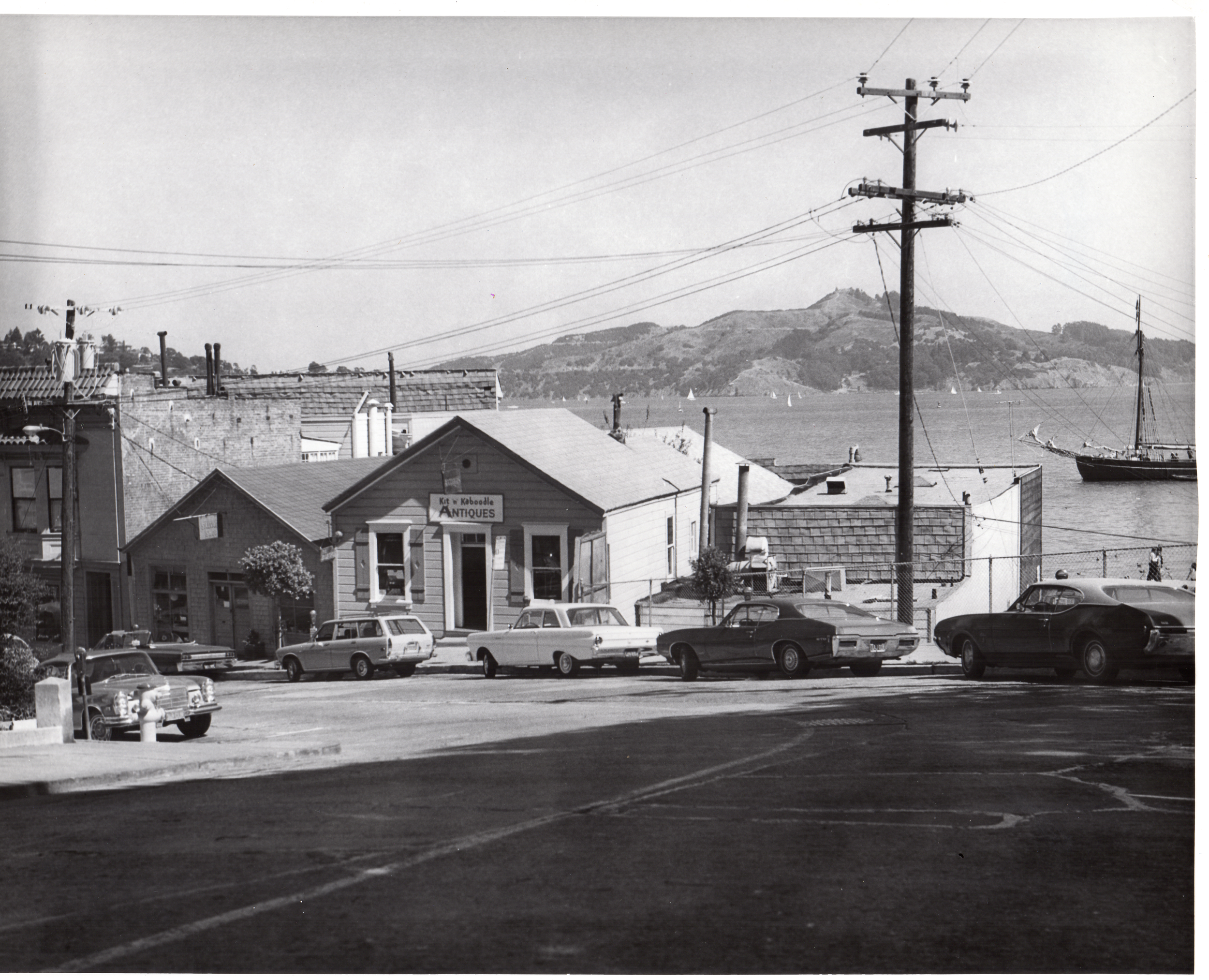
Aerial view of Sausalito
Transcript
Jack Vandermuelen, interviewed by Dorothy Gibson | August 15th, 1996 | Temporal Coverage: 1960 to 1999
Dorothy Gibson: This is Dorothy Gibson in the home, houseboat home, of Jack Vandermuelen, and we're about to have an interview. This is Thursday, August the 15th, correct?
Dorothy Gibson: Correct.
Dorothy Gibson: Jack, there are two things I seem to want to start off with. One is how the Dickens you got to Sausalito, because that's always an interesting story from people. And the other one is when we met, and that was sometime, I think, in the 70s. Which do you want to start with first? Okay, I see you're from Michigan, right?
Jack Vandermuelen: I am from Michigan, and I've been in the Bay Area for probably almost 30 years, I think 28 or 30 years. I came during the Summer of Love and all that stuff, and worked at various things in my life, including being a display director for Macy's. I had a period in my life when I was about 35 when I went through a problem with alcohol, and I ended up at a recuperation center, where I found out about this camper that was available on the waterfront. I just overheard some people talking about it, and I said, well, to get my life together again, this might be a very good idea. It would be reasonable, and I could pursue my art, maybe find a place like a studio there reasonably, and begin the work of an artist, which I had done many years before and really enjoyed. So I asked about the camper and subsequently went to look at it. It was over at Gate 3, in a junkyard on the old Arquez property, and I ended up buying it and living there, in an area we call Gypsy Camp, for a number of years. Actually, these little dreams I had, like having a studio there and getting involved with artistic people again, all more or less came true. I guess that's basically how I got here. Sort of an accident.
Dorothy Gibson: How did you get to California from Michigan? You went to Calvin College, was it?
Jack Vandermuelen: Calvin College.
Dorothy Gibson: What's that?
Jack Vandermuelen: It's a parochial college in Grand Rapids, Michigan, a Dutch Reformed college. My parents had actually been missionaries in Zuni, New Mexico, until I was five years old, and then they decided to move up to Michigan so that I'd get better schooling. So then they left that area. I stayed in Michigan through college, and then when I was about 23, I believe, I just decided I wanted to see the world. So one winter morning I left on the train and went to Mexico, and spent about six months there.
Dorothy Gibson: Associated with the church, or with the...
Jack Vandermuelen: No, just wanted to take off and see Mexico. I had rather an idea I might not come back. About that time, a lot of things were also happening in California. The beatniks were in their latter phases, and the whole hippie movement had started, and I had a lot of artistic and creative juices flowing about that time, too. So rather than go back to Michigan when I was done in Mexico, I came up the coast here and ended up in San Francisco, which is where my career here really started.
Dorothy Gibson: Then tell me about your artistic work and the kind of things you've been involved in.
Jack Vandermuelen: Well, one of the things I did back in the late 60s and early 70s was work in the post office, which at that time in San Francisco was a hotbed of creative activity. I got involved with a number of artists and actually did a lot of plexiglass sculpture. That was sort of a new material at that time.
Dorothy Gibson: What do you mean the post office? You mean the people who worked in the post office? Are you talking about Rincon Annex?
Jack Vandermuelen: This was the Ferry Annex, which was close to the Rincon Annex. We handled mail from the Pacific during the Vietnam War, packages and things like that. It's no longer there; it's where the Viencor Fountain is now. But it was a large mail-handling facility. I worked there for about three years and met a lot of people I'm still friends with today, a lot of artists, a lot of writers, and so on.
Dorothy Gibson: These were young people, mostly?
Jack Vandermuelen: Mostly, yeah, about my age. At that time, the post office was like a terminal, a place people passed through on their way to something else. It was a place where people would work for a number of years to make some reasonably good money and then move on into their arts and other creative endeavors. A lot of people in the post office were like that then, unlike today, where it seems everyone there is a careerist. Eventually I got a storefront in Martinez and had a studio in Benicia for a while.
Dorothy Gibson: What kind of work were you doing there?
Jack Vandermuelen: Actually, I was trying to start a gallery with a number of people. We had a place in Benicia called Margins, a concept that dealt in many types of new art. We would use different industrial materials in a fine-arts fashion, I think we were probably among the first to do that, before it became popular, using plexiglass and steel as wall hangings and so forth. That didn't pan out terribly well financially, so eventually I ended up working for Macy's and worked my way up into the display department, becoming display director of Macy's San Rafael for a while, and also working for them at their San Jose store before coming up here.
Dorothy Gibson: So, in a way, it's kind of related, this artistic type of work.
Jack Vandermuelen: Oh, yeah, yeah, yeah.
Dorothy Gibson: Now, how and when did you get linked with the Pacific Sun, because that's writing, of course.
Jack Vandermuelen: Yeah. Well, when I was younger, I did a lot of writing, and I loved to sort of secretly write. I became involved politically on the waterfront when Bob's Boatyard, the destruction of Bob's Boatyard, occurred.
Dorothy Gibson: I'm not sure people know about that, so do you want to do that in a nutshell?
Jack Vandermuelen: Yeah. Well, I think where I left off is that I was living in a camper at Gate 3. I eventually was able to get a studio there by taking care of someone's cats, they gave me the studio when they left, as long as I kept the cats. So I started a creative life there, and I also met a woman, and we eventually bought a boat together. I moved out of the camper and sold it, and we set up house offshore, where Marina Plaza is now. No sooner had we started that than we were told the marina was going to be demolished and office buildings, and maybe eventually a new marina, built there. So we were asked to leave, and a whole situation ensued, which is a story in itself. What happened almost simultaneously was the destruction of Bob's Boatyard at Napa Street, where I am now, at Galilee Harbor. Without getting too detailed, the owner of the land, along with the city, came one morning, after they felt they had notified the residents who were living on boats here, and just destroyed the buildings on shore and all the infrastructure for the boats that were there. Now, these people had lived there for many, many years, for the most part.
Dorothy Gibson: Was that under the guise that it was a fire hazard or something?
Jack Vandermuelen: Yeah. Since I wasn't exactly here at the time, I don't know all the details, but they used many forms of rationale. One of them, as I recall, was that it was a fire hazard and had been condemned, that was never proven. At any rate, there wasn't ample notice given, and it was very much like a Gestapo raid. This was pretty evident to anybody who went by that morning. It was, I believe, August 4th, 19...
Dorothy Gibson: It was a shock to see those buildings, and then all of a sudden not see those buildings.
Jack Vandermuelen: Yeah, yeah, they were pretty large. I think it was a Friday morning. I don't know.
Dorothy Gibson: A Friday morning. Yeah.
Jack Vandermuelen: And so I stopped and asked what was happening, and when I got the full picture of what was going on, I got angry, like everyone else, particularly because we were in a similarly vulnerable position over at Marine, you know, Gate 3, what we called Deeks Field, or Deeks Water, at the time. I was very concerned, and started writing letters to the paper and joining organizations to help preserve the waterfront and what was left of the working waterfront. So this is really a roundabout way of getting to writing for the Pacific Sun. But apparently a number of people really enjoyed my letters at that time, and Annette Rose found out that the Pacific Sun was looking for an arts writer. She was somewhat aware of my arts background, because we had become friends by then, and she said, you know, I'm going to tell Linda Hickes about you, and you should get together with her and see if that might work out. And that's indeed what happened. It interested me to write art criticism for a while, because at that time I really enjoyed trying different things. It worked out, and so for about two years I was the art critic for the Pacific Sun. It was a lot of work for me, because I was such a perfectionist about it, and I was doing so many other things, so after two years I sort of gave it up, and that was that. But I enjoyed the writing. It was a lot of fun.
Dorothy Gibson: I remember enjoying reading them.
Jack Vandermuelen: Did you?
Dorothy Gibson: Oh, yes. I don't remember missing any of your articles. I couldn't tell you in any detail what you wrote about, but yes, I was very, very impressed.
Jack Vandermuelen: I tried to take a different slant, a more personal slant, on art criticism. It got me a lot of criticism from artists, often. But there was a lot of dialogue that didn't always get into the paper, that I would have with individual artists and so forth, from that column.
Dorothy Gibson: Do I imagine this, or didn't you also write about Marin County and the environment of the area, along with your writings?
Jack Vandermuelen: Yeah, I'd throw in a lot of...
Dorothy Gibson: Including maybe even some political stuff?
Jack Vandermuelen: Yeah, I would throw in a lot of stuff.
Dorothy Gibson: Well, then, that's it. That's it.
Jack Vandermuelen: In fact, some of the criticism of my writing was, 'I wish you'd just stick to art.'
Dorothy Gibson: Okay. And it was probably precisely because you didn't that I was reading you. A lot of people did enjoy that quality, but the more dyed-in-the-wool artists were looking more for a purist.
Dorothy Gibson: Okay, so you were involved then in that whole 70s scene when, well, the county was coming down, wanting to purify everybody's boats, or clear them out.
Jack Vandermuelen: No, by and large, I missed what were known as the Houseboat Wars.
Dorothy Gibson: So you missed that, but you did become very close friends with the Kaliks, right?
Jack Vandermuelen: Right.
Dorothy Gibson: Uh-huh.
Jack Vandermuelen: Yeah, Bob and Laura Bell lived in Gypsy Camp, over at Gate 3, at that time, even though apparently they still had a houseboat over in the area of the wars. In fact, that's why I think they lived in Gypsy Camp, because it was really too hot over there at the time.
Dorothy Gibson: A kind of escape, huh?
Jack Vandermuelen: Yeah, yeah, between Oregon and Gypsy Camp and their houseboat. They just sort of kept to these safe zones, wherever it was coolest at the moment.
Dorothy Gibson: It was the development that was about to begin on the Deke property that pushed you all out, and many of you came to Galilee.
Jack Vandermuelen: Exactly, yeah. Actually, Galilee...
Dorothy Gibson: As a kind of refuge.
Jack Vandermuelen: Right. Galilee at the time was inviting people from there, because a lot of people had left in fear after Bob's Boatyard. They didn't want to stick around and fight for their rights, so many of them left, and the ranks were a bit decimated. And what would be more logical than to get some of the other dispossessed or disenfranchised people from down the waterfront to come here and help support the cause? So that all seemed logical, and we brought our boat over at the time. I actually didn't live on the boat for a number of years, I stayed in my studio back there, with my girlfriend at the time and her daughter, and we'd come over here and work on the boat. That happened for about a year and a half, and I, of course, did a lot of political work also in the interim, and helped get the co-op here on its feet, and I've been here since.
Dorothy Gibson: You might go back and talk a little bit about Galilee, because I don't quite remember who all was here before it started expanding. I know it was a small-to-medium-sized boatyard. The pier extended out to Napa Street, a very long Napa Street pier. The remains of the boat Galilee were embedded in the mud. Tell us a little bit about the history of it, if you know it.
Jack Vandermuelen: Recently I was over in the city, down at Fort Mason, and there is, of course, the hull that's sticking out there, attached to a fence. We were really sorry to see that.
Dorothy Gibson: Where did the rest of it go?
Jack Vandermuelen: I don't know. A big chunk of it went to Benicia, to the industrial park, where Matthew Turner was apparently the designer and builder.
Dorothy Gibson: What was the theme of that boat?
Jack Vandermuelen: Well, it was a mail brigantine, a mail packet, which went across the Pacific to Tahiti, and I think the Marshall Islands, and I think all the way to Australia, just delivering the mail.
Dorothy Gibson: I guess back in those days it was a big deal how fast you were.
Jack Vandermuelen: That was one of the things, apparently it had the record for the fastest circuit, whatever that mail circuit was, across the Pacific and back. So it was very famous in that sense.
Dorothy Gibson: How did it literally get stuck in the mud here?
Jack Vandermuelen: I'm told that it was no longer financially feasible, once the age of steam really took over, for it to sail and do its mail run anymore on the Pacific. So it just ended up sitting here, waiting for an assignment. And then, I guess, there were ownership changes.
Dorothy Gibson: Had it been sailing in and out of Sausalito port?
Jack Vandermuelen: Oh, yeah.
Dorothy Gibson: Ah, okay.
Jack Vandermuelen: Yeah, and this was actually a deepwater harbor here.
Dorothy Gibson: Ah.
Jack Vandermuelen: I'm not really certain why it just stayed here. Like I say, I think it had to do with ownership changes and recalcitrant people, and so forth. There are stories about that.
Dorothy Gibson: I know that.
Jack Vandermuelen: Then this one captain ended up, his name escapes me, living on it for a long time with his wife. Apparently he was really the first houseboater in this area, the one who really lived here, and eventually had trouble with the city government, which tried to get rid of him because he was too high-profile, apparently. So I've always thought of this captain as somebody who's probably still around, in some sort of ghostly form, watching us here, because he's the first one who said, well, why can't I live on my boat? As I understand it, he bought the boat eventually, once it could no longer be sailed out.
Dorothy Gibson: So it was more than a boat, it was the whole concept of living on your boat, which developed into the whole Galilee community that you've all inherited.
Jack Vandermuelen: Yes. There were other examples on the waterfront of people living on their boats at that time, too, but the one here at Galilee was this captain and his wife, English, I believe he was. He eventually got sick of City Hall and just went to Carmel. He got sick of the whole fight and just took off. And then he wrote letters back from Carmel, castigating the city council and the planning commission and everyone in Sausalito for being inhumane and not allowing the natural flow of life to occur on their waterfront.
Dorothy Gibson: It's wonderful reading these records at the historical society about that, and in old scopes, or whatever the predecessor of the Scope was.
Jack Vandermuelen: Right.
Dorothy Gibson: So we're talking about what year now, when you moved here?
Jack Vandermuelen: That would be about 1980, I believe, 1980, 1981.
Dorothy Gibson: Have you been active in building Galilee as a community?
Jack Vandermuelen: Oh, yeah, yeah. There are only a few of us left who have the history. Sonny Singerman is one of the old-timers, he was even here before I was, on the old pier. Keith London, of course, was here. Tom Hoover, even though I don't believe he had a boat at the time, was still in the area and had a place. And, you know, that's just about it for the old-timers who were actually here. Of course, Cass Geardly had his business next door, he had it before Bob's Boatyard, and then he went down the waterfront for many years, and then returned to Galilee two or three years after Bob's Boatyard, as did a number of the other people who were very active in other parts of the waterfront.
Dorothy Gibson: And then when did Chris and Annette Hardman, and Annette Rose, come here?
Jack Vandermuelen: That, again, was about three or four years after Bob's Boatyard, I think.
Dorothy Gibson: It was demolished, you mean.
Jack Vandermuelen: Yeah, probably about '84, '83, '84.
Dorothy Gibson: So there's still a sizable core group of you.
Jack Vandermuelen: Yeah, there are still some of us, but more people from all over the waterfront, those of us who just sort of hung on. Anywhere from the Gates down there, I mean down by, oh, let's see, you'd say South 40, this way, all sort of ended up here, plus a number of people from the old Gates Co-op and so forth are here too, but not so many from that. Mostly this is just a collection from Gate 3 and the Deke property, and people who were always here on Napa Street. And Galilee has also been enriched over the years by other people who enjoyed the lifestyle, who had skills that were vaguely or strongly waterfront-ish, and became part of the community.
Dorothy Gibson: Let's go back and pick up on how you made your living. You were with Macy's, you were at the post office, you were with Macy's, with the Pacific Sun.
Jack Vandermuelen: Yeah, well, let's see. I would say once...
Dorothy Gibson: Because I think that's fascinating to people, how you can live this lifestyle and somehow swing it.
Jack Vandermuelen: Well, one way I supported myself during that time, because the art wasn't really doing it, was picking up part-time maintenance work for condominiums and apartment buildings nearby. I worked up at Eden Rock, up on the hill here. For a while I worked at the Towers, which is also a Sausalito apartment building with a lot of history, and various places in Tiburon and Mill Valley.
Dorothy Gibson: Does that mean you had a business, or you worked for someone else?
Jack Vandermuelen: No, I worked for various companies, including the Eugene Berger Management Company and First Columbia, which was a management company. And now I work for the John Stewart Company. So that's sort of been my bread and butter over the years. Although at the time, I thought I would only do it part-time, to supplement my income so I could do my art the rest of the time. But then, sort of as a family thing, that changed, and I slowly took on more hours and worked more. I did less creative work, but was involved more politically, more involved in community building. And then, later on, I'd say within the last six or seven years, I became very interested in Buddhism and spent a great deal of time in the East Bay at the Nyingma Institute, both studying and teaching.
Dorothy Gibson: Tell me how all that developed, because here you've got this John Calvin background.
Jack Vandermuelen: Oh, yeah.
Dorothy Gibson: What a contrast, yeah?
Jack Vandermuelen: Well, actually, though I have that John Calvin background, when I was in college in Grand Rapids, I read a lot of Alan Watts. I was very restless philosophically, very much in tune with the movement of the age. I was particularly fascinated by Alan Watts, and by Buddhism and Hinduism, Eastern religions. So when I got out here, I made a point of going to the Zen temple in the city, and so forth. Although formally none of that stuck, I kept reading over the years.
Dorothy Gibson: Tell me, what was fascinating to you? It seemed like it was so much the antithesis of the Western viewpoint and the Western religion.
Jack Vandermuelen: Exactly, exactly. Yeah, I mean, it is quite a change from a very strict, fundamental...
Dorothy Gibson: Were you finding yourself, as you were growing up, resisting this Calvinistic type of thinking?
Jack Vandermuelen: Oh, definitely.
Dorothy Gibson: So you were open, and almost a sitting duck, from another point of view?
Jack Vandermuelen: Oh, yeah. At an early age I remember going to church and thinking to myself, why does this very tiny percentage of the people on the planet that I'm around believe so totally that they are the only ones with the truth, and that 99 percent of the planet must be wrong? That can't be. That was my reaction, and it kept growing as I got older. I think even as a seven- or eight-year-old, I felt I had a bigger mind than what I was getting back there, a mind that wanted more. So all the movement in my life, and even ending up on the waterfront in Sausalito, from that perspective, seems logical, seems to make a lot of sense.
Dorothy Gibson: Any particular tenets that you became argumentative with?
Jack Vandermuelen: Well, the Vietnam War was happening then, and I remember one of the big arguments I had with my parents and everybody else was: if you're all saved and you're going to heaven, why do you want to go and kill people who haven't had that opportunity yet? It was sort of a silly argument, but they couldn't answer it, and that was a crucial thing for me. If you're so confident, so sure that you're saved and going to a place of bliss, and you also say you're full of compassion, why would you go over there and kill people who haven't had the opportunity to learn what you've learned, and at the same time send missionaries to Zuni, New Mexico, where I was born? None of it made sense to me. The doctrine of Christianity particularly made no sense. As you get older, you start keying into some of the better parts of Christianity, and now that I'm so thoroughly immersed in Buddhism, I'm beginning to see Christianity from another viewpoint, and to see my mother's spirituality from another viewpoint, too. She was what we would call a fanatic, but I also see part of her in me, it's just geared in a different direction. I've become very interested in things spiritual, and I see I got a lot of that from her. We were just headed in different directions. Perceptions like that occur as you get older. But yeah, that's one of the main reasons I came out here, I wanted to be in a much more cosmopolitan place, a place where ideas had value.
Dorothy Gibson: Do you find yourself, like your mother, with a degree of passion and surety that you're right?
Jack Vandermuelen: No, not the surety that I'm right, that's the one thing I would still argue forever with my mother. But I think her passion and total devotion to what she believed, it was constant, every moment of the day. It's what we'd call in Buddhism, mindfulness. She had it. She'd be singing as she was working, totally into her work, but there was always Jesus and Christ running through her head. It was a mantra for her. So from that standpoint, she was an incredibly spiritual person, and one I envy for that sense of...
Dorothy Gibson: Completely ego-syntonic.
Jack Vandermuelen: Exactly. Yeah, yeah, and being right there with her God, all the time.
Dorothy Gibson: That's quite a feat.
Jack Vandermuelen: I think the difference between that and going off the deep end is sometimes very narrow, but she always managed to stay grounded. She ran the family fine, she did all the things she was expected to do well enough, but she kept this spiritual focus.
Dorothy Gibson: Before we go on, define for me what you mean by spiritual, and then I'd like to move on to where you are now.
Jack Vandermuelen: Well, one way of looking at it is just a preoccupation with what isn't immediately visible, a preoccupation with what it all means, why we're here, where we're going, the things that aren't readily apparent in life. I guess that's the first way to define spirituality. What I've grown to see it as now is something really very simple: for me, spirituality is just being completely alive in the moment, present for whatever is real around me, but totally there, and not going off in flights of fancy. After many detours and many different routes, that's pretty much what I have.
Dorothy Gibson: So you're talking about fantastic concentration, close to 100 percent concentration on any given moment, with the moment.
Jack Vandermuelen: Mm-hmm. Yeah, and just not letting the mind take off on its own. The turning of the mind has been such an important thing to me. I've done a lot of meditation, and a lot of what the Tibetans call kumne, which is like yoga, body exercises and practices that help you concentrate, help you be more tuned into the body's feelings and what's going on around you.
Dorothy Gibson: And now, assuming you get that, what do you do with it? Is that a goal in itself?
Jack Vandermuelen: That's a goal in itself. It's been the hardest thing for me, and I'm still very poor at it, just being with what's flowing through you, and not making it a goal, not making it something you're moving toward, but something that just is. If you have any obligation, it's simply to be within that moment, because I've found that if you do that, other things flow from it, including compassion, including helpfulness. But it only really seems to happen genuinely if you are within your very breath, no further away than that. And that's terribly difficult, after years of just letting the mind go wherever it wants, following the mind and all its imaginings. I got to a place where I asked myself, where is that really taking me?
Dorothy Gibson: Wasn't that part and parcel of the whole hippie movement?
Jack Vandermuelen: A lot of it, yeah.
Dorothy Gibson: To flower power, to go where anything went and everything would turn out fine.
Jack Vandermuelen: Yeah, but this is a little different than that, in many cases, that didn't have morality or ethics attached to it.
Dorothy Gibson: You say it did, or it didn't?
Jack Vandermuelen: It didn't. A good deal of it did not. Whereas Buddhism, for example, has a very powerful ethical quality. The theory being that it's not good enough just to be in the moment, there still have to be guidelines that are larger than that, having to do with respect for life, by and large. So it gets more complicated. But there are elements, what the Buddhists call the precepts, the five precepts, which have a lot to do with what the Ten Commandments have to do with, except there's no punishment at the end of it, other than what might naturally befall you. There's not a sense of sin in the same way as in Christianity, just the natural flow of life. If you're not a good person, that will out in the end.
Dorothy Gibson: Now, what are these five?
Jack Vandermuelen: Okay, the first precept is, I know the first two offhand. The first one is the...
Dorothy Gibson: I'm asking you this because you're a teacher.
Jack Vandermuelen: I don't teach Buddhism as such. I teach kumne, which is the exercise form of it.
Dorothy Gibson: Well, don't let me push you to the wall here.
Jack Vandermuelen: But, no, the first one is just, thou shalt not kill. Thou shalt not drink intoxicants is one of them, or anything that really changes the mind. Another is thou shalt not do anything sexual that hurts anybody. And then another one is, let's see, I think that's three. There's one that has to do with compassion. I'm not sure exactly, they escape me at the moment. But they're good things to live by.
Dorothy Gibson: Good character.
Jack Vandermuelen: Mm-hm.
Dorothy Gibson: And human relations.
Jack Vandermuelen: Mm-hm. Yeah, that's part of it.
Dorothy Gibson: So what about this institute, then? What are you doing there?
Jack Vandermuelen: Well, the Nyingma Institute is just...
Dorothy Gibson: Please spell that.
Jack Vandermuelen: N-Y-I-N-G-M-A.
Dorothy Gibson: Where does the name come from?
Jack Vandermuelen: It's a sect, or a group. The Tibetan Buddhists have had four or five different groups throughout history, like the Galagas, which is where the Dalai Lama is. That's his particular branch of Tibetan Buddhism. The Nyingma tradition is known as the Ancient Ones, which is just a name. Tatang Toku, who I think came to the United States in 1970, decided he wanted to start a temple and promote Tibetan Buddhism in the United States. So he started out in Berkeley, and eventually it grew into an institute, with a retreat center up north. Like so many other Tibetans who were forced out of China during the '50s, he's been a very powerful and effective teacher. I started going there about six years ago and got very involved in kumne, because it was so physical, a yoga sort of discipline, and it seemed to do wonders for my body. So I've just been studying it, going to retreats, and started teaching about two years ago, which has been a real pleasure for me, because it's something I thought I could never do. I do retreats on Sundays sometimes, workshops. In fact, about a year ago I did just about every Sunday workshop, and sometimes evening courses as well. I still go to classes, too, that's still very important.
Dorothy Gibson: Now, California, and the Bay Area, and Berkeley, Sausalito, have been seats for thinkers like this. Do you have any idea why they come here, as opposed to, say, Columbus, Ohio?
Jack Vandermuelen: Well, a university is a good, liberal university, and Berkeley's case, I think, is the big one, there was just so much social and spiritual ferment around there during the '60s. I don't know beyond that. I don't know how it happened, I guess, California being the last stop on the continent, at least that's what I thought back in the '60s, everything was faster, there was more of everything, including ideas, and more to choose from. I think people from other countries coming here, if they have the means to look around and choose their place, become aware of that pretty quickly, too. Although I think that's changing quite a bit now, I think there are other centers, in upstate New York, New York City, Madison, Wisconsin, that are growing very strong intellectually, and as places where spiritual leaders settle. Boulder, Colorado is another one, and the Seattle, Washington area. So I think over the years you'll find this won't be anything special to the Bay Area, that Seattle, the Madison, Wisconsin area, upstate New York, and the Boston area will be just as influential. We'll see.
Dorothy Gibson: Because over time, and a lot of the time you're talking about, dating back, what, to the '50s, '60s?
Jack Vandermuelen: '60s.
Dorothy Gibson: '60s. I remember the waterfront was just full, we counted them once. It was almost over 500 young people living in that whole area you're describing, from the county line on down through Galilee.
Jack Vandermuelen: No, I'm sure.
Dorothy Gibson: Living in boxes, living on boats, living in tents, living in what we now call RVs, but they were really cars or trucks or God knows what on wheels, things they would build themselves. I found people living in shelters they'd made underneath steps, and things like that, anything to make a home. And people had all kinds of gardens and animals, goats and chickens.
Dorothy Gibson: Sort of a laboratory for the Haight-Ashbury, almost, as I understand it.
Jack Vandermuelen: Yes, but people came from all over creation, and by that I almost mean it literally, all over the United States, certainly. They came here from different countries, too. Look at the people who came here from Ireland, from England.
Dorothy Gibson: Particularly that, yes, yeah.
Jack Vandermuelen: To me, that was one of the real cross-fertilizations that made the waterfront exciting, all the people from England, some French people, that was tremendously exciting. And people with different maritime heritages from those countries, too. The English people, for instance, had a different viewpoint toward boats and what they could and couldn't do. And we had German people here, too, which to me was particularly fascinating.
Dorothy Gibson: I guess mostly North Europeans we're talking about.
Jack Vandermuelen: Yeah, yeah, it seemed like that, yeah.
Dorothy Gibson: But people rethinking their lives and their values.
Jack Vandermuelen: Yeah, yeah, yeah, and they'd hear about this place in Europe and all over the world. It was like a circuit, you know, if you were headed this way, you had to stop on the waterfront in Sausalito. It was part of the world circuit at that time. And a lot of people stayed, a lot of people said, this is where to go. I mean, I wish I had come here that way, that would have been an interesting way to arrive. But I suspect if that had been the case, I'd probably be somewhere else by now. I don't know why I say that.
Dorothy Gibson: Why do you say that? Because you did come in the '70s.
Jack Vandermuelen: Yeah, but see, I think the Summer of Love, the hippie thing, was really winding down by then. It had started getting ugly. The Houseboat Wars had started a year or two before that. The whole vibe had changed, as we said then. I got here just as the vibe was changing. The great waterfront party, as I'm told, was just about over, and I got in on the last end of it. A lot of those people ended up going up to the forests of Oregon and places like that, and moved on. They'd come back for visits, people would introduce me to people who'd been here in the early days. But many of them moved on, and I think if I'd really been part of that group, I probably would have, too, at that time. It was just part of what you did, you stayed for a few years, and then you went back, or you moved on.
Dorothy Gibson: So you were a more settled person.
Jack Vandermuelen: Yeah. Well, I had come here...
Dorothy Gibson: I think of Bob Kallick sort of in the same light.
Jack Vandermuelen: Possibly, yeah. See, I arrived at the waterfront...
Dorothy Gibson: He became a part of the community, and so did you.
Jack Vandermuelen: Yeah, those people used it, it served a purpose, and then they moved on north, to a commune or whatever.
Dorothy Gibson: Right, it was a transition. And then there were select individuals who fit in well enough with the community that they decided to stay.
Jack Vandermuelen: Yeah.
Dorothy Gibson: And argue it out.
Jack Vandermuelen: Yeah. See, I came here in recovery. To me, it was a new life. I had really been through hell the year or two before I came here, it was my life's watershed. Thank God I haven't had anything like it since, or before, it was my little Armageddon. I came here, and it was like being reborn, so to me it was sort of heaven. Even the mess, the junk, it took a little while getting used to, because I came from a very pristine, Macy's-cube-like environment, one I'd even helped create. So that was a big adaptation. Still, it was wonderful. It was recovery for me. It wasn't like the early-'60s kids, I was already mature, had already gone through my Armageddon.
Dorothy Gibson: You were older.
Jack Vandermuelen: Yes, older. And there were a number of people who came to the waterfront at that time who were a little like me, at least.
Dorothy Gibson: There seemed to be a lot of camaraderie there.
Jack Vandermuelen: The waterfront always performs sort of a purifying process. People come here and transition, they go through things, particularly at Galilee. Galilee is like a psychological entity more than anything else, this father figure that people use and abuse and kick around. They hate it and they love it, and they go through this process with the idea of Galilee, or in those days with the waterfront in general, and they sort of work things out. It's sort of like a room where you have pillows you beat up, I guess. A lot of psychological stuff has always gotten worked out here, although sometimes people still don't recover from it.
Dorothy Gibson: You mean among yourselves, or within the establishment that surrounds you?
Jack Vandermuelen: A lot of people come here to take care of things, to recover, like I did, or to try to recover from something. It's always performed that function. That's why things look chaotic here frequently, because there have traditionally been a lot of chaotic minds here, a lot of people going through things, and that always shows in the physical, as far as I'm concerned. So, I guess what I'm trying to say is, there's a bigger reason the waterfront existed, probably a more important reason than what's visible. When I look back at my own life, I can see how I couldn't have recovered the way I did, and rebuilt my life, without a place like this waterfront that I came to at that particular time. It's a little more difficult now, there aren't so many cracks in the sidewalk, but it's still possible for people to do that in certain areas of the waterfront. What we tend to get more of now are people who are really down on their luck, coming through, really broken, completely homeless. Those are the extremes. So for me, that's been very interesting about the waterfront, seeing the changes in people, people coming through and working things out, and using the authority figures here, for example, to work through stuff and then move on, or to sink, in some cases. So there's been a lot more to the waterfront than just the political battle, or the fact that you're on the water, learning about boats. There's a deeper level of something going on here, too.
Dorothy Gibson: Have you ever been tempted to become involved in the politics of this town? Meaning city council and board appointments and things like that? Because you are a real solid person here now.
Jack Vandermuelen: I guess I could. In the old days I certainly, you know, I was campaign manager for Chris Hardman when he ran, so I learned a lot about politics in the town.
Dorothy Gibson: Forgot about that.
Jack Vandermuelen: Yeah, oh yeah, there was a period of a few years when I was pretty involved on that level. I could get interested in it again, I don't know how successful I'd be, or even whether I could get on a board or something like that. But yeah, I have a lot of interest in the city. Recently I've...
Dorothy Gibson: And you're very articulate.
Jack Vandermuelen: If I slow myself down, I think on this tape I'm rambling, because I'm just sort of running, and I'm not used to it. Recently I've been doing aerobic exercise, going up and down the hills. Every other day I walk up the hills and take different routes, and I'm really falling in love with Sausalito again. I'm discovering these sections of streets, like the corner at Casano, before you go down into Pine, with all its fascinating little houses. I'm getting reborn, as far as the lay of the land here, I hadn't really spent a lot of time up there, other than in a car or doing political work. This exercise has really opened up the hill to me. So, yeah, I guess from that standpoint.
Dorothy Gibson: And the different lifestyles that are associated with it.
Jack Vandermuelen: Yeah.
Dorothy Gibson: Right?
Jack Vandermuelen: Yeah, and it's not all wealthy people up on those hills. You find these crazy little houses tucked back off the road, and particularly these unusual paths that look like private paths but are actually just ways to get from one road to another. I've been having a lot of fun discovering this stuff. I guess if I'd like to do anything someday, it would be nice to serve on the design review board, or something like that, something where aesthetics are involved. I could see myself doing something like that sometime. I haven't had a lot of time in recent years to get involved in the town, because I've recently gone through getting married, and my wife has had open-heart surgery and so on this past year. But I know Candace, too, we've spent time at City Hall, going up to watch a couple of meetings. She's fascinated by it.
Dorothy Gibson: Tell me, how did you happen to meet her?
Jack Vandermuelen: At the Institute. She was a cook there.
Dorothy Gibson: Oh. So you have an awful lot in common, right?
Jack Vandermuelen: Yeah, yeah, we were two of the few people up there who really had a sense of humor. A lot of people tend to take themselves so seriously in a religious or spiritual setting like that. We hit it off immediately, because we both had a similar sense of humor. One thing led to another, and at this late age, my first marriage, actually.
Dorothy Gibson: Oh, really?
Jack Vandermuelen: Yeah, my first actual marriage. And, no, we love each other very dearly. It's been a wonderful thing. We had a great wedding in Berkeley, people from the waterfront came, people from Nyingma came, and we had this wonderful backyard wedding with different parts of our lives all showing up. My sisters all came back from Michigan, whom I hadn't seen in many years, and they were here for the wedding and had a wonderful time. So it sort of brought all the forces of our lives together. Even with the problems this past year, with her medical condition and everything, it's still been a great year, a year or two, because so many things have been resolved and tightened up in my life. My sisters, my family, I've got a Michigan family again, and we're all getting along, and so forth.
Dorothy Gibson: Had you been separated from them?
Jack Vandermuelen: Yeah.
Dorothy Gibson: Not only by distance, but mentally, too.
Jack Vandermuelen: Not so much mentally. In my mind we were, but as it turned out, it wasn't like that at all, they still love me very much. So, you know, we've had a real...
Dorothy Gibson: Are you really a lot alike?
Jack Vandermuelen: Oh, yeah. Oh, yeah, yeah.
Dorothy Gibson: Yeah. We don't really change a lot, do we?
Jack Vandermuelen: Nope.
Dorothy Gibson: But listening to you, it sounds like you've had a whole series of bursts and rebirths.
Jack Vandermuelen: Yeah, it's, well, listening to myself, it sounds like that for the first time. I hadn't really noticed it. It seems like every seven or ten years, something happens.
Dorothy Gibson: That's pretty typical of all our lives, that sort of jettisons you into another area.
Jack Vandermuelen: Yeah, it's been sort of like that.
Dorothy Gibson: Since you're sort of speaking to posterity here with this oral history tape, is there anything you'd like to pass on?
Jack Vandermuelen: Well, since this is for the Sausalito Historical Society, I can really give a sales pitch. I love Sausalito, I'm sure I love it about as much as you do, Dorothy, and I know you really love it a lot. Sausalito's been such a surprise for me, on so many levels, it stays rich, and it stays a place that always seems to be changing. There's something about it, no matter what the economic or social forces are, that always remains interesting. I think that has a lot to do with the waterfront, the coming-and-going quality of it. You go over to Mill Valley, for example, and as beautiful and neat and hip and cool as it all is, there's a static quality to it, it's not exciting. Whereas Sausalito remains exciting, remains changeable. In other places in Marin County, as beautiful as they are, I don't feel that. And I guess the only thing I'd say, in summary, is that when I travel to other places, as beautiful and wonderful as they are, I can't see myself living anywhere else than Sausalito.
Dorothy Gibson: Is it the people, or the elements, or just the way you work on each other?
Jack Vandermuelen: It's all that, yeah, it's all that. I'm not so sure it's the people, because I have so many friends and good relationships in other places, though there certainly are wonderful people here, even if my deepest friendships aren't in Sausalito. I think it's the openness of the environment, both social and physical. It's where things meet, the fog, for instance. Sometimes the fog will just sit right over the boat here, will it come all the way in, or will it stay out for the whole day? It'll just sit at the edge, very much like the edge of the shore. I just love living on what I once wrote about in an article, it's sort of the inside lining of the bay, this little silver lining. It's perfect. I wouldn't want to be out at Muir Beach, where you're right in all that energy, nor would I want to live in Sacramento, with just flatlands and heat. This is just enough of the ocean and those forces, along with a softening quality. So physically, I love Sausalito for that reason. And I've had so many great experiences here, the parades, for instance. As a kid, I remember the Fourth of July parades. So much fun.
Dorothy Gibson: You mean parades literally?
Jack Vandermuelen: Yeah. And then for years I would even poo-poo the idea of a parade for your country and all that. And then, coming back here, I found there's a good number of people, even on the waterfront, who really just love the pageantry of a parade. Every year, working on the Fourth of July float, doing all these silly, corny, wonderful things you did as a kid, and now you're not ashamed of them anymore. It's really what you want to do, as much as anything else. Sausalito still gives you the opportunity to have a really wild and crazy time, doing floats, doing parades...
Dorothy Gibson: Faulty boat races and...
Jack Vandermuelen: Yeah, all that stuff, riding around on your dilapidated bicycles. Exactly, exactly. To me, if it were Turlock, that wouldn't be so strange. But the fact that this, quote, wealthy seaside community can still have such a funky, small-town flavor in the midst of all this wealth, to me, is so enigmatic that I love it. I just love living in that sort of enigma. Right adjacent to here now is the Schoonmaker area, it's never been formally developed beyond the beach or yacht area, and there are all these little boxes, little craft shops, and who knows what goes on there. Recently I had a friend visiting from Scotland, and I walked her around the waterfront. She looked at that out of the side of her eye and said, well, what's this? And I said, well, I'm not sure, those are craft shops where people work, and I think people also live there, too. Well, you know, that's sort of what Sausalito is, I said. I was stumbling and fumbling around, but I said, you know, I think you could almost do anything in this town if you're low-key about it.
Dorothy Gibson: Do you feel the same way?
Jack Vandermuelen: Oh, definitely, yeah, you still can. There's less of that going on, but the possibility is still there.
Dorothy Gibson: Yeah, I mean, those spaces are getting fewer, for sure.
Jack Vandermuelen: But yeah, you still can. I think what you're referring to, the atmosphere, is still there, even though the places to actually do that are fewer. There's still sort of a swashbuckling atmosphere that, I don't know, I think it's people like you, who've been here most of your entire lives, who set that. It's deeply ingrained in the hills. I'm not sure that those of us who've only been here 15 or 20 years have had a whole lot to do with that, we sort of sustain it. But I think it's the people who have been here their entire lives.
Dorothy Gibson: Well, I've only been here since '55.
Jack Vandermuelen: Well, that's still going back a long way, about 15 years more than me, right?
Dorothy Gibson: Yeah. That's not like the Ralston's, maybe, but that's still way back.
Jack Vandermuelen: I think these energies were set up a long time ago, and we're just sort of surfing on them now. Sometimes it almost seems that, as organized and regimented and conservative and clean and neat as the hill people may try to be, and the government may try to be, on both the county and local levels, there are always these other things creeping in, going on all over the place, filling in the cracks.
Dorothy Gibson: Well, you need the extremes the other way. And you're saying the cracks are as important, if not more so, to Sausalito than the edifices. And people like the Peter Romanowskis are needed. You've got the terribly uptight person who runs for city council, he's got to be balanced somewhere, and we've got to have an extreme in the other direction. So, you know, we need these characters. We still need Tom Rockford's.
