
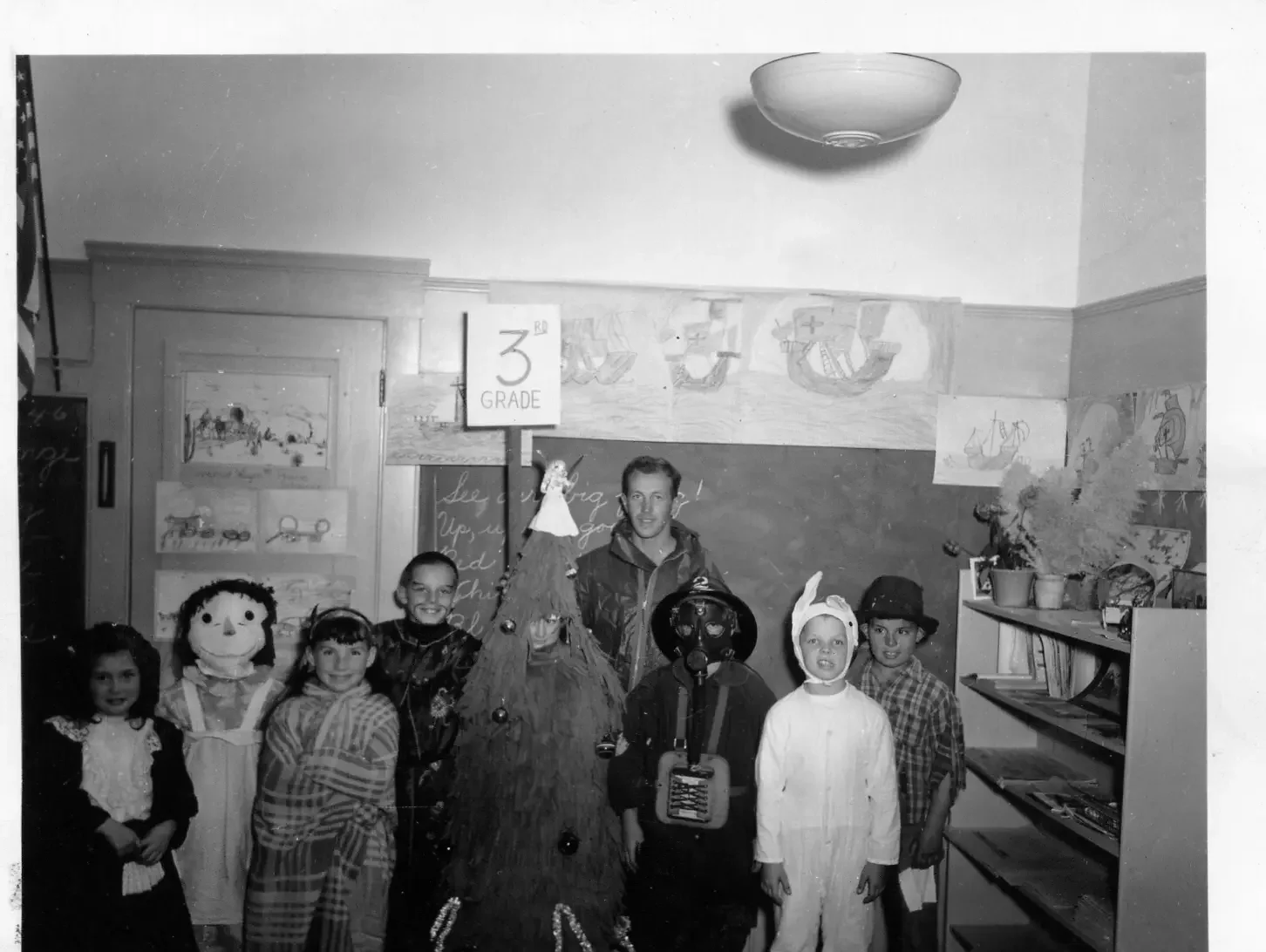
Photo of children in old City Hall Library October 31, 1946. On reverse side first names were written by the 3rd eight graders. Francie T., Wendy H., Bruns P., Billy D.R., Donova B., Diane F., Lenard J., Walter F. The teacher, or librarian is also in the photo.
Transcript
Mary Richardson, interviewed by Betsy Stroman | August 15th, 2006 | Temporal Coverage: 1985 to 2006
Betsy Stroman: Okay, this is Betsy Stroman. I'm here with Mary Richardson, in the Sausalito Historical Society History Room, for Mary's oral history, with a special emphasis on the period during which she has been working for the Sausalito Library, and, since 1985, as the librarian. Mary has looked at some materials that I've prepared in connection with a book about the library, and she'll probably be referring to that, including making corrections to information I've provided, and supplementing it. Mary, why don't you just get started, and then we can get more focused at some point, if we need to.
Mary Richardson: Well, it's very interesting reading a lot of this history, because a lot of it I wasn't even aware of, over the last hundred years, all the stories that went on. But what makes it, after reading it, what makes it kind of significant to me is how much there is of a tradition to the library, of having it be a very comfortable living room sort of feel to it, no matter where it's been, and the personal touch with the community. Maybe a lot of other libraries could claim that, but I've known libraries that can't claim that. So I'd say there's something really unique, that the community really feels at home coming into this library. It's not just a place to go get a book, but a place to meet people, and the staff is willing to take their time and talk to you. So that was particularly touching to see. And that kind of feeds in. I'll start off with the thing we were talking about earlier, that my dream, or my vision, for the library has always been to maintain that comfortable feel of a living room, because I believe that a lot of people do come into the space because of that, and it's an important space because of that. I've seen a lot of people meet new people, run into old friends, overhear someone talking about a subject and get involved in helping them do something. I just like that, the gathering place notion of it, and making it comfortable makes it even more important. But not just that. Over the years, trying to maintain that small sense also means we're running out of space. So the only way I can see to maintain that, and still provide a good collection, is technology. As much as we love it and hate it, technology really has been a race against time, because sometimes it's money, or the technology isn't there yet, and the space is running out. But, for example, we used to have a lot more reference books than we do now, or rather, we've been able to let our reference collection continue to grow, because a lot of the books we used to get as big printed sets we now obtain online, which makes perfect sense for a lot of reference books. You don't need the book to sit on the shelf forever, because you want the information updated. So we started by getting things on CD-ROM, and that was a big change, and now a lot of things are online, from websites. That's really fabulous, because it's really enabled us to keep the same small space. The other area technology has contributed to is audiovisual materials. A lot of books on tape we can now download from our website, and I noticed that in Colorado people are downloading movies from the library's website. So I'm looking at that space in the library right now, where we have books on tape, videos, and DVDs, as space for people to sit, or more space for books, because I think books will always be in the library, and people will expect that to be part of the library landscape they feel comfortable coming into. It's been a real struggle not to fill the open space with bookshelves, and I'll tell you, that happens to so many libraries. We were so fortunate in our library to have the tall ceilings and the windows that look out to the bay. So my vision is a library that looks just like that 1910 picture you showed me of the library, a comfortable living room, only behind all that now would be technology that would enable us not only to access books online, where people can print them out, but also interlibrary loan. Our collection is as big as the world, because we can access all those books and bring them here, either as hard copies or online. So we don't need a big space to do that. We need a comfortable space, and a space where people feel they can interact well with the staff. That's what's really going to be important as the years go on, I think, for our library, to have that. That's kind of always been my goal. Even the look of it, for example. The computers used to be big and clunky, and they keep getting smaller and smaller. My ideal is that one day you walk in, and the frame of the very thin screen computer is maybe wood, or you don't even notice there's a computer there anymore, and you don't hear the sound of it. It's just a quiet space again, with technology. That's one thing we haven't quite gotten to, the quiet space, because the computers are still kind of noisy, and there's always someone in there typing on a keyboard. But people, we're still teaching kids about their library voices, and people still respect it as a place where they can have quiet, and that kind of sense of peace in the library. I guess that's enough on that subject. But I think the environment of the library has so much to do with its future.
Betsy Stroman: What do you mean by that?
Mary Richardson: I think it has to be an environment that appeals to people, an environment that people expect and want, and we have to maintain that. If you talk to people and ask them what they want, that's what they want. Some people, oh, they want all this fancy this and fancy that. Often they just want what they consider to be the traditional features of a library. They want all the technology and all the bells and whistles, but they still want the space to feel like a library.
Betsy Stroman: So there's some intrinsic value to just having a home-like room, but with all of the resources of modern technology available in an unobtrusive way.
Mary Richardson: Exactly. To me, if you can do that, you've got it made, with a pleasant and helpful staff.
Betsy Stroman: Okay, great.
Mary Richardson: That's been my goal. Let's see what else I wanted to talk about. Maybe I'll talk a little bit about what kind of collections we have in the library. I don't know if that's been mentioned in any of the books. I know Patricia started the boating collection, back when she was the librarian. She recognized that this was a real boating community, and she started it. I continued and expanded on it, to include a lot of very practical boating books: building books, chart guides, sailing instruction, actual charts themselves, videos related to that. We now have quite a reputation, up and down the coast of California, for having a really good boating collection, and we have people coming from long distances to use our collection. For a small library, that's a pretty big claim to fame. And it's really heavily used in this community, too. A lot of people really appreciate that we collect just about every kind of practical boating book there is. Not large-scale boat building, but sailboats, personal-use type boats.
Betsy Stroman: Now, I remember, in the earlier chapters of this manuscript draft, we talked about building the art collection, the art book collection, and you're also talking about the boating collection. Are there any other specialties that the Sausalito Library has had?
Mary Richardson: Well, I'd say that the boating and art books continued. I've heard, and I think, that we have a pretty strong art collection, and gardening, and travel, I think, would be the other two. Our rare book collection focuses on boats, and California and Bay Area history. We had to start limiting it, because of space, to just those areas. And then the only other collection of note is, we have the complete set of Alan Watts tapes. I don't think it's from his radio, maybe some of it's from his radio programs, but any kind of oral, any spoken thing that Alan Watts has done, we have on tape. And we have people who come from a long distance to look at those, to listen to those, as well. But in terms of unique collections, I'd say the big ones are boating, and then art.
Betsy Stroman: Have people been donating these boating books, or are these things you just put in your budget to buy?
Mary Richardson: The budget to buy.
Betsy Stroman: Yeah, okay.
Mary Richardson: Let's see, what else did I want to talk about? Actually, one thing, this is a side note. Looking at the budgets, the city budgets over the years, I have a complete collection of the city budgets.
Betsy Stroman: Oh, okay.
Mary Richardson: It's a good way to get information.
Betsy Stroman: And you have those?
Mary Richardson: I have them going back into the '70s.
Betsy Stroman: Okay. So maybe when we get through, I can follow up?
Mary Richardson: Yeah, because I think they often have a narrative, and goals, and things like that. They change depending on who the manager was at the time, but those are good bits of information.
Betsy Stroman: I'm just noticing you're drooping.
Mary Richardson: I'm jumping around here.
Betsy Stroman: That's fine.
Mary Richardson: Before I forget, I wanted to talk about the Centennial Fund campaign. You could probably get some more details that I've overlooked by looking in the minutes, in the librarians' reports, from February 2004 to present.
Betsy Stroman: And you have those downstairs?
Mary Richardson: Yeah, those are downstairs. I think, of all the things, that was one of those good news, bad news sort of situations. The bad news was that the budget was cut, in 2004. Our budget was cut so dramatically, I mean, it would have meant the library going from an almost $90,000 book budget to a less than $20,000 book budget. That's pretty dramatic. Right around January of 2004, when we discovered that, or actually 2003 when we discovered it, in 2004 I went to the Friends and said, help. And the president at the time was Katie Kalplush, and she said, no problem, we can do it. She was one of the most amazing people, she would make the most impossible tasks seem like they could happen, because I know all the other city staff people thought, oh yeah, right, you can raise the money. It was one of those grassroots efforts, but everybody just came together and cut to the chase. No long meetings, no long planning, just, we know you need the money, what are we going to do to raise it. They came out with brochures, they came out with a sticker you could put in your window, letters, door-to-door campaigning. The first donation Katie ever got from somebody was one they wrote on their hand, and we took a picture of it. It was just one of those things, she just got it going, and we made it. We made it a three-year program, to raise three hundred thousand dollars, a hundred thousand dollars a year, and just this last March, in March of 2006, we reached the goal, much to everybody's surprise and pleasure. What was so amazing about it was how quickly we were able to raise the consciousness of the people in the community, and how much everybody just stepped up to the plate and helped, because they saw the importance. It's really touching. I think of, my whole career, that's probably the most moving.
Mary Richardson: Sorry, I don't have it. I didn't think I was going to cry.
Betsy Stroman: No, that's wonderful.
Mary Richardson: Just to see how everybody stood up and helped. It made you realize what a part of the community, and how much it is in everybody's hearts, to help the library. Because the library, well, of course the library has to stay open, and it just was, it was just quite remarkable to see. And not only that, it raised the consciousness of people who didn't know about the library, and they became interested in helping, so it created a whole grassroots group in the community of new people who would help and support the library, to the point now where we're into phase two of the Centennial Fund, which is what we call this, because it was the library's hundredth year. We're into phase two of the campaign now, where we've created a library foundation. Katie, and sadly, Katie, in the middle of the campaign, passed away.
Betsy Stroman: Okay. Is it on again?
Mary Richardson: Yeah. She bequeathed a third of her estate to the library, and with that money we were able to create the library foundation. Just yesterday I got the paperwork from the state, and we already received the paperwork from the IRS, we are now a 501(c)(3), and able to start looking to the library's future, in terms of preserving what we have, in case the same sort of thing comes up again, and expanding to do new things and have a new vision for the library. One of the first things we'll probably do is come up with some sort of strategic plan for the library's future, so that we'll have some goal toward which any money raised for the foundation can go.
Betsy Stroman: Let me just ask you about the budget cuts in 2004. Was that just for that year, or has the budget stayed low?
Mary Richardson: It has stayed low. It's been flat. Although this year, that's the other good part of it, that's the other good news. This year, in 2006, we're now in the '06-'07 budget year, the library was able to restore part of its budget. And the reason the council gave for restoring part of the library's budget was to reward all the hard work of the Centennial Fund campaign. They saw that the community really valued it, put their money where their mouth was, and it was the council's turn to do the same. That was the other moving moment, to realize how strong such a huge grassroots effort can be, to change the minds of people. It was pretty remarkable, because, to tell you the truth, I wasn't expecting it to happen this soon. I knew eventually we'd be able to restore some position, or get some of the money back, but I didn't think it was going to happen quite as soon as it did. But I think the council was moved, just as everybody else was.
Betsy Stroman: You also had a big party for the Centennial Fund.
Mary Richardson: Oh, I wasn't thinking of that. I was thinking about the...
Betsy Stroman: You have your cord on your clasp.
Mary Richardson: Oh. This study that was done of satisfaction with the library, the library was number two behind the fire department.
Betsy Stroman: Oh, the one for the whole city?
Mary Richardson: The one that was for the whole city, yeah.
Betsy Stroman: Would you think that had some influence on the City Council?
Mary Richardson: It could have. I don't know. They didn't mention it, so I don't know.
Betsy Stroman: That reminds me, I should give you this. You didn't see it: in 2005, every five years we do a patron survey.
Mary Richardson: Oh, okay, good.
Betsy Stroman: So you might want to take that.
Mary Richardson: Yeah, thank you.
Betsy Stroman: Fold that into what you're doing.
Mary Richardson: Okay. I think, of all the most personally moving, and actually manifesting into something real, tangible, for the library, this, since 2004 until now, has been the most incredible period.
Betsy Stroman: And how wonderful that it happened at the 100-year mark.
Mary Richardson: Yeah. I think that was part of what, I mean, it was so perfect. We thought, what are we going to call this campaign? And then we thought, oh, we're going to turn 100, Centennial Fund. It just gave it some weight, and it made people realize how important the library has been to this community for 100 years. I think we're like the second oldest library in the county, so it carries some weight, and it is important to this community.
Betsy Stroman: Okay. Oh, go ahead.
Mary Richardson: I'm just looking to see if there's anything else I wanted to add about that.
Betsy Stroman: No, I think that's probably it, unless you can think of something. Yeah, I have some other things. I know there's been an issue, I've been told it's important, about being a branch library versus being an independent library in Marin County. Is that anything you've come across as an issue? I know at one point they were considering being a branch, or there was a proposal that it would be a branch library.
Mary Richardson: Well, around Patricia's time, when the library, just after the library had been remodeled, they remodeled the space, the workroom space, with the fact that they were outsourcing the processing and cataloging of the books to the county. So it always has been an extra small space, because all you have to do is receive the books, you don't have to do anything major to them. I don't know, you'd have to ask Patricia, maybe at that time that could have been considered. But as time went on we no longer outsourced that to the county, because they charge too much, so we outsource to a vendor now. That might have been the only time they'd considered doing that, just for practical purposes, but I never heard of any recently. San Anselmo is going through some very, even more dramatic budget cuts and tough financial times. They considered joining the county library system, but I read their Friends newsletter recently, and it would have cost them more to be a branch of the library than it would cost them to run as a city library separately. Plus, they would have less control over what they did in their library. And earlier, the Tiburon Library used to be part of the county library system, and they seceded, because they realized they weren't getting as great of services as they could if they just used the same money otherwise. So I think there's more of a trend away from that than toward it.
Betsy Stroman: Okay. Especially currently, with San Anselmo as an example.
Betsy Stroman: What about discussions about independent buildings? Is that subject, freestanding libraries, sort of off the table these days?
Mary Richardson: I've never heard anybody talk about it in my time, except to talk about it as a past discussion. I mean, personally, I think the most realistic thing would be if any other part of City Hall were to move out of City Hall. There was some talk, at one point, of the Recreation Department moving to the Martin Luther King property, or going to another location. If that were to happen, and offices could get shuffled around in City Hall, I think it would be magnificent to expand the library space into this existing building. It just seems, you know, that would be. And if we got the whole building, it would be a freestanding building, but I doubt that would happen. Although Jack Tracy and I used to joke it would be great to have all of City Hall just be the Historical Society and the Library, but we realized there are other offices that need the building, and then, of course, the Friends, too. Friends of the Library would be in the building, stay in the building. That's always been fabulous, having the Friends bookstore down the hall.
Betsy Stroman: Oh, you were mentioning you had a discussion with the city attorney about the internet, and about you not trusting the internet. Why don't you talk about that?
Mary Richardson: Oh, I remember. We'll talk about technology. I think you have something in there about me, you know, it took me a while to move over from using a typewriter to using Word, I don't know what it was called at the time, WordPerfect or whatever it was. Just adjusting to that, and taking the time out to learn it. I was slow at doing that, but that was just me sitting down and learning it. But I was even more hesitant with the internet, because I was being a stuffy librarian who didn't trust all the sources on the internet, and I just wanted the books, or whatever sources we used for reference purposes, to be totally reliable. But then I started to realize that there were things on the internet that, because they were so current, there was just nothing quite like it. So finally I caved. I remember, at the time, the city attorney was also doing a lot with computers, and he was really pushing the city to catch up with technology. He used to tease me about not being willing to do the internet. Finally, I remember, at a council meeting, I gave in and said, all right, you'll now see me crawling around plugging things in under the table, because I've now decided technology really is where it's at. Especially with the internet, I saw the value of it. Although there still is a place for reference books, and yet now I see them as more side by side. I sometimes have to remind the reference staff that we do have those reference books, because it's so comfortable to just sit at the reference desk and do everything on the internet. But there are still some arrangements, and some hard, long work that goes into some reference tools, that aren't available on the internet. So we still do have a good reference collection. That was, I guess I'm trying to think when he finally, that was probably the early '90s. And then with MarinNet, I think that's probably the other big achievement since I've been here, since I became the city librarian in 1985, was getting all the, well, now we have more libraries as part of MarinNet than Marin, you've got it written down.
Betsy Stroman: The North Bay?
Mary Richardson: No, no, North Bay is a bigger system. North Bay covers all the North Bay counties. We are members of North Bay now, basically for delivery, second-level reference. They used to do more for us, but I'd say primarily that's what we...
Betsy Stroman: What does that mean, delivery?
Mary Richardson: North Bay Cooperative, oh, delivery of books. We have daily delivery of books from all the libraries in the North Bay.
Betsy Stroman: Oh, the interlibrary loan?
Mary Richardson: For interlibrary loan purposes, and for delivering books among all the different MarinNet libraries. Their delivery is a truck that comes around every day and picks up books and drops off books. So that's part of the service we get from them. And then, if we have a reference question we want to go into more depth on, we can send it up to them. They used to do other services, cataloging and children's services, but we no longer get that from them. They also have something called SuperSearch, which is an online interlibrary loan tool where you can live-search and place holds on books in the whole North Bay system, which is another really useful tool. But MarinNet is closer, MarinNet is just Marin County, and that was a consortium, now includes all the public libraries in Marin County. We created that back in the early '90s, to come together and have an online catalog. Before that, we had an online circulation system called CLSI, that was just used for checking books out, it wasn't used as a catalog. We still had microfiche catalogs, which came out four times a year, and then we were immediately dated, and we realized that just wasn't where it was at. It was the most difficult part, getting all those jurisdictions, which were used to being on their own, making their own decisions, to come together, so that we could do this, because we knew we couldn't afford to have online catalogs individually. It took a couple of years, at least one or maybe two years, of meeting after meeting after meeting, trying to come to some agreement, and finally making a huge expenditure. We also got some funding from the Marin Community Foundation to start this. It was a pretty major step for the Marin County libraries, to finally have an online circulation system, and an online catalog, and daily delivery. We thought about taking some baby steps, and having CD-ROM catalogs, but then finally we decided, let's just cut to the chase and go live. We picked a really good system, Innovative Interfaces, and now we can't imagine life not being that way. It's really benefited everybody, to the point where a lot of people don't realize one library from the next, because you're borrowing books from each other, and they just think of us as all one system, even though we are, several of us, individual city libraries. We're just all MarinNet.
Betsy Stroman: Do you have regular meetings with the librarians?
Mary Richardson: Monthly. And then we have subcommittees of the different groups, like the reference librarians and the circulation people, to talk about their issues. So it's a whole new thing we have to maintain, but we were going to have to do it somehow or other, and this is the best way to do it. As librarians, we're used to having to make do with very little money, and this is how we can maximize the money we had.
Betsy Stroman: You mentioned something about being at the point, how many books did you say you have now?
Mary Richardson: Around 60,000.
Betsy Stroman: Around 60,000. And you say you're at the point where, even though you withdraw a book, you have to withdraw a book?
Mary Richardson: We pretty much have to withdraw as many books as we add each year. However, there are classics you want to keep every year, so eventually you're going to want more than 60,000 books, the space for 60,000 books. I can't give you an accurate, scientific figure as to when we're going to need what number, but I think we've thought of every possible shelving extension solution we can, short of intruding on the open space of the library, where we have tables for people to sit, and we really don't want to do that. So I think the next step would be to do something like expanding into the building.
Betsy Stroman: After reading this book, I really think the freestanding building might not be a viable idea. It hasn't happened in 100 years. It might not happen in the next 100.
Mary Richardson: Exactly. Although, you know, you never know, there might be other opportunities that open up. But I think probably the most realistic thing I could think of, and I've tried to be pretty practical since I've been here, is to try to make do with what you have, and the space that you have, and the footprint that you have. So we've added shelving to the existing space, and tried to get online versions of the books. But eventually, I would say, within the next 100 years, we're going to want a little more space.
Betsy Stroman: That's a modest proposal.
Mary Richardson: One of the things we talked about doing is wrapping around, above the reference area and above the children's area, wrapping that space around. And another idea, that Libby drew plans for, which is beautiful, was to extend outside the tall windows, kind of a glass-enclosed garden reading and quiet space, and underneath, to have a cafe, or some place where people could make noise. I don't know, that was another idea, where we were trying to think within keeping it close to the original footprint. So those are ideas that might happen, because they're realistic, they don't involve a brand new building. But they would involve a lot of structural changes, and it wouldn't be cheap.
Betsy Stroman: Doing things to existing space is often not cheap.
Betsy Stroman: You mentioned Lois Anderson. There was some more information beyond that.
Mary Richardson: Oh, well, she was our children's librarian. I don't know, you'd have to look up the years she was a children's librarian, part-time. That was the time when she had a lot of school visits and brought the kids to school. She had been a school librarian before she came to work at our library, so she had that part down. But she's also a well-known artist, and she brought that flavor of her artistry into the library, with seasonal exhibits in the children's area. We did bring children's artwork into the children's area periodically, from the local schools. But every season, Lois would put up a display that was lavish and magnificent. People would come and just stand back and look at it in awe, because she would use a lot of the materials she had on hand for her artwork, and bring them into her displays. She also, Lois, I don't know if you've ever met Lois, but she's a very, very tall, very dramatic person, and she would dress up as the witch for the children's programs, and she really was quite an effective witch for the children's programs at Halloween. She was never shy about livening things up, so she always brought a lot of energy to everything she did, and we miss her.
Betsy Stroman: Did she...
Mary Richardson: She passed away.
Betsy Stroman: Did she live in Sausalito?
Mary Richardson: She lived in Mill Valley. She also, because she was an artist, brought a lot of information, the artists would come and ask for information. So she brought that flavor to the library as well.
Betsy Stroman: That's the thing, all the reference librarians bring something different from their backgrounds.
Mary Richardson: Penny Green really was a great reader's advisor. She reads a lot of fiction, so if you wanted an idea of what book to read, she would always have a good idea of what you could read. And Lois, with her art knowledge. And Phil Sheridan, who's an actor, has been fabulous with the children's story times. The kids just adore him, they're just like crawling all over him and trying to participate in the program he's doing, because he really gets them into the story time. He also, because of his understanding of theater, has helped people, there was one person who was writing their own play that he helped with that aspect of it. He's brought a certain flavor to it, so that's what's nice about having different backgrounds on the reference staff.
Betsy Stroman: Oh, why don't you just talk a little bit about dealing with art, and how you've dealt with art in the library?
Mary Richardson: Well, I think a lot of the controversy I was reading about must have kind of subsided a bit by the time I became the librarian, so it wasn't quite as big. They seem to have settled all the differences, to the point where, I think, Janet Gartner was right around when they stopped receiving or purchasing art from the art festival. I think it was right around her time that that ended, because there really wasn't that much space. So much of our wall space now is filled with bookshelves, there really isn't that much place to hang artwork in the library now, so we're pretty limited. In my time, we just had the sculptures, the Warren Arnold sculptures, two of them. People love those sculptures, by the way. The kids, everyone immediately wants to come and touch them, they're fabulous. And the only other artwork is a painting by Babe Lamberton. But I'd say the only artwork we've had on a rotating basis has been children's art in the children's area, no other discussion of artwork in the library. I think if we were to expand the library and have a space where people could have rotating exhibits, we would. But right now I think the exhibits have been moved to the council chambers, and that's pretty much where the rotating art exhibits go now.
Betsy Stroman: Okay. Now, with the understanding that this is not going to be used in any publications unless we decide to do that, could you just give a little discussion about the schools? Recently, there was some involvement with the schools.
Mary Richardson: Well, I think the time in my recollection that we had the most involvement with the schools was when we hired Lois, because she was hired basically to have that contact with the schools as a children's librarian. She went to the schools, and we had school visits, and she would go to the schools and take information, library card applications, and all the rest. We had school visits where we would show them around the library. But over the years since then, we've tried, we've gone to the teachers of the schools and given handouts and tried to get them involved in school visits, but nothing seems to happen on a regular basis. It's pretty erratic. Every now and then we'll get a teacher who wants to bring the class to the library, and we welcome them to come to the library. I think, more the, not the charter school, yes, the charter school, I think, is the school that's come most recently. But I don't know if it's turnover in staffing or administration, or just for what reason, I'd like to start it up again. Every time we try, periodically we'll try, and then nothing will happen, and then we'll try again. We wait a while and try again, and maybe it's time to try again. But we do welcome them. It's just that we aren't prepared, and don't really have the staff to develop a curriculum for the schools, and I think that's kind of what they were hoping we could do. We're willing to meet them halfway, but we can't really be the ones to develop the curriculum.
Betsy Stroman: Well, it's probably an issue of budgetary constraints on both ends.
Mary Richardson: I think that's kind of what it is. I don't know what the status of their library is, they have a space, but I don't think it's an active library. I think I heard something about it being flooded, or something.
Betsy Stroman: Yeah, it's too bad.
Mary Richardson: You know, these things run in cycles, and it'll come back again. I've just kind of watched it cycle out, and it'll be time soon to cycle it back in.
Betsy Stroman: Okay. Well, I think, Mary, that sort of covers it, do you think? If there's anything else you want to talk about.
Mary Richardson: I mean, space-wise, the only other thing we've done to the library since I've been here is, twice, we've repainted and re-carpeted it. But other than that, it's pretty much the same space. It's no huge, interesting story. But I'll tell you, when you paint and carpet a library, it's a pretty big deal. The first time we did it, we removed everything from the library. There's more space up here. We moved it all, all the furniture, everything, except the circulation desk, was moved out of the library. The library was closed for a month, to repaint and re-carpet. The next time we did it, we cut around a lot of things, because I wasn't prepared to, we had no place to put everything, but that's about the only thing we've done to the space physically. A lot of people are glad we haven't made too many changes physically, because they like the space to remain the same. It's like, in the '60s, they liked the space they had. I think, because there's so much change happening all around, people want some things, they're really glad that we have a pretty stable staff, and a library that doesn't change too much in the way it looks, because it's nice to have some things you go to that aren't changing every day, that you can rely on as being more or less the same. It's kind of comfortable to have that happen in certain areas, we're one of them. It's hard to make changes quickly in a library, because there are so many details that have to change along with it, that you kind of hesitate before you make a change, to wait until it's something you really want to do, because it's a big deal.
Betsy Stroman: Yeah, that's probably it that I can think of. But if I think of something else, I'll let you know.
